
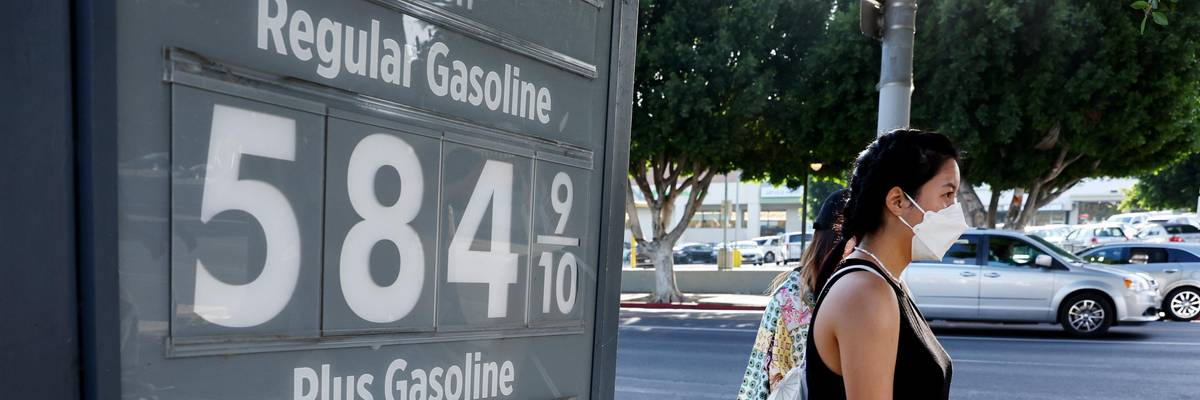
A pedestrian walks past a gas station advertising gas prices on March 25, 2022 in Los Angeles, California.
Economic Shock Therapy for Neoliberals
Neoliberalism has failed yet another test and must finally be replaced by a new economic vision based on new values.
The fallout from Russia's invasion of Ukraine has reminded us of the unforeseeable disruptions constantly confronting the global economy. We have been taught this lesson many times. No one could have predicted the September 11, 2001, terrorist attacks, and few anticipated the 2008 financial crisis, the COVID-19 pandemic, or Donald Trump's election, which resulted in the United States turning toward protectionism and nationalism. Even those who did anticipate these crises could not have said with any precision when they would occur.
Each of these events has had enormous macroeconomic consequences. The pandemic called our attention to our seemingly robust economies' lack of resilience. America, the superpower, could not even produce simple products like masks and other protective gear, let alone more sophisticated items like tests and ventilators. The crisis reinforced our understanding of economic fragility, reprising one of the lessons of the global financial crisis, when the bankruptcy of just one firm, Lehman Brothers, triggered the near-collapse of the entire global financial system.
Similarly, Russian President Vladimir Putin's war in Ukraine is aggravating an already-worrisome increase in food and energy prices, with potentially severe ramifications for many developing countries and emerging markets, especially those whose debts have soared during the pandemic. Europe, too, is acutely vulnerable, owing to its reliance on Russian gas--a resource from which major economies like Germany cannot quickly or inexpensively wean themselves. Many are rightly worried that such dependence is tempering the response to Russia's egregious actions.
This particular development was foreseeable. More than 15 years ago, in Making Globalization Work, I asked, "Does each country simply accept [security] risks as part of the price we face for a more efficient global economy? Does Europe simply say that if Russia is the cheapest provider of gas, then we should buy from Russia regardless of the implications for its security...?" Unfortunately, Europe's answer was to ignore obvious dangers in the pursuit of short-run profits.
Underlying the current lack of resilience is the fundamental failure of neoliberalism and the policy framework it underpins. Markets on their own are short-sighted, and the financialization of the economy has made them even more so. They do not fully account for key risks--especially those that seem distant--even when the consequences can be enormous. Moreover, market participants know that when risks are systemic--as was the case in all the crises listed above--policymakers cannot idly stand by and watch.
Precisely because markets do not account fully for such risks, there will be too little investment in resilience, and the costs to society end up being even higher. The commonly proposed solution is to "price" risk, by forcing firms to bear more of the consequences of their actions. The same logic also dictates that we price negative externalities like greenhouse-gas emissions. Without a price on carbon, there will be too much pollution, too much fossil-fuel use, and too little green investment and innovation.
But pricing risk is far more difficult than pricing carbon. And while other options--industrial policies and regulations--can move an economy in the right direction, the neoliberal "rules of the game" have made interventions to enhance resilience more difficult. Neoliberalism is predicated on a fanciful vision of rational firms seeking to maximize their long-run profits in a context of perfectly efficient markets. Under the neoliberal globalization regime, firms are supposed to buy from the cheapest source, and if individual firms fail to account appropriately for the risk of being dependent on Russian gas, governments are not supposed to intervene.
True, the World Trade Organization framework includes a national-security exemption that European authorities could have invoked to justify interventions to limit their dependence on Russian gas. But for many years, the German government seemed to be an active promoter of economic interdependence. The charitable interpretation of Germany's position is that it hoped commerce would tame Russia. But there has long been a whiff of corruption, personified by Gerhard Schroder, the German chancellor who presided over critical stages of his country's deepening entanglement with Russia and then went to work for Gazprom, the Russian state-owned gas giant.
The challenge now is to establish appropriate global norms by which to distinguish rank protectionism from legitimate responses to dependency and security concerns, and to develop corresponding systemic domestic policies. This will require multilateral deliberation and careful policy design to prevent bad-faith moves like Trump's use of "national security" concerns to justify tariffs on Canadian automobiles and steel.
But the point is not merely to tweak the neoliberal trade framework. During the pandemic, thousands died unnecessarily because WTO intellectual-property rules inhibited the production of vaccines in many parts of the world. As the virus continued to spread, it acquired new mutations, making it more contagious and resistant to the first generation of vaccines.
Clearly, there has been too much focus on the security of IP, and too little on the security of our economy. We need to start rethinking globalization and its rules. We have paid a high price for the current orthodoxy. Hope now lies in heeding the lessons of this century's big shocks.
An Urgent Message From Our Co-Founder
Dear Common Dreams reader, It’s been nearly 30 years since I co-founded Common Dreams with my late wife, Lina Newhouser. We had the radical notion that journalism should serve the public good, not corporate profits. It was clear to us from the outset what it would take to build such a project. No paid advertisements. No corporate sponsors. No millionaire publisher telling us what to think or do. Many people said we wouldn't last a year, but we proved those doubters wrong. Together with a tremendous team of journalists and dedicated staff, we built an independent media outlet free from the constraints of profits and corporate control. Our mission has always been simple: To inform. To inspire. To ignite change for the common good. Building Common Dreams was not easy. Our survival was never guaranteed. When you take on the most powerful forces—Wall Street greed, fossil fuel industry destruction, Big Tech lobbyists, and uber-rich oligarchs who have spent billions upon billions rigging the economy and democracy in their favor—the only bulwark you have is supporters who believe in your work. But here’s the urgent message from me today. It's never been this bad out there. And it's never been this hard to keep us going. At the very moment Common Dreams is most needed, the threats we face are intensifying. We need your support now more than ever. We don't accept corporate advertising and never will. We don't have a paywall because we don't think people should be blocked from critical news based on their ability to pay. Everything we do is funded by the donations of readers like you. When everyone does the little they can afford, we are strong. But if that support retreats or dries up, so do we. Will you donate now to make sure Common Dreams not only survives but thrives? —Craig Brown, Co-founder |
The fallout from Russia's invasion of Ukraine has reminded us of the unforeseeable disruptions constantly confronting the global economy. We have been taught this lesson many times. No one could have predicted the September 11, 2001, terrorist attacks, and few anticipated the 2008 financial crisis, the COVID-19 pandemic, or Donald Trump's election, which resulted in the United States turning toward protectionism and nationalism. Even those who did anticipate these crises could not have said with any precision when they would occur.
Each of these events has had enormous macroeconomic consequences. The pandemic called our attention to our seemingly robust economies' lack of resilience. America, the superpower, could not even produce simple products like masks and other protective gear, let alone more sophisticated items like tests and ventilators. The crisis reinforced our understanding of economic fragility, reprising one of the lessons of the global financial crisis, when the bankruptcy of just one firm, Lehman Brothers, triggered the near-collapse of the entire global financial system.
Similarly, Russian President Vladimir Putin's war in Ukraine is aggravating an already-worrisome increase in food and energy prices, with potentially severe ramifications for many developing countries and emerging markets, especially those whose debts have soared during the pandemic. Europe, too, is acutely vulnerable, owing to its reliance on Russian gas--a resource from which major economies like Germany cannot quickly or inexpensively wean themselves. Many are rightly worried that such dependence is tempering the response to Russia's egregious actions.
This particular development was foreseeable. More than 15 years ago, in Making Globalization Work, I asked, "Does each country simply accept [security] risks as part of the price we face for a more efficient global economy? Does Europe simply say that if Russia is the cheapest provider of gas, then we should buy from Russia regardless of the implications for its security...?" Unfortunately, Europe's answer was to ignore obvious dangers in the pursuit of short-run profits.
Underlying the current lack of resilience is the fundamental failure of neoliberalism and the policy framework it underpins. Markets on their own are short-sighted, and the financialization of the economy has made them even more so. They do not fully account for key risks--especially those that seem distant--even when the consequences can be enormous. Moreover, market participants know that when risks are systemic--as was the case in all the crises listed above--policymakers cannot idly stand by and watch.
Precisely because markets do not account fully for such risks, there will be too little investment in resilience, and the costs to society end up being even higher. The commonly proposed solution is to "price" risk, by forcing firms to bear more of the consequences of their actions. The same logic also dictates that we price negative externalities like greenhouse-gas emissions. Without a price on carbon, there will be too much pollution, too much fossil-fuel use, and too little green investment and innovation.
But pricing risk is far more difficult than pricing carbon. And while other options--industrial policies and regulations--can move an economy in the right direction, the neoliberal "rules of the game" have made interventions to enhance resilience more difficult. Neoliberalism is predicated on a fanciful vision of rational firms seeking to maximize their long-run profits in a context of perfectly efficient markets. Under the neoliberal globalization regime, firms are supposed to buy from the cheapest source, and if individual firms fail to account appropriately for the risk of being dependent on Russian gas, governments are not supposed to intervene.
True, the World Trade Organization framework includes a national-security exemption that European authorities could have invoked to justify interventions to limit their dependence on Russian gas. But for many years, the German government seemed to be an active promoter of economic interdependence. The charitable interpretation of Germany's position is that it hoped commerce would tame Russia. But there has long been a whiff of corruption, personified by Gerhard Schroder, the German chancellor who presided over critical stages of his country's deepening entanglement with Russia and then went to work for Gazprom, the Russian state-owned gas giant.
The challenge now is to establish appropriate global norms by which to distinguish rank protectionism from legitimate responses to dependency and security concerns, and to develop corresponding systemic domestic policies. This will require multilateral deliberation and careful policy design to prevent bad-faith moves like Trump's use of "national security" concerns to justify tariffs on Canadian automobiles and steel.
But the point is not merely to tweak the neoliberal trade framework. During the pandemic, thousands died unnecessarily because WTO intellectual-property rules inhibited the production of vaccines in many parts of the world. As the virus continued to spread, it acquired new mutations, making it more contagious and resistant to the first generation of vaccines.
Clearly, there has been too much focus on the security of IP, and too little on the security of our economy. We need to start rethinking globalization and its rules. We have paid a high price for the current orthodoxy. Hope now lies in heeding the lessons of this century's big shocks.
The fallout from Russia's invasion of Ukraine has reminded us of the unforeseeable disruptions constantly confronting the global economy. We have been taught this lesson many times. No one could have predicted the September 11, 2001, terrorist attacks, and few anticipated the 2008 financial crisis, the COVID-19 pandemic, or Donald Trump's election, which resulted in the United States turning toward protectionism and nationalism. Even those who did anticipate these crises could not have said with any precision when they would occur.
Each of these events has had enormous macroeconomic consequences. The pandemic called our attention to our seemingly robust economies' lack of resilience. America, the superpower, could not even produce simple products like masks and other protective gear, let alone more sophisticated items like tests and ventilators. The crisis reinforced our understanding of economic fragility, reprising one of the lessons of the global financial crisis, when the bankruptcy of just one firm, Lehman Brothers, triggered the near-collapse of the entire global financial system.
Similarly, Russian President Vladimir Putin's war in Ukraine is aggravating an already-worrisome increase in food and energy prices, with potentially severe ramifications for many developing countries and emerging markets, especially those whose debts have soared during the pandemic. Europe, too, is acutely vulnerable, owing to its reliance on Russian gas--a resource from which major economies like Germany cannot quickly or inexpensively wean themselves. Many are rightly worried that such dependence is tempering the response to Russia's egregious actions.
This particular development was foreseeable. More than 15 years ago, in Making Globalization Work, I asked, "Does each country simply accept [security] risks as part of the price we face for a more efficient global economy? Does Europe simply say that if Russia is the cheapest provider of gas, then we should buy from Russia regardless of the implications for its security...?" Unfortunately, Europe's answer was to ignore obvious dangers in the pursuit of short-run profits.
Underlying the current lack of resilience is the fundamental failure of neoliberalism and the policy framework it underpins. Markets on their own are short-sighted, and the financialization of the economy has made them even more so. They do not fully account for key risks--especially those that seem distant--even when the consequences can be enormous. Moreover, market participants know that when risks are systemic--as was the case in all the crises listed above--policymakers cannot idly stand by and watch.
Precisely because markets do not account fully for such risks, there will be too little investment in resilience, and the costs to society end up being even higher. The commonly proposed solution is to "price" risk, by forcing firms to bear more of the consequences of their actions. The same logic also dictates that we price negative externalities like greenhouse-gas emissions. Without a price on carbon, there will be too much pollution, too much fossil-fuel use, and too little green investment and innovation.
But pricing risk is far more difficult than pricing carbon. And while other options--industrial policies and regulations--can move an economy in the right direction, the neoliberal "rules of the game" have made interventions to enhance resilience more difficult. Neoliberalism is predicated on a fanciful vision of rational firms seeking to maximize their long-run profits in a context of perfectly efficient markets. Under the neoliberal globalization regime, firms are supposed to buy from the cheapest source, and if individual firms fail to account appropriately for the risk of being dependent on Russian gas, governments are not supposed to intervene.
True, the World Trade Organization framework includes a national-security exemption that European authorities could have invoked to justify interventions to limit their dependence on Russian gas. But for many years, the German government seemed to be an active promoter of economic interdependence. The charitable interpretation of Germany's position is that it hoped commerce would tame Russia. But there has long been a whiff of corruption, personified by Gerhard Schroder, the German chancellor who presided over critical stages of his country's deepening entanglement with Russia and then went to work for Gazprom, the Russian state-owned gas giant.
The challenge now is to establish appropriate global norms by which to distinguish rank protectionism from legitimate responses to dependency and security concerns, and to develop corresponding systemic domestic policies. This will require multilateral deliberation and careful policy design to prevent bad-faith moves like Trump's use of "national security" concerns to justify tariffs on Canadian automobiles and steel.
But the point is not merely to tweak the neoliberal trade framework. During the pandemic, thousands died unnecessarily because WTO intellectual-property rules inhibited the production of vaccines in many parts of the world. As the virus continued to spread, it acquired new mutations, making it more contagious and resistant to the first generation of vaccines.
Clearly, there has been too much focus on the security of IP, and too little on the security of our economy. We need to start rethinking globalization and its rules. We have paid a high price for the current orthodoxy. Hope now lies in heeding the lessons of this century's big shocks.