SUBSCRIBE TO OUR FREE NEWSLETTER
Daily news & progressive opinion—funded by the people, not the corporations—delivered straight to your inbox.
5
#000000
#FFFFFF
To donate by check, phone, or other method, see our More Ways to Give page.
Daily news & progressive opinion—funded by the people, not the corporations—delivered straight to your inbox.
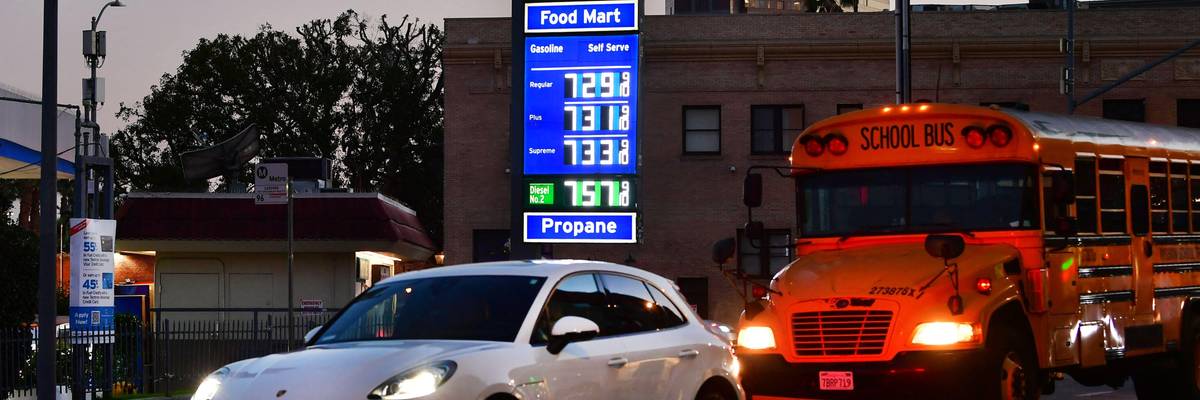
Gas prices of more than $7.00 per gallon are posted at a downtown Los Angeles gas station on March 9, 2022. (Photo: Frederic J. Brown/AFP via Getty Images)
At the height of Covid, diaper banks across the US upped their diaper contributions to communities by 86%, and we have no intention of scaling back, because the need did not diminish alongside the daily positivity rate. There are new stressors on families, of course, like rising gas prices. But if paying another 50 cents a gallon for gas means that you can no longer afford diapers for your baby, the price of gas is not the problem. Removing federal and state taxes on gas might ease the pain incrementally, but it won't end the ongoing crisis that is poverty.
Charitable organizations must provide people with the basic stuff of life because far too many US workers are not paid a living wage.
More than 225 community-based diaper banks work with the National Diaper Bank Network (NDBN) to get diapers to the one in three US children whose families lack the money to buy them. Many of those members, along with other nonprofits, also belong to our Alliance for Period Supplies, providing free menstrual products, which about one in four people who need them cannot afford. These organizations exist in every state. Some large cities have more than one diaper or period supplies bank, in addition of course to food pantries, fuel banks and other non-profits that help people span the gap between their paychecks and their needs.
I am proud of the work that this philanthropic community does to get our neighbors the things they need to thrive. But as the saying goes: Rather than just fish people out of the river, we need to go upstream and find out why they are falling (or being pushed) in. This is not about gas, so much as gaslighting. The likes of Kim Kardashian tell folks that they need to work harder. I get anonymous messages lecturing me about how "those people" should get a job. People in poverty do work, often harder than I'll ever work, in multiple physically demanding jobs.
Yet charitable organizations must provide people with the basic stuff of life because far too many US workers are not paid a living wage. Changing that is the single most effective thing that we can do to advance justice and put our entire country on track to prosper.
The Diaper Bank of Connecticut did a study in 2016 in cooperation with NDBN and The Connecticut Center for Economic Analysis which found that in a majority of families receiving free diapers, there was a working adult. The labor participation rate--defined as adults working or looking for work--was slightly higher among households receiving diapers (70%) than the state average for all adults in Connecticut (67%). Unemployment was higher among these families than among the general population. But again, most worked. Working did not keep them out of poverty.
The federal minimum wage has been $7.25 since 2008. (During the study period in Connecticut, it was $9.60. Better than the federal minimum but still not enough to support a family in one of the highest cost states.) Since 2008, inflation has increased 34%, according to the U.S. Bureau of Labor Statistics. That figure was calculated in February and so does not include the recent surge in gas prices. Before the newest consumer stressor, workers had gotten their pay cut in constant dollars by one third since 2008.
Actually, workers had been losing ground since the late 20th century. Real wages of line workers have fallen as CEO pay has risen to dizzying heights. In 1969, CEOs made 61 times what their lowest paid workers did. In 2020, the ratio was 351 to 1. Though some employers have lately offered higher wages to recruit in a tight labor market, those gains have been more than offset by inflation.
Rather than address gas prices as an isolated problem, policymakers should act on wages. Fair pay would turn this crisis into an inconvenience. Better yet, it would give families the resilience to face things that can easily pull them into destitution now: an illness, a temporary layoff, an unexpected repair.
Corporate profits have been on an upward trajectory throughout the 21st century, which been marked by stock buybacks. Paying employees a living wage is more likely to stimulate the economy than harm it. I love my job. I would also love it to be unnecessary. In this rich nation, it can be - and it should be.
Dear Common Dreams reader, It’s been nearly 30 years since I co-founded Common Dreams with my late wife, Lina Newhouser. We had the radical notion that journalism should serve the public good, not corporate profits. It was clear to us from the outset what it would take to build such a project. No paid advertisements. No corporate sponsors. No millionaire publisher telling us what to think or do. Many people said we wouldn't last a year, but we proved those doubters wrong. Together with a tremendous team of journalists and dedicated staff, we built an independent media outlet free from the constraints of profits and corporate control. Our mission has always been simple: To inform. To inspire. To ignite change for the common good. Building Common Dreams was not easy. Our survival was never guaranteed. When you take on the most powerful forces—Wall Street greed, fossil fuel industry destruction, Big Tech lobbyists, and uber-rich oligarchs who have spent billions upon billions rigging the economy and democracy in their favor—the only bulwark you have is supporters who believe in your work. But here’s the urgent message from me today. It's never been this bad out there. And it's never been this hard to keep us going. At the very moment Common Dreams is most needed, the threats we face are intensifying. We need your support now more than ever. We don't accept corporate advertising and never will. We don't have a paywall because we don't think people should be blocked from critical news based on their ability to pay. Everything we do is funded by the donations of readers like you. When everyone does the little they can afford, we are strong. But if that support retreats or dries up, so do we. Will you donate now to make sure Common Dreams not only survives but thrives? —Craig Brown, Co-founder |
At the height of Covid, diaper banks across the US upped their diaper contributions to communities by 86%, and we have no intention of scaling back, because the need did not diminish alongside the daily positivity rate. There are new stressors on families, of course, like rising gas prices. But if paying another 50 cents a gallon for gas means that you can no longer afford diapers for your baby, the price of gas is not the problem. Removing federal and state taxes on gas might ease the pain incrementally, but it won't end the ongoing crisis that is poverty.
Charitable organizations must provide people with the basic stuff of life because far too many US workers are not paid a living wage.
More than 225 community-based diaper banks work with the National Diaper Bank Network (NDBN) to get diapers to the one in three US children whose families lack the money to buy them. Many of those members, along with other nonprofits, also belong to our Alliance for Period Supplies, providing free menstrual products, which about one in four people who need them cannot afford. These organizations exist in every state. Some large cities have more than one diaper or period supplies bank, in addition of course to food pantries, fuel banks and other non-profits that help people span the gap between their paychecks and their needs.
I am proud of the work that this philanthropic community does to get our neighbors the things they need to thrive. But as the saying goes: Rather than just fish people out of the river, we need to go upstream and find out why they are falling (or being pushed) in. This is not about gas, so much as gaslighting. The likes of Kim Kardashian tell folks that they need to work harder. I get anonymous messages lecturing me about how "those people" should get a job. People in poverty do work, often harder than I'll ever work, in multiple physically demanding jobs.
Yet charitable organizations must provide people with the basic stuff of life because far too many US workers are not paid a living wage. Changing that is the single most effective thing that we can do to advance justice and put our entire country on track to prosper.
The Diaper Bank of Connecticut did a study in 2016 in cooperation with NDBN and The Connecticut Center for Economic Analysis which found that in a majority of families receiving free diapers, there was a working adult. The labor participation rate--defined as adults working or looking for work--was slightly higher among households receiving diapers (70%) than the state average for all adults in Connecticut (67%). Unemployment was higher among these families than among the general population. But again, most worked. Working did not keep them out of poverty.
The federal minimum wage has been $7.25 since 2008. (During the study period in Connecticut, it was $9.60. Better than the federal minimum but still not enough to support a family in one of the highest cost states.) Since 2008, inflation has increased 34%, according to the U.S. Bureau of Labor Statistics. That figure was calculated in February and so does not include the recent surge in gas prices. Before the newest consumer stressor, workers had gotten their pay cut in constant dollars by one third since 2008.
Actually, workers had been losing ground since the late 20th century. Real wages of line workers have fallen as CEO pay has risen to dizzying heights. In 1969, CEOs made 61 times what their lowest paid workers did. In 2020, the ratio was 351 to 1. Though some employers have lately offered higher wages to recruit in a tight labor market, those gains have been more than offset by inflation.
Rather than address gas prices as an isolated problem, policymakers should act on wages. Fair pay would turn this crisis into an inconvenience. Better yet, it would give families the resilience to face things that can easily pull them into destitution now: an illness, a temporary layoff, an unexpected repair.
Corporate profits have been on an upward trajectory throughout the 21st century, which been marked by stock buybacks. Paying employees a living wage is more likely to stimulate the economy than harm it. I love my job. I would also love it to be unnecessary. In this rich nation, it can be - and it should be.
At the height of Covid, diaper banks across the US upped their diaper contributions to communities by 86%, and we have no intention of scaling back, because the need did not diminish alongside the daily positivity rate. There are new stressors on families, of course, like rising gas prices. But if paying another 50 cents a gallon for gas means that you can no longer afford diapers for your baby, the price of gas is not the problem. Removing federal and state taxes on gas might ease the pain incrementally, but it won't end the ongoing crisis that is poverty.
Charitable organizations must provide people with the basic stuff of life because far too many US workers are not paid a living wage.
More than 225 community-based diaper banks work with the National Diaper Bank Network (NDBN) to get diapers to the one in three US children whose families lack the money to buy them. Many of those members, along with other nonprofits, also belong to our Alliance for Period Supplies, providing free menstrual products, which about one in four people who need them cannot afford. These organizations exist in every state. Some large cities have more than one diaper or period supplies bank, in addition of course to food pantries, fuel banks and other non-profits that help people span the gap between their paychecks and their needs.
I am proud of the work that this philanthropic community does to get our neighbors the things they need to thrive. But as the saying goes: Rather than just fish people out of the river, we need to go upstream and find out why they are falling (or being pushed) in. This is not about gas, so much as gaslighting. The likes of Kim Kardashian tell folks that they need to work harder. I get anonymous messages lecturing me about how "those people" should get a job. People in poverty do work, often harder than I'll ever work, in multiple physically demanding jobs.
Yet charitable organizations must provide people with the basic stuff of life because far too many US workers are not paid a living wage. Changing that is the single most effective thing that we can do to advance justice and put our entire country on track to prosper.
The Diaper Bank of Connecticut did a study in 2016 in cooperation with NDBN and The Connecticut Center for Economic Analysis which found that in a majority of families receiving free diapers, there was a working adult. The labor participation rate--defined as adults working or looking for work--was slightly higher among households receiving diapers (70%) than the state average for all adults in Connecticut (67%). Unemployment was higher among these families than among the general population. But again, most worked. Working did not keep them out of poverty.
The federal minimum wage has been $7.25 since 2008. (During the study period in Connecticut, it was $9.60. Better than the federal minimum but still not enough to support a family in one of the highest cost states.) Since 2008, inflation has increased 34%, according to the U.S. Bureau of Labor Statistics. That figure was calculated in February and so does not include the recent surge in gas prices. Before the newest consumer stressor, workers had gotten their pay cut in constant dollars by one third since 2008.
Actually, workers had been losing ground since the late 20th century. Real wages of line workers have fallen as CEO pay has risen to dizzying heights. In 1969, CEOs made 61 times what their lowest paid workers did. In 2020, the ratio was 351 to 1. Though some employers have lately offered higher wages to recruit in a tight labor market, those gains have been more than offset by inflation.
Rather than address gas prices as an isolated problem, policymakers should act on wages. Fair pay would turn this crisis into an inconvenience. Better yet, it would give families the resilience to face things that can easily pull them into destitution now: an illness, a temporary layoff, an unexpected repair.
Corporate profits have been on an upward trajectory throughout the 21st century, which been marked by stock buybacks. Paying employees a living wage is more likely to stimulate the economy than harm it. I love my job. I would also love it to be unnecessary. In this rich nation, it can be - and it should be.