During this darkest time of year, ponder this: you are alive, and life is the only act in town. (Photo: Zoe Weil)
Winter Solstice: Finding Light in Dark Times
Even in the darkness you have a choice. You can look for the light. You can pay attention to what is good. You can give of yourself. So take a deep breath and call forth your light.
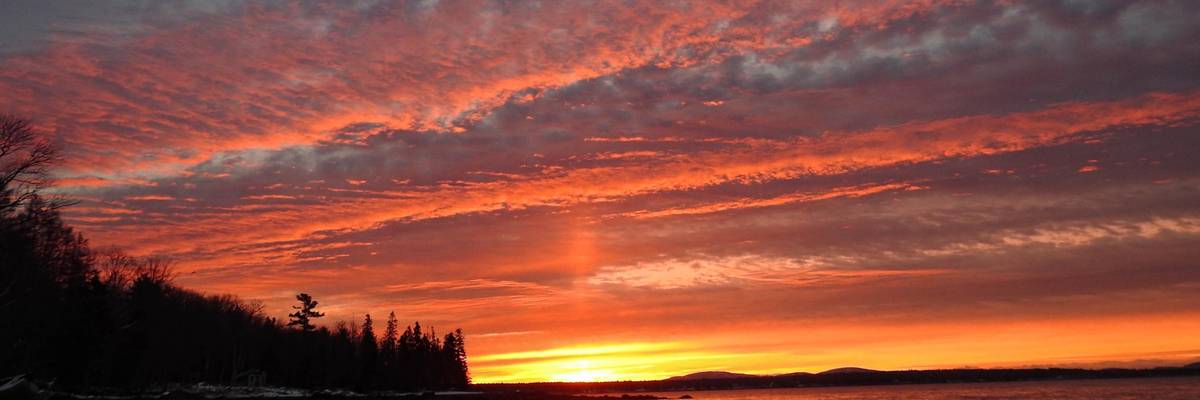
I'm writing this post on the Winter Solstice--the longest night of the year. As I watched the sunrise this morning, and as the vermilion clouds put on the stunning show captured in this photograph, I felt my usual complex feelings on this day. The first day of winter, when we enter the coldest time of year in the northern hemisphere, is also the beginning of the returning light. The days will lengthen. The sun will begin its journey back north. There is promise in this celestial rhythm.
Almost all of us--to varying degrees--are experiencing uncertainty, fear, frustration, loneliness, and loss, but some are suffering more than others.
But the promise of what exactly? So much is uncertain and foreboding--the Omicron variant of COVID-19; a heating planet that is causing deadlier storms, droughts, and floods; polarization that is tearing apart the goodwill of people and U.S. democracy itself. Yet I cannot help but feel buoyed on this solstice. The sun rose. The day beckoned. I felt the opportunity to contribute and do some good in the world. And I was deeply aware of the unfathomable miracle of existence and consciousness.
I don't mean to minimize the pain that we collectively (and you personally) may be experiencing as I type these words on my computer. My computer itself is one of the contributors to much of that collective pain. Its components have been mined in unsustainable and destructive ways. It was assembled in a factory where people may have suffered terribly. The fossil fuels used in its production and operation are contributing to the dire heating of our planet and the rapid extinction of species. And that's just my computer. If we take a moment to examine the impacts of the foods we eat, the clothes we wear, and the products we buy on other people and animals, the misery we leave in our path can take one's breath away.
But such ruminations may seem theoretical and removed, easy to ignore or dismiss. Closer to home is COVID's persistence and its myriad impacts on our lives and states of mind. Most of us thought the pandemic would be behind us, not raging anew with a highly contagious variant that is spreading exponentially and doing so during the holidays when many of us yearn to be with our extended families.
Almost all of us--to varying degrees--are experiencing uncertainty, fear, frustration, loneliness, and loss, but some are suffering more than others. Teachers and administrators, healthcare workers, and those stocking shelves and staffing registers are overwhelmed. Their numbers can't meet demand, so they are working overtime and then some, stressed to breaking. And as if being on the front lines isn't hard enough, they are often treated miserably.
Schools are being attacked for both mask mandates and no mask mandates. Teachers are being threatened for teaching about structural racism, when their imperative to do so is so noble--to educate a generation to build a future free of racial injustice, a future we should all want.
Healthcare workers must hold their tongues when unvaccinated people fill ICUs. Then they must steel their hearts as they watch people die unnecessarily because they've been misled by misinformation about the safety of vaccines.
Most people don't have the luxury of working from home, safely ensconced in a protected bubble, which, for those of us who are able to stay relatively protected and less stressed, begs the question: Are we making an effort to treat others with true kindness, or are we snappish when our wants and needs aren't being met?
Such is life right now, precarious, uncertain, stressful, anxiety-producing, less than kind.
One can point out that life has always been this way, and that in the long history of our planet, we have always lived precariously. But so, too, have we always lived with hope. If we cast our awareness across the wide arc of our existence on Earth, surely we can see that even as we struggle; even as we threaten other life forms through our greed and myopia; even as we can't seem to agree on how to move forward to create a more just, sustainable, and humane future, we are simultaneously racing to help one another, donating our time and our money to nonprofit organizations to further humanitarian and solutionary efforts, collaborating to make a difference.
During this darkest time of year, ponder this: you are alive, and life is the only act in town. Even in the darkness you have a choice. You can look for the light. You can pay attention to what is good. You can give of yourself. So take a deep breath and call forth your light. Shine it on those who most need it. As we do this, we are, in an important sense, taking part in the celestial rhythm and helping the light grow brighter day by day.
We are at a crossroads
This country and this world are at a monumental crossroads. In a few short weeks, US voters will have an opportunity to beat back the forces of fascism and confront the billionaires who are rigging the economy, our media system, and our democracy, making it increasingly impossible for ordinary people to get by. We’re not just talking about the election. We’re talking about what must be done once these fascist elements are vanquished from power. We need a bolder set of solutions than what either major party has so far been willing to offer and a working-class movement ready to fight like hell for it. Trump didn't emerge from nowhere. The conditions that fueled MAGA authoritarianism were created by decades of radical neoliberal economic policies and a corrupt political system dominated by corporate interests. They slashed taxes on the super-rich, promising that the benefits would trickle down. They said giveaways to the corporate titans would make life more affordable for the rest of us. It was all bullshit. And when a bitter, betrayed populace searches for someone to blame, right-wing demagogues have little trouble finding scapegoats. People know when they're being lied to, but you won't hear any of this from the corporate media. Only independent journalism—powered and funded by people who believe in building a better world—can deliver truly trustworthy daily news. Our Fall Campaign is underway, and we need your help. To power our newsroom through the rest of the year, we need to raise $125,000 by midnight on October 31. So if you share our vision, please contribute whatever you can to sustain our work. |
I'm writing this post on the Winter Solstice--the longest night of the year. As I watched the sunrise this morning, and as the vermilion clouds put on the stunning show captured in this photograph, I felt my usual complex feelings on this day. The first day of winter, when we enter the coldest time of year in the northern hemisphere, is also the beginning of the returning light. The days will lengthen. The sun will begin its journey back north. There is promise in this celestial rhythm.
Almost all of us--to varying degrees--are experiencing uncertainty, fear, frustration, loneliness, and loss, but some are suffering more than others.
But the promise of what exactly? So much is uncertain and foreboding--the Omicron variant of COVID-19; a heating planet that is causing deadlier storms, droughts, and floods; polarization that is tearing apart the goodwill of people and U.S. democracy itself. Yet I cannot help but feel buoyed on this solstice. The sun rose. The day beckoned. I felt the opportunity to contribute and do some good in the world. And I was deeply aware of the unfathomable miracle of existence and consciousness.
I don't mean to minimize the pain that we collectively (and you personally) may be experiencing as I type these words on my computer. My computer itself is one of the contributors to much of that collective pain. Its components have been mined in unsustainable and destructive ways. It was assembled in a factory where people may have suffered terribly. The fossil fuels used in its production and operation are contributing to the dire heating of our planet and the rapid extinction of species. And that's just my computer. If we take a moment to examine the impacts of the foods we eat, the clothes we wear, and the products we buy on other people and animals, the misery we leave in our path can take one's breath away.
But such ruminations may seem theoretical and removed, easy to ignore or dismiss. Closer to home is COVID's persistence and its myriad impacts on our lives and states of mind. Most of us thought the pandemic would be behind us, not raging anew with a highly contagious variant that is spreading exponentially and doing so during the holidays when many of us yearn to be with our extended families.
Almost all of us--to varying degrees--are experiencing uncertainty, fear, frustration, loneliness, and loss, but some are suffering more than others. Teachers and administrators, healthcare workers, and those stocking shelves and staffing registers are overwhelmed. Their numbers can't meet demand, so they are working overtime and then some, stressed to breaking. And as if being on the front lines isn't hard enough, they are often treated miserably.
Schools are being attacked for both mask mandates and no mask mandates. Teachers are being threatened for teaching about structural racism, when their imperative to do so is so noble--to educate a generation to build a future free of racial injustice, a future we should all want.
Healthcare workers must hold their tongues when unvaccinated people fill ICUs. Then they must steel their hearts as they watch people die unnecessarily because they've been misled by misinformation about the safety of vaccines.
Most people don't have the luxury of working from home, safely ensconced in a protected bubble, which, for those of us who are able to stay relatively protected and less stressed, begs the question: Are we making an effort to treat others with true kindness, or are we snappish when our wants and needs aren't being met?
Such is life right now, precarious, uncertain, stressful, anxiety-producing, less than kind.
One can point out that life has always been this way, and that in the long history of our planet, we have always lived precariously. But so, too, have we always lived with hope. If we cast our awareness across the wide arc of our existence on Earth, surely we can see that even as we struggle; even as we threaten other life forms through our greed and myopia; even as we can't seem to agree on how to move forward to create a more just, sustainable, and humane future, we are simultaneously racing to help one another, donating our time and our money to nonprofit organizations to further humanitarian and solutionary efforts, collaborating to make a difference.
During this darkest time of year, ponder this: you are alive, and life is the only act in town. Even in the darkness you have a choice. You can look for the light. You can pay attention to what is good. You can give of yourself. So take a deep breath and call forth your light. Shine it on those who most need it. As we do this, we are, in an important sense, taking part in the celestial rhythm and helping the light grow brighter day by day.
I'm writing this post on the Winter Solstice--the longest night of the year. As I watched the sunrise this morning, and as the vermilion clouds put on the stunning show captured in this photograph, I felt my usual complex feelings on this day. The first day of winter, when we enter the coldest time of year in the northern hemisphere, is also the beginning of the returning light. The days will lengthen. The sun will begin its journey back north. There is promise in this celestial rhythm.
Almost all of us--to varying degrees--are experiencing uncertainty, fear, frustration, loneliness, and loss, but some are suffering more than others.
But the promise of what exactly? So much is uncertain and foreboding--the Omicron variant of COVID-19; a heating planet that is causing deadlier storms, droughts, and floods; polarization that is tearing apart the goodwill of people and U.S. democracy itself. Yet I cannot help but feel buoyed on this solstice. The sun rose. The day beckoned. I felt the opportunity to contribute and do some good in the world. And I was deeply aware of the unfathomable miracle of existence and consciousness.
I don't mean to minimize the pain that we collectively (and you personally) may be experiencing as I type these words on my computer. My computer itself is one of the contributors to much of that collective pain. Its components have been mined in unsustainable and destructive ways. It was assembled in a factory where people may have suffered terribly. The fossil fuels used in its production and operation are contributing to the dire heating of our planet and the rapid extinction of species. And that's just my computer. If we take a moment to examine the impacts of the foods we eat, the clothes we wear, and the products we buy on other people and animals, the misery we leave in our path can take one's breath away.
But such ruminations may seem theoretical and removed, easy to ignore or dismiss. Closer to home is COVID's persistence and its myriad impacts on our lives and states of mind. Most of us thought the pandemic would be behind us, not raging anew with a highly contagious variant that is spreading exponentially and doing so during the holidays when many of us yearn to be with our extended families.
Almost all of us--to varying degrees--are experiencing uncertainty, fear, frustration, loneliness, and loss, but some are suffering more than others. Teachers and administrators, healthcare workers, and those stocking shelves and staffing registers are overwhelmed. Their numbers can't meet demand, so they are working overtime and then some, stressed to breaking. And as if being on the front lines isn't hard enough, they are often treated miserably.
Schools are being attacked for both mask mandates and no mask mandates. Teachers are being threatened for teaching about structural racism, when their imperative to do so is so noble--to educate a generation to build a future free of racial injustice, a future we should all want.
Healthcare workers must hold their tongues when unvaccinated people fill ICUs. Then they must steel their hearts as they watch people die unnecessarily because they've been misled by misinformation about the safety of vaccines.
Most people don't have the luxury of working from home, safely ensconced in a protected bubble, which, for those of us who are able to stay relatively protected and less stressed, begs the question: Are we making an effort to treat others with true kindness, or are we snappish when our wants and needs aren't being met?
Such is life right now, precarious, uncertain, stressful, anxiety-producing, less than kind.
One can point out that life has always been this way, and that in the long history of our planet, we have always lived precariously. But so, too, have we always lived with hope. If we cast our awareness across the wide arc of our existence on Earth, surely we can see that even as we struggle; even as we threaten other life forms through our greed and myopia; even as we can't seem to agree on how to move forward to create a more just, sustainable, and humane future, we are simultaneously racing to help one another, donating our time and our money to nonprofit organizations to further humanitarian and solutionary efforts, collaborating to make a difference.
During this darkest time of year, ponder this: you are alive, and life is the only act in town. Even in the darkness you have a choice. You can look for the light. You can pay attention to what is good. You can give of yourself. So take a deep breath and call forth your light. Shine it on those who most need it. As we do this, we are, in an important sense, taking part in the celestial rhythm and helping the light grow brighter day by day.