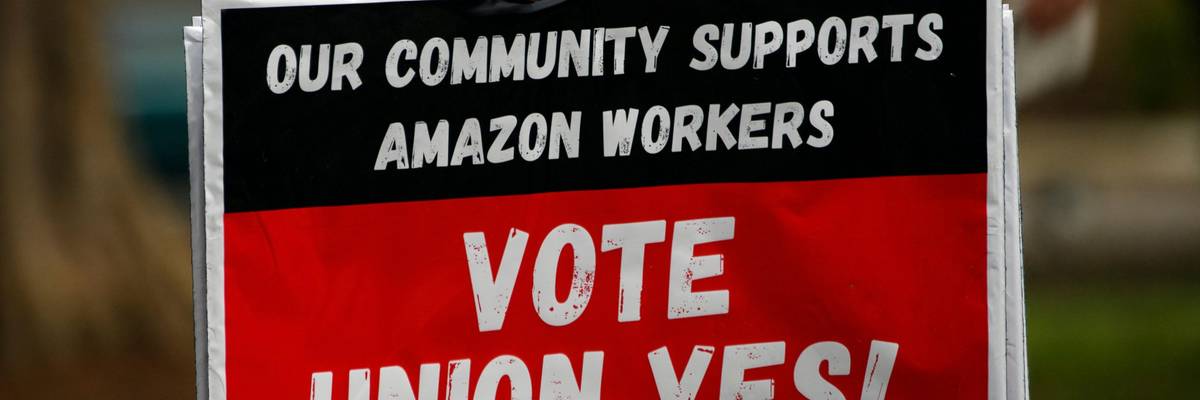
A person holds "Vote Union Yes!" signs during a protest in solidarity with Black Lives Matter, Stop Asian Hate and the unionization of Amazon.com, Inc. fulfillment center workers at Kelly Ingram Park on March 27, 2021 in Birmingham, Alabama. (Photo: Patrick T. Fallon/AFP via Getty Images)
With Billions in Profit, Amazon Can't Mistreat Their Workers Forever
Even when it’s raking in record profits, the company is trying to keep workers from earning their fair share. This time, it may not work.
The National Labor Relations Board, or NLRB, just ruled that a historic union vote among Amazon warehouse workers in Bessemer, Alabama was not valid.
The highly publicized vote resulted in a resounding defeat for the union in March 2021, with more than 70 percent of those voting choosing against union membership. The union accused Amazon of engaging in "efforts to gaslight its own employees" and filed a petition in April to nullify the vote.
This sort of progress is exactly what Amazon wants to avoid in the United States, where numerous studies have detailed how the company mistreats its workers.
After investigating, the NLRB agreed. Federal officials decided that Amazon interfered so blatantly in its workers' ability to vote that a second election is now in order.
The ruling detailed how Amazon defied NLRB guidance and set up a vote collection box right outside the warehouse entrance, giving workers the impression that it was involved in the vote counting.
The company also distributed "vote no" paraphernalia to workers in the presence of managers and held what the NLRB called "captive audience meetings" with small groups of workers-- "six days a week, 18 hours a day"--and blasted them with anti-union messaging.
The company "essentially hijacked the process and gave a strong impression that it controlled the process," concluded NLRB regional director Lisa Henderson. In a separate decision, the NLRB also determined that Amazon illegally fired two employees last year who were agitating against unfair labor practices.
It's no wonder that the election turnout was low.
Yet Amazon has already begun paving the way for more interference. According to Reuters, it's again "forcing thousands of employees to attend meetings" and "posting signs critical of labor groups in bathrooms."
This aggressive pushback against a unionizing effort at a single warehouse indicates Amazon's absolute determination to deny workers a say in their labor conditions.
And it's no mystery why.
A study of 20 years of wage data for the retail industry found a clear and growing advantage for unionized workers compared to non-union workers, with the weekly wage gap between the two groups increasing from $20 in 2013 to $50 in 2019.
You can see the difference firsthand for Amazon's workers in Europe. There, Amazon's workers are already unionized--and actively demanding better wages and working conditions.
In November unionized Amazon workers in Germany walked off their jobs for higher pay. Last year, Italian workers went on strike for 11 days to win an extra five-minute break. And during the early months of the pandemic, French unions successfully demanded that Amazon suspend activity at its warehouses in the interest of worker safety.
This sort of progress is exactly what Amazon wants to avoid in the United States, where numerous studies have detailed how the company mistreats its workers.
One investigation by the New York Times earlier this year found extremely high employee turnover at the company's Staten Island warehouse. The paper found that although managers keep careful track of nearly every conceivable aspect of employee efficiency and productivity, there were few if any records of employee health--including COVID-19 infections.
Amazon can afford to do better.
While Bessemer warehouse workers were being bombarded with anti-union propaganda, the company was practically minting money with record profits. And now, with a do-over on the horizon in Alabama, American workers are increasingly intolerant of suffering poor labor conditions and low wages while their bosses rake it in.
A wave of strikes and mass resignations this fall impacted Amazon's ability to hire more workers. And another union, the International Brotherhood of Teamsters, has vowed to engage in organizing efforts aimed at Amazon.
Amazon's workers have made the company one of the most valuable on earth--and their CEO the second-wealthiest man on this planet. They deserve to have their voices heard.

Urgent. It's never been this bad.
Dear Common Dreams reader, It’s been nearly 30 years since I co-founded Common Dreams with my late wife, Lina Newhouser. We had the radical notion that journalism should serve the public good, not corporate profits. It was clear to us from the outset what it would take to build such a project. No paid advertisements. No corporate sponsors. No millionaire publisher telling us what to think or do. Many people said we wouldn't last a year, but we proved those doubters wrong. Together with a tremendous team of journalists and dedicated staff, we built an independent media outlet free from the constraints of profits and corporate control. Our mission from the outset was simple. To inform. To inspire. To ignite change for the common good. Building Common Dreams was not easy. Our survival was never guaranteed. When you take on the most powerful forces—Wall Street greed, fossil fuel industry destruction, Big Tech lobbyists, and uber-rich oligarchs who have spent billions upon billions rigging the economy and democracy in their favor—the only bulwark you have is supporters who believe in your work. But here’s the urgent message from me today. It’s never been this bad out there. And it’s never been this hard to keep us going. At the very moment Common Dreams is most needed and doing some of its best and most important work, the threats we face are intensifying. Right now, with just four days to go in our Spring Campaign, we are not even halfway to our goal. When everyone does the little they can afford, we are strong. But if that support retreats or dries up, so do we. Can you make a gift right now to make sure Common Dreams not only survives but thrives? There is no backup plan or rainy day fund. There is only you. —Craig Brown, Co-founder |
The National Labor Relations Board, or NLRB, just ruled that a historic union vote among Amazon warehouse workers in Bessemer, Alabama was not valid.
The highly publicized vote resulted in a resounding defeat for the union in March 2021, with more than 70 percent of those voting choosing against union membership. The union accused Amazon of engaging in "efforts to gaslight its own employees" and filed a petition in April to nullify the vote.
This sort of progress is exactly what Amazon wants to avoid in the United States, where numerous studies have detailed how the company mistreats its workers.
After investigating, the NLRB agreed. Federal officials decided that Amazon interfered so blatantly in its workers' ability to vote that a second election is now in order.
The ruling detailed how Amazon defied NLRB guidance and set up a vote collection box right outside the warehouse entrance, giving workers the impression that it was involved in the vote counting.
The company also distributed "vote no" paraphernalia to workers in the presence of managers and held what the NLRB called "captive audience meetings" with small groups of workers-- "six days a week, 18 hours a day"--and blasted them with anti-union messaging.
The company "essentially hijacked the process and gave a strong impression that it controlled the process," concluded NLRB regional director Lisa Henderson. In a separate decision, the NLRB also determined that Amazon illegally fired two employees last year who were agitating against unfair labor practices.
It's no wonder that the election turnout was low.
Yet Amazon has already begun paving the way for more interference. According to Reuters, it's again "forcing thousands of employees to attend meetings" and "posting signs critical of labor groups in bathrooms."
This aggressive pushback against a unionizing effort at a single warehouse indicates Amazon's absolute determination to deny workers a say in their labor conditions.
And it's no mystery why.
A study of 20 years of wage data for the retail industry found a clear and growing advantage for unionized workers compared to non-union workers, with the weekly wage gap between the two groups increasing from $20 in 2013 to $50 in 2019.
You can see the difference firsthand for Amazon's workers in Europe. There, Amazon's workers are already unionized--and actively demanding better wages and working conditions.
In November unionized Amazon workers in Germany walked off their jobs for higher pay. Last year, Italian workers went on strike for 11 days to win an extra five-minute break. And during the early months of the pandemic, French unions successfully demanded that Amazon suspend activity at its warehouses in the interest of worker safety.
This sort of progress is exactly what Amazon wants to avoid in the United States, where numerous studies have detailed how the company mistreats its workers.
One investigation by the New York Times earlier this year found extremely high employee turnover at the company's Staten Island warehouse. The paper found that although managers keep careful track of nearly every conceivable aspect of employee efficiency and productivity, there were few if any records of employee health--including COVID-19 infections.
Amazon can afford to do better.
While Bessemer warehouse workers were being bombarded with anti-union propaganda, the company was practically minting money with record profits. And now, with a do-over on the horizon in Alabama, American workers are increasingly intolerant of suffering poor labor conditions and low wages while their bosses rake it in.
A wave of strikes and mass resignations this fall impacted Amazon's ability to hire more workers. And another union, the International Brotherhood of Teamsters, has vowed to engage in organizing efforts aimed at Amazon.
Amazon's workers have made the company one of the most valuable on earth--and their CEO the second-wealthiest man on this planet. They deserve to have their voices heard.
The National Labor Relations Board, or NLRB, just ruled that a historic union vote among Amazon warehouse workers in Bessemer, Alabama was not valid.
The highly publicized vote resulted in a resounding defeat for the union in March 2021, with more than 70 percent of those voting choosing against union membership. The union accused Amazon of engaging in "efforts to gaslight its own employees" and filed a petition in April to nullify the vote.
This sort of progress is exactly what Amazon wants to avoid in the United States, where numerous studies have detailed how the company mistreats its workers.
After investigating, the NLRB agreed. Federal officials decided that Amazon interfered so blatantly in its workers' ability to vote that a second election is now in order.
The ruling detailed how Amazon defied NLRB guidance and set up a vote collection box right outside the warehouse entrance, giving workers the impression that it was involved in the vote counting.
The company also distributed "vote no" paraphernalia to workers in the presence of managers and held what the NLRB called "captive audience meetings" with small groups of workers-- "six days a week, 18 hours a day"--and blasted them with anti-union messaging.
The company "essentially hijacked the process and gave a strong impression that it controlled the process," concluded NLRB regional director Lisa Henderson. In a separate decision, the NLRB also determined that Amazon illegally fired two employees last year who were agitating against unfair labor practices.
It's no wonder that the election turnout was low.
Yet Amazon has already begun paving the way for more interference. According to Reuters, it's again "forcing thousands of employees to attend meetings" and "posting signs critical of labor groups in bathrooms."
This aggressive pushback against a unionizing effort at a single warehouse indicates Amazon's absolute determination to deny workers a say in their labor conditions.
And it's no mystery why.
A study of 20 years of wage data for the retail industry found a clear and growing advantage for unionized workers compared to non-union workers, with the weekly wage gap between the two groups increasing from $20 in 2013 to $50 in 2019.
You can see the difference firsthand for Amazon's workers in Europe. There, Amazon's workers are already unionized--and actively demanding better wages and working conditions.
In November unionized Amazon workers in Germany walked off their jobs for higher pay. Last year, Italian workers went on strike for 11 days to win an extra five-minute break. And during the early months of the pandemic, French unions successfully demanded that Amazon suspend activity at its warehouses in the interest of worker safety.
This sort of progress is exactly what Amazon wants to avoid in the United States, where numerous studies have detailed how the company mistreats its workers.
One investigation by the New York Times earlier this year found extremely high employee turnover at the company's Staten Island warehouse. The paper found that although managers keep careful track of nearly every conceivable aspect of employee efficiency and productivity, there were few if any records of employee health--including COVID-19 infections.
Amazon can afford to do better.
While Bessemer warehouse workers were being bombarded with anti-union propaganda, the company was practically minting money with record profits. And now, with a do-over on the horizon in Alabama, American workers are increasingly intolerant of suffering poor labor conditions and low wages while their bosses rake it in.
A wave of strikes and mass resignations this fall impacted Amazon's ability to hire more workers. And another union, the International Brotherhood of Teamsters, has vowed to engage in organizing efforts aimed at Amazon.
Amazon's workers have made the company one of the most valuable on earth--and their CEO the second-wealthiest man on this planet. They deserve to have their voices heard.