SUBSCRIBE TO OUR FREE NEWSLETTER
Daily news & progressive opinion—funded by the people, not the corporations—delivered straight to your inbox.
5
#000000
#FFFFFF
To donate by check, phone, or other method, see our More Ways to Give page.
Daily news & progressive opinion—funded by the people, not the corporations—delivered straight to your inbox.
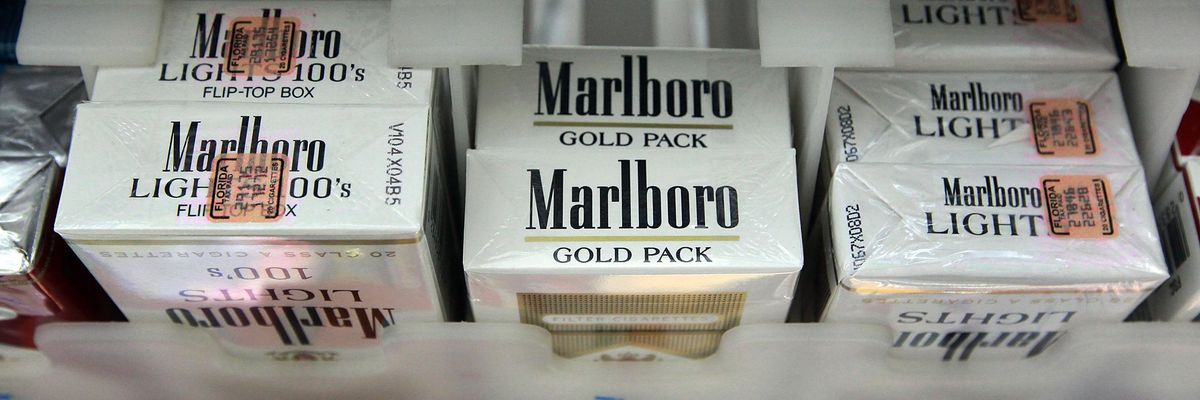
A pack of cigarettes with the new label, "Gold Pack," is seen next to packs with the old labeling at the Quick Stop store on June 22, 2010 in Miami, Florida. (Photo: Joe Raedle/Getty Images)
The top executives of ExxonMobil, Shell, Chevron, and BP America were put in the hot seat last month, when the House Oversight and Reform Committee grilled them under oath about their companies' well-documented campaigns to spread disinformation and deceive the public about the role their products play in causing climate change.
Right on cue the executives offer up phony low carbon framing as their latest deception, making clear that the industry is not particularly interested in mending its tortured relationship with the truth that there is no fossil fuel that is safe for our climate.
When the titans of climate pollution were pressed again and again about their paltry investments in renewable energy, and the incompatibility of their oil and gas businesses with a safe and sustainable planet, they all relied on one talking point in their defense: we are working toward "lower carbon" solutions.
This rebrand was so consistent that ExxonMobil CEO Darren Woods, Chevron CEO Michael Wirth, Shell Oil President Gretchen Watkins, BP America CEO David Lawler, and American Petroleum Institute President Mike Sommers all touted their commitment to a "low carbon" or "lower carbon" future in their scripted opening statements.
And what are these low carbon solutions? Largely natural gas, which as science has repeatedly shown, is roughly as bad for the climate as coal when methane leaks and total emissions are added to the equation. Natural gas is so problematic that to meet the 1.5 C Paris goal, production will have to decline 3 percent per year to 2030, starting last year.
Yet Shell plans to increase its production of natural gas as a key "lever" in the company's energy transition strategy, Exxon claims natural gas is a product that will "help customers reduce their emissions," and Chevron says it is "advancing a lower carbon future" even as it plans to increase both oil and gas production. Even BP, which has pledged to reduce oil and gas production (though with significant loopholes), claims "natural gas allows billions of people to enjoy access to lower carbon heat and power" and groups gas together with renewables and low carbon energy in the company's corporate structure.
If there is one lesson to be learned from these executives, it is that their climate pledges depend almost entirely on convincing members of Congress that they are doing something that they are clearly not doing: significantly reducing emissions from their products over the next ten years.
Enter natural gas, the "low tar" cigarette of fossil fuels.
While not as blatant as the fossil fuel industry's overt climate denial from decades past, today's savvier embrace of "low carbon" is still an intentionally deceptive phrase, meant to confuse the public and policymakers while conjuring up an image of corporate mega polluters working around the clock to devise products that are safer for the climate.
The parallels with tobacco industry tactics are so obvious they are almost painful. Make a product you know will cause massive devastation. Cover it up. Get sued. Then hire literally the same lawyers and same PR companies as the tobacco industry, and employ the same core legal strategy to defend yourself--"everybody knew our product was dangerous, and it's your fault for using it." When things start to go south, rebrand with "low carbon" natural gas, which like its cousin, low tar cigarettes, is presented as a solution even though the companies know it is not--all in service of keeping the world addicted to a product that they know will cause widespread suffering and death.
The oil and gas industry is now staring down the barrel of congressional subpoenas while being sued for climate fraud and damages by 26 states and municipalities. Following the tobacco playbook, one would expect the industry to double down on disinformation as fact finders zero in on their sordid climate record. And not wanting to disappoint, right on cue the executives offer up phony low carbon framing as their latest deception, making clear that the industry is not particularly interested in mending its tortured relationship with the truth that there is no fossil fuel that is safe for our climate.
While international negotiations get overrun by fossil fuel interests and what remains of Build Back Better staggers to the finish line, we need to press even harder for the truth about the origins of the climate crisis. That truth--that the oil and gas industry knew their products would cause climate change half a century ago, and then lied about it and are still lying about it today--must become our moral foundation, unifying all just efforts to solve this greatest challenge in human history. Anything less would be just another low carbon charade.
Dear Common Dreams reader, It’s been nearly 30 years since I co-founded Common Dreams with my late wife, Lina Newhouser. We had the radical notion that journalism should serve the public good, not corporate profits. It was clear to us from the outset what it would take to build such a project. No paid advertisements. No corporate sponsors. No millionaire publisher telling us what to think or do. Many people said we wouldn't last a year, but we proved those doubters wrong. Together with a tremendous team of journalists and dedicated staff, we built an independent media outlet free from the constraints of profits and corporate control. Our mission has always been simple: To inform. To inspire. To ignite change for the common good. Building Common Dreams was not easy. Our survival was never guaranteed. When you take on the most powerful forces—Wall Street greed, fossil fuel industry destruction, Big Tech lobbyists, and uber-rich oligarchs who have spent billions upon billions rigging the economy and democracy in their favor—the only bulwark you have is supporters who believe in your work. But here’s the urgent message from me today. It's never been this bad out there. And it's never been this hard to keep us going. At the very moment Common Dreams is most needed, the threats we face are intensifying. We need your support now more than ever. We don't accept corporate advertising and never will. We don't have a paywall because we don't think people should be blocked from critical news based on their ability to pay. Everything we do is funded by the donations of readers like you. When everyone does the little they can afford, we are strong. But if that support retreats or dries up, so do we. Will you donate now to make sure Common Dreams not only survives but thrives? —Craig Brown, Co-founder |
The top executives of ExxonMobil, Shell, Chevron, and BP America were put in the hot seat last month, when the House Oversight and Reform Committee grilled them under oath about their companies' well-documented campaigns to spread disinformation and deceive the public about the role their products play in causing climate change.
Right on cue the executives offer up phony low carbon framing as their latest deception, making clear that the industry is not particularly interested in mending its tortured relationship with the truth that there is no fossil fuel that is safe for our climate.
When the titans of climate pollution were pressed again and again about their paltry investments in renewable energy, and the incompatibility of their oil and gas businesses with a safe and sustainable planet, they all relied on one talking point in their defense: we are working toward "lower carbon" solutions.
This rebrand was so consistent that ExxonMobil CEO Darren Woods, Chevron CEO Michael Wirth, Shell Oil President Gretchen Watkins, BP America CEO David Lawler, and American Petroleum Institute President Mike Sommers all touted their commitment to a "low carbon" or "lower carbon" future in their scripted opening statements.
And what are these low carbon solutions? Largely natural gas, which as science has repeatedly shown, is roughly as bad for the climate as coal when methane leaks and total emissions are added to the equation. Natural gas is so problematic that to meet the 1.5 C Paris goal, production will have to decline 3 percent per year to 2030, starting last year.
Yet Shell plans to increase its production of natural gas as a key "lever" in the company's energy transition strategy, Exxon claims natural gas is a product that will "help customers reduce their emissions," and Chevron says it is "advancing a lower carbon future" even as it plans to increase both oil and gas production. Even BP, which has pledged to reduce oil and gas production (though with significant loopholes), claims "natural gas allows billions of people to enjoy access to lower carbon heat and power" and groups gas together with renewables and low carbon energy in the company's corporate structure.
If there is one lesson to be learned from these executives, it is that their climate pledges depend almost entirely on convincing members of Congress that they are doing something that they are clearly not doing: significantly reducing emissions from their products over the next ten years.
Enter natural gas, the "low tar" cigarette of fossil fuels.
While not as blatant as the fossil fuel industry's overt climate denial from decades past, today's savvier embrace of "low carbon" is still an intentionally deceptive phrase, meant to confuse the public and policymakers while conjuring up an image of corporate mega polluters working around the clock to devise products that are safer for the climate.
The parallels with tobacco industry tactics are so obvious they are almost painful. Make a product you know will cause massive devastation. Cover it up. Get sued. Then hire literally the same lawyers and same PR companies as the tobacco industry, and employ the same core legal strategy to defend yourself--"everybody knew our product was dangerous, and it's your fault for using it." When things start to go south, rebrand with "low carbon" natural gas, which like its cousin, low tar cigarettes, is presented as a solution even though the companies know it is not--all in service of keeping the world addicted to a product that they know will cause widespread suffering and death.
The oil and gas industry is now staring down the barrel of congressional subpoenas while being sued for climate fraud and damages by 26 states and municipalities. Following the tobacco playbook, one would expect the industry to double down on disinformation as fact finders zero in on their sordid climate record. And not wanting to disappoint, right on cue the executives offer up phony low carbon framing as their latest deception, making clear that the industry is not particularly interested in mending its tortured relationship with the truth that there is no fossil fuel that is safe for our climate.
While international negotiations get overrun by fossil fuel interests and what remains of Build Back Better staggers to the finish line, we need to press even harder for the truth about the origins of the climate crisis. That truth--that the oil and gas industry knew their products would cause climate change half a century ago, and then lied about it and are still lying about it today--must become our moral foundation, unifying all just efforts to solve this greatest challenge in human history. Anything less would be just another low carbon charade.
The top executives of ExxonMobil, Shell, Chevron, and BP America were put in the hot seat last month, when the House Oversight and Reform Committee grilled them under oath about their companies' well-documented campaigns to spread disinformation and deceive the public about the role their products play in causing climate change.
Right on cue the executives offer up phony low carbon framing as their latest deception, making clear that the industry is not particularly interested in mending its tortured relationship with the truth that there is no fossil fuel that is safe for our climate.
When the titans of climate pollution were pressed again and again about their paltry investments in renewable energy, and the incompatibility of their oil and gas businesses with a safe and sustainable planet, they all relied on one talking point in their defense: we are working toward "lower carbon" solutions.
This rebrand was so consistent that ExxonMobil CEO Darren Woods, Chevron CEO Michael Wirth, Shell Oil President Gretchen Watkins, BP America CEO David Lawler, and American Petroleum Institute President Mike Sommers all touted their commitment to a "low carbon" or "lower carbon" future in their scripted opening statements.
And what are these low carbon solutions? Largely natural gas, which as science has repeatedly shown, is roughly as bad for the climate as coal when methane leaks and total emissions are added to the equation. Natural gas is so problematic that to meet the 1.5 C Paris goal, production will have to decline 3 percent per year to 2030, starting last year.
Yet Shell plans to increase its production of natural gas as a key "lever" in the company's energy transition strategy, Exxon claims natural gas is a product that will "help customers reduce their emissions," and Chevron says it is "advancing a lower carbon future" even as it plans to increase both oil and gas production. Even BP, which has pledged to reduce oil and gas production (though with significant loopholes), claims "natural gas allows billions of people to enjoy access to lower carbon heat and power" and groups gas together with renewables and low carbon energy in the company's corporate structure.
If there is one lesson to be learned from these executives, it is that their climate pledges depend almost entirely on convincing members of Congress that they are doing something that they are clearly not doing: significantly reducing emissions from their products over the next ten years.
Enter natural gas, the "low tar" cigarette of fossil fuels.
While not as blatant as the fossil fuel industry's overt climate denial from decades past, today's savvier embrace of "low carbon" is still an intentionally deceptive phrase, meant to confuse the public and policymakers while conjuring up an image of corporate mega polluters working around the clock to devise products that are safer for the climate.
The parallels with tobacco industry tactics are so obvious they are almost painful. Make a product you know will cause massive devastation. Cover it up. Get sued. Then hire literally the same lawyers and same PR companies as the tobacco industry, and employ the same core legal strategy to defend yourself--"everybody knew our product was dangerous, and it's your fault for using it." When things start to go south, rebrand with "low carbon" natural gas, which like its cousin, low tar cigarettes, is presented as a solution even though the companies know it is not--all in service of keeping the world addicted to a product that they know will cause widespread suffering and death.
The oil and gas industry is now staring down the barrel of congressional subpoenas while being sued for climate fraud and damages by 26 states and municipalities. Following the tobacco playbook, one would expect the industry to double down on disinformation as fact finders zero in on their sordid climate record. And not wanting to disappoint, right on cue the executives offer up phony low carbon framing as their latest deception, making clear that the industry is not particularly interested in mending its tortured relationship with the truth that there is no fossil fuel that is safe for our climate.
While international negotiations get overrun by fossil fuel interests and what remains of Build Back Better staggers to the finish line, we need to press even harder for the truth about the origins of the climate crisis. That truth--that the oil and gas industry knew their products would cause climate change half a century ago, and then lied about it and are still lying about it today--must become our moral foundation, unifying all just efforts to solve this greatest challenge in human history. Anything less would be just another low carbon charade.