SUBSCRIBE TO OUR FREE NEWSLETTER
Daily news & progressive opinion—funded by the people, not the corporations—delivered straight to your inbox.
5
#000000
#FFFFFF
To donate by check, phone, or other method, see our More Ways to Give page.
Daily news & progressive opinion—funded by the people, not the corporations—delivered straight to your inbox.
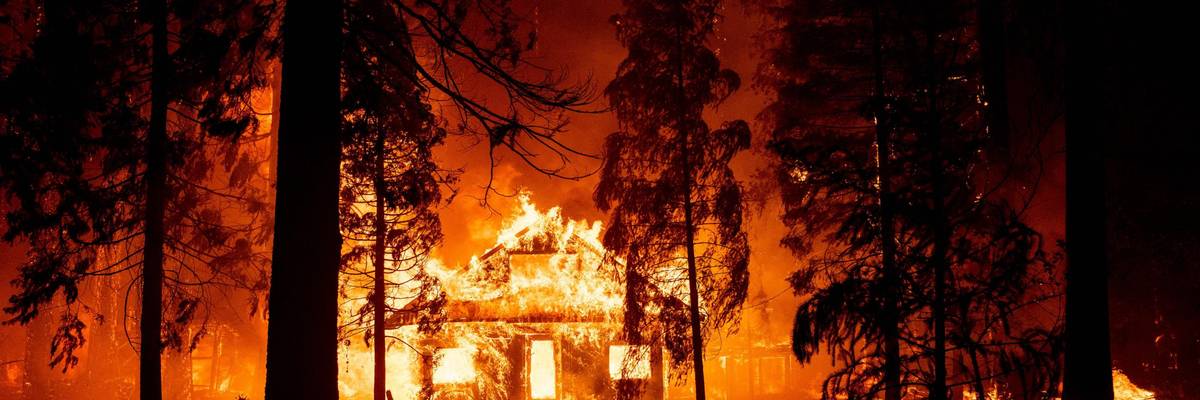
A home burns as flames from the Dixie Fire tear through the Indian Falls neighborhood of unincorporated Plumas County, California on July 24, 2021. (Photo: Josh Edelson/AFP via Getty Images)
For almost 75 years, GuideOne has been an insurance firm whose primary business has been insuring places of worship, faith organizations, and religious schools. The firm has consistently projected a wholesome image suitable for an insurer focused on safety. "Every product and service GuideOne offers protects organizations dedicated to making our communities better places to live", Jessica Clark, GuideOne's CEO at the time, said in 2018.
Consistent with this philosophy the firm committed in 2017 to divest from coal, the most dangerous of all fossil fuels in terms of carbon emissions and air pollution, by 2019.
The insurance industry has a vital role to play by underwriting the transition from fossil fuels to renewable energy.
But in the past year, GuideOne has undergone a conversion, and not for the better. The company has become a growing insurer of coal, oil, and gas projects, essentially offering a lifeline to the very industry that is driving the planet's destruction.
In response, a group of religious leaders sent a letter to GuideOne last month, calling on the company to end its practice of insuring coal and fossil fuel projects. "Climate change is a sin against God and fossil fuels are its cause," said the letter. "GuideOne needs to live up to the moral values that we have come to expect from it and end its coverage for an unrepentant industry responsible for the destructive impacts of the climate crisis." To date, they have not received a response.
This comes as, over the past several years, more and more insurance companies have backed away from underwriting fossil fuels and pressure has grown for an end to new fossil fuel projects. Even the International Energy Agency, the world's leading energy organization which has been notoriously pro-fossil fuels, issued a report in May calling for an immediate end to new fossil fuel projects.
The insurance industry has a vital role to play by underwriting the transition from fossil fuels to renewable energy. All around the world, more than 30 major insurance companies (including market leaders like Allianz, AXA, and Generali) have ended their cover for coal and in some cases, extreme oil projects like tar sands pipelines. This shift is accelerating the decarbonization of the global economy.
However, according to Willis Towers Watson, an international insurance broker, the shift of these insurers from coal to renewable energy is now "likely to be increasingly offset" by the arrival of GuideOne and another insurer from Bermuda. Mark Groenheide, GuideOne's Senior Vice President of Specialty, argues that the energy industry "in particular needs capacity, needs capital ... We will be supporting that."
At the same time, GuideOne says that it "remains dedicated to helping people whose organizations make our communities better places to live: people who spread faith, who care for individuals on the margins of society, who invest in their communities as small business owners, who educate tomorrow's leaders, and give compassion to seniors in their time of need. That's who we are. It's what we do."
We disagree.
There is, simply put, no way that any insurance firm can underwrite fossil fuel projects while claiming to make communities "better places to live."
Ask the survivors of this summer's Oregon wildfires or Chinese floods, dramatically worsened by climate change, if their communities were safer thanks to fossil fuels.
Ask the millions of small farmers across the globe who, facing climate-jacked droughts, are forced to abandon their land if underwriting fossil fuels is "compassionate."
Ask the world's poorest communities, ravaged by severe storms and deadly heatwaves, if supporting fossil fuels is "caring for those on the margins."
Religious groups of all stripes--from Catholic to Evangelicals, Hindus to Buddhists, Muslims to Mormons--have made it clear that climate change is a dire threat. Pope Francis and the Vatican have called on Catholics to "shun companies that are harmful to ... the environment, such as fossil fuels". The World Council of Churches ruled out any investments in fossil fuels as early as 2014. The Lutheran World Federation, many branches of the global Anglican Church, the United Church of Christ, the Islamic Society of North America, and hundreds of other religious organizations globally have divested from fossil fuels.
This unequivocal religious consensus is reflected in the letter religious leaders sent to GuideOne. As leaders and organizations in the faith community, they wrote, "we see a moral imperative to address the climate crisis with the urgency it demands."
GuideOne clearly sees fossil fuels as a new profit center. The company wouldn't be the first to choose mammon over God. But given GuideOne's stake in the religious community, the letter's authors have made it clear that faith organizations will watch closely how GuideOne's management will choose between the insurer's original mission and the interests of the fossil fuel industry.
Dear Common Dreams reader, It’s been nearly 30 years since I co-founded Common Dreams with my late wife, Lina Newhouser. We had the radical notion that journalism should serve the public good, not corporate profits. It was clear to us from the outset what it would take to build such a project. No paid advertisements. No corporate sponsors. No millionaire publisher telling us what to think or do. Many people said we wouldn't last a year, but we proved those doubters wrong. Together with a tremendous team of journalists and dedicated staff, we built an independent media outlet free from the constraints of profits and corporate control. Our mission has always been simple: To inform. To inspire. To ignite change for the common good. Building Common Dreams was not easy. Our survival was never guaranteed. When you take on the most powerful forces—Wall Street greed, fossil fuel industry destruction, Big Tech lobbyists, and uber-rich oligarchs who have spent billions upon billions rigging the economy and democracy in their favor—the only bulwark you have is supporters who believe in your work. But here’s the urgent message from me today. It's never been this bad out there. And it's never been this hard to keep us going. At the very moment Common Dreams is most needed, the threats we face are intensifying. We need your support now more than ever. We don't accept corporate advertising and never will. We don't have a paywall because we don't think people should be blocked from critical news based on their ability to pay. Everything we do is funded by the donations of readers like you. When everyone does the little they can afford, we are strong. But if that support retreats or dries up, so do we. Will you donate now to make sure Common Dreams not only survives but thrives? —Craig Brown, Co-founder |
For almost 75 years, GuideOne has been an insurance firm whose primary business has been insuring places of worship, faith organizations, and religious schools. The firm has consistently projected a wholesome image suitable for an insurer focused on safety. "Every product and service GuideOne offers protects organizations dedicated to making our communities better places to live", Jessica Clark, GuideOne's CEO at the time, said in 2018.
Consistent with this philosophy the firm committed in 2017 to divest from coal, the most dangerous of all fossil fuels in terms of carbon emissions and air pollution, by 2019.
The insurance industry has a vital role to play by underwriting the transition from fossil fuels to renewable energy.
But in the past year, GuideOne has undergone a conversion, and not for the better. The company has become a growing insurer of coal, oil, and gas projects, essentially offering a lifeline to the very industry that is driving the planet's destruction.
In response, a group of religious leaders sent a letter to GuideOne last month, calling on the company to end its practice of insuring coal and fossil fuel projects. "Climate change is a sin against God and fossil fuels are its cause," said the letter. "GuideOne needs to live up to the moral values that we have come to expect from it and end its coverage for an unrepentant industry responsible for the destructive impacts of the climate crisis." To date, they have not received a response.
This comes as, over the past several years, more and more insurance companies have backed away from underwriting fossil fuels and pressure has grown for an end to new fossil fuel projects. Even the International Energy Agency, the world's leading energy organization which has been notoriously pro-fossil fuels, issued a report in May calling for an immediate end to new fossil fuel projects.
The insurance industry has a vital role to play by underwriting the transition from fossil fuels to renewable energy. All around the world, more than 30 major insurance companies (including market leaders like Allianz, AXA, and Generali) have ended their cover for coal and in some cases, extreme oil projects like tar sands pipelines. This shift is accelerating the decarbonization of the global economy.
However, according to Willis Towers Watson, an international insurance broker, the shift of these insurers from coal to renewable energy is now "likely to be increasingly offset" by the arrival of GuideOne and another insurer from Bermuda. Mark Groenheide, GuideOne's Senior Vice President of Specialty, argues that the energy industry "in particular needs capacity, needs capital ... We will be supporting that."
At the same time, GuideOne says that it "remains dedicated to helping people whose organizations make our communities better places to live: people who spread faith, who care for individuals on the margins of society, who invest in their communities as small business owners, who educate tomorrow's leaders, and give compassion to seniors in their time of need. That's who we are. It's what we do."
We disagree.
There is, simply put, no way that any insurance firm can underwrite fossil fuel projects while claiming to make communities "better places to live."
Ask the survivors of this summer's Oregon wildfires or Chinese floods, dramatically worsened by climate change, if their communities were safer thanks to fossil fuels.
Ask the millions of small farmers across the globe who, facing climate-jacked droughts, are forced to abandon their land if underwriting fossil fuels is "compassionate."
Ask the world's poorest communities, ravaged by severe storms and deadly heatwaves, if supporting fossil fuels is "caring for those on the margins."
Religious groups of all stripes--from Catholic to Evangelicals, Hindus to Buddhists, Muslims to Mormons--have made it clear that climate change is a dire threat. Pope Francis and the Vatican have called on Catholics to "shun companies that are harmful to ... the environment, such as fossil fuels". The World Council of Churches ruled out any investments in fossil fuels as early as 2014. The Lutheran World Federation, many branches of the global Anglican Church, the United Church of Christ, the Islamic Society of North America, and hundreds of other religious organizations globally have divested from fossil fuels.
This unequivocal religious consensus is reflected in the letter religious leaders sent to GuideOne. As leaders and organizations in the faith community, they wrote, "we see a moral imperative to address the climate crisis with the urgency it demands."
GuideOne clearly sees fossil fuels as a new profit center. The company wouldn't be the first to choose mammon over God. But given GuideOne's stake in the religious community, the letter's authors have made it clear that faith organizations will watch closely how GuideOne's management will choose between the insurer's original mission and the interests of the fossil fuel industry.
For almost 75 years, GuideOne has been an insurance firm whose primary business has been insuring places of worship, faith organizations, and religious schools. The firm has consistently projected a wholesome image suitable for an insurer focused on safety. "Every product and service GuideOne offers protects organizations dedicated to making our communities better places to live", Jessica Clark, GuideOne's CEO at the time, said in 2018.
Consistent with this philosophy the firm committed in 2017 to divest from coal, the most dangerous of all fossil fuels in terms of carbon emissions and air pollution, by 2019.
The insurance industry has a vital role to play by underwriting the transition from fossil fuels to renewable energy.
But in the past year, GuideOne has undergone a conversion, and not for the better. The company has become a growing insurer of coal, oil, and gas projects, essentially offering a lifeline to the very industry that is driving the planet's destruction.
In response, a group of religious leaders sent a letter to GuideOne last month, calling on the company to end its practice of insuring coal and fossil fuel projects. "Climate change is a sin against God and fossil fuels are its cause," said the letter. "GuideOne needs to live up to the moral values that we have come to expect from it and end its coverage for an unrepentant industry responsible for the destructive impacts of the climate crisis." To date, they have not received a response.
This comes as, over the past several years, more and more insurance companies have backed away from underwriting fossil fuels and pressure has grown for an end to new fossil fuel projects. Even the International Energy Agency, the world's leading energy organization which has been notoriously pro-fossil fuels, issued a report in May calling for an immediate end to new fossil fuel projects.
The insurance industry has a vital role to play by underwriting the transition from fossil fuels to renewable energy. All around the world, more than 30 major insurance companies (including market leaders like Allianz, AXA, and Generali) have ended their cover for coal and in some cases, extreme oil projects like tar sands pipelines. This shift is accelerating the decarbonization of the global economy.
However, according to Willis Towers Watson, an international insurance broker, the shift of these insurers from coal to renewable energy is now "likely to be increasingly offset" by the arrival of GuideOne and another insurer from Bermuda. Mark Groenheide, GuideOne's Senior Vice President of Specialty, argues that the energy industry "in particular needs capacity, needs capital ... We will be supporting that."
At the same time, GuideOne says that it "remains dedicated to helping people whose organizations make our communities better places to live: people who spread faith, who care for individuals on the margins of society, who invest in their communities as small business owners, who educate tomorrow's leaders, and give compassion to seniors in their time of need. That's who we are. It's what we do."
We disagree.
There is, simply put, no way that any insurance firm can underwrite fossil fuel projects while claiming to make communities "better places to live."
Ask the survivors of this summer's Oregon wildfires or Chinese floods, dramatically worsened by climate change, if their communities were safer thanks to fossil fuels.
Ask the millions of small farmers across the globe who, facing climate-jacked droughts, are forced to abandon their land if underwriting fossil fuels is "compassionate."
Ask the world's poorest communities, ravaged by severe storms and deadly heatwaves, if supporting fossil fuels is "caring for those on the margins."
Religious groups of all stripes--from Catholic to Evangelicals, Hindus to Buddhists, Muslims to Mormons--have made it clear that climate change is a dire threat. Pope Francis and the Vatican have called on Catholics to "shun companies that are harmful to ... the environment, such as fossil fuels". The World Council of Churches ruled out any investments in fossil fuels as early as 2014. The Lutheran World Federation, many branches of the global Anglican Church, the United Church of Christ, the Islamic Society of North America, and hundreds of other religious organizations globally have divested from fossil fuels.
This unequivocal religious consensus is reflected in the letter religious leaders sent to GuideOne. As leaders and organizations in the faith community, they wrote, "we see a moral imperative to address the climate crisis with the urgency it demands."
GuideOne clearly sees fossil fuels as a new profit center. The company wouldn't be the first to choose mammon over God. But given GuideOne's stake in the religious community, the letter's authors have made it clear that faith organizations will watch closely how GuideOne's management will choose between the insurer's original mission and the interests of the fossil fuel industry.