SUBSCRIBE TO OUR FREE NEWSLETTER
Daily news & progressive opinion—funded by the people, not the corporations—delivered straight to your inbox.
5
#000000
#FFFFFF
To donate by check, phone, or other method, see our More Ways to Give page.
Daily news & progressive opinion—funded by the people, not the corporations—delivered straight to your inbox.

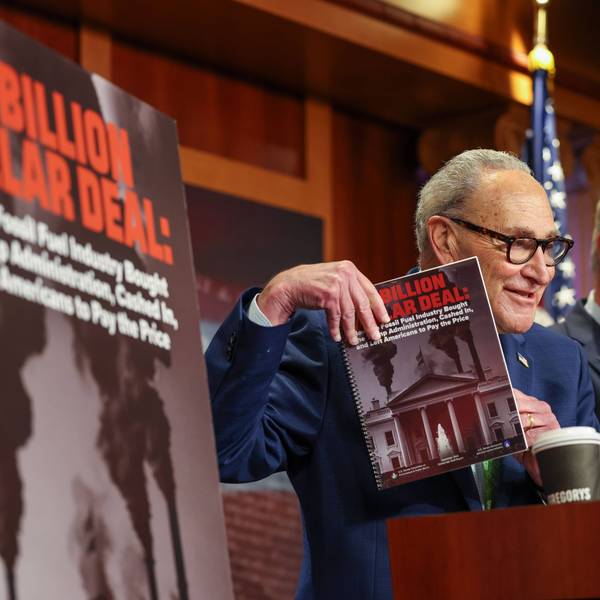
Curbing the power of corporations and those who own them--so we can have a future--should be our top priority.(Photo: Union of Concerned Scientists)
For years, it was assumed the world wouldn't start seriously tackling climate change until we were directly confronted with its horrors--thereby revealing how truly reckless humans are.
But now that the world is engulfed in terrifying fires, heat domes, floods and droughts--yet still we don't act!--it's tempting to conclude humans aren't just reckless but utterly stupid, unable to stop ourselves from going over a cliff, even as the jagged rocks below come starkly into view.
But that would be unfair to humans.
Recent surveys show most Canadians--and most of the global population as well--understand we're in a climate emergency and must take immediate action to avoid disaster.
This failure to shine a spotlight on the real force blocking climate progress leads to a sense of hopelessness.
So humans grasp the danger and want to act, but there's something blocking us.
Yet, in the midst of a Canadian federal election, that brutal political reality barely figures into the discussion.
For sure, there's talk about climate change--how low our emissions must go, how the parties' climate plans compare, etc. But rarely does such talk zero in on the corporate crowd that keeps real climate action off the agenda and even manages to push a "climate warrior" government to purchase an oil pipeline, enabling ever higher emissions.
This failure to shine a spotlight on the real force blocking climate progress leads to a sense of hopelessness. It feels like we're up against human stupidity when we're really up against a highly organized group of cunning and ruthless corporate barons with the biggest war-chest of all time and legions of political and business lackies working tirelessly on their behalf.
This problem of overwhelming corporate power--and its effective veto over key areas of public policy--isn't confined to the fossil fuel industry, but the stakes there are particularly high.
Curbing the power of corporations and those who own them--so we can have a future--should be our top priority. At the very least, it should be an election issue.
One reason it isn't is that the exercise of corporate power is hard to see.
Corporate interests have countless levers of influence, starting with their control over capital necessary for job creation, which gives them a powerful hand in negotiations with government. They also retain a vast army of lobbyists pushing for results. They influence politicians and civil servants by dangling the prospect of future high-paying jobs at their companies and on their boards. They often have personal access to political leaders through social connections and private clubs. And they contribute generously to political campaigns and leadership drives.
They also shape public opinion through their control of think tanks, trade and industrial groups, even university departments funded by billionaires. They retain clever consultants and advertisers to package their actions in a favourable light. And, of course, they own the mass media.
It's not surprising they've succeeded in rolling back legislation protecting workers' rights, diminishing the strength of labour--one of the few organized forces potentially capable of challenging their dominance.
So how to rein in this runaway corporate power?
The election promise that comes closest is the NDP's call for an annual net wealth tax of 1 per cent, applied exclusively to those with assets of more than $10 million.
In addition to raising billions of dollars, the tax could target wealth concentration--particularly if it were designed more like the wealth taxes proposed by U.S. Senators Elizabeth Warren and Bernie Sanders, which impose higher rates on larger holdings, thereby enabling large fortunes to actually be reduced.
Almost a century ago, U.S. Supreme Court Justice Louis Brandeis observed: "We can have democracy in this country, or we can have great wealth concentrated in the hands of a few, but we can't have both."
That could be updated: "We can have a world that is livable for humans or we can have great wealth concentrated in the hands of the few; but we can't have both."
That's the real choice on the ballot on Sept. 20. The rest is just talkity-talk.
Dear Common Dreams reader, It’s been nearly 30 years since I co-founded Common Dreams with my late wife, Lina Newhouser. We had the radical notion that journalism should serve the public good, not corporate profits. It was clear to us from the outset what it would take to build such a project. No paid advertisements. No corporate sponsors. No millionaire publisher telling us what to think or do. Many people said we wouldn't last a year, but we proved those doubters wrong. Together with a tremendous team of journalists and dedicated staff, we built an independent media outlet free from the constraints of profits and corporate control. Our mission has always been simple: To inform. To inspire. To ignite change for the common good. Building Common Dreams was not easy. Our survival was never guaranteed. When you take on the most powerful forces—Wall Street greed, fossil fuel industry destruction, Big Tech lobbyists, and uber-rich oligarchs who have spent billions upon billions rigging the economy and democracy in their favor—the only bulwark you have is supporters who believe in your work. But here’s the urgent message from me today. It's never been this bad out there. And it's never been this hard to keep us going. At the very moment Common Dreams is most needed, the threats we face are intensifying. We need your support now more than ever. We don't accept corporate advertising and never will. We don't have a paywall because we don't think people should be blocked from critical news based on their ability to pay. Everything we do is funded by the donations of readers like you. When everyone does the little they can afford, we are strong. But if that support retreats or dries up, so do we. Will you donate now to make sure Common Dreams not only survives but thrives? —Craig Brown, Co-founder |
For years, it was assumed the world wouldn't start seriously tackling climate change until we were directly confronted with its horrors--thereby revealing how truly reckless humans are.
But now that the world is engulfed in terrifying fires, heat domes, floods and droughts--yet still we don't act!--it's tempting to conclude humans aren't just reckless but utterly stupid, unable to stop ourselves from going over a cliff, even as the jagged rocks below come starkly into view.
But that would be unfair to humans.
Recent surveys show most Canadians--and most of the global population as well--understand we're in a climate emergency and must take immediate action to avoid disaster.
This failure to shine a spotlight on the real force blocking climate progress leads to a sense of hopelessness.
So humans grasp the danger and want to act, but there's something blocking us.
Yet, in the midst of a Canadian federal election, that brutal political reality barely figures into the discussion.
For sure, there's talk about climate change--how low our emissions must go, how the parties' climate plans compare, etc. But rarely does such talk zero in on the corporate crowd that keeps real climate action off the agenda and even manages to push a "climate warrior" government to purchase an oil pipeline, enabling ever higher emissions.
This failure to shine a spotlight on the real force blocking climate progress leads to a sense of hopelessness. It feels like we're up against human stupidity when we're really up against a highly organized group of cunning and ruthless corporate barons with the biggest war-chest of all time and legions of political and business lackies working tirelessly on their behalf.
This problem of overwhelming corporate power--and its effective veto over key areas of public policy--isn't confined to the fossil fuel industry, but the stakes there are particularly high.
Curbing the power of corporations and those who own them--so we can have a future--should be our top priority. At the very least, it should be an election issue.
One reason it isn't is that the exercise of corporate power is hard to see.
Corporate interests have countless levers of influence, starting with their control over capital necessary for job creation, which gives them a powerful hand in negotiations with government. They also retain a vast army of lobbyists pushing for results. They influence politicians and civil servants by dangling the prospect of future high-paying jobs at their companies and on their boards. They often have personal access to political leaders through social connections and private clubs. And they contribute generously to political campaigns and leadership drives.
They also shape public opinion through their control of think tanks, trade and industrial groups, even university departments funded by billionaires. They retain clever consultants and advertisers to package their actions in a favourable light. And, of course, they own the mass media.
It's not surprising they've succeeded in rolling back legislation protecting workers' rights, diminishing the strength of labour--one of the few organized forces potentially capable of challenging their dominance.
So how to rein in this runaway corporate power?
The election promise that comes closest is the NDP's call for an annual net wealth tax of 1 per cent, applied exclusively to those with assets of more than $10 million.
In addition to raising billions of dollars, the tax could target wealth concentration--particularly if it were designed more like the wealth taxes proposed by U.S. Senators Elizabeth Warren and Bernie Sanders, which impose higher rates on larger holdings, thereby enabling large fortunes to actually be reduced.
Almost a century ago, U.S. Supreme Court Justice Louis Brandeis observed: "We can have democracy in this country, or we can have great wealth concentrated in the hands of a few, but we can't have both."
That could be updated: "We can have a world that is livable for humans or we can have great wealth concentrated in the hands of the few; but we can't have both."
That's the real choice on the ballot on Sept. 20. The rest is just talkity-talk.
For years, it was assumed the world wouldn't start seriously tackling climate change until we were directly confronted with its horrors--thereby revealing how truly reckless humans are.
But now that the world is engulfed in terrifying fires, heat domes, floods and droughts--yet still we don't act!--it's tempting to conclude humans aren't just reckless but utterly stupid, unable to stop ourselves from going over a cliff, even as the jagged rocks below come starkly into view.
But that would be unfair to humans.
Recent surveys show most Canadians--and most of the global population as well--understand we're in a climate emergency and must take immediate action to avoid disaster.
This failure to shine a spotlight on the real force blocking climate progress leads to a sense of hopelessness.
So humans grasp the danger and want to act, but there's something blocking us.
Yet, in the midst of a Canadian federal election, that brutal political reality barely figures into the discussion.
For sure, there's talk about climate change--how low our emissions must go, how the parties' climate plans compare, etc. But rarely does such talk zero in on the corporate crowd that keeps real climate action off the agenda and even manages to push a "climate warrior" government to purchase an oil pipeline, enabling ever higher emissions.
This failure to shine a spotlight on the real force blocking climate progress leads to a sense of hopelessness. It feels like we're up against human stupidity when we're really up against a highly organized group of cunning and ruthless corporate barons with the biggest war-chest of all time and legions of political and business lackies working tirelessly on their behalf.
This problem of overwhelming corporate power--and its effective veto over key areas of public policy--isn't confined to the fossil fuel industry, but the stakes there are particularly high.
Curbing the power of corporations and those who own them--so we can have a future--should be our top priority. At the very least, it should be an election issue.
One reason it isn't is that the exercise of corporate power is hard to see.
Corporate interests have countless levers of influence, starting with their control over capital necessary for job creation, which gives them a powerful hand in negotiations with government. They also retain a vast army of lobbyists pushing for results. They influence politicians and civil servants by dangling the prospect of future high-paying jobs at their companies and on their boards. They often have personal access to political leaders through social connections and private clubs. And they contribute generously to political campaigns and leadership drives.
They also shape public opinion through their control of think tanks, trade and industrial groups, even university departments funded by billionaires. They retain clever consultants and advertisers to package their actions in a favourable light. And, of course, they own the mass media.
It's not surprising they've succeeded in rolling back legislation protecting workers' rights, diminishing the strength of labour--one of the few organized forces potentially capable of challenging their dominance.
So how to rein in this runaway corporate power?
The election promise that comes closest is the NDP's call for an annual net wealth tax of 1 per cent, applied exclusively to those with assets of more than $10 million.
In addition to raising billions of dollars, the tax could target wealth concentration--particularly if it were designed more like the wealth taxes proposed by U.S. Senators Elizabeth Warren and Bernie Sanders, which impose higher rates on larger holdings, thereby enabling large fortunes to actually be reduced.
Almost a century ago, U.S. Supreme Court Justice Louis Brandeis observed: "We can have democracy in this country, or we can have great wealth concentrated in the hands of a few, but we can't have both."
That could be updated: "We can have a world that is livable for humans or we can have great wealth concentrated in the hands of the few; but we can't have both."
That's the real choice on the ballot on Sept. 20. The rest is just talkity-talk.