SUBSCRIBE TO OUR FREE NEWSLETTER
Daily news & progressive opinion—funded by the people, not the corporations—delivered straight to your inbox.
5
#000000
#FFFFFF
To donate by check, phone, or other method, see our More Ways to Give page.
Daily news & progressive opinion—funded by the people, not the corporations—delivered straight to your inbox.
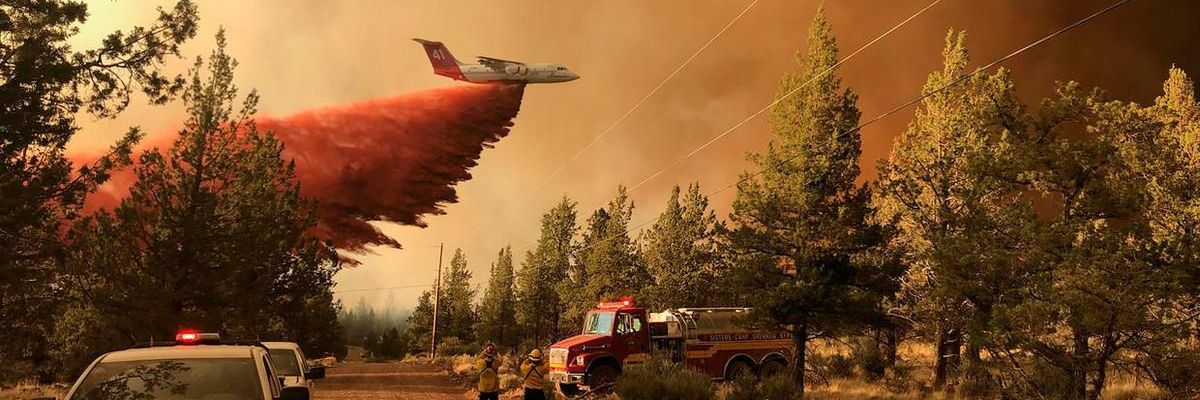
A firefighting tanker drops retardant over the Grandview Fire on July 11, 2021, northeast of Sisters, Oregon. (Photo: Oregon Department of Forestry via Getty Images)
100 days from now, the central point of climate politics will be Glasgow as the UK hosts the 26th Conference of Parties or COP26 under the UN Framework Convention on Climate Change. These negotiations are the most important climate talks on the climate emergency since COP21 in Paris in 2015, when almost every nation on earth signed a legally binding treaty called the Paris Agreement, which aims to limit global temperature rises to 1.5degC.
Unfortunately, we are not yet on track to limit global warming to 1.5degC, the threshold that scientists agree will prevent the most dangerous climate impacts.
The meeting in Glasgow is the first meeting for stock-taking of the commitments in Paris is achieving that goal. Many see COP26 as our last, best chance to prevent global temperatures from spiraling out of control.
Unfortunately, we are not yet on track to limit global warming to 1.5degC, the threshold that scientists agree will prevent the most dangerous climate impacts. Failure to reach this goal will take a disproportionate toll on developing countries. In fact, we now have less than a decade to keep global warming to that level. As we see now at 1.2degC global average since the industrial revolution, which started in England in the 18th Century, climate change is affecting everybody. We have recently seen the devastating floods that affected Germany and Belgium, the heatwave in Canada and the US, as well as floods in India and elsewhere.
However, vulnerable nations that have been experiencing such climate-induced catastrophe for decades now, have watched their key demands and needs ignored by huge and historically-emitting nations in the negotiations. These vulnerable nations, small island developing states and least developed countries are the least responsible for creating the climate change problem. But they are often the most affected by its impacts like sea level rise, floods, droughts and more.
Outside the climate negotiation process, but with impacts that undermine climate actions, are global trade rules and processes. These include Investor-State Dispute Settlement (ISDS) mechanisms or corporate courts in trade treaties and the Energy Charter Treaty (ECT). With these agreements, governments that phase out coal, end gas production, or stop oil pipelines can be sued by corporations in private courts and be held liable for billions in damages. This means coal, oil and gas corporations can obstruct necessary government climate actions to address the climate emergency and just transition to a clean energy system.
Dear Common Dreams reader, It’s been nearly 30 years since I co-founded Common Dreams with my late wife, Lina Newhouser. We had the radical notion that journalism should serve the public good, not corporate profits. It was clear to us from the outset what it would take to build such a project. No paid advertisements. No corporate sponsors. No millionaire publisher telling us what to think or do. Many people said we wouldn't last a year, but we proved those doubters wrong. Together with a tremendous team of journalists and dedicated staff, we built an independent media outlet free from the constraints of profits and corporate control. Our mission has always been simple: To inform. To inspire. To ignite change for the common good. Building Common Dreams was not easy. Our survival was never guaranteed. When you take on the most powerful forces—Wall Street greed, fossil fuel industry destruction, Big Tech lobbyists, and uber-rich oligarchs who have spent billions upon billions rigging the economy and democracy in their favor—the only bulwark you have is supporters who believe in your work. But here’s the urgent message from me today. It's never been this bad out there. And it's never been this hard to keep us going. At the very moment Common Dreams is most needed, the threats we face are intensifying. We need your support now more than ever. We don't accept corporate advertising and never will. We don't have a paywall because we don't think people should be blocked from critical news based on their ability to pay. Everything we do is funded by the donations of readers like you. When everyone does the little they can afford, we are strong. But if that support retreats or dries up, so do we. Will you donate now to make sure Common Dreams not only survives but thrives? —Craig Brown, Co-founder |
100 days from now, the central point of climate politics will be Glasgow as the UK hosts the 26th Conference of Parties or COP26 under the UN Framework Convention on Climate Change. These negotiations are the most important climate talks on the climate emergency since COP21 in Paris in 2015, when almost every nation on earth signed a legally binding treaty called the Paris Agreement, which aims to limit global temperature rises to 1.5degC.
Unfortunately, we are not yet on track to limit global warming to 1.5degC, the threshold that scientists agree will prevent the most dangerous climate impacts.
The meeting in Glasgow is the first meeting for stock-taking of the commitments in Paris is achieving that goal. Many see COP26 as our last, best chance to prevent global temperatures from spiraling out of control.
Unfortunately, we are not yet on track to limit global warming to 1.5degC, the threshold that scientists agree will prevent the most dangerous climate impacts. Failure to reach this goal will take a disproportionate toll on developing countries. In fact, we now have less than a decade to keep global warming to that level. As we see now at 1.2degC global average since the industrial revolution, which started in England in the 18th Century, climate change is affecting everybody. We have recently seen the devastating floods that affected Germany and Belgium, the heatwave in Canada and the US, as well as floods in India and elsewhere.
However, vulnerable nations that have been experiencing such climate-induced catastrophe for decades now, have watched their key demands and needs ignored by huge and historically-emitting nations in the negotiations. These vulnerable nations, small island developing states and least developed countries are the least responsible for creating the climate change problem. But they are often the most affected by its impacts like sea level rise, floods, droughts and more.
Outside the climate negotiation process, but with impacts that undermine climate actions, are global trade rules and processes. These include Investor-State Dispute Settlement (ISDS) mechanisms or corporate courts in trade treaties and the Energy Charter Treaty (ECT). With these agreements, governments that phase out coal, end gas production, or stop oil pipelines can be sued by corporations in private courts and be held liable for billions in damages. This means coal, oil and gas corporations can obstruct necessary government climate actions to address the climate emergency and just transition to a clean energy system.
100 days from now, the central point of climate politics will be Glasgow as the UK hosts the 26th Conference of Parties or COP26 under the UN Framework Convention on Climate Change. These negotiations are the most important climate talks on the climate emergency since COP21 in Paris in 2015, when almost every nation on earth signed a legally binding treaty called the Paris Agreement, which aims to limit global temperature rises to 1.5degC.
Unfortunately, we are not yet on track to limit global warming to 1.5degC, the threshold that scientists agree will prevent the most dangerous climate impacts.
The meeting in Glasgow is the first meeting for stock-taking of the commitments in Paris is achieving that goal. Many see COP26 as our last, best chance to prevent global temperatures from spiraling out of control.
Unfortunately, we are not yet on track to limit global warming to 1.5degC, the threshold that scientists agree will prevent the most dangerous climate impacts. Failure to reach this goal will take a disproportionate toll on developing countries. In fact, we now have less than a decade to keep global warming to that level. As we see now at 1.2degC global average since the industrial revolution, which started in England in the 18th Century, climate change is affecting everybody. We have recently seen the devastating floods that affected Germany and Belgium, the heatwave in Canada and the US, as well as floods in India and elsewhere.
However, vulnerable nations that have been experiencing such climate-induced catastrophe for decades now, have watched their key demands and needs ignored by huge and historically-emitting nations in the negotiations. These vulnerable nations, small island developing states and least developed countries are the least responsible for creating the climate change problem. But they are often the most affected by its impacts like sea level rise, floods, droughts and more.
Outside the climate negotiation process, but with impacts that undermine climate actions, are global trade rules and processes. These include Investor-State Dispute Settlement (ISDS) mechanisms or corporate courts in trade treaties and the Energy Charter Treaty (ECT). With these agreements, governments that phase out coal, end gas production, or stop oil pipelines can be sued by corporations in private courts and be held liable for billions in damages. This means coal, oil and gas corporations can obstruct necessary government climate actions to address the climate emergency and just transition to a clean energy system.