SUBSCRIBE TO OUR FREE NEWSLETTER
Daily news & progressive opinion—funded by the people, not the corporations—delivered straight to your inbox.
5
#000000
#FFFFFF
To donate by check, phone, or other method, see our More Ways to Give page.
Daily news & progressive opinion—funded by the people, not the corporations—delivered straight to your inbox.
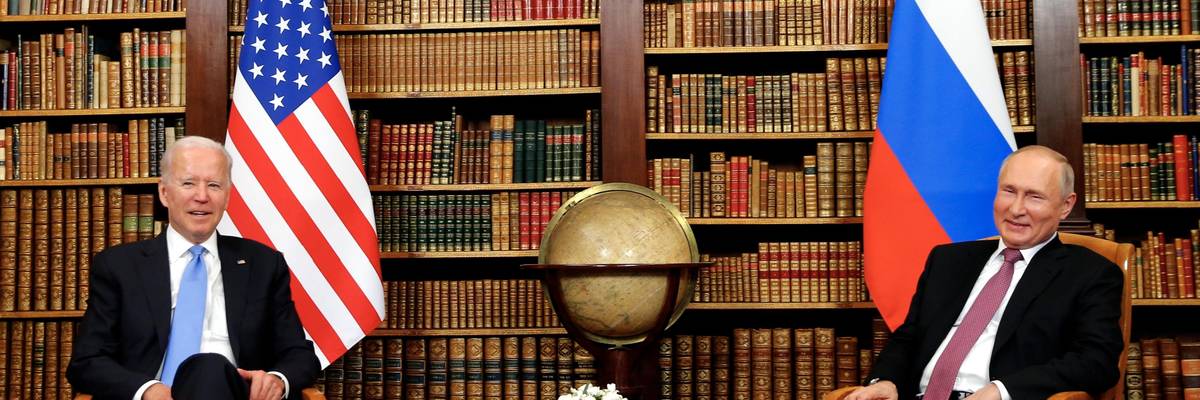
US president Joe Biden (L) and Russia's President Vladimir Putin meet at the start of the U.S.-Russia summit at Villa La Grange on June 16, 2021 in Geneva, Switzerland. (Photo: Denis Balibouse - Pool/Keystone via Getty Images)
Presidents Joe Biden and Vladimir Putin meet Wednesday for a summit that will discuss strategic stability, which includes nuclear weapons. The summit takes place in Geneva, the international city renowned for advancing peace and disarmament, and will be held between two individuals who control 90% of the world's nuclear arsenals.
Right now, the risk of nuclear war is unacceptably high, according to experts such as the Bulletin of Atomic Scientists, the International Committee of the Red Cross, and UN Secretary General Antonio Guterres. Recently, a paper from Stanford University concluded that a child born today has a greater chance of experiencing nuclear war during their lifetime than not.
We must act urgently like our world depends on it, because it does. The only way to eliminate the risk of nuclear use is to eliminate nuclear weapons.
The ongoing nuclear modernization programs, emerging technologies in the military, and increasing hostile rhetoric between nuclear armed states slowly ups the risk of nuclear use, by intent or accident. Even with the world's overall stockpile of nuclear weapons decreasing since 2020, the amount of operationally deployable weapons is growing, according to a new report from the Stockholm International Peace Research Institute. In 2020, the nine nuclear-armed states spent more money than ever on their nuclear arsenals, totalling $73.6 billion. We have been lucky for 75 years, but eventually our luck might run out.
The catastrophic consequences of the COVID-19 pandemic should make us take scientists, doctors, and experts seriously--before the worst happens. No country or group of countries possess any ability to mount an effective humanitarian response to any use of nuclear weapons. Health care systems and infrastructure would collapse. No help would come.
We must act urgently like our world depends on it, because it does. The only way to eliminate the risk of nuclear use is to eliminate nuclear weapons.
This will be the first time the two Presidents meet since Biden took office, and it's being compared to the historic U.S.-Soviet meeting in Geneva that Presidents Reagan and Gorbachev had nearly 40 years ago in November of 1985. That meeting was an important step in the rapprochement of the two countries and was considered a turning point in the Cold War between the Soviet Union and the U.S., leading to a huge reduction of over 80% of global nuclear arsenals.
Nuclear weapons are a considerable problem that requires substantial action. But massive progress is not unprecedented. This week, both countries have the opportunity to make history. The U.S. and Russia must act in accordance with the ever-growing risk of nuclear annihilation and in recognition of the humanitarian consequences of nuclear use to significantly reduce their nuclear arsenals on the road to a world free of nuclear weapons.
They can accomplish this by agreeing to sign the Treaty on the Prohibition of Nuclear Weapons, which bans nuclear weapons under international law. The treaty, which entered into force in January, has been adopted by the majority of states in the world and has the support of international organizations like the United Nations, International Committee of the Red Cross, and World Medical Association.
That's not all. Over 200 cities, like Paris, Washington, Tokyo, and Sydney, support this treaty, along with thousands of elected representatives in parliaments around the world and moral leaders like Pope Francis, Desmund Tutu, and the Dalai Lama. Trade unions, banks, and pension funds are keeping the well-being of their workers in mind by divesting from companies that make nuclear weapons. And of course, most regular people around the world want nuclear weapons to be banned.
As Putin and Biden meet in beautiful Geneva, they should remember the destruction and horror in Hiroshima and Nagasaki over 75 years ago, and commit to working to ban and eliminate nuclear weapons before such a tragedy happens again.
Dear Common Dreams reader, It’s been nearly 30 years since I co-founded Common Dreams with my late wife, Lina Newhouser. We had the radical notion that journalism should serve the public good, not corporate profits. It was clear to us from the outset what it would take to build such a project. No paid advertisements. No corporate sponsors. No millionaire publisher telling us what to think or do. Many people said we wouldn't last a year, but we proved those doubters wrong. Together with a tremendous team of journalists and dedicated staff, we built an independent media outlet free from the constraints of profits and corporate control. Our mission has always been simple: To inform. To inspire. To ignite change for the common good. Building Common Dreams was not easy. Our survival was never guaranteed. When you take on the most powerful forces—Wall Street greed, fossil fuel industry destruction, Big Tech lobbyists, and uber-rich oligarchs who have spent billions upon billions rigging the economy and democracy in their favor—the only bulwark you have is supporters who believe in your work. But here’s the urgent message from me today. It's never been this bad out there. And it's never been this hard to keep us going. At the very moment Common Dreams is most needed, the threats we face are intensifying. We need your support now more than ever. We don't accept corporate advertising and never will. We don't have a paywall because we don't think people should be blocked from critical news based on their ability to pay. Everything we do is funded by the donations of readers like you. When everyone does the little they can afford, we are strong. But if that support retreats or dries up, so do we. Will you donate now to make sure Common Dreams not only survives but thrives? —Craig Brown, Co-founder |
Presidents Joe Biden and Vladimir Putin meet Wednesday for a summit that will discuss strategic stability, which includes nuclear weapons. The summit takes place in Geneva, the international city renowned for advancing peace and disarmament, and will be held between two individuals who control 90% of the world's nuclear arsenals.
Right now, the risk of nuclear war is unacceptably high, according to experts such as the Bulletin of Atomic Scientists, the International Committee of the Red Cross, and UN Secretary General Antonio Guterres. Recently, a paper from Stanford University concluded that a child born today has a greater chance of experiencing nuclear war during their lifetime than not.
We must act urgently like our world depends on it, because it does. The only way to eliminate the risk of nuclear use is to eliminate nuclear weapons.
The ongoing nuclear modernization programs, emerging technologies in the military, and increasing hostile rhetoric between nuclear armed states slowly ups the risk of nuclear use, by intent or accident. Even with the world's overall stockpile of nuclear weapons decreasing since 2020, the amount of operationally deployable weapons is growing, according to a new report from the Stockholm International Peace Research Institute. In 2020, the nine nuclear-armed states spent more money than ever on their nuclear arsenals, totalling $73.6 billion. We have been lucky for 75 years, but eventually our luck might run out.
The catastrophic consequences of the COVID-19 pandemic should make us take scientists, doctors, and experts seriously--before the worst happens. No country or group of countries possess any ability to mount an effective humanitarian response to any use of nuclear weapons. Health care systems and infrastructure would collapse. No help would come.
We must act urgently like our world depends on it, because it does. The only way to eliminate the risk of nuclear use is to eliminate nuclear weapons.
This will be the first time the two Presidents meet since Biden took office, and it's being compared to the historic U.S.-Soviet meeting in Geneva that Presidents Reagan and Gorbachev had nearly 40 years ago in November of 1985. That meeting was an important step in the rapprochement of the two countries and was considered a turning point in the Cold War between the Soviet Union and the U.S., leading to a huge reduction of over 80% of global nuclear arsenals.
Nuclear weapons are a considerable problem that requires substantial action. But massive progress is not unprecedented. This week, both countries have the opportunity to make history. The U.S. and Russia must act in accordance with the ever-growing risk of nuclear annihilation and in recognition of the humanitarian consequences of nuclear use to significantly reduce their nuclear arsenals on the road to a world free of nuclear weapons.
They can accomplish this by agreeing to sign the Treaty on the Prohibition of Nuclear Weapons, which bans nuclear weapons under international law. The treaty, which entered into force in January, has been adopted by the majority of states in the world and has the support of international organizations like the United Nations, International Committee of the Red Cross, and World Medical Association.
That's not all. Over 200 cities, like Paris, Washington, Tokyo, and Sydney, support this treaty, along with thousands of elected representatives in parliaments around the world and moral leaders like Pope Francis, Desmund Tutu, and the Dalai Lama. Trade unions, banks, and pension funds are keeping the well-being of their workers in mind by divesting from companies that make nuclear weapons. And of course, most regular people around the world want nuclear weapons to be banned.
As Putin and Biden meet in beautiful Geneva, they should remember the destruction and horror in Hiroshima and Nagasaki over 75 years ago, and commit to working to ban and eliminate nuclear weapons before such a tragedy happens again.
Presidents Joe Biden and Vladimir Putin meet Wednesday for a summit that will discuss strategic stability, which includes nuclear weapons. The summit takes place in Geneva, the international city renowned for advancing peace and disarmament, and will be held between two individuals who control 90% of the world's nuclear arsenals.
Right now, the risk of nuclear war is unacceptably high, according to experts such as the Bulletin of Atomic Scientists, the International Committee of the Red Cross, and UN Secretary General Antonio Guterres. Recently, a paper from Stanford University concluded that a child born today has a greater chance of experiencing nuclear war during their lifetime than not.
We must act urgently like our world depends on it, because it does. The only way to eliminate the risk of nuclear use is to eliminate nuclear weapons.
The ongoing nuclear modernization programs, emerging technologies in the military, and increasing hostile rhetoric between nuclear armed states slowly ups the risk of nuclear use, by intent or accident. Even with the world's overall stockpile of nuclear weapons decreasing since 2020, the amount of operationally deployable weapons is growing, according to a new report from the Stockholm International Peace Research Institute. In 2020, the nine nuclear-armed states spent more money than ever on their nuclear arsenals, totalling $73.6 billion. We have been lucky for 75 years, but eventually our luck might run out.
The catastrophic consequences of the COVID-19 pandemic should make us take scientists, doctors, and experts seriously--before the worst happens. No country or group of countries possess any ability to mount an effective humanitarian response to any use of nuclear weapons. Health care systems and infrastructure would collapse. No help would come.
We must act urgently like our world depends on it, because it does. The only way to eliminate the risk of nuclear use is to eliminate nuclear weapons.
This will be the first time the two Presidents meet since Biden took office, and it's being compared to the historic U.S.-Soviet meeting in Geneva that Presidents Reagan and Gorbachev had nearly 40 years ago in November of 1985. That meeting was an important step in the rapprochement of the two countries and was considered a turning point in the Cold War between the Soviet Union and the U.S., leading to a huge reduction of over 80% of global nuclear arsenals.
Nuclear weapons are a considerable problem that requires substantial action. But massive progress is not unprecedented. This week, both countries have the opportunity to make history. The U.S. and Russia must act in accordance with the ever-growing risk of nuclear annihilation and in recognition of the humanitarian consequences of nuclear use to significantly reduce their nuclear arsenals on the road to a world free of nuclear weapons.
They can accomplish this by agreeing to sign the Treaty on the Prohibition of Nuclear Weapons, which bans nuclear weapons under international law. The treaty, which entered into force in January, has been adopted by the majority of states in the world and has the support of international organizations like the United Nations, International Committee of the Red Cross, and World Medical Association.
That's not all. Over 200 cities, like Paris, Washington, Tokyo, and Sydney, support this treaty, along with thousands of elected representatives in parliaments around the world and moral leaders like Pope Francis, Desmund Tutu, and the Dalai Lama. Trade unions, banks, and pension funds are keeping the well-being of their workers in mind by divesting from companies that make nuclear weapons. And of course, most regular people around the world want nuclear weapons to be banned.
As Putin and Biden meet in beautiful Geneva, they should remember the destruction and horror in Hiroshima and Nagasaki over 75 years ago, and commit to working to ban and eliminate nuclear weapons before such a tragedy happens again.