

SUBSCRIBE TO OUR FREE NEWSLETTER
Daily news & progressive opinion—funded by the people, not the corporations—delivered straight to your inbox.
5
#000000
#FFFFFF
To donate by check, phone, or other method, see our More Ways to Give page.
Daily news & progressive opinion—funded by the people, not the corporations—delivered straight to your inbox.
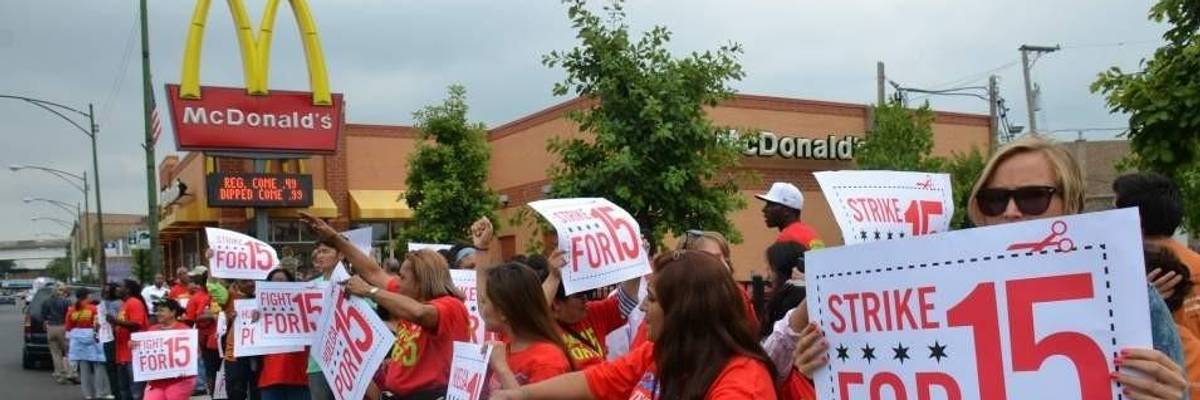
Workers and allies demanding a $15 an hour wage stage a protest outside a McDonald's restaurant. (Photo: Steve Rhodes/flickr/cc)
McDonald's workers in 15 U.S. cities recently staged a weeklong strike demanding a $15 hourly wage for every McDonald's worker. McDonald's resisted, pledging only to raise average wages to $13 an hour.
In the meantime, the profits keep rolling in. The fast-food giant registered $4.7 billion in 2020 earnings. CEO Chris Kempczinski personally pocketed $10.8 million last year, 1,189 times more than the $9,124 that went to the company's median worker.
The fast-food giant registered $4.7 billion in 2020 earnings. CEO Chris Kempczinski personally pocketed $10.8 million last year, 1,189 times more than the $9,124 that went to the company's median worker.
Executives at McDonald's seem to think they can outlast the Fight for $15 campaign. More to the point, they think they know everything. Nothing happens at Mickey D's without incredibly intensive market research: "Plan, test, feedback, tweak, repeat." More hours may go into planning the launch of a new McDonald's menu item than Ike marshaled planning the D-Day invasion.
All this planning has McDonald's executives supremely confident about their business know-how. But, in fact, these execs do not know their business inside-out. They don't know their workers.
Workers remain, for McDonald's executive class, a disposable item. Why pay them decently? If some workers feel underpaid and overstressed, the McDonald's corporate attitude has historically been "good riddance to them." Turnover at McDonald's was running at an annual rate of 150 percent before the pandemic.
The entire fast-food industry rests on a low-wage, high-turnover foundation. And at those rare moments--like this spring--when new workers seem harder to find, the industry starts expecting its politician pals to cut away at jobless benefits and force workers to take positions that don't pay a living wage.
But if leaders were really doing their research, they'd learn very quickly that this makes no sense. Instead of treating workers as disposable and replaceable, businesses ought to be treating them as partners.
Who says? The Harvard Business Review, hardly a haven for anti-corporate sloganeering. Employee ownership, the journal concluded recently, "can reduce inequality and improve productivity."
Thomas Dudley and Ethan Rouen reviewed a host of studies on enterprises where employees hold at least 30 percent of their company's shares. These companies are more productive and grow faster than their counterparts, Dudley and Rouen found. Cooperatives are also less likely to go out of business.
Enterprises with at least a 30-percent employee ownership share currently employ about 1.5 million U.S. workers, just under 1 percent of the nation's total workforce. If we raise that number to 30 percent, Dudley and Rouen calculate, the bottom half of Americans would see their share of national wealth more than quadruple.
Elsewhere, enterprises with 100-percent employee ownership already exist. Spain's Mondragon cooperatives, the New York Times noted earlier this year, have flourished since the 1950s. They aim "not to lavish dividends on shareholders or shower stock options on executives, but to preserve paychecks."
At each of Mondragon's 96 cooperative enterprises, executives make no more than six times what workers in the network's Spanish co-ops make. In the United States, the typical rate runs well over 300 to 1.
We're not talking artsy-crafty boutiques here. Mondragon co-ops, including one of Spain's largest grocery chains, currently employ 70,000 people in the country.
Mondragon has had a particularly powerful impact on the Basque region in Spain, the network's home base. By one standard measure, the Basque region currently ranks as one of the most egalitarian political areas on Earth.
"We want to transform our society," Mondragon International president Josu Ugarte told me in a 2016 interview. "We want to have a more equal society."
So do workers at McDonald's.
Dear Common Dreams reader, It’s been nearly 30 years since I co-founded Common Dreams with my late wife, Lina Newhouser. We had the radical notion that journalism should serve the public good, not corporate profits. It was clear to us from the outset what it would take to build such a project. No paid advertisements. No corporate sponsors. No millionaire publisher telling us what to think or do. Many people said we wouldn't last a year, but we proved those doubters wrong. Together with a tremendous team of journalists and dedicated staff, we built an independent media outlet free from the constraints of profits and corporate control. Our mission has always been simple: To inform. To inspire. To ignite change for the common good. Building Common Dreams was not easy. Our survival was never guaranteed. When you take on the most powerful forces—Wall Street greed, fossil fuel industry destruction, Big Tech lobbyists, and uber-rich oligarchs who have spent billions upon billions rigging the economy and democracy in their favor—the only bulwark you have is supporters who believe in your work. But here’s the urgent message from me today. It's never been this bad out there. And it's never been this hard to keep us going. At the very moment Common Dreams is most needed, the threats we face are intensifying. We need your support now more than ever. We don't accept corporate advertising and never will. We don't have a paywall because we don't think people should be blocked from critical news based on their ability to pay. Everything we do is funded by the donations of readers like you. When everyone does the little they can afford, we are strong. But if that support retreats or dries up, so do we. Will you donate now to make sure Common Dreams not only survives but thrives? —Craig Brown, Co-founder |
McDonald's workers in 15 U.S. cities recently staged a weeklong strike demanding a $15 hourly wage for every McDonald's worker. McDonald's resisted, pledging only to raise average wages to $13 an hour.
In the meantime, the profits keep rolling in. The fast-food giant registered $4.7 billion in 2020 earnings. CEO Chris Kempczinski personally pocketed $10.8 million last year, 1,189 times more than the $9,124 that went to the company's median worker.
The fast-food giant registered $4.7 billion in 2020 earnings. CEO Chris Kempczinski personally pocketed $10.8 million last year, 1,189 times more than the $9,124 that went to the company's median worker.
Executives at McDonald's seem to think they can outlast the Fight for $15 campaign. More to the point, they think they know everything. Nothing happens at Mickey D's without incredibly intensive market research: "Plan, test, feedback, tweak, repeat." More hours may go into planning the launch of a new McDonald's menu item than Ike marshaled planning the D-Day invasion.
All this planning has McDonald's executives supremely confident about their business know-how. But, in fact, these execs do not know their business inside-out. They don't know their workers.
Workers remain, for McDonald's executive class, a disposable item. Why pay them decently? If some workers feel underpaid and overstressed, the McDonald's corporate attitude has historically been "good riddance to them." Turnover at McDonald's was running at an annual rate of 150 percent before the pandemic.
The entire fast-food industry rests on a low-wage, high-turnover foundation. And at those rare moments--like this spring--when new workers seem harder to find, the industry starts expecting its politician pals to cut away at jobless benefits and force workers to take positions that don't pay a living wage.
But if leaders were really doing their research, they'd learn very quickly that this makes no sense. Instead of treating workers as disposable and replaceable, businesses ought to be treating them as partners.
Who says? The Harvard Business Review, hardly a haven for anti-corporate sloganeering. Employee ownership, the journal concluded recently, "can reduce inequality and improve productivity."
Thomas Dudley and Ethan Rouen reviewed a host of studies on enterprises where employees hold at least 30 percent of their company's shares. These companies are more productive and grow faster than their counterparts, Dudley and Rouen found. Cooperatives are also less likely to go out of business.
Enterprises with at least a 30-percent employee ownership share currently employ about 1.5 million U.S. workers, just under 1 percent of the nation's total workforce. If we raise that number to 30 percent, Dudley and Rouen calculate, the bottom half of Americans would see their share of national wealth more than quadruple.
Elsewhere, enterprises with 100-percent employee ownership already exist. Spain's Mondragon cooperatives, the New York Times noted earlier this year, have flourished since the 1950s. They aim "not to lavish dividends on shareholders or shower stock options on executives, but to preserve paychecks."
At each of Mondragon's 96 cooperative enterprises, executives make no more than six times what workers in the network's Spanish co-ops make. In the United States, the typical rate runs well over 300 to 1.
We're not talking artsy-crafty boutiques here. Mondragon co-ops, including one of Spain's largest grocery chains, currently employ 70,000 people in the country.
Mondragon has had a particularly powerful impact on the Basque region in Spain, the network's home base. By one standard measure, the Basque region currently ranks as one of the most egalitarian political areas on Earth.
"We want to transform our society," Mondragon International president Josu Ugarte told me in a 2016 interview. "We want to have a more equal society."
So do workers at McDonald's.
McDonald's workers in 15 U.S. cities recently staged a weeklong strike demanding a $15 hourly wage for every McDonald's worker. McDonald's resisted, pledging only to raise average wages to $13 an hour.
In the meantime, the profits keep rolling in. The fast-food giant registered $4.7 billion in 2020 earnings. CEO Chris Kempczinski personally pocketed $10.8 million last year, 1,189 times more than the $9,124 that went to the company's median worker.
The fast-food giant registered $4.7 billion in 2020 earnings. CEO Chris Kempczinski personally pocketed $10.8 million last year, 1,189 times more than the $9,124 that went to the company's median worker.
Executives at McDonald's seem to think they can outlast the Fight for $15 campaign. More to the point, they think they know everything. Nothing happens at Mickey D's without incredibly intensive market research: "Plan, test, feedback, tweak, repeat." More hours may go into planning the launch of a new McDonald's menu item than Ike marshaled planning the D-Day invasion.
All this planning has McDonald's executives supremely confident about their business know-how. But, in fact, these execs do not know their business inside-out. They don't know their workers.
Workers remain, for McDonald's executive class, a disposable item. Why pay them decently? If some workers feel underpaid and overstressed, the McDonald's corporate attitude has historically been "good riddance to them." Turnover at McDonald's was running at an annual rate of 150 percent before the pandemic.
The entire fast-food industry rests on a low-wage, high-turnover foundation. And at those rare moments--like this spring--when new workers seem harder to find, the industry starts expecting its politician pals to cut away at jobless benefits and force workers to take positions that don't pay a living wage.
But if leaders were really doing their research, they'd learn very quickly that this makes no sense. Instead of treating workers as disposable and replaceable, businesses ought to be treating them as partners.
Who says? The Harvard Business Review, hardly a haven for anti-corporate sloganeering. Employee ownership, the journal concluded recently, "can reduce inequality and improve productivity."
Thomas Dudley and Ethan Rouen reviewed a host of studies on enterprises where employees hold at least 30 percent of their company's shares. These companies are more productive and grow faster than their counterparts, Dudley and Rouen found. Cooperatives are also less likely to go out of business.
Enterprises with at least a 30-percent employee ownership share currently employ about 1.5 million U.S. workers, just under 1 percent of the nation's total workforce. If we raise that number to 30 percent, Dudley and Rouen calculate, the bottom half of Americans would see their share of national wealth more than quadruple.
Elsewhere, enterprises with 100-percent employee ownership already exist. Spain's Mondragon cooperatives, the New York Times noted earlier this year, have flourished since the 1950s. They aim "not to lavish dividends on shareholders or shower stock options on executives, but to preserve paychecks."
At each of Mondragon's 96 cooperative enterprises, executives make no more than six times what workers in the network's Spanish co-ops make. In the United States, the typical rate runs well over 300 to 1.
We're not talking artsy-crafty boutiques here. Mondragon co-ops, including one of Spain's largest grocery chains, currently employ 70,000 people in the country.
Mondragon has had a particularly powerful impact on the Basque region in Spain, the network's home base. By one standard measure, the Basque region currently ranks as one of the most egalitarian political areas on Earth.
"We want to transform our society," Mondragon International president Josu Ugarte told me in a 2016 interview. "We want to have a more equal society."
So do workers at McDonald's.

