SUBSCRIBE TO OUR FREE NEWSLETTER
Daily news & progressive opinion—funded by the people, not the corporations—delivered straight to your inbox.
5
#000000
#FFFFFF
To donate by check, phone, or other method, see our More Ways to Give page.
Daily news & progressive opinion—funded by the people, not the corporations—delivered straight to your inbox.
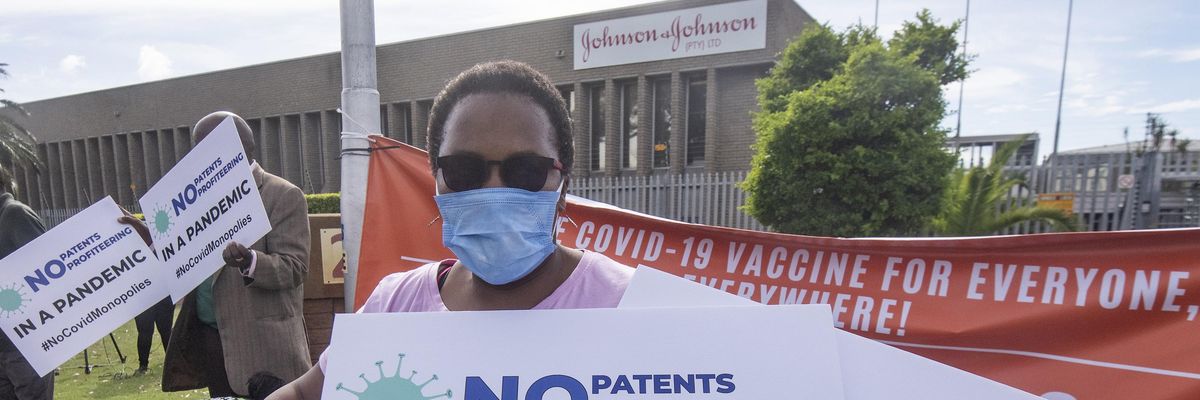
Protesters picket outside Johnson & Johnson Offices during the Global Day Of Action For A People's Vaccine on March 11, 2021 in Cape Town, South Africa. The group demanded that governments suspend patent rules at the World Trade Organization on COVID-19 vaccines. (Photo: Brenton Geach/Getty Images)
The U.S. surprised the world last week by throwing its weight behind waiving intellectual property rights for COVID-19 vaccines. Under pressure to respond similarly, Prime Minister Justin Trudeau said: "I can assure you Canada is not interfering or blocking. Canada is very much working to find a solution."
This is typical non-confrontational Canadian prevarication. "Not blocking" in this case still functions as a block.
Callous capitalism dictates that we get what we pay for. Ergo, the rich get more, the poor ... bring their suffering on themselves. The proposal to waive certain patents on vaccines and medicines was brought forward in October by South Africa and India, well before any vaccines had been approved to prevent COVID-19. It has the support of some 100 nations, but the World Trade Organization works by "consensus," meaning every one of its 164 members has to agree to the proposal. If you're ever looking for the quintessential definition of structural discrimination, this is it. Create a coalition in the name of progress, but build in foundational structural barriers to equal access.
All this is happening against the backdrop of rich nations over-ordering vaccines, hoarding them, while blocking badly hit poor nations from accessing them.
By some counts, Canada has ordered enough vaccines to inoculate our population four times over. Meanwhile, where the virus feasts on humans, it continues to mutate dangerously making life unsafe for all -- and exposing our myopic decision-making in the bargain.
So when Trudeau says he wants Canada to play mediator, to bring about a balance between protecting companies and improving vaccine access to poorer countries, he's talking about a balance between profit and life. "Our" profit, "their" lives.
Callous capitalism dictates that we get what we pay for. Ergo, the rich get more, the poor ... bring their suffering on themselves.
Except, the pharmaceutical companies claiming ownership to the recipes to the vaccines didn't even bring these products to the market with their own funds. The COVID-19 vaccine production process fails its own capitalist sniff test.
As intellectual property rights expert Achal Prabhala outlines on The Dig podcast, the U.S. and other rich nations gave companies such as Pfizer, Moderna, AstraZeneca billions of dollars -- billions -- in no-strings-attached grants to do the research, meaning no risk to the companies if they failed. Then they paid the companies billions of dollars -- billions -- in preorders so the companies were guaranteed buyers even before coming into the market. Now, they enjoy a global monopoly -- largely funded by taxpayer labor.
As a result, poorer countries might not get vaccinated until 2023, according to some estimates.
We've seen this circus before with the same criminal consequences.
In 1996, antiviral therapy for HIV/AIDS was developed but was inaccessible to about 95 percent of the world's people living with HIV, according to The Lancet.
That's because one year prior, the creation of the World Trade Organization allowed companies to turn what were domestic patents into global ones. Nongeneric drugs cost about $10,000 a year at the turn of the century and were well out of the reach of many people. Calls for affordable generic antiretroviral drugs met by threats and lawsuits from pharmaceutical corporations. It took years to battle monopoly rights and finally make therapy affordable.
Meanwhile, people simply died.
In the case of smallpox, another deadly disease eradicated from the West but ravaging the developing world, it took a 1965 pledge by then U.S. President Lyndon Johnson to fund a program to wipe the disease off the Earth.
What about COVAX, the COVID-19 Vaccines Global Access program, that is supposed to offer equitable access to vaccines? The U.S. and G7 nations committed to vaccinating at least 20 percent of developing countries by the end of 2021, but herd immunity requires 70 to 85 percent of the people to be vaccinated.
COVAX is so underfunded the vaccines don't even reach front-line workers in poor countries. It has also been undermined by rich nations that jumped to the front of the queue by striking their own bilateral deals with pharmaceutical companies.
Opposition to the patent waiver has come with healthy doses of paternalism: Is this really the answer to the problem? Nations outside the U.S. and Europe don't have the know-how to produce it. The waiver process is so long, it's not worth it. And so it goes.
Look deeper and it gets messier.
The Indian government halted all exports of vaccines to combat its own deadly surge, leaving 91 countries depending on it in the lurch. "This colossal mess was entirely predictable, and could have been avoided at every turn," Prabhala and pharmaceutical lawyer Leena Menghaney wrote in The Guardian. If only rich nations had nipped vaccine monopolies in the bud, they say.
Meanwhile, thousands die of this disease, daily. The patents remain in place. Canada is still "considering" supporting the waiver.
This country and this world are at a monumental crossroads. US voters have an opportunity to beat back the forces of fascism and confront the billionaires who are rigging the economy, our media system, and our democracy, making it increasingly impossible for ordinary people to get by. We’re not just talking about the election. We’re talking about what must be done once these fascist elements are vanquished from power. We need a bolder set of solutions than what either major party has so far been willing to offer and a working-class movement ready to fight like hell for it. Trump didn't emerge from nowhere. The conditions that fueled MAGA authoritarianism were created by decades of radical neoliberal economic policies and a corrupt political system dominated by corporate interests. They slashed taxes on the super-rich, promising that the benefits would trickle down. They said giveaways to the corporate titans would make life more affordable for the rest of us. It was all bullshit. And when a bitter, betrayed populace searches for someone to blame, right-wing demagogues have little trouble finding scapegoats. People know when they're being lied to, but you won't hear any of this from the corporate media. Only independent journalism—powered and funded by people who believe in building a better world—can deliver truly trustworthy daily news. If you share our vision, please contribute whatever you can to sustain our work. |
The U.S. surprised the world last week by throwing its weight behind waiving intellectual property rights for COVID-19 vaccines. Under pressure to respond similarly, Prime Minister Justin Trudeau said: "I can assure you Canada is not interfering or blocking. Canada is very much working to find a solution."
This is typical non-confrontational Canadian prevarication. "Not blocking" in this case still functions as a block.
Callous capitalism dictates that we get what we pay for. Ergo, the rich get more, the poor ... bring their suffering on themselves. The proposal to waive certain patents on vaccines and medicines was brought forward in October by South Africa and India, well before any vaccines had been approved to prevent COVID-19. It has the support of some 100 nations, but the World Trade Organization works by "consensus," meaning every one of its 164 members has to agree to the proposal. If you're ever looking for the quintessential definition of structural discrimination, this is it. Create a coalition in the name of progress, but build in foundational structural barriers to equal access.
All this is happening against the backdrop of rich nations over-ordering vaccines, hoarding them, while blocking badly hit poor nations from accessing them.
By some counts, Canada has ordered enough vaccines to inoculate our population four times over. Meanwhile, where the virus feasts on humans, it continues to mutate dangerously making life unsafe for all -- and exposing our myopic decision-making in the bargain.
So when Trudeau says he wants Canada to play mediator, to bring about a balance between protecting companies and improving vaccine access to poorer countries, he's talking about a balance between profit and life. "Our" profit, "their" lives.
Callous capitalism dictates that we get what we pay for. Ergo, the rich get more, the poor ... bring their suffering on themselves.
Except, the pharmaceutical companies claiming ownership to the recipes to the vaccines didn't even bring these products to the market with their own funds. The COVID-19 vaccine production process fails its own capitalist sniff test.
As intellectual property rights expert Achal Prabhala outlines on The Dig podcast, the U.S. and other rich nations gave companies such as Pfizer, Moderna, AstraZeneca billions of dollars -- billions -- in no-strings-attached grants to do the research, meaning no risk to the companies if they failed. Then they paid the companies billions of dollars -- billions -- in preorders so the companies were guaranteed buyers even before coming into the market. Now, they enjoy a global monopoly -- largely funded by taxpayer labor.
As a result, poorer countries might not get vaccinated until 2023, according to some estimates.
We've seen this circus before with the same criminal consequences.
In 1996, antiviral therapy for HIV/AIDS was developed but was inaccessible to about 95 percent of the world's people living with HIV, according to The Lancet.
That's because one year prior, the creation of the World Trade Organization allowed companies to turn what were domestic patents into global ones. Nongeneric drugs cost about $10,000 a year at the turn of the century and were well out of the reach of many people. Calls for affordable generic antiretroviral drugs met by threats and lawsuits from pharmaceutical corporations. It took years to battle monopoly rights and finally make therapy affordable.
Meanwhile, people simply died.
In the case of smallpox, another deadly disease eradicated from the West but ravaging the developing world, it took a 1965 pledge by then U.S. President Lyndon Johnson to fund a program to wipe the disease off the Earth.
What about COVAX, the COVID-19 Vaccines Global Access program, that is supposed to offer equitable access to vaccines? The U.S. and G7 nations committed to vaccinating at least 20 percent of developing countries by the end of 2021, but herd immunity requires 70 to 85 percent of the people to be vaccinated.
COVAX is so underfunded the vaccines don't even reach front-line workers in poor countries. It has also been undermined by rich nations that jumped to the front of the queue by striking their own bilateral deals with pharmaceutical companies.
Opposition to the patent waiver has come with healthy doses of paternalism: Is this really the answer to the problem? Nations outside the U.S. and Europe don't have the know-how to produce it. The waiver process is so long, it's not worth it. And so it goes.
Look deeper and it gets messier.
The Indian government halted all exports of vaccines to combat its own deadly surge, leaving 91 countries depending on it in the lurch. "This colossal mess was entirely predictable, and could have been avoided at every turn," Prabhala and pharmaceutical lawyer Leena Menghaney wrote in The Guardian. If only rich nations had nipped vaccine monopolies in the bud, they say.
Meanwhile, thousands die of this disease, daily. The patents remain in place. Canada is still "considering" supporting the waiver.