SUBSCRIBE TO OUR FREE NEWSLETTER
Daily news & progressive opinion—funded by the people, not the corporations—delivered straight to your inbox.
5
#000000
#FFFFFF
To donate by check, phone, or other method, see our More Ways to Give page.
Daily news & progressive opinion—funded by the people, not the corporations—delivered straight to your inbox.
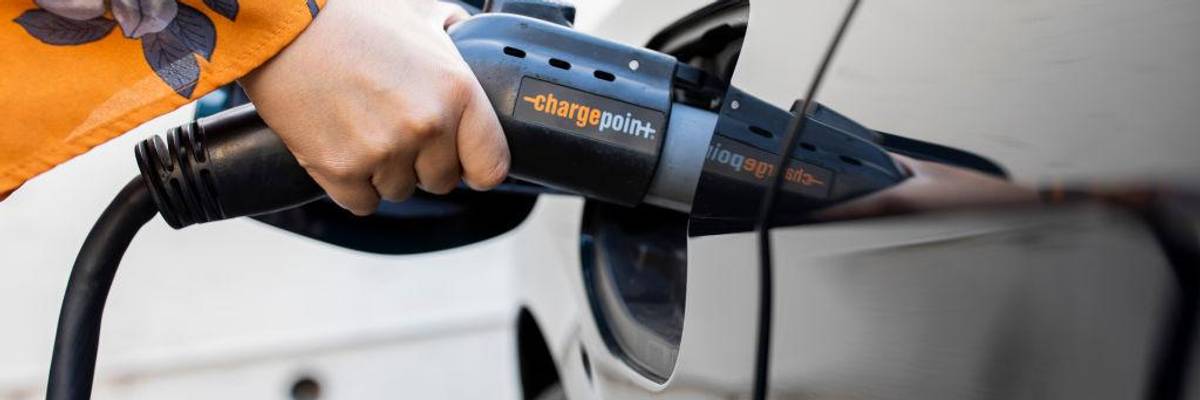
A portrait of Maya Katz-Ali with her new car charging at a station along Lakeshore Avenue, Tuesday, Nov. 10, 2020, in Oakland, Calif. Katz-Ali recently bought the electric car with the help of an incentive through the state's Clean Cars for All program, which is designed to help Californians from diverse backgrounds purchase zero-emissions vehicles. (Photo: Santiago Mejia/The San Francisco Chronicle via Getty Images)
America is about to revive an idea that was left for dead decades ago. It's called industrial policy, and it's at the heart of Joe Biden's plans to restructure the U.S. economy.
The dirty little secret is that America already has an industrial policy, but one that's focused on pumping up profits with industry-specific subsidies, tax loopholes and credits, bailouts, and tariffs.
When industrial policy was last debated in the 1980s, critics recoiled from government "picking winners." But times have changed. Devastating climate change, a deadly pandemic, and the rise of China as a technological powerhouse require an active government pushing the private sector to achieve public purposes.
The dirty little secret is that America already has an industrial policy, but one that's focused on pumping up profits with industry-specific subsidies, tax loopholes and credits, bailouts, and tariffs. The practical choice isn't whether to have an industrial policy but whether it meets society's needs or those of politically powerful industries.
Consider energy. The fossil fuel industry has accumulated "billions of dollars in subsidies, loopholes, and special foreign tax credits," in Biden's words. He intends to eliminate these and shift to non-carbon energy by strengthening the nation's electrical grid, creating a new "clean electricity standard" that will force utilities to end carbon emissions by 2035 and providing research support and tax credits for clean energy.
It's a sensible 180-degree shift of industrial policy.
The old industrial policy for the automobile industry consisted largely of bailouts--of Chrysler in 1979 and General Motors and Chrysler in 2008.
Biden intends to shift away from gas-powered cars entirely and invest $174 billion in companies making electric vehicles. He'll also create 500,000 new charging stations.
This also makes sense. Notwithstanding the success of Tesla, which received $2.44 billion in government subsidies before becoming profitable, the switch to electric vehicles still needs pump priming.
Internet service providers have been subsidized by the states and the federal government, and federal regulators have allowed them to consolidate into a few telecom giants. But they've dragged their feet on upgrading copper networks with fiber, some 30 million Americans still lack access to high-speed broadband, and America has among the world's highest prices for internet service.
Biden intends to invest $100 billion to extend high-speed broadband coverage. He also threatens to "hold providers accountable," for their sky-high prices--suggesting either price controls or antitrust enforcement.
I hope he follows through. A proper industrial policy requires that industries receiving public benefits act in the public interest.
The pharmaceutical industry exemplifies the old industrial policy at its worst. Big Pharma's basic research has been subsidized through the National Institutes of Health. Medicare, Medicaid, and the Affordable Care Act bankroll much of its production costs. The industry has barred Americans from buying drugs from abroad. Yet Americans pay among the highest drug prices in the world.
Biden intends to invest an additional $30 billion to reduce the risk of future pandemics--replenishing the national stockpile of vaccines and therapeutics, accelerating the timeline for drug development, and boosting domestic production of pharmaceutical ingredients currently made overseas.
That's a good start but he must insist on a more basic and long-overdue quid pro quo from big pharma: allow government to use its bargaining power to restrain drug prices.
A case in point: The U.S. government paid in advance for hundreds of millions of doses of multiple COVID-19 vaccines. The appropriate quid pro quo here is to temporarily waive patents so vaccine manufacturers around the world can quickly ramp up. Americans can't be safe until most of the rest of the world is inoculated.
Some of Biden's emerging industrial policy is coming in response to China. Last week's annual intelligence report from the Office of the Director of National Intelligence warns that Beijing threatens American leadership in an array of emerging technologies.
Expect more subsidies for supercomputers, advanced semiconductors, artificial intelligence, and other technologies linked to national security. These are likely to be embedded in Biden's whopping $715 billion defense budget--larger even than Trump's last defense budget.
Here again, it's old industrial policy versus new. The new should focus on cutting-edge breakthroughs and not be frittered away on pointless projects like the F35 fighter jet. And it should meet human needs rather than add to an overstuffed defense arsenal.
Biden's restructuring of the American economy is necessary. America's old industrial policy was stifling innovation and gauging taxpayers and consumers. The challenges ahead demand a very different economy.
But Biden's new industrial policy must avoid capture by the industries that dominated the old. He needs to be clear about its aims and the expected response from the private sector, and to reframe the debate so it's not about whether government should "pick winners" but what kind industrial policy will help America and much of the world win.
Dear Common Dreams reader, It’s been nearly 30 years since I co-founded Common Dreams with my late wife, Lina Newhouser. We had the radical notion that journalism should serve the public good, not corporate profits. It was clear to us from the outset what it would take to build such a project. No paid advertisements. No corporate sponsors. No millionaire publisher telling us what to think or do. Many people said we wouldn't last a year, but we proved those doubters wrong. Together with a tremendous team of journalists and dedicated staff, we built an independent media outlet free from the constraints of profits and corporate control. Our mission has always been simple: To inform. To inspire. To ignite change for the common good. Building Common Dreams was not easy. Our survival was never guaranteed. When you take on the most powerful forces—Wall Street greed, fossil fuel industry destruction, Big Tech lobbyists, and uber-rich oligarchs who have spent billions upon billions rigging the economy and democracy in their favor—the only bulwark you have is supporters who believe in your work. But here’s the urgent message from me today. It's never been this bad out there. And it's never been this hard to keep us going. At the very moment Common Dreams is most needed, the threats we face are intensifying. We need your support now more than ever. We don't accept corporate advertising and never will. We don't have a paywall because we don't think people should be blocked from critical news based on their ability to pay. Everything we do is funded by the donations of readers like you. When everyone does the little they can afford, we are strong. But if that support retreats or dries up, so do we. Will you donate now to make sure Common Dreams not only survives but thrives? —Craig Brown, Co-founder |
America is about to revive an idea that was left for dead decades ago. It's called industrial policy, and it's at the heart of Joe Biden's plans to restructure the U.S. economy.
The dirty little secret is that America already has an industrial policy, but one that's focused on pumping up profits with industry-specific subsidies, tax loopholes and credits, bailouts, and tariffs.
When industrial policy was last debated in the 1980s, critics recoiled from government "picking winners." But times have changed. Devastating climate change, a deadly pandemic, and the rise of China as a technological powerhouse require an active government pushing the private sector to achieve public purposes.
The dirty little secret is that America already has an industrial policy, but one that's focused on pumping up profits with industry-specific subsidies, tax loopholes and credits, bailouts, and tariffs. The practical choice isn't whether to have an industrial policy but whether it meets society's needs or those of politically powerful industries.
Consider energy. The fossil fuel industry has accumulated "billions of dollars in subsidies, loopholes, and special foreign tax credits," in Biden's words. He intends to eliminate these and shift to non-carbon energy by strengthening the nation's electrical grid, creating a new "clean electricity standard" that will force utilities to end carbon emissions by 2035 and providing research support and tax credits for clean energy.
It's a sensible 180-degree shift of industrial policy.
The old industrial policy for the automobile industry consisted largely of bailouts--of Chrysler in 1979 and General Motors and Chrysler in 2008.
Biden intends to shift away from gas-powered cars entirely and invest $174 billion in companies making electric vehicles. He'll also create 500,000 new charging stations.
This also makes sense. Notwithstanding the success of Tesla, which received $2.44 billion in government subsidies before becoming profitable, the switch to electric vehicles still needs pump priming.
Internet service providers have been subsidized by the states and the federal government, and federal regulators have allowed them to consolidate into a few telecom giants. But they've dragged their feet on upgrading copper networks with fiber, some 30 million Americans still lack access to high-speed broadband, and America has among the world's highest prices for internet service.
Biden intends to invest $100 billion to extend high-speed broadband coverage. He also threatens to "hold providers accountable," for their sky-high prices--suggesting either price controls or antitrust enforcement.
I hope he follows through. A proper industrial policy requires that industries receiving public benefits act in the public interest.
The pharmaceutical industry exemplifies the old industrial policy at its worst. Big Pharma's basic research has been subsidized through the National Institutes of Health. Medicare, Medicaid, and the Affordable Care Act bankroll much of its production costs. The industry has barred Americans from buying drugs from abroad. Yet Americans pay among the highest drug prices in the world.
Biden intends to invest an additional $30 billion to reduce the risk of future pandemics--replenishing the national stockpile of vaccines and therapeutics, accelerating the timeline for drug development, and boosting domestic production of pharmaceutical ingredients currently made overseas.
That's a good start but he must insist on a more basic and long-overdue quid pro quo from big pharma: allow government to use its bargaining power to restrain drug prices.
A case in point: The U.S. government paid in advance for hundreds of millions of doses of multiple COVID-19 vaccines. The appropriate quid pro quo here is to temporarily waive patents so vaccine manufacturers around the world can quickly ramp up. Americans can't be safe until most of the rest of the world is inoculated.
Some of Biden's emerging industrial policy is coming in response to China. Last week's annual intelligence report from the Office of the Director of National Intelligence warns that Beijing threatens American leadership in an array of emerging technologies.
Expect more subsidies for supercomputers, advanced semiconductors, artificial intelligence, and other technologies linked to national security. These are likely to be embedded in Biden's whopping $715 billion defense budget--larger even than Trump's last defense budget.
Here again, it's old industrial policy versus new. The new should focus on cutting-edge breakthroughs and not be frittered away on pointless projects like the F35 fighter jet. And it should meet human needs rather than add to an overstuffed defense arsenal.
Biden's restructuring of the American economy is necessary. America's old industrial policy was stifling innovation and gauging taxpayers and consumers. The challenges ahead demand a very different economy.
But Biden's new industrial policy must avoid capture by the industries that dominated the old. He needs to be clear about its aims and the expected response from the private sector, and to reframe the debate so it's not about whether government should "pick winners" but what kind industrial policy will help America and much of the world win.
America is about to revive an idea that was left for dead decades ago. It's called industrial policy, and it's at the heart of Joe Biden's plans to restructure the U.S. economy.
The dirty little secret is that America already has an industrial policy, but one that's focused on pumping up profits with industry-specific subsidies, tax loopholes and credits, bailouts, and tariffs.
When industrial policy was last debated in the 1980s, critics recoiled from government "picking winners." But times have changed. Devastating climate change, a deadly pandemic, and the rise of China as a technological powerhouse require an active government pushing the private sector to achieve public purposes.
The dirty little secret is that America already has an industrial policy, but one that's focused on pumping up profits with industry-specific subsidies, tax loopholes and credits, bailouts, and tariffs. The practical choice isn't whether to have an industrial policy but whether it meets society's needs or those of politically powerful industries.
Consider energy. The fossil fuel industry has accumulated "billions of dollars in subsidies, loopholes, and special foreign tax credits," in Biden's words. He intends to eliminate these and shift to non-carbon energy by strengthening the nation's electrical grid, creating a new "clean electricity standard" that will force utilities to end carbon emissions by 2035 and providing research support and tax credits for clean energy.
It's a sensible 180-degree shift of industrial policy.
The old industrial policy for the automobile industry consisted largely of bailouts--of Chrysler in 1979 and General Motors and Chrysler in 2008.
Biden intends to shift away from gas-powered cars entirely and invest $174 billion in companies making electric vehicles. He'll also create 500,000 new charging stations.
This also makes sense. Notwithstanding the success of Tesla, which received $2.44 billion in government subsidies before becoming profitable, the switch to electric vehicles still needs pump priming.
Internet service providers have been subsidized by the states and the federal government, and federal regulators have allowed them to consolidate into a few telecom giants. But they've dragged their feet on upgrading copper networks with fiber, some 30 million Americans still lack access to high-speed broadband, and America has among the world's highest prices for internet service.
Biden intends to invest $100 billion to extend high-speed broadband coverage. He also threatens to "hold providers accountable," for their sky-high prices--suggesting either price controls or antitrust enforcement.
I hope he follows through. A proper industrial policy requires that industries receiving public benefits act in the public interest.
The pharmaceutical industry exemplifies the old industrial policy at its worst. Big Pharma's basic research has been subsidized through the National Institutes of Health. Medicare, Medicaid, and the Affordable Care Act bankroll much of its production costs. The industry has barred Americans from buying drugs from abroad. Yet Americans pay among the highest drug prices in the world.
Biden intends to invest an additional $30 billion to reduce the risk of future pandemics--replenishing the national stockpile of vaccines and therapeutics, accelerating the timeline for drug development, and boosting domestic production of pharmaceutical ingredients currently made overseas.
That's a good start but he must insist on a more basic and long-overdue quid pro quo from big pharma: allow government to use its bargaining power to restrain drug prices.
A case in point: The U.S. government paid in advance for hundreds of millions of doses of multiple COVID-19 vaccines. The appropriate quid pro quo here is to temporarily waive patents so vaccine manufacturers around the world can quickly ramp up. Americans can't be safe until most of the rest of the world is inoculated.
Some of Biden's emerging industrial policy is coming in response to China. Last week's annual intelligence report from the Office of the Director of National Intelligence warns that Beijing threatens American leadership in an array of emerging technologies.
Expect more subsidies for supercomputers, advanced semiconductors, artificial intelligence, and other technologies linked to national security. These are likely to be embedded in Biden's whopping $715 billion defense budget--larger even than Trump's last defense budget.
Here again, it's old industrial policy versus new. The new should focus on cutting-edge breakthroughs and not be frittered away on pointless projects like the F35 fighter jet. And it should meet human needs rather than add to an overstuffed defense arsenal.
Biden's restructuring of the American economy is necessary. America's old industrial policy was stifling innovation and gauging taxpayers and consumers. The challenges ahead demand a very different economy.
But Biden's new industrial policy must avoid capture by the industries that dominated the old. He needs to be clear about its aims and the expected response from the private sector, and to reframe the debate so it's not about whether government should "pick winners" but what kind industrial policy will help America and much of the world win.