SUBSCRIBE TO OUR FREE NEWSLETTER
Daily news & progressive opinion—funded by the people, not the corporations—delivered straight to your inbox.
5
#000000
#FFFFFF
To donate by check, phone, or other method, see our More Ways to Give page.
Daily news & progressive opinion—funded by the people, not the corporations—delivered straight to your inbox.
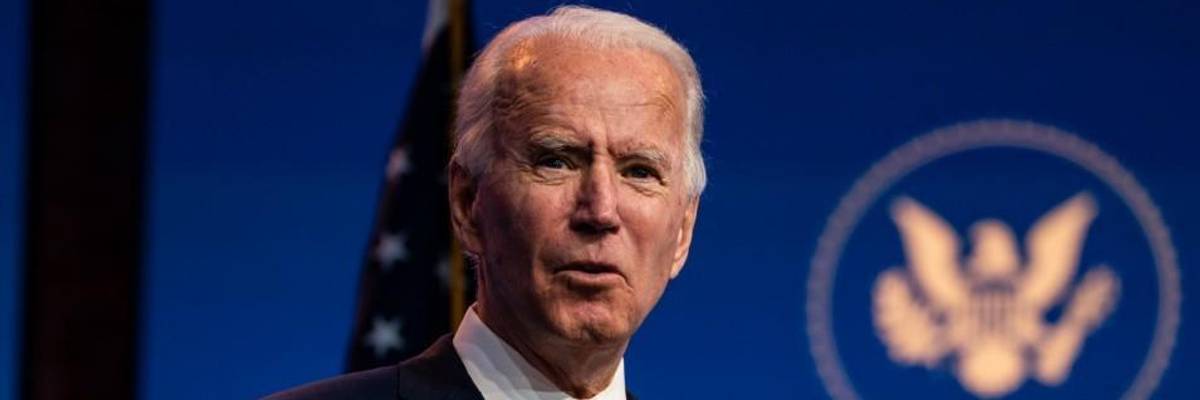
President-elect Joe Biden delivers a remarks on the economic recovery in Wilmington, Delaware on Monday, November 16, 2020. (Photo: Salwan Georges/The Washington Post via Getty Images)
When President Joe Biden rolls out his $3 trillion infrastructure and jobs package, one of the questions he will be asked is, "How will you pay for it?"
Reports indicate that he is considering a "menu of tax options."
Biden would be wise not to fall into the same trap as U.S. Sen. Elizabeth Warren (D-Mass.), who, by dubbing her recent proposal to levy a tax on the wealthy a "wealth tax" and naming her bill the Ultra-Millionaire Tax Act, may have doomed it.
The problem? The word "tax."
Conservatives long ago attached a bevy of negative connotations to the word "tax." And they stuck.
Words matter. They evoke an array of images and emotions, thanks to the power of framing, which as the cognitive linguist George Lakoff has explained is the creation of mental structures that shape the way we see the world. The way lawmakers frame their ideas matters when it comes to garnering support. Why? Because framing focuses the conversation on what the framer wants to highlight. Using the opposition's framing and language means that the driver of the conversation has lost control of the discussion and must play defense from the start.
For two decades, conservatives have successfully cemented in the public discourse that taxes are a burden. In 2001, conservatives in Congress successfully pushed through tax cuts that most benefited high-income taxpayers. Proponents called it the "tax relief bill"--a phrase so ubiquitous that reporters and headline writers used it in news stories--without quotes--stating it as fact, even though the legislation provided little to no relief for most low- and middle-income taxpayers.
What does "relief" imply? That a burden must be lifted.
Conservatives have long vilified taxes as something that punishes self-made millionaires and billionaires--those disciplined and hard-working people who pulled themselves up by their bootstraps and earned their way. The implication is that the poor are lazy and therefore undeserving. According to this view, taxing the wealthy and using the money to help those in need is "wealth redistribution" that borders on the dreaded "S" word, "socialism."
The word "tax," then, carries heavy baggage. Repeating it--even when trying to refute an anti-tax argument--serves only to reinforce that baggage. When people hear the name of Warren's bill or Biden's proposal for paying for a massive investment in the nation's infrastructure, the word that likely will stick in their minds is "tax."
It doesn't matter whether Warren and Biden subsequently explain that their proposals will ensure that the wealthy pay their fair share, narrow the racial wealth gap and level the playing field. Without a different starting point, they are doing the equivalent of building a sleek and powerful ship, then steering it straight into a hurricane. Even if the ship survives the storm, it will be damaged.
This is despite the nationwide popularity among voters of requiring the wealthy to pay their fair share. But congressional lawmakers--the ones who will be deciding on these proposals--rely on the anti-tax conservatives and corporations to help fund their campaigns. They are the ones who need to be convinced otherwise.
Strategic communications strategist Anat Shenker-Osorio points out in "Don't Buy It: The Trouble with Talking Nonsense about the Economy" that "[w]hen we take a 'tax the rich' messaging approach to trying to rectify our deep and damaging inequality, we succeed at one thing for certain. We get people to hate paying taxes even more."
So, what else can a tax be called? Reframing taxes as an investment in public services that we all use or benefit from--such as roads and bridges, water and sewer systems--would be one approach. Merely by talking about infrastructure, Biden is launching a long-overdue national conversation about the public benefits for which Treasury money can be used.
Will a change in rhetoric really make stalwart GOP lawmakers soften? Some may think it unlikely, but we have seen GOP support over the past year for policies that, absent the pandemic, never would have gained traction, such as for a federal moratorium on evictions and higher unemployment benefits.
If investment in the country were the focus of editorials, political talk shows, op-eds and social media campaigns, lawmakers who are on the fence about the proposal may be swayed.
The pandemic started a new, more urgent conversation about inequity. It continues to focus national attention on economic inequality and unemployment in a way that opens the door to proposals like Warren's and Biden's. Starting the conversation by talking about the need to invest in the country would enable Warren and Biden to keep the focus on restoring balance to an out-of-whack system.
Whether one thinks requiring the wealthy to pay more to help fund new projects and initiatives is a good idea--and many have noted potential pitfalls--one thing is certain: If those who espouse the proposals make taxing the rich their starting point, they will have difficulty getting their ship out of the port.
Dear Common Dreams reader, It’s been nearly 30 years since I co-founded Common Dreams with my late wife, Lina Newhouser. We had the radical notion that journalism should serve the public good, not corporate profits. It was clear to us from the outset what it would take to build such a project. No paid advertisements. No corporate sponsors. No millionaire publisher telling us what to think or do. Many people said we wouldn't last a year, but we proved those doubters wrong. Together with a tremendous team of journalists and dedicated staff, we built an independent media outlet free from the constraints of profits and corporate control. Our mission has always been simple: To inform. To inspire. To ignite change for the common good. Building Common Dreams was not easy. Our survival was never guaranteed. When you take on the most powerful forces—Wall Street greed, fossil fuel industry destruction, Big Tech lobbyists, and uber-rich oligarchs who have spent billions upon billions rigging the economy and democracy in their favor—the only bulwark you have is supporters who believe in your work. But here’s the urgent message from me today. It's never been this bad out there. And it's never been this hard to keep us going. At the very moment Common Dreams is most needed, the threats we face are intensifying. We need your support now more than ever. We don't accept corporate advertising and never will. We don't have a paywall because we don't think people should be blocked from critical news based on their ability to pay. Everything we do is funded by the donations of readers like you. When everyone does the little they can afford, we are strong. But if that support retreats or dries up, so do we. Will you donate now to make sure Common Dreams not only survives but thrives? —Craig Brown, Co-founder |
When President Joe Biden rolls out his $3 trillion infrastructure and jobs package, one of the questions he will be asked is, "How will you pay for it?"
Reports indicate that he is considering a "menu of tax options."
Biden would be wise not to fall into the same trap as U.S. Sen. Elizabeth Warren (D-Mass.), who, by dubbing her recent proposal to levy a tax on the wealthy a "wealth tax" and naming her bill the Ultra-Millionaire Tax Act, may have doomed it.
The problem? The word "tax."
Conservatives long ago attached a bevy of negative connotations to the word "tax." And they stuck.
Words matter. They evoke an array of images and emotions, thanks to the power of framing, which as the cognitive linguist George Lakoff has explained is the creation of mental structures that shape the way we see the world. The way lawmakers frame their ideas matters when it comes to garnering support. Why? Because framing focuses the conversation on what the framer wants to highlight. Using the opposition's framing and language means that the driver of the conversation has lost control of the discussion and must play defense from the start.
For two decades, conservatives have successfully cemented in the public discourse that taxes are a burden. In 2001, conservatives in Congress successfully pushed through tax cuts that most benefited high-income taxpayers. Proponents called it the "tax relief bill"--a phrase so ubiquitous that reporters and headline writers used it in news stories--without quotes--stating it as fact, even though the legislation provided little to no relief for most low- and middle-income taxpayers.
What does "relief" imply? That a burden must be lifted.
Conservatives have long vilified taxes as something that punishes self-made millionaires and billionaires--those disciplined and hard-working people who pulled themselves up by their bootstraps and earned their way. The implication is that the poor are lazy and therefore undeserving. According to this view, taxing the wealthy and using the money to help those in need is "wealth redistribution" that borders on the dreaded "S" word, "socialism."
The word "tax," then, carries heavy baggage. Repeating it--even when trying to refute an anti-tax argument--serves only to reinforce that baggage. When people hear the name of Warren's bill or Biden's proposal for paying for a massive investment in the nation's infrastructure, the word that likely will stick in their minds is "tax."
It doesn't matter whether Warren and Biden subsequently explain that their proposals will ensure that the wealthy pay their fair share, narrow the racial wealth gap and level the playing field. Without a different starting point, they are doing the equivalent of building a sleek and powerful ship, then steering it straight into a hurricane. Even if the ship survives the storm, it will be damaged.
This is despite the nationwide popularity among voters of requiring the wealthy to pay their fair share. But congressional lawmakers--the ones who will be deciding on these proposals--rely on the anti-tax conservatives and corporations to help fund their campaigns. They are the ones who need to be convinced otherwise.
Strategic communications strategist Anat Shenker-Osorio points out in "Don't Buy It: The Trouble with Talking Nonsense about the Economy" that "[w]hen we take a 'tax the rich' messaging approach to trying to rectify our deep and damaging inequality, we succeed at one thing for certain. We get people to hate paying taxes even more."
So, what else can a tax be called? Reframing taxes as an investment in public services that we all use or benefit from--such as roads and bridges, water and sewer systems--would be one approach. Merely by talking about infrastructure, Biden is launching a long-overdue national conversation about the public benefits for which Treasury money can be used.
Will a change in rhetoric really make stalwart GOP lawmakers soften? Some may think it unlikely, but we have seen GOP support over the past year for policies that, absent the pandemic, never would have gained traction, such as for a federal moratorium on evictions and higher unemployment benefits.
If investment in the country were the focus of editorials, political talk shows, op-eds and social media campaigns, lawmakers who are on the fence about the proposal may be swayed.
The pandemic started a new, more urgent conversation about inequity. It continues to focus national attention on economic inequality and unemployment in a way that opens the door to proposals like Warren's and Biden's. Starting the conversation by talking about the need to invest in the country would enable Warren and Biden to keep the focus on restoring balance to an out-of-whack system.
Whether one thinks requiring the wealthy to pay more to help fund new projects and initiatives is a good idea--and many have noted potential pitfalls--one thing is certain: If those who espouse the proposals make taxing the rich their starting point, they will have difficulty getting their ship out of the port.
When President Joe Biden rolls out his $3 trillion infrastructure and jobs package, one of the questions he will be asked is, "How will you pay for it?"
Reports indicate that he is considering a "menu of tax options."
Biden would be wise not to fall into the same trap as U.S. Sen. Elizabeth Warren (D-Mass.), who, by dubbing her recent proposal to levy a tax on the wealthy a "wealth tax" and naming her bill the Ultra-Millionaire Tax Act, may have doomed it.
The problem? The word "tax."
Conservatives long ago attached a bevy of negative connotations to the word "tax." And they stuck.
Words matter. They evoke an array of images and emotions, thanks to the power of framing, which as the cognitive linguist George Lakoff has explained is the creation of mental structures that shape the way we see the world. The way lawmakers frame their ideas matters when it comes to garnering support. Why? Because framing focuses the conversation on what the framer wants to highlight. Using the opposition's framing and language means that the driver of the conversation has lost control of the discussion and must play defense from the start.
For two decades, conservatives have successfully cemented in the public discourse that taxes are a burden. In 2001, conservatives in Congress successfully pushed through tax cuts that most benefited high-income taxpayers. Proponents called it the "tax relief bill"--a phrase so ubiquitous that reporters and headline writers used it in news stories--without quotes--stating it as fact, even though the legislation provided little to no relief for most low- and middle-income taxpayers.
What does "relief" imply? That a burden must be lifted.
Conservatives have long vilified taxes as something that punishes self-made millionaires and billionaires--those disciplined and hard-working people who pulled themselves up by their bootstraps and earned their way. The implication is that the poor are lazy and therefore undeserving. According to this view, taxing the wealthy and using the money to help those in need is "wealth redistribution" that borders on the dreaded "S" word, "socialism."
The word "tax," then, carries heavy baggage. Repeating it--even when trying to refute an anti-tax argument--serves only to reinforce that baggage. When people hear the name of Warren's bill or Biden's proposal for paying for a massive investment in the nation's infrastructure, the word that likely will stick in their minds is "tax."
It doesn't matter whether Warren and Biden subsequently explain that their proposals will ensure that the wealthy pay their fair share, narrow the racial wealth gap and level the playing field. Without a different starting point, they are doing the equivalent of building a sleek and powerful ship, then steering it straight into a hurricane. Even if the ship survives the storm, it will be damaged.
This is despite the nationwide popularity among voters of requiring the wealthy to pay their fair share. But congressional lawmakers--the ones who will be deciding on these proposals--rely on the anti-tax conservatives and corporations to help fund their campaigns. They are the ones who need to be convinced otherwise.
Strategic communications strategist Anat Shenker-Osorio points out in "Don't Buy It: The Trouble with Talking Nonsense about the Economy" that "[w]hen we take a 'tax the rich' messaging approach to trying to rectify our deep and damaging inequality, we succeed at one thing for certain. We get people to hate paying taxes even more."
So, what else can a tax be called? Reframing taxes as an investment in public services that we all use or benefit from--such as roads and bridges, water and sewer systems--would be one approach. Merely by talking about infrastructure, Biden is launching a long-overdue national conversation about the public benefits for which Treasury money can be used.
Will a change in rhetoric really make stalwart GOP lawmakers soften? Some may think it unlikely, but we have seen GOP support over the past year for policies that, absent the pandemic, never would have gained traction, such as for a federal moratorium on evictions and higher unemployment benefits.
If investment in the country were the focus of editorials, political talk shows, op-eds and social media campaigns, lawmakers who are on the fence about the proposal may be swayed.
The pandemic started a new, more urgent conversation about inequity. It continues to focus national attention on economic inequality and unemployment in a way that opens the door to proposals like Warren's and Biden's. Starting the conversation by talking about the need to invest in the country would enable Warren and Biden to keep the focus on restoring balance to an out-of-whack system.
Whether one thinks requiring the wealthy to pay more to help fund new projects and initiatives is a good idea--and many have noted potential pitfalls--one thing is certain: If those who espouse the proposals make taxing the rich their starting point, they will have difficulty getting their ship out of the port.