SUBSCRIBE TO OUR FREE NEWSLETTER
Daily news & progressive opinion—funded by the people, not the corporations—delivered straight to your inbox.
5
#000000
#FFFFFF
To donate by check, phone, or other method, see our More Ways to Give page.
Daily news & progressive opinion—funded by the people, not the corporations—delivered straight to your inbox.
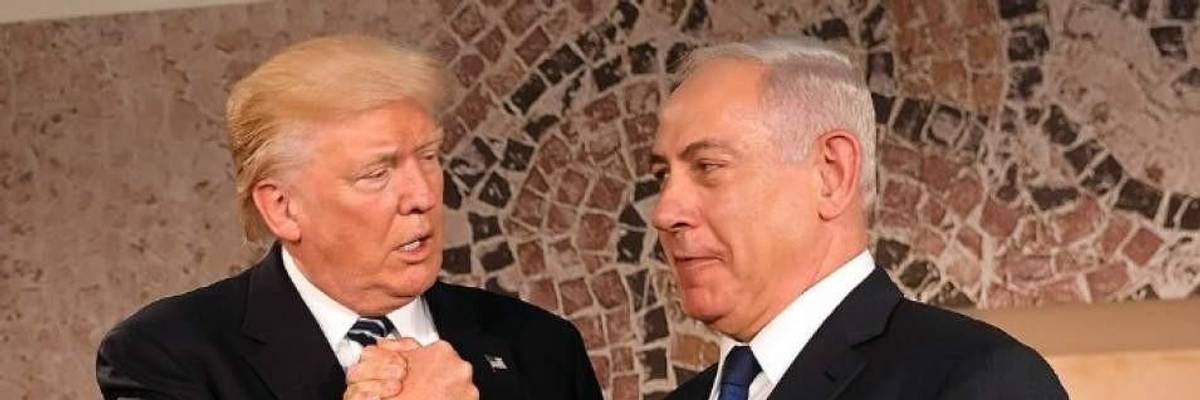
U.S. President Donald Trump and Israeli Prime Minister Benjamin Netanyahu at the Israel Museum in Jerusalem on May 23, 2017. (Photo: PRE-COVID, U.S. Embassy Tel Aviv/flickr/cc)
Donald Trump and Benjamin Netanyahu continue trying to goad Iran into a conflict--and the U.S. mainstream media continues its awful record of distorting or ignoring this truth. Look at this dishonest headline in the New York Times the other day:
Pentagon Sends More B-52s to Middle East to Deter Iranian Attacks on U.S. Troops
It is not a huge stretch to imagine an equivalent headline in Europe in late August 1939:
Germany Sends More Troops to Its Eastern Border to Deter Polish Attacks
It is exactly one year since the U.S. assassinated the prominent Iranian General, Qasem Soleimani, and the Times cites anonymous "American intelligence analysts" warning that Tehran may retaliate today for the killing. But you don't have to be a Mideast expert to recognize that Iran's leaders know how to count -- up to 18, the number of days until Joe Biden becomes president, after which the dangerous warmongering will stop. So Iran has every incentive to remain patient, just as it did in November after Israel (almost certainly) sponsored the murder of the Iranian nuclear scientist, Mohsin Fakhrizadeh, near Tehran.
Netanyahu has long tried to instigate the U.S. into a conflict with Tehran, probably in the hope that it might even topple the regime, which is Israel's biggest rival in the region.
By contrast, both Trump and Netanyahu do have plenty of motivation to provoke conflict with Iran. Even if Trump recognizes that an international emergency will not permit him to stay in power, he wants to sabotage the incoming Biden administration any way he can--and also repay his major donor, billionaire pro-Israel gambling magnate Sheldon Adelson, who once called for the U.S. to fire "an atomic bomb" at Iran.
Netanyahu has long tried to instigate the U.S. into a conflict with Tehran, probably in the hope that it might even topple the regime, which is Israel's biggest rival in the region. But the Israeli prime minister is now also personally desperate. He faces his 4th election in 2 years; right-wingers are abandoning his Likud party -- and if he loses the premiereship, he faces multiple corruption cases in court and could end up in prison.
Both desperate men need a big distraction. None of this analysis is original. You can find genuine experts online in minutes, people like Trita Parsi, Sina Toossi, and Negar Mortazavi, who, although no friends of Iran's regime, will explain that the last thing Tehran wants today is even the slightest pretext for conflict. And they speak on the record, instead of hiding behind anonymity. Or you could glance at Haaretz, the valuable Israeli daily, which after the assassination of Iran's nuclear scientist in November warned in an editorial: "Killing of Iranian Scientist Is a Dangerous Provocation."
Arguably the U.S. mainstream media's biggest failure is not that it distorts coverage, but that most of it doesn't cover the danger of a Mideast conflict at all. You can watch the cable news networks for hours without stumbling across a single report about Iran. Which means that if the U.S. and Israel do attack before noon on January 20, or if a tragic accident amid the tightened tensions triggers an outbreak of violence, the American public will have no idea of what just happened. To Americans, it will seem like a surprise Iranian attack, and they will support what they think is "retaliation."
Meanwhile, Mortazavi, a distinguished Iranian-American reporter, tweets:
My own family/friends in Iran are worried. They keep asking me if @realDonaldTrump will attack Iran. I say hopefully not but also explain that the threat is real because some people around him, like {Secretary of State Mike] Pompeo, wanted the US to bomb Iran for years and this is their final opportunity.
Dear Common Dreams reader, It’s been nearly 30 years since I co-founded Common Dreams with my late wife, Lina Newhouser. We had the radical notion that journalism should serve the public good, not corporate profits. It was clear to us from the outset what it would take to build such a project. No paid advertisements. No corporate sponsors. No millionaire publisher telling us what to think or do. Many people said we wouldn't last a year, but we proved those doubters wrong. Together with a tremendous team of journalists and dedicated staff, we built an independent media outlet free from the constraints of profits and corporate control. Our mission has always been simple: To inform. To inspire. To ignite change for the common good. Building Common Dreams was not easy. Our survival was never guaranteed. When you take on the most powerful forces—Wall Street greed, fossil fuel industry destruction, Big Tech lobbyists, and uber-rich oligarchs who have spent billions upon billions rigging the economy and democracy in their favor—the only bulwark you have is supporters who believe in your work. But here’s the urgent message from me today. It's never been this bad out there. And it's never been this hard to keep us going. At the very moment Common Dreams is most needed, the threats we face are intensifying. We need your support now more than ever. We don't accept corporate advertising and never will. We don't have a paywall because we don't think people should be blocked from critical news based on their ability to pay. Everything we do is funded by the donations of readers like you. When everyone does the little they can afford, we are strong. But if that support retreats or dries up, so do we. Will you donate now to make sure Common Dreams not only survives but thrives? —Craig Brown, Co-founder |
Donald Trump and Benjamin Netanyahu continue trying to goad Iran into a conflict--and the U.S. mainstream media continues its awful record of distorting or ignoring this truth. Look at this dishonest headline in the New York Times the other day:
Pentagon Sends More B-52s to Middle East to Deter Iranian Attacks on U.S. Troops
It is not a huge stretch to imagine an equivalent headline in Europe in late August 1939:
Germany Sends More Troops to Its Eastern Border to Deter Polish Attacks
It is exactly one year since the U.S. assassinated the prominent Iranian General, Qasem Soleimani, and the Times cites anonymous "American intelligence analysts" warning that Tehran may retaliate today for the killing. But you don't have to be a Mideast expert to recognize that Iran's leaders know how to count -- up to 18, the number of days until Joe Biden becomes president, after which the dangerous warmongering will stop. So Iran has every incentive to remain patient, just as it did in November after Israel (almost certainly) sponsored the murder of the Iranian nuclear scientist, Mohsin Fakhrizadeh, near Tehran.
Netanyahu has long tried to instigate the U.S. into a conflict with Tehran, probably in the hope that it might even topple the regime, which is Israel's biggest rival in the region.
By contrast, both Trump and Netanyahu do have plenty of motivation to provoke conflict with Iran. Even if Trump recognizes that an international emergency will not permit him to stay in power, he wants to sabotage the incoming Biden administration any way he can--and also repay his major donor, billionaire pro-Israel gambling magnate Sheldon Adelson, who once called for the U.S. to fire "an atomic bomb" at Iran.
Netanyahu has long tried to instigate the U.S. into a conflict with Tehran, probably in the hope that it might even topple the regime, which is Israel's biggest rival in the region. But the Israeli prime minister is now also personally desperate. He faces his 4th election in 2 years; right-wingers are abandoning his Likud party -- and if he loses the premiereship, he faces multiple corruption cases in court and could end up in prison.
Both desperate men need a big distraction. None of this analysis is original. You can find genuine experts online in minutes, people like Trita Parsi, Sina Toossi, and Negar Mortazavi, who, although no friends of Iran's regime, will explain that the last thing Tehran wants today is even the slightest pretext for conflict. And they speak on the record, instead of hiding behind anonymity. Or you could glance at Haaretz, the valuable Israeli daily, which after the assassination of Iran's nuclear scientist in November warned in an editorial: "Killing of Iranian Scientist Is a Dangerous Provocation."
Arguably the U.S. mainstream media's biggest failure is not that it distorts coverage, but that most of it doesn't cover the danger of a Mideast conflict at all. You can watch the cable news networks for hours without stumbling across a single report about Iran. Which means that if the U.S. and Israel do attack before noon on January 20, or if a tragic accident amid the tightened tensions triggers an outbreak of violence, the American public will have no idea of what just happened. To Americans, it will seem like a surprise Iranian attack, and they will support what they think is "retaliation."
Meanwhile, Mortazavi, a distinguished Iranian-American reporter, tweets:
My own family/friends in Iran are worried. They keep asking me if @realDonaldTrump will attack Iran. I say hopefully not but also explain that the threat is real because some people around him, like {Secretary of State Mike] Pompeo, wanted the US to bomb Iran for years and this is their final opportunity.
Donald Trump and Benjamin Netanyahu continue trying to goad Iran into a conflict--and the U.S. mainstream media continues its awful record of distorting or ignoring this truth. Look at this dishonest headline in the New York Times the other day:
Pentagon Sends More B-52s to Middle East to Deter Iranian Attacks on U.S. Troops
It is not a huge stretch to imagine an equivalent headline in Europe in late August 1939:
Germany Sends More Troops to Its Eastern Border to Deter Polish Attacks
It is exactly one year since the U.S. assassinated the prominent Iranian General, Qasem Soleimani, and the Times cites anonymous "American intelligence analysts" warning that Tehran may retaliate today for the killing. But you don't have to be a Mideast expert to recognize that Iran's leaders know how to count -- up to 18, the number of days until Joe Biden becomes president, after which the dangerous warmongering will stop. So Iran has every incentive to remain patient, just as it did in November after Israel (almost certainly) sponsored the murder of the Iranian nuclear scientist, Mohsin Fakhrizadeh, near Tehran.
Netanyahu has long tried to instigate the U.S. into a conflict with Tehran, probably in the hope that it might even topple the regime, which is Israel's biggest rival in the region.
By contrast, both Trump and Netanyahu do have plenty of motivation to provoke conflict with Iran. Even if Trump recognizes that an international emergency will not permit him to stay in power, he wants to sabotage the incoming Biden administration any way he can--and also repay his major donor, billionaire pro-Israel gambling magnate Sheldon Adelson, who once called for the U.S. to fire "an atomic bomb" at Iran.
Netanyahu has long tried to instigate the U.S. into a conflict with Tehran, probably in the hope that it might even topple the regime, which is Israel's biggest rival in the region. But the Israeli prime minister is now also personally desperate. He faces his 4th election in 2 years; right-wingers are abandoning his Likud party -- and if he loses the premiereship, he faces multiple corruption cases in court and could end up in prison.
Both desperate men need a big distraction. None of this analysis is original. You can find genuine experts online in minutes, people like Trita Parsi, Sina Toossi, and Negar Mortazavi, who, although no friends of Iran's regime, will explain that the last thing Tehran wants today is even the slightest pretext for conflict. And they speak on the record, instead of hiding behind anonymity. Or you could glance at Haaretz, the valuable Israeli daily, which after the assassination of Iran's nuclear scientist in November warned in an editorial: "Killing of Iranian Scientist Is a Dangerous Provocation."
Arguably the U.S. mainstream media's biggest failure is not that it distorts coverage, but that most of it doesn't cover the danger of a Mideast conflict at all. You can watch the cable news networks for hours without stumbling across a single report about Iran. Which means that if the U.S. and Israel do attack before noon on January 20, or if a tragic accident amid the tightened tensions triggers an outbreak of violence, the American public will have no idea of what just happened. To Americans, it will seem like a surprise Iranian attack, and they will support what they think is "retaliation."
Meanwhile, Mortazavi, a distinguished Iranian-American reporter, tweets:
My own family/friends in Iran are worried. They keep asking me if @realDonaldTrump will attack Iran. I say hopefully not but also explain that the threat is real because some people around him, like {Secretary of State Mike] Pompeo, wanted the US to bomb Iran for years and this is their final opportunity.