SUBSCRIBE TO OUR FREE NEWSLETTER
Daily news & progressive opinion—funded by the people, not the corporations—delivered straight to your inbox.
5
#000000
#FFFFFF
To donate by check, phone, or other method, see our More Ways to Give page.
Daily news & progressive opinion—funded by the people, not the corporations—delivered straight to your inbox.
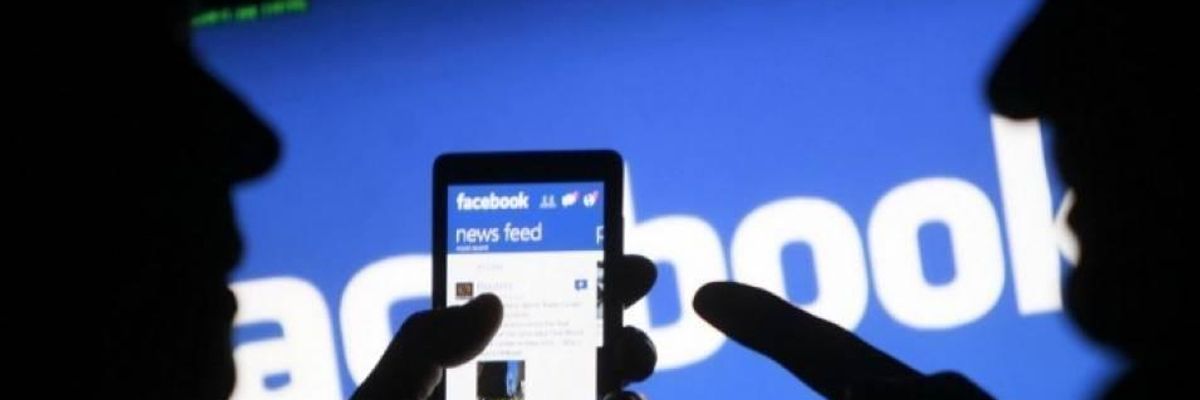
Just because some of us don't see hateful posts in our newsfeeds doesn't diminish the impact they have on those who do. (Photo: Legal Loop)
I confess: I still have a Facebook account. This might seem unusual for someone who works on curbing the spread of hate speech online.
Much of my feed consists of puppies, babies and posts from my local Buy Nothing Group. Your Facebook feed probably looks a lot different than mine. We have different friends, different likes, different group affiliations and different interests. As a result, Facebook's algorithms deliver an experience unique to each of us, specifically designed to keep us hooked on the platform. On Facebook, none of us share the same reality.
Facebook has long deployed algorithms that amplify and spread these organic posts, ads, events, groups and pages that endanger people's lives.
Just because some of us don't see hateful posts in our newsfeeds doesn't diminish the impact they have on those who do. Facebook has long deployed algorithms that amplify and spread these organic posts, ads, events, groups and pages that endanger people's lives.
The proliferation of divisive and hateful content is baked into Facebook's business model: The platform profits from finely targeting ads to users who are most likely to respond to them.
Facebook's own research shows that divisive content more deeply engages users. And a Facebook executive recently revealed that "right-wing populism is always more engaging" than centrist or progressive fare, with content that touches on topics such as "nation, protection, the other, anger, [and] fear."
The guidelines of what is acceptable or banned on the platform are sprawled across a confusing labyrinth of pages that make up Facebook's humongous corporate site. You'll need to look at all of the Community Standards, Terms of Service, Newsroom and Help Center posts to begin to get a clear picture. And just when you think you've figured it out, Facebook announces another policy change or tweaks its standards.
By intentionally seeding this patchwork, Facebook creates the illusion of transparency. This tangle of conflicting policies and webpages -- in addition to the patchwork of internal guidelines to content moderators -- allows Facebook to systematically break its promise to keep people safe, allowing white supremacists and hate groups to use the platform to spread brutal ideologies, fundraise and organize events that incite violence.
We saw a tragic example of this just recently, when the event page of right-wing paramilitary group the Kenosha Guard invited its members to arrive armed at a racial-justice protest in Wisconsin. The event was flagged 455 times in a day and reviewed by four human moderators who determined it did not violate Facebook's policies. Facebook took notice only after a 17-year-old crossed state lines and killed two people protesting the police shooting of James Blake. Mark Zuckerberg called Facebook's failure to remove the page an "operational mistake."
These types of "mistakes" are inexcusable -- especially since the organization Muslim Advocates has been sounding alarms about event-page abuses since 2015. Facebook repeatedly ignored the group's prescient warnings and repeatedly failed to take down pages promoting hateful rallies. And even in the wake of Kenosha, Facebook has yet to modify its events policies to clearly indicate that calls to arms are prohibited.
In an attempt to placate critics, Facebook has announced a slew of policy changes in recent weeks. These include a ban on ads that "praise, support or represent militarized social movements," the addition of context to posts when a candidate or party prematurely declares victory, a ban on ads that delegitimize the election's outcome, and a ban on political ads after Election Day until a winner is officially declared.
Facebook also banned all pages by QAnon and other violent groups across its platforms (but not the content itself). The company also updated its hate-speech policy, adding Holocaust denial to the list of prohibited content. A New York Times opinion piece by Charlie Warzel noted that these changes are a "tacit admission that what is good for Facebook is, on the whole, destabilizing for society
Civil-rights and racial-justice organizations, scholars, activists and journalists have long pressured Facebook to make these kinds of changes -- and many others. And for its part, Facebook is spinning these updates as "progress," even though they came too late -- a month before the presidential election -- to repair the significant damage inflicted throughout 2020.
Clear action steps to mitigate hate online have been available to Facebook for years. In 2018, a coalition of groups, including Free Press, crafted Change the Terms -- a set of model policies to curb hateful activities on online platforms. Among the many recommendations is that platforms enforce policies in a transparent, equitable and culturally relevant way.
Despite its recent changes and enforcement actions, Facebook still has a long way to go to meaningfully address its failure to protect our communities and our democracy. People's lives are on the line.
Dear Common Dreams reader, It’s been nearly 30 years since I co-founded Common Dreams with my late wife, Lina Newhouser. We had the radical notion that journalism should serve the public good, not corporate profits. It was clear to us from the outset what it would take to build such a project. No paid advertisements. No corporate sponsors. No millionaire publisher telling us what to think or do. Many people said we wouldn't last a year, but we proved those doubters wrong. Together with a tremendous team of journalists and dedicated staff, we built an independent media outlet free from the constraints of profits and corporate control. Our mission has always been simple: To inform. To inspire. To ignite change for the common good. Building Common Dreams was not easy. Our survival was never guaranteed. When you take on the most powerful forces—Wall Street greed, fossil fuel industry destruction, Big Tech lobbyists, and uber-rich oligarchs who have spent billions upon billions rigging the economy and democracy in their favor—the only bulwark you have is supporters who believe in your work. But here’s the urgent message from me today. It's never been this bad out there. And it's never been this hard to keep us going. At the very moment Common Dreams is most needed, the threats we face are intensifying. We need your support now more than ever. We don't accept corporate advertising and never will. We don't have a paywall because we don't think people should be blocked from critical news based on their ability to pay. Everything we do is funded by the donations of readers like you. When everyone does the little they can afford, we are strong. But if that support retreats or dries up, so do we. Will you donate now to make sure Common Dreams not only survives but thrives? —Craig Brown, Co-founder |
I confess: I still have a Facebook account. This might seem unusual for someone who works on curbing the spread of hate speech online.
Much of my feed consists of puppies, babies and posts from my local Buy Nothing Group. Your Facebook feed probably looks a lot different than mine. We have different friends, different likes, different group affiliations and different interests. As a result, Facebook's algorithms deliver an experience unique to each of us, specifically designed to keep us hooked on the platform. On Facebook, none of us share the same reality.
Facebook has long deployed algorithms that amplify and spread these organic posts, ads, events, groups and pages that endanger people's lives.
Just because some of us don't see hateful posts in our newsfeeds doesn't diminish the impact they have on those who do. Facebook has long deployed algorithms that amplify and spread these organic posts, ads, events, groups and pages that endanger people's lives.
The proliferation of divisive and hateful content is baked into Facebook's business model: The platform profits from finely targeting ads to users who are most likely to respond to them.
Facebook's own research shows that divisive content more deeply engages users. And a Facebook executive recently revealed that "right-wing populism is always more engaging" than centrist or progressive fare, with content that touches on topics such as "nation, protection, the other, anger, [and] fear."
The guidelines of what is acceptable or banned on the platform are sprawled across a confusing labyrinth of pages that make up Facebook's humongous corporate site. You'll need to look at all of the Community Standards, Terms of Service, Newsroom and Help Center posts to begin to get a clear picture. And just when you think you've figured it out, Facebook announces another policy change or tweaks its standards.
By intentionally seeding this patchwork, Facebook creates the illusion of transparency. This tangle of conflicting policies and webpages -- in addition to the patchwork of internal guidelines to content moderators -- allows Facebook to systematically break its promise to keep people safe, allowing white supremacists and hate groups to use the platform to spread brutal ideologies, fundraise and organize events that incite violence.
We saw a tragic example of this just recently, when the event page of right-wing paramilitary group the Kenosha Guard invited its members to arrive armed at a racial-justice protest in Wisconsin. The event was flagged 455 times in a day and reviewed by four human moderators who determined it did not violate Facebook's policies. Facebook took notice only after a 17-year-old crossed state lines and killed two people protesting the police shooting of James Blake. Mark Zuckerberg called Facebook's failure to remove the page an "operational mistake."
These types of "mistakes" are inexcusable -- especially since the organization Muslim Advocates has been sounding alarms about event-page abuses since 2015. Facebook repeatedly ignored the group's prescient warnings and repeatedly failed to take down pages promoting hateful rallies. And even in the wake of Kenosha, Facebook has yet to modify its events policies to clearly indicate that calls to arms are prohibited.
In an attempt to placate critics, Facebook has announced a slew of policy changes in recent weeks. These include a ban on ads that "praise, support or represent militarized social movements," the addition of context to posts when a candidate or party prematurely declares victory, a ban on ads that delegitimize the election's outcome, and a ban on political ads after Election Day until a winner is officially declared.
Facebook also banned all pages by QAnon and other violent groups across its platforms (but not the content itself). The company also updated its hate-speech policy, adding Holocaust denial to the list of prohibited content. A New York Times opinion piece by Charlie Warzel noted that these changes are a "tacit admission that what is good for Facebook is, on the whole, destabilizing for society
Civil-rights and racial-justice organizations, scholars, activists and journalists have long pressured Facebook to make these kinds of changes -- and many others. And for its part, Facebook is spinning these updates as "progress," even though they came too late -- a month before the presidential election -- to repair the significant damage inflicted throughout 2020.
Clear action steps to mitigate hate online have been available to Facebook for years. In 2018, a coalition of groups, including Free Press, crafted Change the Terms -- a set of model policies to curb hateful activities on online platforms. Among the many recommendations is that platforms enforce policies in a transparent, equitable and culturally relevant way.
Despite its recent changes and enforcement actions, Facebook still has a long way to go to meaningfully address its failure to protect our communities and our democracy. People's lives are on the line.
I confess: I still have a Facebook account. This might seem unusual for someone who works on curbing the spread of hate speech online.
Much of my feed consists of puppies, babies and posts from my local Buy Nothing Group. Your Facebook feed probably looks a lot different than mine. We have different friends, different likes, different group affiliations and different interests. As a result, Facebook's algorithms deliver an experience unique to each of us, specifically designed to keep us hooked on the platform. On Facebook, none of us share the same reality.
Facebook has long deployed algorithms that amplify and spread these organic posts, ads, events, groups and pages that endanger people's lives.
Just because some of us don't see hateful posts in our newsfeeds doesn't diminish the impact they have on those who do. Facebook has long deployed algorithms that amplify and spread these organic posts, ads, events, groups and pages that endanger people's lives.
The proliferation of divisive and hateful content is baked into Facebook's business model: The platform profits from finely targeting ads to users who are most likely to respond to them.
Facebook's own research shows that divisive content more deeply engages users. And a Facebook executive recently revealed that "right-wing populism is always more engaging" than centrist or progressive fare, with content that touches on topics such as "nation, protection, the other, anger, [and] fear."
The guidelines of what is acceptable or banned on the platform are sprawled across a confusing labyrinth of pages that make up Facebook's humongous corporate site. You'll need to look at all of the Community Standards, Terms of Service, Newsroom and Help Center posts to begin to get a clear picture. And just when you think you've figured it out, Facebook announces another policy change or tweaks its standards.
By intentionally seeding this patchwork, Facebook creates the illusion of transparency. This tangle of conflicting policies and webpages -- in addition to the patchwork of internal guidelines to content moderators -- allows Facebook to systematically break its promise to keep people safe, allowing white supremacists and hate groups to use the platform to spread brutal ideologies, fundraise and organize events that incite violence.
We saw a tragic example of this just recently, when the event page of right-wing paramilitary group the Kenosha Guard invited its members to arrive armed at a racial-justice protest in Wisconsin. The event was flagged 455 times in a day and reviewed by four human moderators who determined it did not violate Facebook's policies. Facebook took notice only after a 17-year-old crossed state lines and killed two people protesting the police shooting of James Blake. Mark Zuckerberg called Facebook's failure to remove the page an "operational mistake."
These types of "mistakes" are inexcusable -- especially since the organization Muslim Advocates has been sounding alarms about event-page abuses since 2015. Facebook repeatedly ignored the group's prescient warnings and repeatedly failed to take down pages promoting hateful rallies. And even in the wake of Kenosha, Facebook has yet to modify its events policies to clearly indicate that calls to arms are prohibited.
In an attempt to placate critics, Facebook has announced a slew of policy changes in recent weeks. These include a ban on ads that "praise, support or represent militarized social movements," the addition of context to posts when a candidate or party prematurely declares victory, a ban on ads that delegitimize the election's outcome, and a ban on political ads after Election Day until a winner is officially declared.
Facebook also banned all pages by QAnon and other violent groups across its platforms (but not the content itself). The company also updated its hate-speech policy, adding Holocaust denial to the list of prohibited content. A New York Times opinion piece by Charlie Warzel noted that these changes are a "tacit admission that what is good for Facebook is, on the whole, destabilizing for society
Civil-rights and racial-justice organizations, scholars, activists and journalists have long pressured Facebook to make these kinds of changes -- and many others. And for its part, Facebook is spinning these updates as "progress," even though they came too late -- a month before the presidential election -- to repair the significant damage inflicted throughout 2020.
Clear action steps to mitigate hate online have been available to Facebook for years. In 2018, a coalition of groups, including Free Press, crafted Change the Terms -- a set of model policies to curb hateful activities on online platforms. Among the many recommendations is that platforms enforce policies in a transparent, equitable and culturally relevant way.
Despite its recent changes and enforcement actions, Facebook still has a long way to go to meaningfully address its failure to protect our communities and our democracy. People's lives are on the line.