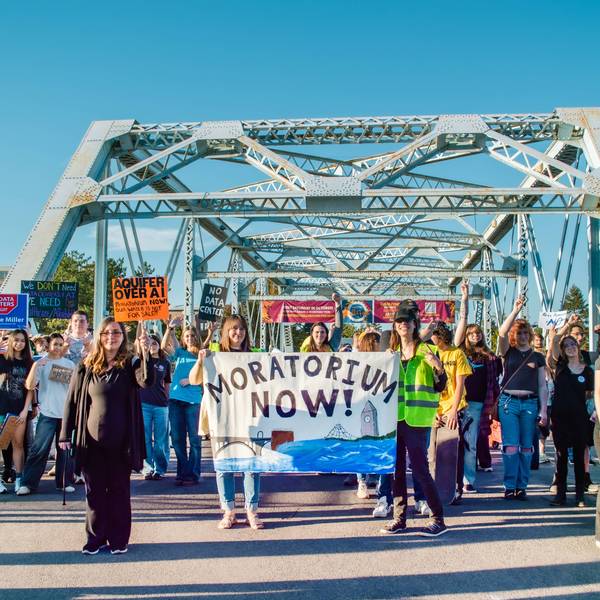
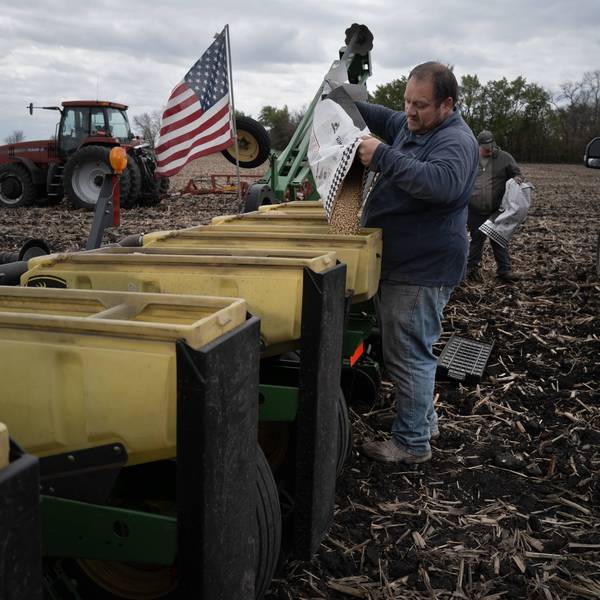
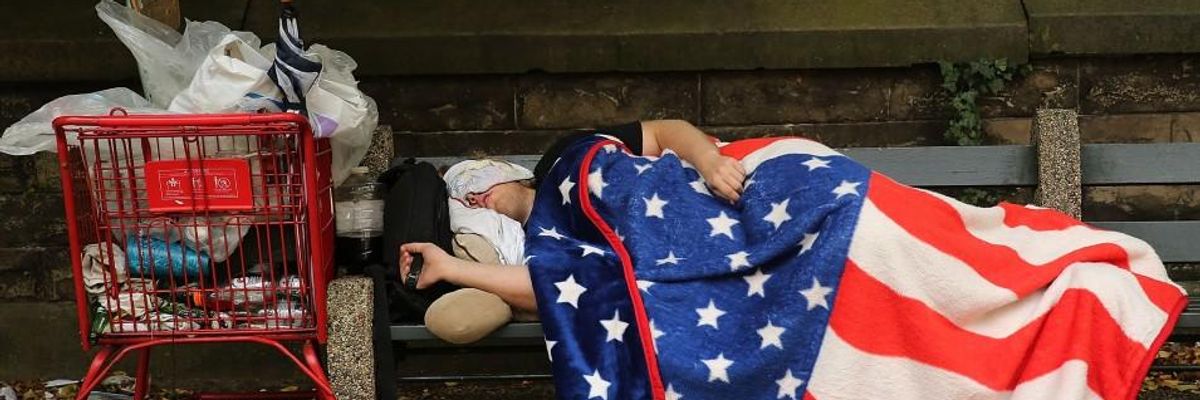
We may call this state of affairs Capitalism, but the rot goes back deep into the history of Civilization, a history of conquest, colonization, and oppression of the many by the few. (Photo: Spencer Platt/Getty Images)
Between Chaos and Commonwealth
Some reflections from decades of contemplating the rich, the poor, and the conviviality that comes with common purpose.
In my own life, by choice or by chance, I have had the good luck to cross various frontiers. Not on any great mission, but because that seemed the best when the occasion arose. Which it did for me in my late teens. I left my Quaker school as soon as I decently could, after learning I could choose between required military service and more peaceful challenges at home and abroad.
My "alternative service" in the mid-1950s, my preludes in a Swedish mountain hotel and an English geriatric hospital, may have turned out to be more of a relief to me than a service to others. But those experiences left me happier in my skin. A lot older now, I feel, if not a better person, more at ease with people and more at home in the world.
But not more accepting of our world's systematic disparities of wealth and poverty -- and corresponding distortions of corporate and political power. What half-decent society would allow its richest 1 percent to own as much as its poorest 50 percent? And allow that same 1 percent to emit twice as much toxic CO2 as its poorest half?
We may call this state of affairs Capitalism, but the rot goes back deep into the history of Civilization, a history of conquest, colonization, and oppression of the many by the few.
Centuries ago, in a flat-earth world, looking up to the great lords on their commanding heights may have seemed quite natural. Didn't the sun, moon, and stars shine down from the sky and didn't gods in heaven above dictate from mountaintops? What's not so natural or comprehensible today: that this Babel of wealth, power, and knowledge should still survive intact.
For all our scientific wizardry, our reframing of evolution and relativities in space-time, we find ourselves still stuck in the same old crumbling forms, not quite pyramids but more like tepees with converging ladders that prop each other up and support the fabric of the wider society. Where the ladders meet, at the social summit, a privileged few share or trade the tricks that got them there and fend off any threat from down below. And somehow this primitive structure now spans the world, across all frontiers.
The poor may always have been with us, but now the rich most concern us. In the face of climate change and Covid, we may all be bent by the same storm, but we do not all sit in the same boats. Some boats hold more of the resources needed to survive. Yet today we need all the energy and skills, ideas and models, plans and images we can muster between us. Only by bridging our differences, pooling resources, reaching out and joining hands can we hope to save each other and our fragile ecosphere. In a world as varied and divided as ours, only some broader common sense and purpose can turn things round and save our mortal souls.
What should be clear but often isn't: None of us can earn a fortune on our own, and no one person should be in a position to peel off the profit from other people's earning and spending.
The old geometries no longer hold. On our endangered globe, fixed poles at the top and bottom can no longer deliver a brighter tomorrow. Nor can straight-line grids or pyramids and teepees. We need new forms that acknowledge our curving, our converging and diverging trajectories.
Imagine perhaps a humble tangerine, a softer and more flexible sphere, divided and joined together in more or less equal segments. Within each segment we might envisage not a step-change vertical hierarchy but a confluence of the many occupations, professions, and specialities we need for a more fairly balanced and prosperous world. Across more permeable boundaries we could enjoy a new freedom of movement -- and find the new combinations of physical and cognitive energy we need to fashion a safer and happier world.
Einstein ascribed his world-changing E=MC2 to intuition and daydream, to musical, visual, and muscular images. Muscular? He played the piano long before he took to maths. Van Gogh compared his paint strokes to the movement of a violin bow. Icarus failed to fly, but more modern children may still watch birds, flap arms in sympathy, and fly around their playgrounds.
In our real-life meetings and matings, we produce and reproduce our own and the space where we nurture the comfort, challenge, and companionship that make life. We can all make little everyday choices, but, sadly, the power of more radical choice remains largely monopolized by the same privileged minorities who have cornered the heights of wealth, authority, and armament. In the real world as we know it -- or as they have made it with our help -- some people remain far better placed to change the world than others.
Might the rich make the choice to shed their wealth and join the rest of us? Maybe pay-back time has come. Downward mobility may not yet be in fashion , but does have a fine pedigree. From the Buddha through medieval monasteries and convents to more recent communist agitators and worker-priests, well-heeled men and women have chosen to turn their backs on material wealth and rejoin the common weal. They have found stashing grand fortunes in private hideaways less invigorating than the challenges of building communities ever wider and more inclusive, communities with the conviviality that comes with a common purpose in life.
We especially need this common purpose today, as we face a darker global backdrop and an ever-starker choice between Chaos and Commonwealth.
The treasure we seek at the end of the rainbow will only appear on common ground, the place where we can draw on some intuitive bond with each other and the rest of our natural world. As the 17th-century Quaker upstart George Fox once suggested:
There's a light that is shining in the heart of a man,
It's the light that was shining when the world began.
My mother Mary lived as a Quaker. I haven't, and for most of our lives we found each other quite difficult. In her last years we did get to know each other better, and this freedom song of Nina Simone's may now speak for both of us: "I wish I knew how it would feel to be free."
In a more equal world, we all just might come to know that feeling.
We are at a crossroads
This country and this world are at a monumental crossroads. In a few short weeks, US voters will have an opportunity to beat back the forces of fascism and confront the billionaires who are rigging the economy, our media system, and our democracy, making it increasingly impossible for ordinary people to get by. We’re not just talking about the election. We’re talking about what must be done once these fascist elements are vanquished from power. We need a bolder set of solutions than what either major party has so far been willing to offer and a working-class movement ready to fight like hell for it. Trump didn't emerge from nowhere. The conditions that fueled MAGA authoritarianism were created by decades of radical neoliberal economic policies and a corrupt political system dominated by corporate interests. They slashed taxes on the super-rich, promising that the benefits would trickle down. They said giveaways to the corporate titans would make life more affordable for the rest of us. It was all bullshit. And when a bitter, betrayed populace searches for someone to blame, right-wing demagogues have little trouble finding scapegoats. People know when they're being lied to, but you won't hear any of this from the corporate media. Only independent journalism—powered and funded by people who believe in building a better world—can deliver truly trustworthy daily news. Our Fall Campaign is underway, and we need your help. To power our newsroom through the rest of the year, we need to raise $125,000 by midnight on October 31. So if you share our vision, please contribute whatever you can to sustain our work. |
In my own life, by choice or by chance, I have had the good luck to cross various frontiers. Not on any great mission, but because that seemed the best when the occasion arose. Which it did for me in my late teens. I left my Quaker school as soon as I decently could, after learning I could choose between required military service and more peaceful challenges at home and abroad.
My "alternative service" in the mid-1950s, my preludes in a Swedish mountain hotel and an English geriatric hospital, may have turned out to be more of a relief to me than a service to others. But those experiences left me happier in my skin. A lot older now, I feel, if not a better person, more at ease with people and more at home in the world.
But not more accepting of our world's systematic disparities of wealth and poverty -- and corresponding distortions of corporate and political power. What half-decent society would allow its richest 1 percent to own as much as its poorest 50 percent? And allow that same 1 percent to emit twice as much toxic CO2 as its poorest half?
We may call this state of affairs Capitalism, but the rot goes back deep into the history of Civilization, a history of conquest, colonization, and oppression of the many by the few.
Centuries ago, in a flat-earth world, looking up to the great lords on their commanding heights may have seemed quite natural. Didn't the sun, moon, and stars shine down from the sky and didn't gods in heaven above dictate from mountaintops? What's not so natural or comprehensible today: that this Babel of wealth, power, and knowledge should still survive intact.
For all our scientific wizardry, our reframing of evolution and relativities in space-time, we find ourselves still stuck in the same old crumbling forms, not quite pyramids but more like tepees with converging ladders that prop each other up and support the fabric of the wider society. Where the ladders meet, at the social summit, a privileged few share or trade the tricks that got them there and fend off any threat from down below. And somehow this primitive structure now spans the world, across all frontiers.
The poor may always have been with us, but now the rich most concern us. In the face of climate change and Covid, we may all be bent by the same storm, but we do not all sit in the same boats. Some boats hold more of the resources needed to survive. Yet today we need all the energy and skills, ideas and models, plans and images we can muster between us. Only by bridging our differences, pooling resources, reaching out and joining hands can we hope to save each other and our fragile ecosphere. In a world as varied and divided as ours, only some broader common sense and purpose can turn things round and save our mortal souls.
What should be clear but often isn't: None of us can earn a fortune on our own, and no one person should be in a position to peel off the profit from other people's earning and spending.
The old geometries no longer hold. On our endangered globe, fixed poles at the top and bottom can no longer deliver a brighter tomorrow. Nor can straight-line grids or pyramids and teepees. We need new forms that acknowledge our curving, our converging and diverging trajectories.
Imagine perhaps a humble tangerine, a softer and more flexible sphere, divided and joined together in more or less equal segments. Within each segment we might envisage not a step-change vertical hierarchy but a confluence of the many occupations, professions, and specialities we need for a more fairly balanced and prosperous world. Across more permeable boundaries we could enjoy a new freedom of movement -- and find the new combinations of physical and cognitive energy we need to fashion a safer and happier world.
Einstein ascribed his world-changing E=MC2 to intuition and daydream, to musical, visual, and muscular images. Muscular? He played the piano long before he took to maths. Van Gogh compared his paint strokes to the movement of a violin bow. Icarus failed to fly, but more modern children may still watch birds, flap arms in sympathy, and fly around their playgrounds.
In our real-life meetings and matings, we produce and reproduce our own and the space where we nurture the comfort, challenge, and companionship that make life. We can all make little everyday choices, but, sadly, the power of more radical choice remains largely monopolized by the same privileged minorities who have cornered the heights of wealth, authority, and armament. In the real world as we know it -- or as they have made it with our help -- some people remain far better placed to change the world than others.
Might the rich make the choice to shed their wealth and join the rest of us? Maybe pay-back time has come. Downward mobility may not yet be in fashion , but does have a fine pedigree. From the Buddha through medieval monasteries and convents to more recent communist agitators and worker-priests, well-heeled men and women have chosen to turn their backs on material wealth and rejoin the common weal. They have found stashing grand fortunes in private hideaways less invigorating than the challenges of building communities ever wider and more inclusive, communities with the conviviality that comes with a common purpose in life.
We especially need this common purpose today, as we face a darker global backdrop and an ever-starker choice between Chaos and Commonwealth.
The treasure we seek at the end of the rainbow will only appear on common ground, the place where we can draw on some intuitive bond with each other and the rest of our natural world. As the 17th-century Quaker upstart George Fox once suggested:
There's a light that is shining in the heart of a man,
It's the light that was shining when the world began.
My mother Mary lived as a Quaker. I haven't, and for most of our lives we found each other quite difficult. In her last years we did get to know each other better, and this freedom song of Nina Simone's may now speak for both of us: "I wish I knew how it would feel to be free."
In a more equal world, we all just might come to know that feeling.
In my own life, by choice or by chance, I have had the good luck to cross various frontiers. Not on any great mission, but because that seemed the best when the occasion arose. Which it did for me in my late teens. I left my Quaker school as soon as I decently could, after learning I could choose between required military service and more peaceful challenges at home and abroad.
My "alternative service" in the mid-1950s, my preludes in a Swedish mountain hotel and an English geriatric hospital, may have turned out to be more of a relief to me than a service to others. But those experiences left me happier in my skin. A lot older now, I feel, if not a better person, more at ease with people and more at home in the world.
But not more accepting of our world's systematic disparities of wealth and poverty -- and corresponding distortions of corporate and political power. What half-decent society would allow its richest 1 percent to own as much as its poorest 50 percent? And allow that same 1 percent to emit twice as much toxic CO2 as its poorest half?
We may call this state of affairs Capitalism, but the rot goes back deep into the history of Civilization, a history of conquest, colonization, and oppression of the many by the few.
Centuries ago, in a flat-earth world, looking up to the great lords on their commanding heights may have seemed quite natural. Didn't the sun, moon, and stars shine down from the sky and didn't gods in heaven above dictate from mountaintops? What's not so natural or comprehensible today: that this Babel of wealth, power, and knowledge should still survive intact.
For all our scientific wizardry, our reframing of evolution and relativities in space-time, we find ourselves still stuck in the same old crumbling forms, not quite pyramids but more like tepees with converging ladders that prop each other up and support the fabric of the wider society. Where the ladders meet, at the social summit, a privileged few share or trade the tricks that got them there and fend off any threat from down below. And somehow this primitive structure now spans the world, across all frontiers.
The poor may always have been with us, but now the rich most concern us. In the face of climate change and Covid, we may all be bent by the same storm, but we do not all sit in the same boats. Some boats hold more of the resources needed to survive. Yet today we need all the energy and skills, ideas and models, plans and images we can muster between us. Only by bridging our differences, pooling resources, reaching out and joining hands can we hope to save each other and our fragile ecosphere. In a world as varied and divided as ours, only some broader common sense and purpose can turn things round and save our mortal souls.
What should be clear but often isn't: None of us can earn a fortune on our own, and no one person should be in a position to peel off the profit from other people's earning and spending.
The old geometries no longer hold. On our endangered globe, fixed poles at the top and bottom can no longer deliver a brighter tomorrow. Nor can straight-line grids or pyramids and teepees. We need new forms that acknowledge our curving, our converging and diverging trajectories.
Imagine perhaps a humble tangerine, a softer and more flexible sphere, divided and joined together in more or less equal segments. Within each segment we might envisage not a step-change vertical hierarchy but a confluence of the many occupations, professions, and specialities we need for a more fairly balanced and prosperous world. Across more permeable boundaries we could enjoy a new freedom of movement -- and find the new combinations of physical and cognitive energy we need to fashion a safer and happier world.
Einstein ascribed his world-changing E=MC2 to intuition and daydream, to musical, visual, and muscular images. Muscular? He played the piano long before he took to maths. Van Gogh compared his paint strokes to the movement of a violin bow. Icarus failed to fly, but more modern children may still watch birds, flap arms in sympathy, and fly around their playgrounds.
In our real-life meetings and matings, we produce and reproduce our own and the space where we nurture the comfort, challenge, and companionship that make life. We can all make little everyday choices, but, sadly, the power of more radical choice remains largely monopolized by the same privileged minorities who have cornered the heights of wealth, authority, and armament. In the real world as we know it -- or as they have made it with our help -- some people remain far better placed to change the world than others.
Might the rich make the choice to shed their wealth and join the rest of us? Maybe pay-back time has come. Downward mobility may not yet be in fashion , but does have a fine pedigree. From the Buddha through medieval monasteries and convents to more recent communist agitators and worker-priests, well-heeled men and women have chosen to turn their backs on material wealth and rejoin the common weal. They have found stashing grand fortunes in private hideaways less invigorating than the challenges of building communities ever wider and more inclusive, communities with the conviviality that comes with a common purpose in life.
We especially need this common purpose today, as we face a darker global backdrop and an ever-starker choice between Chaos and Commonwealth.
The treasure we seek at the end of the rainbow will only appear on common ground, the place where we can draw on some intuitive bond with each other and the rest of our natural world. As the 17th-century Quaker upstart George Fox once suggested:
There's a light that is shining in the heart of a man,
It's the light that was shining when the world began.
My mother Mary lived as a Quaker. I haven't, and for most of our lives we found each other quite difficult. In her last years we did get to know each other better, and this freedom song of Nina Simone's may now speak for both of us: "I wish I knew how it would feel to be free."
In a more equal world, we all just might come to know that feeling.