SUBSCRIBE TO OUR FREE NEWSLETTER
Daily news & progressive opinion—funded by the people, not the corporations—delivered straight to your inbox.
5
#000000
#FFFFFF
To donate by check, phone, or other method, see our More Ways to Give page.
Daily news & progressive opinion—funded by the people, not the corporations—delivered straight to your inbox.
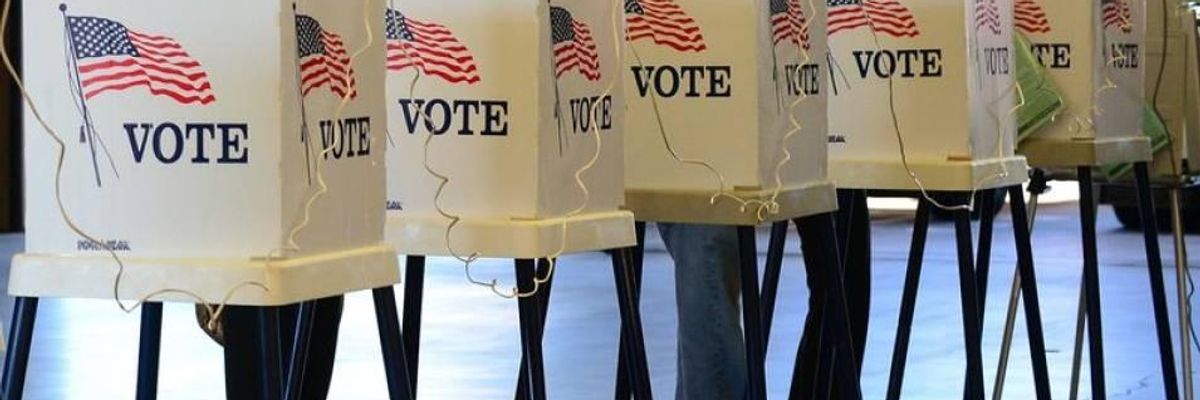
Every election, more than 700,000 Americans are denied to the right to vote as they sit in jail awaiting trial. This must end. (Photo: Frederic Brown/AFP via Getty Images)
In this critical election, Americans are breaking all records for early voting and voting by mail. Yet, over 700,000 Americans have the right to vote but many are denied that right not only in this election, but in every election.
An average of 746,000 Americans are held in local jails. Most of whom have not yet been convicted of a crime or are held only for minor offenses.
Many of these voters are jailed simply because they are poor and cannot make bail. Yet in many jails, they are denied the right to vote--either because officials are confused about their eligibility, or because they have no timely access to registration and absentee ballots, or because they have no access to the voter ID information that many states now require.
This form of voter suppression is a social injustice and a civic indignity.
In-depth political coverage, sports analysis, entertainment reviews and cultural commentary.
Not surprisingly, it disproportionately impacts African Americans, Latinos and the poor. It is part of what Michelle Alexander has called "the new Jim Crow," the use of mass incarceration to strip minorities of their right to vote.
A new report, entitled "Eligible but Excluded: A Guide to Removing the Barriers to Jail Voting," has been released by Prison Policy Institute and the Rainbow Push Coalition, which I lead.
It details the eligibility of prisoners under various state laws, the obstacles they face to exercise their right to vote, and what activists, state and local officials and prison and election officials can do to rectify that right.
Even now, two weeks from the election, prompt action could empower many to vote. The obstacles erected to make voting difficult in this country are particularly hard for prisoners to surmount.
Separate registration forms and dates can foreclose voting for those held in jails during required early registration dates. Voter ID laws hit prisoners who are often stripped of their ID papers when incarcerated and find that jail IDs are not accepted by election officials.
"For Cause" absentee laws too often do not include incarceration as a cause for justifying voting by mail. Jail mail and internet are too often slow or unavailable. Jail churning--most of those in jails are there for short periods of time--means that many will find themselves in different addresses for registration or for voting.
State and local laws reforms are essential. Same-day or automatic voter registration is invaluable not only for prisoners but for most Americans. State law could designate jails a formal voter registration agency under the Motor Voter Law, as Rhode Island has done. Election officials could designate jails an official polling station, with voting booths and computers available on site.
Activists and agencies like the Public Defender Services could run voter registration and get out of the vote operations targeted at jails. In Illinois, Gov. JB Pritzker and Lt Gov. Juliana Stratton have passed legislation that sets the standard for reform. It requires county jails and election officials to create a process that allows eligible detainees to cast a ballot. It designates Cook County Jail--one of the largest county jails in the country--as a temporary polling place so detainees can vote in person.
It mandates providing a voter registration application and notification of their voting rights to every eligible detainee leaving a jail. These are reforms that should spread across the country.
The right to vote is the defining right of a democracy. American history has been marked by the struggle to extend that right--to those who weren't landowners, to women, to those old enough to be drafted. The civil rights movement, led by Dr. Martin Luther King, understood that the right to vote was essential to the struggle for equal justice for all.
The massive turnout expected in this election will lay bare all of the ways that states--which still have authority over voting--have conspired to make voting difficult, particularly for working people who can't afford to take time from work, or poor people who find the various obstacles difficult to overcome.
Facilitating voting--the fundamental right in a democracy--should not be partisan. Sadly, it has become that as those fearful of the majority seek ways to suppress the vote, to undermine the election results, to sow fear and confusion.
It is long past time for national reforms to ensure the right to vote. That reform effort should include the hundreds of thousands held temporarily in jails who still have the right to vote.
Dear Common Dreams reader, It’s been nearly 30 years since I co-founded Common Dreams with my late wife, Lina Newhouser. We had the radical notion that journalism should serve the public good, not corporate profits. It was clear to us from the outset what it would take to build such a project. No paid advertisements. No corporate sponsors. No millionaire publisher telling us what to think or do. Many people said we wouldn't last a year, but we proved those doubters wrong. Together with a tremendous team of journalists and dedicated staff, we built an independent media outlet free from the constraints of profits and corporate control. Our mission has always been simple: To inform. To inspire. To ignite change for the common good. Building Common Dreams was not easy. Our survival was never guaranteed. When you take on the most powerful forces—Wall Street greed, fossil fuel industry destruction, Big Tech lobbyists, and uber-rich oligarchs who have spent billions upon billions rigging the economy and democracy in their favor—the only bulwark you have is supporters who believe in your work. But here’s the urgent message from me today. It's never been this bad out there. And it's never been this hard to keep us going. At the very moment Common Dreams is most needed, the threats we face are intensifying. We need your support now more than ever. We don't accept corporate advertising and never will. We don't have a paywall because we don't think people should be blocked from critical news based on their ability to pay. Everything we do is funded by the donations of readers like you. When everyone does the little they can afford, we are strong. But if that support retreats or dries up, so do we. Will you donate now to make sure Common Dreams not only survives but thrives? —Craig Brown, Co-founder |
In this critical election, Americans are breaking all records for early voting and voting by mail. Yet, over 700,000 Americans have the right to vote but many are denied that right not only in this election, but in every election.
An average of 746,000 Americans are held in local jails. Most of whom have not yet been convicted of a crime or are held only for minor offenses.
Many of these voters are jailed simply because they are poor and cannot make bail. Yet in many jails, they are denied the right to vote--either because officials are confused about their eligibility, or because they have no timely access to registration and absentee ballots, or because they have no access to the voter ID information that many states now require.
This form of voter suppression is a social injustice and a civic indignity.
In-depth political coverage, sports analysis, entertainment reviews and cultural commentary.
Not surprisingly, it disproportionately impacts African Americans, Latinos and the poor. It is part of what Michelle Alexander has called "the new Jim Crow," the use of mass incarceration to strip minorities of their right to vote.
A new report, entitled "Eligible but Excluded: A Guide to Removing the Barriers to Jail Voting," has been released by Prison Policy Institute and the Rainbow Push Coalition, which I lead.
It details the eligibility of prisoners under various state laws, the obstacles they face to exercise their right to vote, and what activists, state and local officials and prison and election officials can do to rectify that right.
Even now, two weeks from the election, prompt action could empower many to vote. The obstacles erected to make voting difficult in this country are particularly hard for prisoners to surmount.
Separate registration forms and dates can foreclose voting for those held in jails during required early registration dates. Voter ID laws hit prisoners who are often stripped of their ID papers when incarcerated and find that jail IDs are not accepted by election officials.
"For Cause" absentee laws too often do not include incarceration as a cause for justifying voting by mail. Jail mail and internet are too often slow or unavailable. Jail churning--most of those in jails are there for short periods of time--means that many will find themselves in different addresses for registration or for voting.
State and local laws reforms are essential. Same-day or automatic voter registration is invaluable not only for prisoners but for most Americans. State law could designate jails a formal voter registration agency under the Motor Voter Law, as Rhode Island has done. Election officials could designate jails an official polling station, with voting booths and computers available on site.
Activists and agencies like the Public Defender Services could run voter registration and get out of the vote operations targeted at jails. In Illinois, Gov. JB Pritzker and Lt Gov. Juliana Stratton have passed legislation that sets the standard for reform. It requires county jails and election officials to create a process that allows eligible detainees to cast a ballot. It designates Cook County Jail--one of the largest county jails in the country--as a temporary polling place so detainees can vote in person.
It mandates providing a voter registration application and notification of their voting rights to every eligible detainee leaving a jail. These are reforms that should spread across the country.
The right to vote is the defining right of a democracy. American history has been marked by the struggle to extend that right--to those who weren't landowners, to women, to those old enough to be drafted. The civil rights movement, led by Dr. Martin Luther King, understood that the right to vote was essential to the struggle for equal justice for all.
The massive turnout expected in this election will lay bare all of the ways that states--which still have authority over voting--have conspired to make voting difficult, particularly for working people who can't afford to take time from work, or poor people who find the various obstacles difficult to overcome.
Facilitating voting--the fundamental right in a democracy--should not be partisan. Sadly, it has become that as those fearful of the majority seek ways to suppress the vote, to undermine the election results, to sow fear and confusion.
It is long past time for national reforms to ensure the right to vote. That reform effort should include the hundreds of thousands held temporarily in jails who still have the right to vote.
In this critical election, Americans are breaking all records for early voting and voting by mail. Yet, over 700,000 Americans have the right to vote but many are denied that right not only in this election, but in every election.
An average of 746,000 Americans are held in local jails. Most of whom have not yet been convicted of a crime or are held only for minor offenses.
Many of these voters are jailed simply because they are poor and cannot make bail. Yet in many jails, they are denied the right to vote--either because officials are confused about their eligibility, or because they have no timely access to registration and absentee ballots, or because they have no access to the voter ID information that many states now require.
This form of voter suppression is a social injustice and a civic indignity.
In-depth political coverage, sports analysis, entertainment reviews and cultural commentary.
Not surprisingly, it disproportionately impacts African Americans, Latinos and the poor. It is part of what Michelle Alexander has called "the new Jim Crow," the use of mass incarceration to strip minorities of their right to vote.
A new report, entitled "Eligible but Excluded: A Guide to Removing the Barriers to Jail Voting," has been released by Prison Policy Institute and the Rainbow Push Coalition, which I lead.
It details the eligibility of prisoners under various state laws, the obstacles they face to exercise their right to vote, and what activists, state and local officials and prison and election officials can do to rectify that right.
Even now, two weeks from the election, prompt action could empower many to vote. The obstacles erected to make voting difficult in this country are particularly hard for prisoners to surmount.
Separate registration forms and dates can foreclose voting for those held in jails during required early registration dates. Voter ID laws hit prisoners who are often stripped of their ID papers when incarcerated and find that jail IDs are not accepted by election officials.
"For Cause" absentee laws too often do not include incarceration as a cause for justifying voting by mail. Jail mail and internet are too often slow or unavailable. Jail churning--most of those in jails are there for short periods of time--means that many will find themselves in different addresses for registration or for voting.
State and local laws reforms are essential. Same-day or automatic voter registration is invaluable not only for prisoners but for most Americans. State law could designate jails a formal voter registration agency under the Motor Voter Law, as Rhode Island has done. Election officials could designate jails an official polling station, with voting booths and computers available on site.
Activists and agencies like the Public Defender Services could run voter registration and get out of the vote operations targeted at jails. In Illinois, Gov. JB Pritzker and Lt Gov. Juliana Stratton have passed legislation that sets the standard for reform. It requires county jails and election officials to create a process that allows eligible detainees to cast a ballot. It designates Cook County Jail--one of the largest county jails in the country--as a temporary polling place so detainees can vote in person.
It mandates providing a voter registration application and notification of their voting rights to every eligible detainee leaving a jail. These are reforms that should spread across the country.
The right to vote is the defining right of a democracy. American history has been marked by the struggle to extend that right--to those who weren't landowners, to women, to those old enough to be drafted. The civil rights movement, led by Dr. Martin Luther King, understood that the right to vote was essential to the struggle for equal justice for all.
The massive turnout expected in this election will lay bare all of the ways that states--which still have authority over voting--have conspired to make voting difficult, particularly for working people who can't afford to take time from work, or poor people who find the various obstacles difficult to overcome.
Facilitating voting--the fundamental right in a democracy--should not be partisan. Sadly, it has become that as those fearful of the majority seek ways to suppress the vote, to undermine the election results, to sow fear and confusion.
It is long past time for national reforms to ensure the right to vote. That reform effort should include the hundreds of thousands held temporarily in jails who still have the right to vote.