SUBSCRIBE TO OUR FREE NEWSLETTER
Daily news & progressive opinion—funded by the people, not the corporations—delivered straight to your inbox.
5
#000000
#FFFFFF
To donate by check, phone, or other method, see our More Ways to Give page.
Daily news & progressive opinion—funded by the people, not the corporations—delivered straight to your inbox.
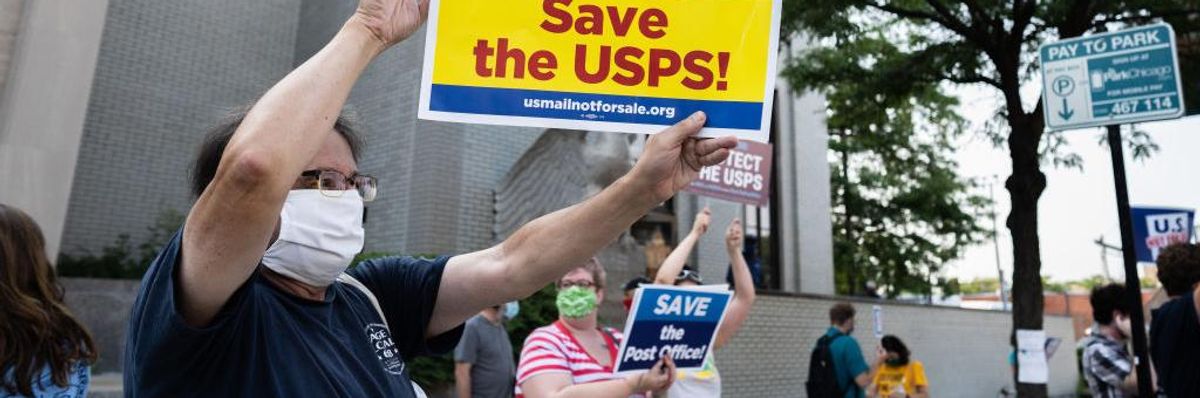
Demonstrators gather outside the Uptown post office in Chicago, IL to demand a fully funded United States Postal Service and an end to cuts by Postmaster General Louis DeJoy on August 25, 2020. (Photo: Max Herman/NurPhoto via Getty Images)
Less than two months after Trump ally and GOP megadonor Louis DeJoy took the helm of the U.S. Postal Service, the House of Representatives met in an emergency session to address widespread fears about potential sabotage of this vital public agency at a time when it is needed more than ever to deliver medicine and other essentials and to facilitate mail-in voting.
On August 22, 26 Republicans joined 231 Democrats to pass H.R. 8015, which addresses these concerns by: providing $25 billion in direct emergency relief for USPS, requiring all official election mail to be treated as "first-class mail," and prohibiting the removal of mail sorting machines and mailboxes and reversing any already implemented changes that could delay mail delivery.
For these changes to become law, activists will need to keep up the pressure. Senate Majority Leader Mitch McConnell has not responded to calls for similar emergency action, including from some within his own party. Seven Senate Republicans have co-sponsored bipartisan legislation that would also provide $25 billion in postal aid, while other Republicans have put forward a scaled-down $10 billion proposal. With USPS forecasting Covid-related losses of up to $50 billion over the next decade, $10 billion in aid is insufficient to ensure that the Postal Service can continue to provide essential services during the pandemic and for years to come. Among ordinary Americans, 90 percent of Republicans and 96 percent of Democrats support a postal relief package.
Without the force of legislation, U.S. Postmaster General Louis DeJoy is unlikely to address the concerns that have sparked more than 800 protests in every state. In testimony before the Senate Homeland Security and Governmental Affairs Committee on August 21 and before the House Oversight and Reform Committee on August 24, DeJoy refused to reverse actions that have caused mail slowdowns and did not support the bipartisan Senate and House calls for $25 billion in crisis relief.
"Without the force of legislation, U.S. Postmaster General Louis DeJoy is unlikely to address the concerns that have sparked more than 800 protests in every state."
Leaked internal USPS documents reveal that DeJoy had detailed data showing significant increases in mail delays after his operational changes went into effect but did not share this information with members of Congress who requested it. DeJoy, a wealthy former CEO of a logistic corporation, reportedly continues to hold at least $30 million in stock in USPS contractor XPO.
At a Congressional Progressive Caucus hearing on August 20, former Postal Board of Governors Vice Chair David Williams said that a full investigation of DeJoy's potential conflicts of interest was not conducted before he was hired.
In his Congressional testimony, DeJoy contradicted President Trump's attacks on vote by mail by stating that USPS is fully capable of expediting mail-in ballots to ensure timely delivery. At the same time, however, he vowed to push forward on operational changes that have led to significant service delays. He continued to boast about forcing trucks to adhere to a rigid schedule in the middle of a pandemic-related package boom and staffing shortage. USPS managers warned from the outset that this would result in mail and packages being left behind.
DeJoy also refused to replace sorting machines and blue collection boxes that have been removed under his watch. In testimony before the Congressional Progressive Caucus on August 20, former Postal Board of Governors member David Williams pointed out that it costs money to remove and destroy machinery and that a USPS analysis of collection boxes concluded that reducing them wouldn't save money.
When Senators asked DeJoy to provide analysis of potential impacts of his actions on seniors, veterans, and others who might suffer from delayed prescription deliveries, late fees on delayed bill payments, and other impacts, he refused, apparently because such analysis was not conducted. In the House hearing, DeJoy acknowledged that he had not consulted with unions or other stakeholders regarding the changes.
It was clear that DeJoy does not grasp that he is leading a public agency with a social mission and a universal service obligation. In Senate testimony, he confirmed a Washington Post report that he is considering further extreme cuts, and said that what he views as "unfunded mandates" are all potentially on the chopping block. Changes under consideration include raising package rates, particularly when delivering the last mile on behalf of big retailers (they've already announced holiday surcharges on commercial customers, which will likely be passed on to consumers); setting higher prices for service in Alaska, Hawaii and Puerto Rico; and curbing discounts for nonprofits.
The former CEO also repeatedly referred to the Postal Service as a business rather than a service in his Senate testimony and said he wants "pricing freedom" (i.e., the ability to hike rates). He claimed to be looking at ideas for revenue increases, but did not mention a single specific idea. The USPS Office of the Inspector General has estimated that expanding postal financial services such as check cashing, bill payment, and electronic money orders could generate as much as $1.1 billion in annual revenue while benefiting low-income Americans, particularly people of color, who now have to rely on predatory financial firms.
When pressed regarding Covid relief, DeJoy said during the Senate hearing that $10 billion would be sufficient--far less than the $25 billion the Postal Board of Governors requested earlier this year, which is the same amount in the just-passed House legislation and the bipartisan Senate bill.
For more on the actions that sparked the current postal crisis, key takeaways from DeJoy's Congressional testimony, and the high stakes for workers, democracy, and all Americans in this debate, see this new "Explainer" from the Institute for Policy Studies and the Congressional Progressive Caucus Center.
Dear Common Dreams reader, It’s been nearly 30 years since I co-founded Common Dreams with my late wife, Lina Newhouser. We had the radical notion that journalism should serve the public good, not corporate profits. It was clear to us from the outset what it would take to build such a project. No paid advertisements. No corporate sponsors. No millionaire publisher telling us what to think or do. Many people said we wouldn't last a year, but we proved those doubters wrong. Together with a tremendous team of journalists and dedicated staff, we built an independent media outlet free from the constraints of profits and corporate control. Our mission has always been simple: To inform. To inspire. To ignite change for the common good. Building Common Dreams was not easy. Our survival was never guaranteed. When you take on the most powerful forces—Wall Street greed, fossil fuel industry destruction, Big Tech lobbyists, and uber-rich oligarchs who have spent billions upon billions rigging the economy and democracy in their favor—the only bulwark you have is supporters who believe in your work. But here’s the urgent message from me today. It's never been this bad out there. And it's never been this hard to keep us going. At the very moment Common Dreams is most needed, the threats we face are intensifying. We need your support now more than ever. We don't accept corporate advertising and never will. We don't have a paywall because we don't think people should be blocked from critical news based on their ability to pay. Everything we do is funded by the donations of readers like you. When everyone does the little they can afford, we are strong. But if that support retreats or dries up, so do we. Will you donate now to make sure Common Dreams not only survives but thrives? —Craig Brown, Co-founder |
Less than two months after Trump ally and GOP megadonor Louis DeJoy took the helm of the U.S. Postal Service, the House of Representatives met in an emergency session to address widespread fears about potential sabotage of this vital public agency at a time when it is needed more than ever to deliver medicine and other essentials and to facilitate mail-in voting.
On August 22, 26 Republicans joined 231 Democrats to pass H.R. 8015, which addresses these concerns by: providing $25 billion in direct emergency relief for USPS, requiring all official election mail to be treated as "first-class mail," and prohibiting the removal of mail sorting machines and mailboxes and reversing any already implemented changes that could delay mail delivery.
For these changes to become law, activists will need to keep up the pressure. Senate Majority Leader Mitch McConnell has not responded to calls for similar emergency action, including from some within his own party. Seven Senate Republicans have co-sponsored bipartisan legislation that would also provide $25 billion in postal aid, while other Republicans have put forward a scaled-down $10 billion proposal. With USPS forecasting Covid-related losses of up to $50 billion over the next decade, $10 billion in aid is insufficient to ensure that the Postal Service can continue to provide essential services during the pandemic and for years to come. Among ordinary Americans, 90 percent of Republicans and 96 percent of Democrats support a postal relief package.
Without the force of legislation, U.S. Postmaster General Louis DeJoy is unlikely to address the concerns that have sparked more than 800 protests in every state. In testimony before the Senate Homeland Security and Governmental Affairs Committee on August 21 and before the House Oversight and Reform Committee on August 24, DeJoy refused to reverse actions that have caused mail slowdowns and did not support the bipartisan Senate and House calls for $25 billion in crisis relief.
"Without the force of legislation, U.S. Postmaster General Louis DeJoy is unlikely to address the concerns that have sparked more than 800 protests in every state."
Leaked internal USPS documents reveal that DeJoy had detailed data showing significant increases in mail delays after his operational changes went into effect but did not share this information with members of Congress who requested it. DeJoy, a wealthy former CEO of a logistic corporation, reportedly continues to hold at least $30 million in stock in USPS contractor XPO.
At a Congressional Progressive Caucus hearing on August 20, former Postal Board of Governors Vice Chair David Williams said that a full investigation of DeJoy's potential conflicts of interest was not conducted before he was hired.
In his Congressional testimony, DeJoy contradicted President Trump's attacks on vote by mail by stating that USPS is fully capable of expediting mail-in ballots to ensure timely delivery. At the same time, however, he vowed to push forward on operational changes that have led to significant service delays. He continued to boast about forcing trucks to adhere to a rigid schedule in the middle of a pandemic-related package boom and staffing shortage. USPS managers warned from the outset that this would result in mail and packages being left behind.
DeJoy also refused to replace sorting machines and blue collection boxes that have been removed under his watch. In testimony before the Congressional Progressive Caucus on August 20, former Postal Board of Governors member David Williams pointed out that it costs money to remove and destroy machinery and that a USPS analysis of collection boxes concluded that reducing them wouldn't save money.
When Senators asked DeJoy to provide analysis of potential impacts of his actions on seniors, veterans, and others who might suffer from delayed prescription deliveries, late fees on delayed bill payments, and other impacts, he refused, apparently because such analysis was not conducted. In the House hearing, DeJoy acknowledged that he had not consulted with unions or other stakeholders regarding the changes.
It was clear that DeJoy does not grasp that he is leading a public agency with a social mission and a universal service obligation. In Senate testimony, he confirmed a Washington Post report that he is considering further extreme cuts, and said that what he views as "unfunded mandates" are all potentially on the chopping block. Changes under consideration include raising package rates, particularly when delivering the last mile on behalf of big retailers (they've already announced holiday surcharges on commercial customers, which will likely be passed on to consumers); setting higher prices for service in Alaska, Hawaii and Puerto Rico; and curbing discounts for nonprofits.
The former CEO also repeatedly referred to the Postal Service as a business rather than a service in his Senate testimony and said he wants "pricing freedom" (i.e., the ability to hike rates). He claimed to be looking at ideas for revenue increases, but did not mention a single specific idea. The USPS Office of the Inspector General has estimated that expanding postal financial services such as check cashing, bill payment, and electronic money orders could generate as much as $1.1 billion in annual revenue while benefiting low-income Americans, particularly people of color, who now have to rely on predatory financial firms.
When pressed regarding Covid relief, DeJoy said during the Senate hearing that $10 billion would be sufficient--far less than the $25 billion the Postal Board of Governors requested earlier this year, which is the same amount in the just-passed House legislation and the bipartisan Senate bill.
For more on the actions that sparked the current postal crisis, key takeaways from DeJoy's Congressional testimony, and the high stakes for workers, democracy, and all Americans in this debate, see this new "Explainer" from the Institute for Policy Studies and the Congressional Progressive Caucus Center.
Less than two months after Trump ally and GOP megadonor Louis DeJoy took the helm of the U.S. Postal Service, the House of Representatives met in an emergency session to address widespread fears about potential sabotage of this vital public agency at a time when it is needed more than ever to deliver medicine and other essentials and to facilitate mail-in voting.
On August 22, 26 Republicans joined 231 Democrats to pass H.R. 8015, which addresses these concerns by: providing $25 billion in direct emergency relief for USPS, requiring all official election mail to be treated as "first-class mail," and prohibiting the removal of mail sorting machines and mailboxes and reversing any already implemented changes that could delay mail delivery.
For these changes to become law, activists will need to keep up the pressure. Senate Majority Leader Mitch McConnell has not responded to calls for similar emergency action, including from some within his own party. Seven Senate Republicans have co-sponsored bipartisan legislation that would also provide $25 billion in postal aid, while other Republicans have put forward a scaled-down $10 billion proposal. With USPS forecasting Covid-related losses of up to $50 billion over the next decade, $10 billion in aid is insufficient to ensure that the Postal Service can continue to provide essential services during the pandemic and for years to come. Among ordinary Americans, 90 percent of Republicans and 96 percent of Democrats support a postal relief package.
Without the force of legislation, U.S. Postmaster General Louis DeJoy is unlikely to address the concerns that have sparked more than 800 protests in every state. In testimony before the Senate Homeland Security and Governmental Affairs Committee on August 21 and before the House Oversight and Reform Committee on August 24, DeJoy refused to reverse actions that have caused mail slowdowns and did not support the bipartisan Senate and House calls for $25 billion in crisis relief.
"Without the force of legislation, U.S. Postmaster General Louis DeJoy is unlikely to address the concerns that have sparked more than 800 protests in every state."
Leaked internal USPS documents reveal that DeJoy had detailed data showing significant increases in mail delays after his operational changes went into effect but did not share this information with members of Congress who requested it. DeJoy, a wealthy former CEO of a logistic corporation, reportedly continues to hold at least $30 million in stock in USPS contractor XPO.
At a Congressional Progressive Caucus hearing on August 20, former Postal Board of Governors Vice Chair David Williams said that a full investigation of DeJoy's potential conflicts of interest was not conducted before he was hired.
In his Congressional testimony, DeJoy contradicted President Trump's attacks on vote by mail by stating that USPS is fully capable of expediting mail-in ballots to ensure timely delivery. At the same time, however, he vowed to push forward on operational changes that have led to significant service delays. He continued to boast about forcing trucks to adhere to a rigid schedule in the middle of a pandemic-related package boom and staffing shortage. USPS managers warned from the outset that this would result in mail and packages being left behind.
DeJoy also refused to replace sorting machines and blue collection boxes that have been removed under his watch. In testimony before the Congressional Progressive Caucus on August 20, former Postal Board of Governors member David Williams pointed out that it costs money to remove and destroy machinery and that a USPS analysis of collection boxes concluded that reducing them wouldn't save money.
When Senators asked DeJoy to provide analysis of potential impacts of his actions on seniors, veterans, and others who might suffer from delayed prescription deliveries, late fees on delayed bill payments, and other impacts, he refused, apparently because such analysis was not conducted. In the House hearing, DeJoy acknowledged that he had not consulted with unions or other stakeholders regarding the changes.
It was clear that DeJoy does not grasp that he is leading a public agency with a social mission and a universal service obligation. In Senate testimony, he confirmed a Washington Post report that he is considering further extreme cuts, and said that what he views as "unfunded mandates" are all potentially on the chopping block. Changes under consideration include raising package rates, particularly when delivering the last mile on behalf of big retailers (they've already announced holiday surcharges on commercial customers, which will likely be passed on to consumers); setting higher prices for service in Alaska, Hawaii and Puerto Rico; and curbing discounts for nonprofits.
The former CEO also repeatedly referred to the Postal Service as a business rather than a service in his Senate testimony and said he wants "pricing freedom" (i.e., the ability to hike rates). He claimed to be looking at ideas for revenue increases, but did not mention a single specific idea. The USPS Office of the Inspector General has estimated that expanding postal financial services such as check cashing, bill payment, and electronic money orders could generate as much as $1.1 billion in annual revenue while benefiting low-income Americans, particularly people of color, who now have to rely on predatory financial firms.
When pressed regarding Covid relief, DeJoy said during the Senate hearing that $10 billion would be sufficient--far less than the $25 billion the Postal Board of Governors requested earlier this year, which is the same amount in the just-passed House legislation and the bipartisan Senate bill.
For more on the actions that sparked the current postal crisis, key takeaways from DeJoy's Congressional testimony, and the high stakes for workers, democracy, and all Americans in this debate, see this new "Explainer" from the Institute for Policy Studies and the Congressional Progressive Caucus Center.