

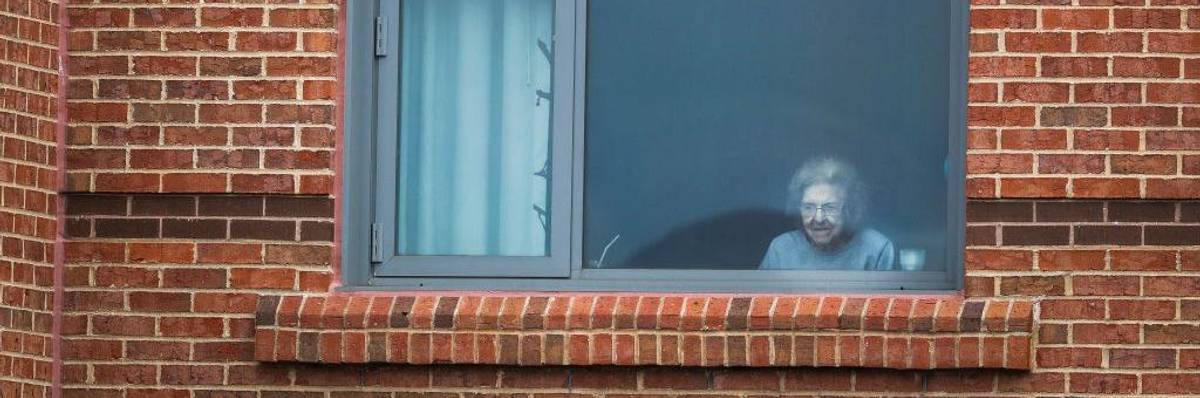
"Covid-19 has also made it clear that we need to rethink our overreliance on institutionalized long-term care," writes Klosinski, "and expand home-based healthcare, daytime care centers, and financial compensation for family caregivers."(Photo: Erin Clark/The Boston Globe via Getty Images)
In the Age of Covid, Elder Care Should Be an Election Issue
The pandemic has made it clearer than ever that we need better care that honors everyone's humanity.
Even before the Covid-19 pandemic, many people--including my parents--said they'd rather die than end up in a nursing home. So when my mother suffered a brain aneurysm and became severely disabled at the age of 57, my father and I cared for her at home.
I had two young children and a full-time job, so I would help after work and on the weekends. But after my father fell ill, we needed more help than I could give.
Like many families with few long-term care options, we were forced to turn to the nursing home system.
Families have few choices when it comes to long-term care, and the ones that do exist can be dehumanizing--especially for those who can't advocate for themselves. Covid-19 has made it clearer than ever that we need better care that honors everyone's humanity.
My mother lived in a nursing home for 14 years. During that time I got to know the residents and learned that many didn't have family or anyone to advocate for them. As a result of this experience, I became a volunteer legal guardian for my county's Adult Protective Services to help those at-risk residents who didn't have the kind of support that my parents did.
I quickly learned that many nursing homes prioritize profit over people--a trend that has only worsened since Covid-19.
The meeting took place in a bright and beautiful conference room with white leather chairs, in stark contrast to dark rooms filled with plastic chairs in the living facility. It's a moment that laid bare who many nursing homes are designed to serve.
"Many nursing aides and other care workers want to provide high-quality care, but can't because they are overworked, underpaid, and fear catching the virus themselves."
The people who live and work in long-term care facilities are especially susceptible to coronavirus, but nursing homes--for-profit ones especially--are "ill-equipped and understaffed" right now, according to a recent New York Times investigation.
Another resident I supported lived in an understaffed facility where administrators didn't require workers to wear masks. The resident wasn't able to get the care he needed as he attempted to self-isolate. He lost 25 pounds in three months.
I worked with a social worker to find him a better place to live, but got no help from the facility to transport him. I ended up sanitizing my own car and masking up so I could move him myself.
Long-term care facilities don't have to be negligent or isolating places.
After all, many of us will need long-term care at some point in our lives. And many nursing aides and other care workers want to provide high-quality care, but can't because they are overworked, underpaid, and fear catching the virus themselves.
Facilities that provide better pay, equipment, and training for care workers would create safer workplaces during Covid-19 and beyond. More accountability and transparency for non-profit and for-profit facilities alike would also go a long way to improving residents' living conditions.
Covid-19 has also made it clear that we need to rethink our overreliance on institutionalized long-term care and expand home-based healthcare, daytime care centers, and financial compensation for family caregivers.
Some members of Congress are trying to do just that, but we need more leaders who are committed to investing in care for all stages of our lives, so that we can live and age with dignity.
The advocacy group Caring Across Generations has created Care Voters, a program to help caregivers like myself get out the vote and have a voice in creating a more caring future.
We all have a stake in transforming how we care for one another.
We are at a crossroads
This country and this world are at a monumental crossroads. In a few short weeks, US voters will have an opportunity to beat back the forces of fascism and confront the billionaires who are rigging the economy, our media system, and our democracy, making it increasingly impossible for ordinary people to get by. We’re not just talking about the election. We’re talking about what must be done once these fascist elements are vanquished from power. We need a bolder set of solutions than what either major party has so far been willing to offer and a working-class movement ready to fight like hell for it. Trump didn't emerge from nowhere. The conditions that fueled MAGA authoritarianism were created by decades of radical neoliberal economic policies and a corrupt political system dominated by corporate interests. They slashed taxes on the super-rich, promising that the benefits would trickle down. They said giveaways to the corporate titans would make life more affordable for the rest of us. It was all bullshit. And when a bitter, betrayed populace searches for someone to blame, right-wing demagogues have little trouble finding scapegoats. People know when they're being lied to, but you won't hear any of this from the corporate media. Only independent journalism—powered and funded by people who believe in building a better world—can deliver truly trustworthy daily news. Our Fall Campaign is underway, and we need your help. To power our newsroom through the rest of the year, we need to raise $125,000 by midnight on October 31. So if you share our vision, please contribute whatever you can to sustain our work. |
Even before the Covid-19 pandemic, many people--including my parents--said they'd rather die than end up in a nursing home. So when my mother suffered a brain aneurysm and became severely disabled at the age of 57, my father and I cared for her at home.
I had two young children and a full-time job, so I would help after work and on the weekends. But after my father fell ill, we needed more help than I could give.
Like many families with few long-term care options, we were forced to turn to the nursing home system.
Families have few choices when it comes to long-term care, and the ones that do exist can be dehumanizing--especially for those who can't advocate for themselves. Covid-19 has made it clearer than ever that we need better care that honors everyone's humanity.
My mother lived in a nursing home for 14 years. During that time I got to know the residents and learned that many didn't have family or anyone to advocate for them. As a result of this experience, I became a volunteer legal guardian for my county's Adult Protective Services to help those at-risk residents who didn't have the kind of support that my parents did.
I quickly learned that many nursing homes prioritize profit over people--a trend that has only worsened since Covid-19.
The meeting took place in a bright and beautiful conference room with white leather chairs, in stark contrast to dark rooms filled with plastic chairs in the living facility. It's a moment that laid bare who many nursing homes are designed to serve.
"Many nursing aides and other care workers want to provide high-quality care, but can't because they are overworked, underpaid, and fear catching the virus themselves."
The people who live and work in long-term care facilities are especially susceptible to coronavirus, but nursing homes--for-profit ones especially--are "ill-equipped and understaffed" right now, according to a recent New York Times investigation.
Another resident I supported lived in an understaffed facility where administrators didn't require workers to wear masks. The resident wasn't able to get the care he needed as he attempted to self-isolate. He lost 25 pounds in three months.
I worked with a social worker to find him a better place to live, but got no help from the facility to transport him. I ended up sanitizing my own car and masking up so I could move him myself.
Long-term care facilities don't have to be negligent or isolating places.
After all, many of us will need long-term care at some point in our lives. And many nursing aides and other care workers want to provide high-quality care, but can't because they are overworked, underpaid, and fear catching the virus themselves.
Facilities that provide better pay, equipment, and training for care workers would create safer workplaces during Covid-19 and beyond. More accountability and transparency for non-profit and for-profit facilities alike would also go a long way to improving residents' living conditions.
Covid-19 has also made it clear that we need to rethink our overreliance on institutionalized long-term care and expand home-based healthcare, daytime care centers, and financial compensation for family caregivers.
Some members of Congress are trying to do just that, but we need more leaders who are committed to investing in care for all stages of our lives, so that we can live and age with dignity.
The advocacy group Caring Across Generations has created Care Voters, a program to help caregivers like myself get out the vote and have a voice in creating a more caring future.
We all have a stake in transforming how we care for one another.
Even before the Covid-19 pandemic, many people--including my parents--said they'd rather die than end up in a nursing home. So when my mother suffered a brain aneurysm and became severely disabled at the age of 57, my father and I cared for her at home.
I had two young children and a full-time job, so I would help after work and on the weekends. But after my father fell ill, we needed more help than I could give.
Like many families with few long-term care options, we were forced to turn to the nursing home system.
Families have few choices when it comes to long-term care, and the ones that do exist can be dehumanizing--especially for those who can't advocate for themselves. Covid-19 has made it clearer than ever that we need better care that honors everyone's humanity.
My mother lived in a nursing home for 14 years. During that time I got to know the residents and learned that many didn't have family or anyone to advocate for them. As a result of this experience, I became a volunteer legal guardian for my county's Adult Protective Services to help those at-risk residents who didn't have the kind of support that my parents did.
I quickly learned that many nursing homes prioritize profit over people--a trend that has only worsened since Covid-19.
The meeting took place in a bright and beautiful conference room with white leather chairs, in stark contrast to dark rooms filled with plastic chairs in the living facility. It's a moment that laid bare who many nursing homes are designed to serve.
"Many nursing aides and other care workers want to provide high-quality care, but can't because they are overworked, underpaid, and fear catching the virus themselves."
The people who live and work in long-term care facilities are especially susceptible to coronavirus, but nursing homes--for-profit ones especially--are "ill-equipped and understaffed" right now, according to a recent New York Times investigation.
Another resident I supported lived in an understaffed facility where administrators didn't require workers to wear masks. The resident wasn't able to get the care he needed as he attempted to self-isolate. He lost 25 pounds in three months.
I worked with a social worker to find him a better place to live, but got no help from the facility to transport him. I ended up sanitizing my own car and masking up so I could move him myself.
Long-term care facilities don't have to be negligent or isolating places.
After all, many of us will need long-term care at some point in our lives. And many nursing aides and other care workers want to provide high-quality care, but can't because they are overworked, underpaid, and fear catching the virus themselves.
Facilities that provide better pay, equipment, and training for care workers would create safer workplaces during Covid-19 and beyond. More accountability and transparency for non-profit and for-profit facilities alike would also go a long way to improving residents' living conditions.
Covid-19 has also made it clear that we need to rethink our overreliance on institutionalized long-term care and expand home-based healthcare, daytime care centers, and financial compensation for family caregivers.
Some members of Congress are trying to do just that, but we need more leaders who are committed to investing in care for all stages of our lives, so that we can live and age with dignity.
The advocacy group Caring Across Generations has created Care Voters, a program to help caregivers like myself get out the vote and have a voice in creating a more caring future.
We all have a stake in transforming how we care for one another.