SUBSCRIBE TO OUR FREE NEWSLETTER
Daily news & progressive opinion—funded by the people, not the corporations—delivered straight to your inbox.
5
#000000
#FFFFFF
To donate by check, phone, or other method, see our More Ways to Give page.
Daily news & progressive opinion—funded by the people, not the corporations—delivered straight to your inbox.
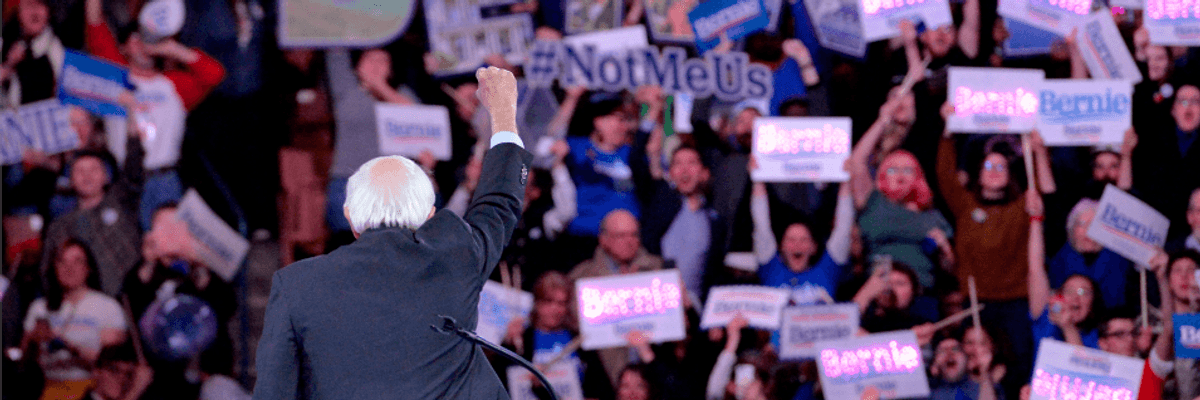
Democratic presidential hopeful Vermont Senator Bernie Sanders raises his fist as he addresses the Democratic Party's 61st Annual McIntyre-Shaheen 100 Club dinner at SNHU arena in Manchester, New Hampshire, on February 8, 2020. (Photo: Joseph Prezioso/AFP via Getty Images)
Politics is ultimately about life and death, as the current pandemic horrors make clear. Policies that can seem abstract not only routinely harm quality of life--they also kill.
Both Bernie Sanders campaigns for president have brought a principled seriousness to the national discourse that no other candidate has come near matching. Now, we seem to be entering new terrain. Or are we?
You might not like "war" metaphors--but a vicious reality is that various types of warfare are constantly happening against billions of people on this planet. Humanity is under siege from structured injustice due to anti-democratic power.
"We don't have a choice of whether or not we're in a class war. It's going on perpetually--waged with enormous financial, political and media firepower... The Bernie campaign is dissipating, but class war is sure to remain unrelenting." We don't have a choice of whether or not we're in a class war. It's going on perpetually--waged with enormous financial, political and media firepower. The firepower of class warfare against Bernie Sanders has been ferocious and unrelenting. The Bernie campaign is dissipating, but class war is sure to remain unrelenting.
Our choices revolve around whether and how to fight back against the centralized wealth and huge corporate interests waging that endless war. Now, as the era after the Bernie 2020 campaign gets underway, I'd like to tell you a little about one of the countless inspiring activists I've met--and why his outlook is so connected to the moment we're in now.
Fifty years ago, Fred Branfman saw the human consequences of war in Laos--an airborne genocide that took place courtesy of U.S. taxpayers and the Orwellian-named Defense Department. Fred was a humanitarian-aid volunteer in Laos when he discovered that his country was taking the lives of peasants there by the thousands.
Fred assembled Voices from the Plain of Jars. Published in 1972, with the subtitle "Life Under an Air War," the book included essays by Laotian people living under long-term U.S. bombardment as well drawings by children who depicted the horrors all around them. As one bookseller put it, "This is the story of the first society to be totally destroyed by aircraft."
In 2006, when I talked with Fred, he said: "At the age of 27, a moral abyss suddenly opened before me. I was shocked to the core of my being as I found myself interviewing Laotian peasants, among the most decent, human and kind people on Earth, who described living underground for years on end, while they saw countless fellow villagers and family members burned alive by napalm, suffocated by 500-pound bombs, and shredded by antipersonnel bombs dropped by my country, the United States."
Fred moved to Washington, where he worked with antiwar groups to lobby Congress and protest the inflicting of mass carnage on Indochina. He saw the urgent need to work inside and outside the political system to change policies and save lives.
More than three decades after his experiences in Laos, Fred wrote about "the effect on the biosphere of the interaction between global warming, biodiversity loss, water aquifer depletion, chemical contamination, and a wide variety of other new threats to the biospheric systems upon which human life depends." He was far from optimistic. And that's where, in April 2020, Fred has much to convey to us with a spirit that remains powerful several years after his death.
Many people who pay attention to national and global realities are in despair, and the loss of the Bernie campaign now adds to the weight of pessimism. Fred would have understood. Looking toward the future, he said, "I find it hard to have much 'hope' that the species will better itself in coming decades."
But, Fred went on, "I have also reached a point in my self-inquiries where I came to dislike the whole notion of 'hope.' If I need to have 'hope' to motivate me, what will I do when I see no rational reason for hope? If I can be 'hopeful,' then I can also be 'hopeless,' and I do not like feeling hopeless."
He added: "When I looked more deeply at my own life, I noticed that my life was not now and never had been built around 'hope.' Laos was an example. I went there, I learned to love the peasants, the bombing shocked my psyche and soul to the core, and I responded--not because I was hopeful or hopeless, but because I was alive."
And human.
That should be reason enough for solidarity and determination. We will often lose. We will not give up. We must not give up.
Dear Common Dreams reader, It’s been nearly 30 years since I co-founded Common Dreams with my late wife, Lina Newhouser. We had the radical notion that journalism should serve the public good, not corporate profits. It was clear to us from the outset what it would take to build such a project. No paid advertisements. No corporate sponsors. No millionaire publisher telling us what to think or do. Many people said we wouldn't last a year, but we proved those doubters wrong. Together with a tremendous team of journalists and dedicated staff, we built an independent media outlet free from the constraints of profits and corporate control. Our mission has always been simple: To inform. To inspire. To ignite change for the common good. Building Common Dreams was not easy. Our survival was never guaranteed. When you take on the most powerful forces—Wall Street greed, fossil fuel industry destruction, Big Tech lobbyists, and uber-rich oligarchs who have spent billions upon billions rigging the economy and democracy in their favor—the only bulwark you have is supporters who believe in your work. But here’s the urgent message from me today. It's never been this bad out there. And it's never been this hard to keep us going. At the very moment Common Dreams is most needed, the threats we face are intensifying. We need your support now more than ever. We don't accept corporate advertising and never will. We don't have a paywall because we don't think people should be blocked from critical news based on their ability to pay. Everything we do is funded by the donations of readers like you. When everyone does the little they can afford, we are strong. But if that support retreats or dries up, so do we. Will you donate now to make sure Common Dreams not only survives but thrives? —Craig Brown, Co-founder |
Norman Solomon is the national director of RootsAction.org and executive director of the Institute for Public Accuracy. The paperback edition of his latest book, War Made Invisible: How America Hides the Human Toll of Its Military Machine, includes an afterword about the Gaza war.
Politics is ultimately about life and death, as the current pandemic horrors make clear. Policies that can seem abstract not only routinely harm quality of life--they also kill.
Both Bernie Sanders campaigns for president have brought a principled seriousness to the national discourse that no other candidate has come near matching. Now, we seem to be entering new terrain. Or are we?
You might not like "war" metaphors--but a vicious reality is that various types of warfare are constantly happening against billions of people on this planet. Humanity is under siege from structured injustice due to anti-democratic power.
"We don't have a choice of whether or not we're in a class war. It's going on perpetually--waged with enormous financial, political and media firepower... The Bernie campaign is dissipating, but class war is sure to remain unrelenting." We don't have a choice of whether or not we're in a class war. It's going on perpetually--waged with enormous financial, political and media firepower. The firepower of class warfare against Bernie Sanders has been ferocious and unrelenting. The Bernie campaign is dissipating, but class war is sure to remain unrelenting.
Our choices revolve around whether and how to fight back against the centralized wealth and huge corporate interests waging that endless war. Now, as the era after the Bernie 2020 campaign gets underway, I'd like to tell you a little about one of the countless inspiring activists I've met--and why his outlook is so connected to the moment we're in now.
Fifty years ago, Fred Branfman saw the human consequences of war in Laos--an airborne genocide that took place courtesy of U.S. taxpayers and the Orwellian-named Defense Department. Fred was a humanitarian-aid volunteer in Laos when he discovered that his country was taking the lives of peasants there by the thousands.
Fred assembled Voices from the Plain of Jars. Published in 1972, with the subtitle "Life Under an Air War," the book included essays by Laotian people living under long-term U.S. bombardment as well drawings by children who depicted the horrors all around them. As one bookseller put it, "This is the story of the first society to be totally destroyed by aircraft."
In 2006, when I talked with Fred, he said: "At the age of 27, a moral abyss suddenly opened before me. I was shocked to the core of my being as I found myself interviewing Laotian peasants, among the most decent, human and kind people on Earth, who described living underground for years on end, while they saw countless fellow villagers and family members burned alive by napalm, suffocated by 500-pound bombs, and shredded by antipersonnel bombs dropped by my country, the United States."
Fred moved to Washington, where he worked with antiwar groups to lobby Congress and protest the inflicting of mass carnage on Indochina. He saw the urgent need to work inside and outside the political system to change policies and save lives.
More than three decades after his experiences in Laos, Fred wrote about "the effect on the biosphere of the interaction between global warming, biodiversity loss, water aquifer depletion, chemical contamination, and a wide variety of other new threats to the biospheric systems upon which human life depends." He was far from optimistic. And that's where, in April 2020, Fred has much to convey to us with a spirit that remains powerful several years after his death.
Many people who pay attention to national and global realities are in despair, and the loss of the Bernie campaign now adds to the weight of pessimism. Fred would have understood. Looking toward the future, he said, "I find it hard to have much 'hope' that the species will better itself in coming decades."
But, Fred went on, "I have also reached a point in my self-inquiries where I came to dislike the whole notion of 'hope.' If I need to have 'hope' to motivate me, what will I do when I see no rational reason for hope? If I can be 'hopeful,' then I can also be 'hopeless,' and I do not like feeling hopeless."
He added: "When I looked more deeply at my own life, I noticed that my life was not now and never had been built around 'hope.' Laos was an example. I went there, I learned to love the peasants, the bombing shocked my psyche and soul to the core, and I responded--not because I was hopeful or hopeless, but because I was alive."
And human.
That should be reason enough for solidarity and determination. We will often lose. We will not give up. We must not give up.
Norman Solomon is the national director of RootsAction.org and executive director of the Institute for Public Accuracy. The paperback edition of his latest book, War Made Invisible: How America Hides the Human Toll of Its Military Machine, includes an afterword about the Gaza war.
Politics is ultimately about life and death, as the current pandemic horrors make clear. Policies that can seem abstract not only routinely harm quality of life--they also kill.
Both Bernie Sanders campaigns for president have brought a principled seriousness to the national discourse that no other candidate has come near matching. Now, we seem to be entering new terrain. Or are we?
You might not like "war" metaphors--but a vicious reality is that various types of warfare are constantly happening against billions of people on this planet. Humanity is under siege from structured injustice due to anti-democratic power.
"We don't have a choice of whether or not we're in a class war. It's going on perpetually--waged with enormous financial, political and media firepower... The Bernie campaign is dissipating, but class war is sure to remain unrelenting." We don't have a choice of whether or not we're in a class war. It's going on perpetually--waged with enormous financial, political and media firepower. The firepower of class warfare against Bernie Sanders has been ferocious and unrelenting. The Bernie campaign is dissipating, but class war is sure to remain unrelenting.
Our choices revolve around whether and how to fight back against the centralized wealth and huge corporate interests waging that endless war. Now, as the era after the Bernie 2020 campaign gets underway, I'd like to tell you a little about one of the countless inspiring activists I've met--and why his outlook is so connected to the moment we're in now.
Fifty years ago, Fred Branfman saw the human consequences of war in Laos--an airborne genocide that took place courtesy of U.S. taxpayers and the Orwellian-named Defense Department. Fred was a humanitarian-aid volunteer in Laos when he discovered that his country was taking the lives of peasants there by the thousands.
Fred assembled Voices from the Plain of Jars. Published in 1972, with the subtitle "Life Under an Air War," the book included essays by Laotian people living under long-term U.S. bombardment as well drawings by children who depicted the horrors all around them. As one bookseller put it, "This is the story of the first society to be totally destroyed by aircraft."
In 2006, when I talked with Fred, he said: "At the age of 27, a moral abyss suddenly opened before me. I was shocked to the core of my being as I found myself interviewing Laotian peasants, among the most decent, human and kind people on Earth, who described living underground for years on end, while they saw countless fellow villagers and family members burned alive by napalm, suffocated by 500-pound bombs, and shredded by antipersonnel bombs dropped by my country, the United States."
Fred moved to Washington, where he worked with antiwar groups to lobby Congress and protest the inflicting of mass carnage on Indochina. He saw the urgent need to work inside and outside the political system to change policies and save lives.
More than three decades after his experiences in Laos, Fred wrote about "the effect on the biosphere of the interaction between global warming, biodiversity loss, water aquifer depletion, chemical contamination, and a wide variety of other new threats to the biospheric systems upon which human life depends." He was far from optimistic. And that's where, in April 2020, Fred has much to convey to us with a spirit that remains powerful several years after his death.
Many people who pay attention to national and global realities are in despair, and the loss of the Bernie campaign now adds to the weight of pessimism. Fred would have understood. Looking toward the future, he said, "I find it hard to have much 'hope' that the species will better itself in coming decades."
But, Fred went on, "I have also reached a point in my self-inquiries where I came to dislike the whole notion of 'hope.' If I need to have 'hope' to motivate me, what will I do when I see no rational reason for hope? If I can be 'hopeful,' then I can also be 'hopeless,' and I do not like feeling hopeless."
He added: "When I looked more deeply at my own life, I noticed that my life was not now and never had been built around 'hope.' Laos was an example. I went there, I learned to love the peasants, the bombing shocked my psyche and soul to the core, and I responded--not because I was hopeful or hopeless, but because I was alive."
And human.
That should be reason enough for solidarity and determination. We will often lose. We will not give up. We must not give up.