SUBSCRIBE TO OUR FREE NEWSLETTER
Daily news & progressive opinion—funded by the people, not the corporations—delivered straight to your inbox.
5
#000000
#FFFFFF
To donate by check, phone, or other method, see our More Ways to Give page.
Daily news & progressive opinion—funded by the people, not the corporations—delivered straight to your inbox.
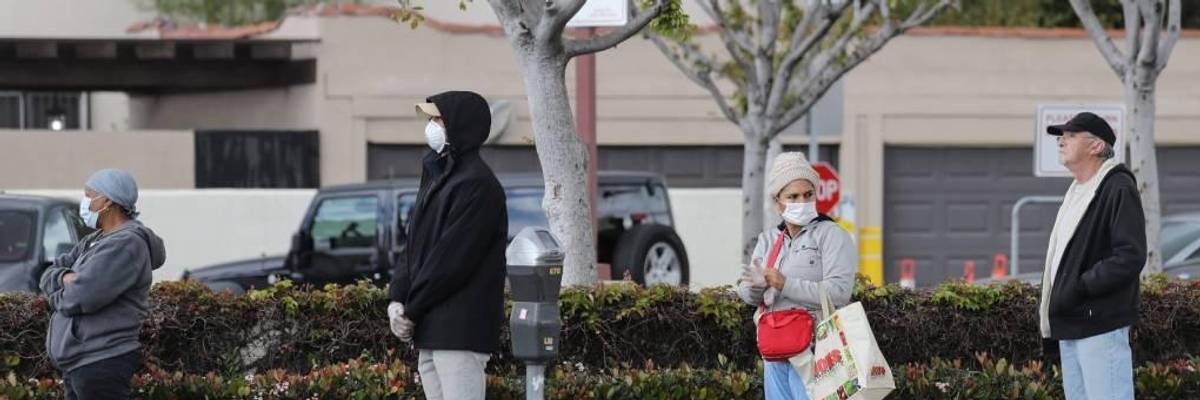
People maintain social distancing while standing in line to enter a Trader Joe's as the coronavirus pandemic continues on March 25, 2020 in Los Angeles, California. (Photo: Mario Tama/Getty Images)
Are you (un)settling in to this brave new reality yet? Beyond hopeful signs of unity, there's a looming sense that we've only just glimpsed how bad things might get in this pandemic crisis. The adjustments in many of our lives to totalized online sociality (quarantinis, anyone?), teleworking (if we're fortunate to have that option), and nesting activities (paralleling claustrophobic and/or conflictual experiences) is coupled with the realization of escalating illness and the exposure of endemic inequalities in society.
Medically, the experts are warning that we're still only partway along on the upward slope of the viral curve, with the peak (staggered across a cascade of shifting hotspots) remaining at least weeks away. Politically, the vacuity of federal guidance leaves a patchwork of uneven responses, and invites more authoritarian interventions if conditions worsen. The call to help "flatten the curve" isn't a panacea, but mainly a way to allow our already-imperfect healthcare system to catch up to the spike in critical cases.
"Whatever we make of this extraordinary time intellectually, there's a kind of suppressed emotional terror that one can discern between the lines (and perhaps in our own quiet moments)."
All the while, it feels like the pendulum of emotional processing swings from being too alarmist to not alarmist enough. At times it's almost too easy to slip into a privileged routine of Zooming into work, puttering around the immediate vicinity and cleaning out neglected spaces of accumulation, living local with a limited (carbon) footprint, catching up with old friends and getting to know colleagues in new ways, and more (insert your own litany here). Life somehow tries to normalize, no matter the baseline.
Moments of crisis can help clarify what's truly important in our lives, amplifying a sense of gratitude for things that previously seemed trivial or even tedious, and prompting us to reach out to people who have mattered to us along the way. Crises illuminate our dependency on one another, and on remote chains of production and distribution--but also highlight a resiliency and capacity to live within limits. Perhaps some of these (re)discoveries will remain once the acute crisis abates and societies attempt to reset.
Yet other changes may linger in our lives as well, and they may not be those grounded in gratitude, solidarity, sustainability, and resilience. The social fabric is changing in real-time, redefining how we do business and, in the process, affirming the hegemony of technology in our lives. It's not only that everyone who has access is using it without hesitation right now (mooting preexisting questions about privacy, veracity, etc.), but also the ways that surveillance tools have been deployed to track the virus.
Just to highlight a few notable examples that are worth bookmarking before they might soon take hold more broadly: Russia has used a mass facial recognition network; South Korea has used robust location tracking and proximity tools; Israel has used vast personal data for mapping movements; and China has required tracking apps for its opaque risk coding system. While the ability to deploy these techniques in a crisis is remarkable, the implications of maintaining these systems after the fact are worth considering.
On the other side of the ledger, there's been a marked upsurge of commentary about how societal responses to the virus have yielded environmental gains--either directly as people rely less on carbon-producing methods of transportation and conveyance, or indirectly by noting the parallels between coronavirus and climate change (an unseen threat, potentially existential in nature) and surmising that if nothing else this unwelcomed moment has demonstrated a pervasive ability to embrace radical change.
Still, whatever we make of this extraordinary time intellectually, there's a kind of suppressed emotional terror that one can discern between the lines (and perhaps in our own quiet moments). We watch with bated breath as the escalating infection and mortality counts come in, and the plummeting financial reports scroll by in the crawl. There's no bailout for the anxiety and anguish attendant to an imposed journey through uncharted waters--only the insistence of momentum, one precious breath at a time.
Dear Common Dreams reader, It’s been nearly 30 years since I co-founded Common Dreams with my late wife, Lina Newhouser. We had the radical notion that journalism should serve the public good, not corporate profits. It was clear to us from the outset what it would take to build such a project. No paid advertisements. No corporate sponsors. No millionaire publisher telling us what to think or do. Many people said we wouldn't last a year, but we proved those doubters wrong. Together with a tremendous team of journalists and dedicated staff, we built an independent media outlet free from the constraints of profits and corporate control. Our mission has always been simple: To inform. To inspire. To ignite change for the common good. Building Common Dreams was not easy. Our survival was never guaranteed. When you take on the most powerful forces—Wall Street greed, fossil fuel industry destruction, Big Tech lobbyists, and uber-rich oligarchs who have spent billions upon billions rigging the economy and democracy in their favor—the only bulwark you have is supporters who believe in your work. But here’s the urgent message from me today. It's never been this bad out there. And it's never been this hard to keep us going. At the very moment Common Dreams is most needed, the threats we face are intensifying. We need your support now more than ever. We don't accept corporate advertising and never will. We don't have a paywall because we don't think people should be blocked from critical news based on their ability to pay. Everything we do is funded by the donations of readers like you. When everyone does the little they can afford, we are strong. But if that support retreats or dries up, so do we. Will you donate now to make sure Common Dreams not only survives but thrives? —Craig Brown, Co-founder |
Are you (un)settling in to this brave new reality yet? Beyond hopeful signs of unity, there's a looming sense that we've only just glimpsed how bad things might get in this pandemic crisis. The adjustments in many of our lives to totalized online sociality (quarantinis, anyone?), teleworking (if we're fortunate to have that option), and nesting activities (paralleling claustrophobic and/or conflictual experiences) is coupled with the realization of escalating illness and the exposure of endemic inequalities in society.
Medically, the experts are warning that we're still only partway along on the upward slope of the viral curve, with the peak (staggered across a cascade of shifting hotspots) remaining at least weeks away. Politically, the vacuity of federal guidance leaves a patchwork of uneven responses, and invites more authoritarian interventions if conditions worsen. The call to help "flatten the curve" isn't a panacea, but mainly a way to allow our already-imperfect healthcare system to catch up to the spike in critical cases.
"Whatever we make of this extraordinary time intellectually, there's a kind of suppressed emotional terror that one can discern between the lines (and perhaps in our own quiet moments)."
All the while, it feels like the pendulum of emotional processing swings from being too alarmist to not alarmist enough. At times it's almost too easy to slip into a privileged routine of Zooming into work, puttering around the immediate vicinity and cleaning out neglected spaces of accumulation, living local with a limited (carbon) footprint, catching up with old friends and getting to know colleagues in new ways, and more (insert your own litany here). Life somehow tries to normalize, no matter the baseline.
Moments of crisis can help clarify what's truly important in our lives, amplifying a sense of gratitude for things that previously seemed trivial or even tedious, and prompting us to reach out to people who have mattered to us along the way. Crises illuminate our dependency on one another, and on remote chains of production and distribution--but also highlight a resiliency and capacity to live within limits. Perhaps some of these (re)discoveries will remain once the acute crisis abates and societies attempt to reset.
Yet other changes may linger in our lives as well, and they may not be those grounded in gratitude, solidarity, sustainability, and resilience. The social fabric is changing in real-time, redefining how we do business and, in the process, affirming the hegemony of technology in our lives. It's not only that everyone who has access is using it without hesitation right now (mooting preexisting questions about privacy, veracity, etc.), but also the ways that surveillance tools have been deployed to track the virus.
Just to highlight a few notable examples that are worth bookmarking before they might soon take hold more broadly: Russia has used a mass facial recognition network; South Korea has used robust location tracking and proximity tools; Israel has used vast personal data for mapping movements; and China has required tracking apps for its opaque risk coding system. While the ability to deploy these techniques in a crisis is remarkable, the implications of maintaining these systems after the fact are worth considering.
On the other side of the ledger, there's been a marked upsurge of commentary about how societal responses to the virus have yielded environmental gains--either directly as people rely less on carbon-producing methods of transportation and conveyance, or indirectly by noting the parallels between coronavirus and climate change (an unseen threat, potentially existential in nature) and surmising that if nothing else this unwelcomed moment has demonstrated a pervasive ability to embrace radical change.
Still, whatever we make of this extraordinary time intellectually, there's a kind of suppressed emotional terror that one can discern between the lines (and perhaps in our own quiet moments). We watch with bated breath as the escalating infection and mortality counts come in, and the plummeting financial reports scroll by in the crawl. There's no bailout for the anxiety and anguish attendant to an imposed journey through uncharted waters--only the insistence of momentum, one precious breath at a time.
Are you (un)settling in to this brave new reality yet? Beyond hopeful signs of unity, there's a looming sense that we've only just glimpsed how bad things might get in this pandemic crisis. The adjustments in many of our lives to totalized online sociality (quarantinis, anyone?), teleworking (if we're fortunate to have that option), and nesting activities (paralleling claustrophobic and/or conflictual experiences) is coupled with the realization of escalating illness and the exposure of endemic inequalities in society.
Medically, the experts are warning that we're still only partway along on the upward slope of the viral curve, with the peak (staggered across a cascade of shifting hotspots) remaining at least weeks away. Politically, the vacuity of federal guidance leaves a patchwork of uneven responses, and invites more authoritarian interventions if conditions worsen. The call to help "flatten the curve" isn't a panacea, but mainly a way to allow our already-imperfect healthcare system to catch up to the spike in critical cases.
"Whatever we make of this extraordinary time intellectually, there's a kind of suppressed emotional terror that one can discern between the lines (and perhaps in our own quiet moments)."
All the while, it feels like the pendulum of emotional processing swings from being too alarmist to not alarmist enough. At times it's almost too easy to slip into a privileged routine of Zooming into work, puttering around the immediate vicinity and cleaning out neglected spaces of accumulation, living local with a limited (carbon) footprint, catching up with old friends and getting to know colleagues in new ways, and more (insert your own litany here). Life somehow tries to normalize, no matter the baseline.
Moments of crisis can help clarify what's truly important in our lives, amplifying a sense of gratitude for things that previously seemed trivial or even tedious, and prompting us to reach out to people who have mattered to us along the way. Crises illuminate our dependency on one another, and on remote chains of production and distribution--but also highlight a resiliency and capacity to live within limits. Perhaps some of these (re)discoveries will remain once the acute crisis abates and societies attempt to reset.
Yet other changes may linger in our lives as well, and they may not be those grounded in gratitude, solidarity, sustainability, and resilience. The social fabric is changing in real-time, redefining how we do business and, in the process, affirming the hegemony of technology in our lives. It's not only that everyone who has access is using it without hesitation right now (mooting preexisting questions about privacy, veracity, etc.), but also the ways that surveillance tools have been deployed to track the virus.
Just to highlight a few notable examples that are worth bookmarking before they might soon take hold more broadly: Russia has used a mass facial recognition network; South Korea has used robust location tracking and proximity tools; Israel has used vast personal data for mapping movements; and China has required tracking apps for its opaque risk coding system. While the ability to deploy these techniques in a crisis is remarkable, the implications of maintaining these systems after the fact are worth considering.
On the other side of the ledger, there's been a marked upsurge of commentary about how societal responses to the virus have yielded environmental gains--either directly as people rely less on carbon-producing methods of transportation and conveyance, or indirectly by noting the parallels between coronavirus and climate change (an unseen threat, potentially existential in nature) and surmising that if nothing else this unwelcomed moment has demonstrated a pervasive ability to embrace radical change.
Still, whatever we make of this extraordinary time intellectually, there's a kind of suppressed emotional terror that one can discern between the lines (and perhaps in our own quiet moments). We watch with bated breath as the escalating infection and mortality counts come in, and the plummeting financial reports scroll by in the crawl. There's no bailout for the anxiety and anguish attendant to an imposed journey through uncharted waters--only the insistence of momentum, one precious breath at a time.