SUBSCRIBE TO OUR FREE NEWSLETTER
Daily news & progressive opinion—funded by the people, not the corporations—delivered straight to your inbox.
5
#000000
#FFFFFF
To donate by check, phone, or other method, see our More Ways to Give page.
Daily news & progressive opinion—funded by the people, not the corporations—delivered straight to your inbox.
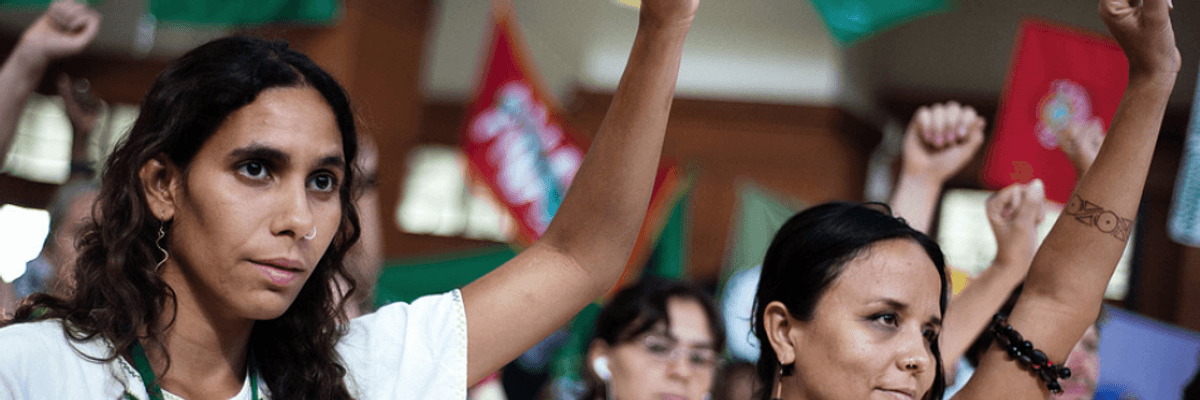
What we need now more than ever is social movements to advocate for solutions that will protect all of us, not just the business sector. (Photo: La Via Campesina)
The novel coronavirus COVID-19 has unleashed a public health and economic crisis in the United States--a situation made exponentially worse by the underlying inequality we have been facing in this country.
Those who were already the most impacted by lack of access to doctors when they're sick, affordable care to keep their children safe, and enough change in their pockets to keep food on the table will feel the impacts of this crisis tenfold.
What we need now more than ever is social movements to advocate for solutions that will protect all of us, not just the business sector.
The very nature of organizing and mobilizing people to make this possible is social interaction--congregating at events, planning meetings, and rallies. But if we want to suppress this virus, experts say we need to practice social distancing. So it's time for organizers to do what they do best: get creative, think outside of the box, and devise new strategies. At Community Change, we created a toolkit to help organizations around the country make digital organizing as effective as in-person organizing.
One of the key factors in organizing is trusted messengers: those close to us who can help combat misinformation and peer pressure us to act. One friend mobilizes another, and then that friend mobilizes their family, and so on until there are thousands of us moving toward the same goal.
We do this in all aspects of our work. But we started with electoral organizing, where even those who weren't able to vote could encourage their peers to get to the polls via self-recorded videos.
In our child care work to help parents, advocates and early childhood educators build a national child care movement, we are developing online digital strategies across various social media platforms. For the past two years, we have worked with United For Respect to take the power of relational organizing online.
With online organizing, we can have more conversations in one day than we ever could with door knocking. This proved successful for our partner OLE in New Mexico, where building out their digital infrastructure allowed them to connect members who live over a large geographical area. Another partner organization Parent Voices Oakland, which just passed a ballot measure to provide affordable child care and better wages for child care providers in Alameda, reported that 65% of their base that mobilized around these efforts were brought in online.
A few weeks ago, we would have used online organizing to mobilize people to act offline--taking to the streets or getting signatures for a legislative initiative or campaign. In the era of the coronavirus, our challenge as organizers is how to move those asks completely online. The upside is, while we're social distancing, we are all on our phones all of the time. And many of those people in power that we seek to influence are also moving more and more online.
So we've been using tools like Soapboxx to gather authentic voices of our impacted communities. Especially in a time of crisis, we need the perspectives of family, friends, neighbors, parents, and colleagues to tell our representatives how this pandemic is transforming our lives and that we're going to hold them accountable for bold and inclusive solutions -- even from our own homes.
Our toolkit can help organizations across the country build up their digital infrastructure to make the shift to successful virtual rallies and social media actions targeting politicians. It has something for organizations at every level of experience with digital, including tips on how to run video conference calls, sample online actions, onboarding newcomers, downloadable tools, and more.
Once organizations make the shift, they can continue their critical work during this pandemic and punch above their weight when it's safe to include offline tactics in the future.
Social distancing doesn't have to mean social isolation. Our democracy depends on us continuing to practice solidarity, making meaningful connections, and sharing our experiences, especially in times of crisis. And with innovative digital methods, it's possible.
Dear Common Dreams reader, It’s been nearly 30 years since I co-founded Common Dreams with my late wife, Lina Newhouser. We had the radical notion that journalism should serve the public good, not corporate profits. It was clear to us from the outset what it would take to build such a project. No paid advertisements. No corporate sponsors. No millionaire publisher telling us what to think or do. Many people said we wouldn't last a year, but we proved those doubters wrong. Together with a tremendous team of journalists and dedicated staff, we built an independent media outlet free from the constraints of profits and corporate control. Our mission has always been simple: To inform. To inspire. To ignite change for the common good. Building Common Dreams was not easy. Our survival was never guaranteed. When you take on the most powerful forces—Wall Street greed, fossil fuel industry destruction, Big Tech lobbyists, and uber-rich oligarchs who have spent billions upon billions rigging the economy and democracy in their favor—the only bulwark you have is supporters who believe in your work. But here’s the urgent message from me today. It's never been this bad out there. And it's never been this hard to keep us going. At the very moment Common Dreams is most needed, the threats we face are intensifying. We need your support now more than ever. We don't accept corporate advertising and never will. We don't have a paywall because we don't think people should be blocked from critical news based on their ability to pay. Everything we do is funded by the donations of readers like you. When everyone does the little they can afford, we are strong. But if that support retreats or dries up, so do we. Will you donate now to make sure Common Dreams not only survives but thrives? —Craig Brown, Co-founder |
The novel coronavirus COVID-19 has unleashed a public health and economic crisis in the United States--a situation made exponentially worse by the underlying inequality we have been facing in this country.
Those who were already the most impacted by lack of access to doctors when they're sick, affordable care to keep their children safe, and enough change in their pockets to keep food on the table will feel the impacts of this crisis tenfold.
What we need now more than ever is social movements to advocate for solutions that will protect all of us, not just the business sector.
The very nature of organizing and mobilizing people to make this possible is social interaction--congregating at events, planning meetings, and rallies. But if we want to suppress this virus, experts say we need to practice social distancing. So it's time for organizers to do what they do best: get creative, think outside of the box, and devise new strategies. At Community Change, we created a toolkit to help organizations around the country make digital organizing as effective as in-person organizing.
One of the key factors in organizing is trusted messengers: those close to us who can help combat misinformation and peer pressure us to act. One friend mobilizes another, and then that friend mobilizes their family, and so on until there are thousands of us moving toward the same goal.
We do this in all aspects of our work. But we started with electoral organizing, where even those who weren't able to vote could encourage their peers to get to the polls via self-recorded videos.
In our child care work to help parents, advocates and early childhood educators build a national child care movement, we are developing online digital strategies across various social media platforms. For the past two years, we have worked with United For Respect to take the power of relational organizing online.
With online organizing, we can have more conversations in one day than we ever could with door knocking. This proved successful for our partner OLE in New Mexico, where building out their digital infrastructure allowed them to connect members who live over a large geographical area. Another partner organization Parent Voices Oakland, which just passed a ballot measure to provide affordable child care and better wages for child care providers in Alameda, reported that 65% of their base that mobilized around these efforts were brought in online.
A few weeks ago, we would have used online organizing to mobilize people to act offline--taking to the streets or getting signatures for a legislative initiative or campaign. In the era of the coronavirus, our challenge as organizers is how to move those asks completely online. The upside is, while we're social distancing, we are all on our phones all of the time. And many of those people in power that we seek to influence are also moving more and more online.
So we've been using tools like Soapboxx to gather authentic voices of our impacted communities. Especially in a time of crisis, we need the perspectives of family, friends, neighbors, parents, and colleagues to tell our representatives how this pandemic is transforming our lives and that we're going to hold them accountable for bold and inclusive solutions -- even from our own homes.
Our toolkit can help organizations across the country build up their digital infrastructure to make the shift to successful virtual rallies and social media actions targeting politicians. It has something for organizations at every level of experience with digital, including tips on how to run video conference calls, sample online actions, onboarding newcomers, downloadable tools, and more.
Once organizations make the shift, they can continue their critical work during this pandemic and punch above their weight when it's safe to include offline tactics in the future.
Social distancing doesn't have to mean social isolation. Our democracy depends on us continuing to practice solidarity, making meaningful connections, and sharing our experiences, especially in times of crisis. And with innovative digital methods, it's possible.
The novel coronavirus COVID-19 has unleashed a public health and economic crisis in the United States--a situation made exponentially worse by the underlying inequality we have been facing in this country.
Those who were already the most impacted by lack of access to doctors when they're sick, affordable care to keep their children safe, and enough change in their pockets to keep food on the table will feel the impacts of this crisis tenfold.
What we need now more than ever is social movements to advocate for solutions that will protect all of us, not just the business sector.
The very nature of organizing and mobilizing people to make this possible is social interaction--congregating at events, planning meetings, and rallies. But if we want to suppress this virus, experts say we need to practice social distancing. So it's time for organizers to do what they do best: get creative, think outside of the box, and devise new strategies. At Community Change, we created a toolkit to help organizations around the country make digital organizing as effective as in-person organizing.
One of the key factors in organizing is trusted messengers: those close to us who can help combat misinformation and peer pressure us to act. One friend mobilizes another, and then that friend mobilizes their family, and so on until there are thousands of us moving toward the same goal.
We do this in all aspects of our work. But we started with electoral organizing, where even those who weren't able to vote could encourage their peers to get to the polls via self-recorded videos.
In our child care work to help parents, advocates and early childhood educators build a national child care movement, we are developing online digital strategies across various social media platforms. For the past two years, we have worked with United For Respect to take the power of relational organizing online.
With online organizing, we can have more conversations in one day than we ever could with door knocking. This proved successful for our partner OLE in New Mexico, where building out their digital infrastructure allowed them to connect members who live over a large geographical area. Another partner organization Parent Voices Oakland, which just passed a ballot measure to provide affordable child care and better wages for child care providers in Alameda, reported that 65% of their base that mobilized around these efforts were brought in online.
A few weeks ago, we would have used online organizing to mobilize people to act offline--taking to the streets or getting signatures for a legislative initiative or campaign. In the era of the coronavirus, our challenge as organizers is how to move those asks completely online. The upside is, while we're social distancing, we are all on our phones all of the time. And many of those people in power that we seek to influence are also moving more and more online.
So we've been using tools like Soapboxx to gather authentic voices of our impacted communities. Especially in a time of crisis, we need the perspectives of family, friends, neighbors, parents, and colleagues to tell our representatives how this pandemic is transforming our lives and that we're going to hold them accountable for bold and inclusive solutions -- even from our own homes.
Our toolkit can help organizations across the country build up their digital infrastructure to make the shift to successful virtual rallies and social media actions targeting politicians. It has something for organizations at every level of experience with digital, including tips on how to run video conference calls, sample online actions, onboarding newcomers, downloadable tools, and more.
Once organizations make the shift, they can continue their critical work during this pandemic and punch above their weight when it's safe to include offline tactics in the future.
Social distancing doesn't have to mean social isolation. Our democracy depends on us continuing to practice solidarity, making meaningful connections, and sharing our experiences, especially in times of crisis. And with innovative digital methods, it's possible.