SUBSCRIBE TO OUR FREE NEWSLETTER
Daily news & progressive opinion—funded by the people, not the corporations—delivered straight to your inbox.
5
#000000
#FFFFFF
To donate by check, phone, or other method, see our More Ways to Give page.
Daily news & progressive opinion—funded by the people, not the corporations—delivered straight to your inbox.
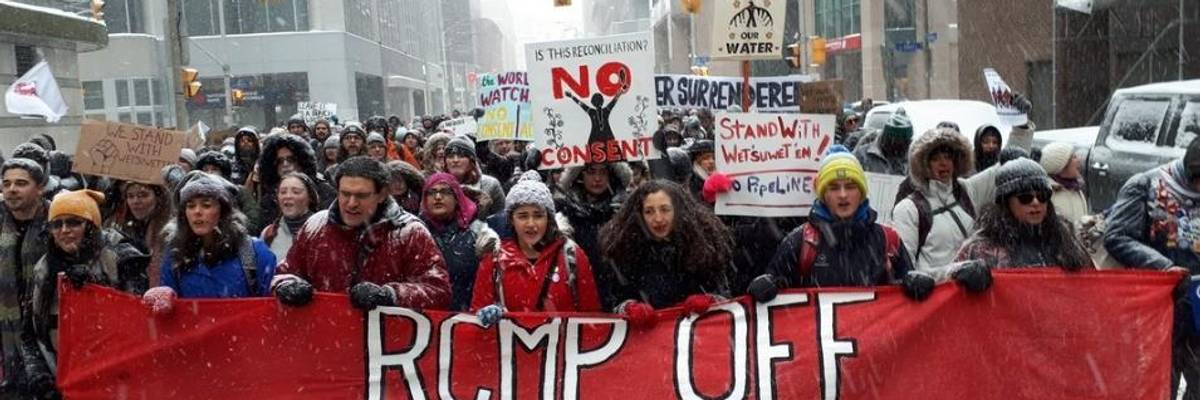
Extinction Rebellion Ottawa marched through the city Friday in support of the Wet'suwet'en Nation. (Photo: @XROttawa/Twitter)
I want to start by turning myself into Jason Kenney's investigators.
I admit to being against further oilsands development, making me a person of interest to the sleuths in Kenney's $30-million "war-room" who are tasked with vilifying oilsands critics. Of course, they're really hoping to unmask "foreign-funded special interests," and I don't have a single dollar of foreign backing. Still, I do what I can!
The war room is just one of the Alberta premier's bullying tactics, along with threatening Western separation, as he tries to intimidate critics and pressure the Trudeau government into approving the proposed Teck mine, a vast 293-square-kilometer open-pit mine, which would be the biggest tarsands mine yet.
Given that such an approval would hopelessly compromise any Canadian effort to battle climate change -- which, let's not forget, threatens the world including us here in Canada -- the answer must clearly be no. In the election last fall, two-thirds of the country voted for parties that advocated strong action on climate change.
The fact that this is seen as a difficult decision reveals the Trudeau government's keenness to be accommodating when dealing with opposition, which is coming from the right and backed by powerful business interests.
Meanwhile, there's a willingness to play hardball when opposition is coming from Indigenous people and powerful business interests are against them.
These hardball tactics have been on display in northwestern B.C. in recent weeks as Wet'suwet'en Indigenous protestors, trying to block a pipeline from crossing their land, have been confronted with highly militarized RCMP officers dressed in combat fatigues, bearing assault rifles and police dogs.
Chainsawing through a gate marked "Reconciliation," the RCMP have forcibly removed the occupiers -- that is, people occupying their own land -- amid prayers for Missing and Murdered Indigenous Women and Girls, sparking nationwide protests. Most of the media attention has focused on how disruptive the protests have been to southern train travel.
But the hardball tactics are alarming. The RCMP were prepared to shoot the Indigenous protestors, according to a report last December in the U.K. Guardian. Documents cited in the article show that RCMP commanders argued that "lethal overwatch is req'd" -- a term for deploying an officer able to use lethal force.
What makes the strong-armed clampdown so outrageous is that the natural gas pipeline, approved by the B.C. government and enforced by a court injunction, is to be built across land that has never been ceded. A 1997 Supreme Court of Canada decision ruled the title was held by the Wet'suwet'en hereditary chiefs.
Indigenous people have long been on the receiving end of strong-arm police tactics ordered by Canada's federal and provincial governments, particularly when they stood in the way of colonial settlement or resource extraction. From the late 1800s, Indigenous people were forcibly relocated to reserves, with their children sent to now-notorious residential schools.
In recent years, Canada has extended the national security apparatus to prevent protestors -- often Indigenous people protecting their lands -- from interfering with oil and gas developments.
Casting such protestors as terrorists, Stephen Harper's government -- with qualified support from Justin Trudeau's Liberals -- passed the 2015 Anti-Terrorism Act, which authorized police surveillance and arrest powers against those interfering with "critical infrastructure."
Dear Common Dreams reader, It’s been nearly 30 years since I co-founded Common Dreams with my late wife, Lina Newhouser. We had the radical notion that journalism should serve the public good, not corporate profits. It was clear to us from the outset what it would take to build such a project. No paid advertisements. No corporate sponsors. No millionaire publisher telling us what to think or do. Many people said we wouldn't last a year, but we proved those doubters wrong. Together with a tremendous team of journalists and dedicated staff, we built an independent media outlet free from the constraints of profits and corporate control. Our mission has always been simple: To inform. To inspire. To ignite change for the common good. Building Common Dreams was not easy. Our survival was never guaranteed. When you take on the most powerful forces—Wall Street greed, fossil fuel industry destruction, Big Tech lobbyists, and uber-rich oligarchs who have spent billions upon billions rigging the economy and democracy in their favor—the only bulwark you have is supporters who believe in your work. But here’s the urgent message from me today. It's never been this bad out there. And it's never been this hard to keep us going. At the very moment Common Dreams is most needed, the threats we face are intensifying. We need your support now more than ever. We don't accept corporate advertising and never will. We don't have a paywall because we don't think people should be blocked from critical news based on their ability to pay. Everything we do is funded by the donations of readers like you. When everyone does the little they can afford, we are strong. But if that support retreats or dries up, so do we. Will you donate now to make sure Common Dreams not only survives but thrives? —Craig Brown, Co-founder |
I want to start by turning myself into Jason Kenney's investigators.
I admit to being against further oilsands development, making me a person of interest to the sleuths in Kenney's $30-million "war-room" who are tasked with vilifying oilsands critics. Of course, they're really hoping to unmask "foreign-funded special interests," and I don't have a single dollar of foreign backing. Still, I do what I can!
The war room is just one of the Alberta premier's bullying tactics, along with threatening Western separation, as he tries to intimidate critics and pressure the Trudeau government into approving the proposed Teck mine, a vast 293-square-kilometer open-pit mine, which would be the biggest tarsands mine yet.
Given that such an approval would hopelessly compromise any Canadian effort to battle climate change -- which, let's not forget, threatens the world including us here in Canada -- the answer must clearly be no. In the election last fall, two-thirds of the country voted for parties that advocated strong action on climate change.
The fact that this is seen as a difficult decision reveals the Trudeau government's keenness to be accommodating when dealing with opposition, which is coming from the right and backed by powerful business interests.
Meanwhile, there's a willingness to play hardball when opposition is coming from Indigenous people and powerful business interests are against them.
These hardball tactics have been on display in northwestern B.C. in recent weeks as Wet'suwet'en Indigenous protestors, trying to block a pipeline from crossing their land, have been confronted with highly militarized RCMP officers dressed in combat fatigues, bearing assault rifles and police dogs.
Chainsawing through a gate marked "Reconciliation," the RCMP have forcibly removed the occupiers -- that is, people occupying their own land -- amid prayers for Missing and Murdered Indigenous Women and Girls, sparking nationwide protests. Most of the media attention has focused on how disruptive the protests have been to southern train travel.
But the hardball tactics are alarming. The RCMP were prepared to shoot the Indigenous protestors, according to a report last December in the U.K. Guardian. Documents cited in the article show that RCMP commanders argued that "lethal overwatch is req'd" -- a term for deploying an officer able to use lethal force.
What makes the strong-armed clampdown so outrageous is that the natural gas pipeline, approved by the B.C. government and enforced by a court injunction, is to be built across land that has never been ceded. A 1997 Supreme Court of Canada decision ruled the title was held by the Wet'suwet'en hereditary chiefs.
Indigenous people have long been on the receiving end of strong-arm police tactics ordered by Canada's federal and provincial governments, particularly when they stood in the way of colonial settlement or resource extraction. From the late 1800s, Indigenous people were forcibly relocated to reserves, with their children sent to now-notorious residential schools.
In recent years, Canada has extended the national security apparatus to prevent protestors -- often Indigenous people protecting their lands -- from interfering with oil and gas developments.
Casting such protestors as terrorists, Stephen Harper's government -- with qualified support from Justin Trudeau's Liberals -- passed the 2015 Anti-Terrorism Act, which authorized police surveillance and arrest powers against those interfering with "critical infrastructure."
I want to start by turning myself into Jason Kenney's investigators.
I admit to being against further oilsands development, making me a person of interest to the sleuths in Kenney's $30-million "war-room" who are tasked with vilifying oilsands critics. Of course, they're really hoping to unmask "foreign-funded special interests," and I don't have a single dollar of foreign backing. Still, I do what I can!
The war room is just one of the Alberta premier's bullying tactics, along with threatening Western separation, as he tries to intimidate critics and pressure the Trudeau government into approving the proposed Teck mine, a vast 293-square-kilometer open-pit mine, which would be the biggest tarsands mine yet.
Given that such an approval would hopelessly compromise any Canadian effort to battle climate change -- which, let's not forget, threatens the world including us here in Canada -- the answer must clearly be no. In the election last fall, two-thirds of the country voted for parties that advocated strong action on climate change.
The fact that this is seen as a difficult decision reveals the Trudeau government's keenness to be accommodating when dealing with opposition, which is coming from the right and backed by powerful business interests.
Meanwhile, there's a willingness to play hardball when opposition is coming from Indigenous people and powerful business interests are against them.
These hardball tactics have been on display in northwestern B.C. in recent weeks as Wet'suwet'en Indigenous protestors, trying to block a pipeline from crossing their land, have been confronted with highly militarized RCMP officers dressed in combat fatigues, bearing assault rifles and police dogs.
Chainsawing through a gate marked "Reconciliation," the RCMP have forcibly removed the occupiers -- that is, people occupying their own land -- amid prayers for Missing and Murdered Indigenous Women and Girls, sparking nationwide protests. Most of the media attention has focused on how disruptive the protests have been to southern train travel.
But the hardball tactics are alarming. The RCMP were prepared to shoot the Indigenous protestors, according to a report last December in the U.K. Guardian. Documents cited in the article show that RCMP commanders argued that "lethal overwatch is req'd" -- a term for deploying an officer able to use lethal force.
What makes the strong-armed clampdown so outrageous is that the natural gas pipeline, approved by the B.C. government and enforced by a court injunction, is to be built across land that has never been ceded. A 1997 Supreme Court of Canada decision ruled the title was held by the Wet'suwet'en hereditary chiefs.
Indigenous people have long been on the receiving end of strong-arm police tactics ordered by Canada's federal and provincial governments, particularly when they stood in the way of colonial settlement or resource extraction. From the late 1800s, Indigenous people were forcibly relocated to reserves, with their children sent to now-notorious residential schools.
In recent years, Canada has extended the national security apparatus to prevent protestors -- often Indigenous people protecting their lands -- from interfering with oil and gas developments.
Casting such protestors as terrorists, Stephen Harper's government -- with qualified support from Justin Trudeau's Liberals -- passed the 2015 Anti-Terrorism Act, which authorized police surveillance and arrest powers against those interfering with "critical infrastructure."