SUBSCRIBE TO OUR FREE NEWSLETTER
Daily news & progressive opinion—funded by the people, not the corporations—delivered straight to your inbox.
5
#000000
#FFFFFF
To donate by check, phone, or other method, see our More Ways to Give page.
Daily news & progressive opinion—funded by the people, not the corporations—delivered straight to your inbox.
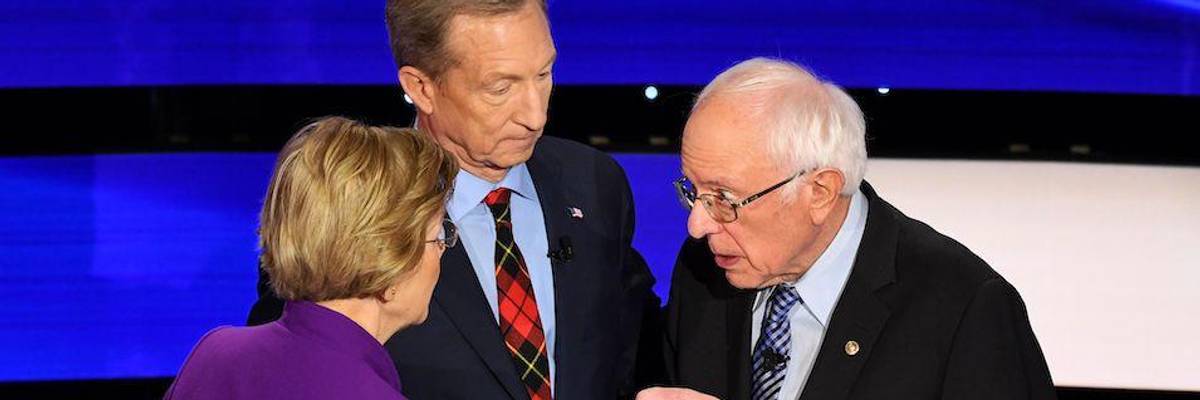
Democratic presidential hopeful Sen. Elizabeth Warren (D-Mass.) chats with Sen. Bernie Sanders (I-Vt.) alongside billionaire-philanthropist Tom Steyer during a break of the seventh Democratic primary debate of the 2020 presidential campaign season co-hosted by CNN and the Des Moines Register at the Drake University campus in Des Moines, Iowa on January 14, 2020.
This week, Elizabeth Warren released a statement confirming that Bernie Sanders told her a woman couldn't win the presidency. We know some liberal feminists have a tendency to weaponize trauma for personal gain, and what we've seen as a result of Warren's statement is further perversion of the language of abuse and victimhood in a context it was never meant to be used.
"Believe women," says Neera Tanden, President of the Center for American Progress and a former close advisor to Hillary Clinton. You might recall that Tanden outed a #metoo victim during an all-staff meeting, to the shock of those in attendance.
Sady Doyle, a liberal feminist "opinion leader," used similar language when tweeting about the situation, stating Elizabeth Warren is the "ONLY PERSON in a position to say whether what [Bernie] did was sexist." The force with which this is communicated almost acts as a distraction from the absurdity of extending the concept of letting victims speak their truth to include the situation at hand.
Moira Donegan, self described "angry feminist writer" and opinion columnist, took it a step further and broke down the situation into several now-familiar liberal feminist tropes, all of which have been misappropriated over and over for cynical purposes without care for how this impacts the people this language was originally meant to help. Nothing in this situation even approaches a "sexual assault allegation." Material retaliation would normally be used to describe employers retaliating against women who report harassment, for example. Gaslighting, a term which has become utterly meaningless, is meant to describe an abuse and manipulation tactic which causes a victim to question their own sanity, not a disagreement between politicians. Even victim blaming is invoked, in a case where there is arguably no victim. It is morally reprehensible to imply this is sexual assault or anything approaching interpersonal abuse.
Let's be clear: we're talking about two public figures in similar positions of power, discussing in a public forum what was intended to be a private conversation among peers. It is stripped of context. Did Sanders perhaps comment on Trump's misogynistic tactics that might demean a woman candidate and create a difficult situation? Was he referring to sexist attacks on previous woman candidates? We don't know. The conversation was leaked in only the vaguest terms, seemingly by the Warren campaign in an attempt to make Sanders look bad(apologies for "inventing nefarious motivations" about Warren's increasingly desperate campaign).
So what are people like Tanden, Doyle, and Donegan really saying when they use language previously reserved for victims of sexual abuse and harassment in this context? They're certainly not saying to believe and support sexual assault victims. The concept of womanhood has become abstracted for them, the meaning of the language has been lost. They're actually telling us what type of woman we should believe and in what context, which is exactly what "believe women" and similar language is meant to do away with.
They've turned "believe women" and similar phrases into a caricature of what they were meant to be. They've brought to life the bad faith criticisms usually leveled at feminists by misogynists and others who seek to silence victims. They've created a perpetual state of emergency. Anything perceived as an attack on a woman has become equal to abuse and trauma in the popular feminist vernacular. Framing all disagreements this way contributes to a self-perpetuating culture of perpetual fear. Everything is equally a threat. These threats can reveal themselves unexpectedly at any time, so you must always be vigilant. And ideally, read their books about it.
"Believe women" caught on as a political slogan with the emergence of the #metoo movement, but it has long been a general sentiment expressed by feminists and victims' rights advocates. So what exactly do we mean when say we should believe women?
Believing women means starting from a context where women are not liars. It means entering a conversation from a place of kindness and acceptance, and knowing that there is no harm in listening to someone's story with compassion. In a way, it's not very different from how you'd expect to enter most conversations with someone who you have no reason to distrust. It means protecting vulnerable and marginalized women who are most likely to be impacted by a system that consistently attacks, discredits, and harms them. The need for "believe women" as a political slogan came about because of the fact that in situations where women are victimized, they are typically first addressed with suspicion. You should not have to prove that you are not a liar as a prerequisite for discussing your trauma or asking for assistance.
So who needs to believe women? We need emergency and crisis workers to believe women and give them the care they need. We need law enforcement to believe women and investigate the crimes they report. We need our friends and family to believe us when we tell them we have been victimized. We need our peers to believe us when we say someone has violated our boundaries. Sadly, like the #metoo movement itself, the slogan has been distorted and repurposed by privileged liberal feminists. We need this language to describe actual instances of abuse, actual emergencies. In a context where minor disagreements are labeled sexual assault, we lose that language. As Sarah Schulman explains in Conflict is Not Abuse, "rhetorical devices that hide details keep truth from being known and faced." When everything is an emergency, nothing is.
Here's the truth: I don't care if Elizabeth Warren is believed about Bernie Sanders saying a woman couldn't be president. I don't care if a rich white woman has an equal peer tell her something that might be slightly bothersome depending on the context. It's not news, it's certainly not relevant to a presidential election, and it's absolutely not abuse or sexual assault. I do care about victims being believed and getting the support they need, and I care about perverting the language used to empower victims to seek that support. The people engaging in these theatrics care about winning. They care about controlling conversations and selling books. They don't care about women.
Dear Common Dreams reader, It’s been nearly 30 years since I co-founded Common Dreams with my late wife, Lina Newhouser. We had the radical notion that journalism should serve the public good, not corporate profits. It was clear to us from the outset what it would take to build such a project. No paid advertisements. No corporate sponsors. No millionaire publisher telling us what to think or do. Many people said we wouldn't last a year, but we proved those doubters wrong. Together with a tremendous team of journalists and dedicated staff, we built an independent media outlet free from the constraints of profits and corporate control. Our mission has always been simple: To inform. To inspire. To ignite change for the common good. Building Common Dreams was not easy. Our survival was never guaranteed. When you take on the most powerful forces—Wall Street greed, fossil fuel industry destruction, Big Tech lobbyists, and uber-rich oligarchs who have spent billions upon billions rigging the economy and democracy in their favor—the only bulwark you have is supporters who believe in your work. But here’s the urgent message from me today. It's never been this bad out there. And it's never been this hard to keep us going. At the very moment Common Dreams is most needed, the threats we face are intensifying. We need your support now more than ever. We don't accept corporate advertising and never will. We don't have a paywall because we don't think people should be blocked from critical news based on their ability to pay. Everything we do is funded by the donations of readers like you. When everyone does the little they can afford, we are strong. But if that support retreats or dries up, so do we. Will you donate now to make sure Common Dreams not only survives but thrives? —Craig Brown, Co-founder |
This week, Elizabeth Warren released a statement confirming that Bernie Sanders told her a woman couldn't win the presidency. We know some liberal feminists have a tendency to weaponize trauma for personal gain, and what we've seen as a result of Warren's statement is further perversion of the language of abuse and victimhood in a context it was never meant to be used.
"Believe women," says Neera Tanden, President of the Center for American Progress and a former close advisor to Hillary Clinton. You might recall that Tanden outed a #metoo victim during an all-staff meeting, to the shock of those in attendance.
Sady Doyle, a liberal feminist "opinion leader," used similar language when tweeting about the situation, stating Elizabeth Warren is the "ONLY PERSON in a position to say whether what [Bernie] did was sexist." The force with which this is communicated almost acts as a distraction from the absurdity of extending the concept of letting victims speak their truth to include the situation at hand.
Moira Donegan, self described "angry feminist writer" and opinion columnist, took it a step further and broke down the situation into several now-familiar liberal feminist tropes, all of which have been misappropriated over and over for cynical purposes without care for how this impacts the people this language was originally meant to help. Nothing in this situation even approaches a "sexual assault allegation." Material retaliation would normally be used to describe employers retaliating against women who report harassment, for example. Gaslighting, a term which has become utterly meaningless, is meant to describe an abuse and manipulation tactic which causes a victim to question their own sanity, not a disagreement between politicians. Even victim blaming is invoked, in a case where there is arguably no victim. It is morally reprehensible to imply this is sexual assault or anything approaching interpersonal abuse.
Let's be clear: we're talking about two public figures in similar positions of power, discussing in a public forum what was intended to be a private conversation among peers. It is stripped of context. Did Sanders perhaps comment on Trump's misogynistic tactics that might demean a woman candidate and create a difficult situation? Was he referring to sexist attacks on previous woman candidates? We don't know. The conversation was leaked in only the vaguest terms, seemingly by the Warren campaign in an attempt to make Sanders look bad(apologies for "inventing nefarious motivations" about Warren's increasingly desperate campaign).
So what are people like Tanden, Doyle, and Donegan really saying when they use language previously reserved for victims of sexual abuse and harassment in this context? They're certainly not saying to believe and support sexual assault victims. The concept of womanhood has become abstracted for them, the meaning of the language has been lost. They're actually telling us what type of woman we should believe and in what context, which is exactly what "believe women" and similar language is meant to do away with.
They've turned "believe women" and similar phrases into a caricature of what they were meant to be. They've brought to life the bad faith criticisms usually leveled at feminists by misogynists and others who seek to silence victims. They've created a perpetual state of emergency. Anything perceived as an attack on a woman has become equal to abuse and trauma in the popular feminist vernacular. Framing all disagreements this way contributes to a self-perpetuating culture of perpetual fear. Everything is equally a threat. These threats can reveal themselves unexpectedly at any time, so you must always be vigilant. And ideally, read their books about it.
"Believe women" caught on as a political slogan with the emergence of the #metoo movement, but it has long been a general sentiment expressed by feminists and victims' rights advocates. So what exactly do we mean when say we should believe women?
Believing women means starting from a context where women are not liars. It means entering a conversation from a place of kindness and acceptance, and knowing that there is no harm in listening to someone's story with compassion. In a way, it's not very different from how you'd expect to enter most conversations with someone who you have no reason to distrust. It means protecting vulnerable and marginalized women who are most likely to be impacted by a system that consistently attacks, discredits, and harms them. The need for "believe women" as a political slogan came about because of the fact that in situations where women are victimized, they are typically first addressed with suspicion. You should not have to prove that you are not a liar as a prerequisite for discussing your trauma or asking for assistance.
So who needs to believe women? We need emergency and crisis workers to believe women and give them the care they need. We need law enforcement to believe women and investigate the crimes they report. We need our friends and family to believe us when we tell them we have been victimized. We need our peers to believe us when we say someone has violated our boundaries. Sadly, like the #metoo movement itself, the slogan has been distorted and repurposed by privileged liberal feminists. We need this language to describe actual instances of abuse, actual emergencies. In a context where minor disagreements are labeled sexual assault, we lose that language. As Sarah Schulman explains in Conflict is Not Abuse, "rhetorical devices that hide details keep truth from being known and faced." When everything is an emergency, nothing is.
Here's the truth: I don't care if Elizabeth Warren is believed about Bernie Sanders saying a woman couldn't be president. I don't care if a rich white woman has an equal peer tell her something that might be slightly bothersome depending on the context. It's not news, it's certainly not relevant to a presidential election, and it's absolutely not abuse or sexual assault. I do care about victims being believed and getting the support they need, and I care about perverting the language used to empower victims to seek that support. The people engaging in these theatrics care about winning. They care about controlling conversations and selling books. They don't care about women.
This week, Elizabeth Warren released a statement confirming that Bernie Sanders told her a woman couldn't win the presidency. We know some liberal feminists have a tendency to weaponize trauma for personal gain, and what we've seen as a result of Warren's statement is further perversion of the language of abuse and victimhood in a context it was never meant to be used.
"Believe women," says Neera Tanden, President of the Center for American Progress and a former close advisor to Hillary Clinton. You might recall that Tanden outed a #metoo victim during an all-staff meeting, to the shock of those in attendance.
Sady Doyle, a liberal feminist "opinion leader," used similar language when tweeting about the situation, stating Elizabeth Warren is the "ONLY PERSON in a position to say whether what [Bernie] did was sexist." The force with which this is communicated almost acts as a distraction from the absurdity of extending the concept of letting victims speak their truth to include the situation at hand.
Moira Donegan, self described "angry feminist writer" and opinion columnist, took it a step further and broke down the situation into several now-familiar liberal feminist tropes, all of which have been misappropriated over and over for cynical purposes without care for how this impacts the people this language was originally meant to help. Nothing in this situation even approaches a "sexual assault allegation." Material retaliation would normally be used to describe employers retaliating against women who report harassment, for example. Gaslighting, a term which has become utterly meaningless, is meant to describe an abuse and manipulation tactic which causes a victim to question their own sanity, not a disagreement between politicians. Even victim blaming is invoked, in a case where there is arguably no victim. It is morally reprehensible to imply this is sexual assault or anything approaching interpersonal abuse.
Let's be clear: we're talking about two public figures in similar positions of power, discussing in a public forum what was intended to be a private conversation among peers. It is stripped of context. Did Sanders perhaps comment on Trump's misogynistic tactics that might demean a woman candidate and create a difficult situation? Was he referring to sexist attacks on previous woman candidates? We don't know. The conversation was leaked in only the vaguest terms, seemingly by the Warren campaign in an attempt to make Sanders look bad(apologies for "inventing nefarious motivations" about Warren's increasingly desperate campaign).
So what are people like Tanden, Doyle, and Donegan really saying when they use language previously reserved for victims of sexual abuse and harassment in this context? They're certainly not saying to believe and support sexual assault victims. The concept of womanhood has become abstracted for them, the meaning of the language has been lost. They're actually telling us what type of woman we should believe and in what context, which is exactly what "believe women" and similar language is meant to do away with.
They've turned "believe women" and similar phrases into a caricature of what they were meant to be. They've brought to life the bad faith criticisms usually leveled at feminists by misogynists and others who seek to silence victims. They've created a perpetual state of emergency. Anything perceived as an attack on a woman has become equal to abuse and trauma in the popular feminist vernacular. Framing all disagreements this way contributes to a self-perpetuating culture of perpetual fear. Everything is equally a threat. These threats can reveal themselves unexpectedly at any time, so you must always be vigilant. And ideally, read their books about it.
"Believe women" caught on as a political slogan with the emergence of the #metoo movement, but it has long been a general sentiment expressed by feminists and victims' rights advocates. So what exactly do we mean when say we should believe women?
Believing women means starting from a context where women are not liars. It means entering a conversation from a place of kindness and acceptance, and knowing that there is no harm in listening to someone's story with compassion. In a way, it's not very different from how you'd expect to enter most conversations with someone who you have no reason to distrust. It means protecting vulnerable and marginalized women who are most likely to be impacted by a system that consistently attacks, discredits, and harms them. The need for "believe women" as a political slogan came about because of the fact that in situations where women are victimized, they are typically first addressed with suspicion. You should not have to prove that you are not a liar as a prerequisite for discussing your trauma or asking for assistance.
So who needs to believe women? We need emergency and crisis workers to believe women and give them the care they need. We need law enforcement to believe women and investigate the crimes they report. We need our friends and family to believe us when we tell them we have been victimized. We need our peers to believe us when we say someone has violated our boundaries. Sadly, like the #metoo movement itself, the slogan has been distorted and repurposed by privileged liberal feminists. We need this language to describe actual instances of abuse, actual emergencies. In a context where minor disagreements are labeled sexual assault, we lose that language. As Sarah Schulman explains in Conflict is Not Abuse, "rhetorical devices that hide details keep truth from being known and faced." When everything is an emergency, nothing is.
Here's the truth: I don't care if Elizabeth Warren is believed about Bernie Sanders saying a woman couldn't be president. I don't care if a rich white woman has an equal peer tell her something that might be slightly bothersome depending on the context. It's not news, it's certainly not relevant to a presidential election, and it's absolutely not abuse or sexual assault. I do care about victims being believed and getting the support they need, and I care about perverting the language used to empower victims to seek that support. The people engaging in these theatrics care about winning. They care about controlling conversations and selling books. They don't care about women.