SUBSCRIBE TO OUR FREE NEWSLETTER
Daily news & progressive opinion—funded by the people, not the corporations—delivered straight to your inbox.
5
#000000
#FFFFFF
To donate by check, phone, or other method, see our More Ways to Give page.
Daily news & progressive opinion—funded by the people, not the corporations—delivered straight to your inbox.
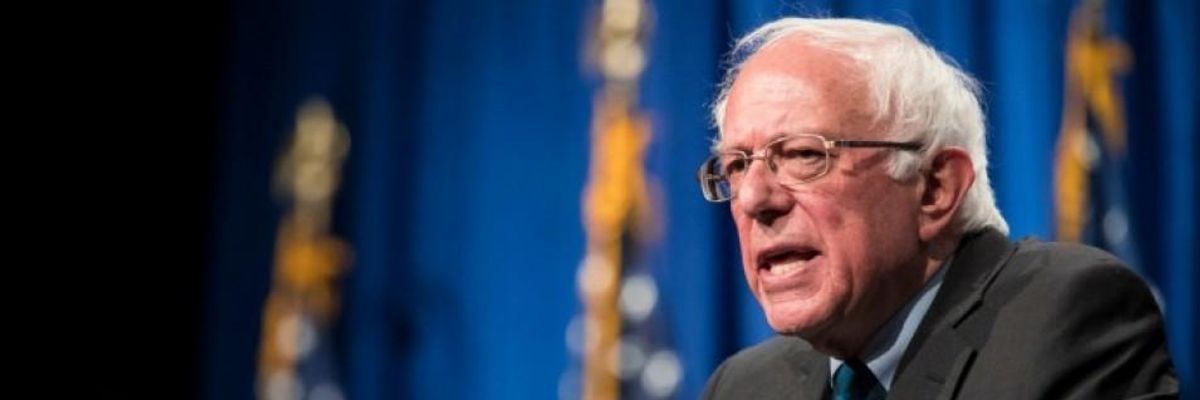
Sanders' commitment to worldwide leftism was apparent even before he announced his second run for president. (Photo: Sarah Silbiger/Getty Images)
Leftist leaders from the United Kingdom to South America have a clear ally in the U.S. presidential election. In a crowded presidential primary, Bernie Sanders has distinguished himself from centrists like Joe Biden and Pete Buttigieg and even fellow progressive Elizabeth Warren by calling the ouster of Bolivia's former President Evo Morales a coup, praising Brazil's former President Luiz Inacio Lula da Silva and drawing parallels between his campaign and mass protests in Chile, Lebanon and Iraq.
Sanders' support for international far-left leaders, Politico explains, "are a clear mark of distinction from Warren in a race in which their domestic agendas are viewed as very similar."
"Bernie is the only candidate who has a comprehensive foreign policy vision to stand up to the growing movement of anti-democratic authoritarianism worldwide and find solidarity with working people around the world who, in many cases, share common needs," Josh Orton, Sanders' national policy director, told Politico.
During a Democratic candidate forum hosted by Spanish-language channel Univision, Sanders said, "I think Morales did a very good job in alleviating poverty and giving the indigenous people of Bolivia a voice that they never had before." Of Morales' ouster, Sanders added, "When the military intervenes ... in my view, that's called a 'coup.' "
Sanders also said that Lula "has done more than anyone to lower poverty in [the country] and to stand up for workers." In 2017, he said he was "very impressed" by UK Labour leader Jeremy Corbyn's campaign, he saw "a real similarity" between their positions, and that he particularly appreciated Corbyn's willingness to take on class issues.
Sanders' commitment to worldwide leftism was apparent even before he announced his second run for president. In one 2017 speech, he called interventions in Asia, the Middle East and Latin America "just a few examples of American foreign policy and interventionism which proved to be counterproductive."
So far, the world leaders appear to return the affection. Morales called him "hermano Bernie Sanders." Lula thanked him for the solidarity.
As Truthdig's Jacob Sugarman has observed about Morales' ouster, "the response of leading Democrats and presidential hopefuls has been one of almost total silence, even among the party's putative progressives." Warren, Sugarman observes, "declined to comment publicly despite the gruesome precedent in the region." Politico points out that a few days after Sanders' initial comments, when pressed by The Young Turks on whether Morales' ouster was a coup, Warren changed her tone and said, it "sure looks like that."
In general, Warren has attempted an "all things to all people" approach on foreign policy. In a 2018 speech at American University, she described America's involvement in international politics thusly: "It wasn't perfect -- we weren't perfect -- but our foreign policy benefited a lot of people around the world."
Read the full Politico story here.
Dear Common Dreams reader, It’s been nearly 30 years since I co-founded Common Dreams with my late wife, Lina Newhouser. We had the radical notion that journalism should serve the public good, not corporate profits. It was clear to us from the outset what it would take to build such a project. No paid advertisements. No corporate sponsors. No millionaire publisher telling us what to think or do. Many people said we wouldn't last a year, but we proved those doubters wrong. Together with a tremendous team of journalists and dedicated staff, we built an independent media outlet free from the constraints of profits and corporate control. Our mission has always been simple: To inform. To inspire. To ignite change for the common good. Building Common Dreams was not easy. Our survival was never guaranteed. When you take on the most powerful forces—Wall Street greed, fossil fuel industry destruction, Big Tech lobbyists, and uber-rich oligarchs who have spent billions upon billions rigging the economy and democracy in their favor—the only bulwark you have is supporters who believe in your work. But here’s the urgent message from me today. It's never been this bad out there. And it's never been this hard to keep us going. At the very moment Common Dreams is most needed, the threats we face are intensifying. We need your support now more than ever. We don't accept corporate advertising and never will. We don't have a paywall because we don't think people should be blocked from critical news based on their ability to pay. Everything we do is funded by the donations of readers like you. When everyone does the little they can afford, we are strong. But if that support retreats or dries up, so do we. Will you donate now to make sure Common Dreams not only survives but thrives? —Craig Brown, Co-founder |
Leftist leaders from the United Kingdom to South America have a clear ally in the U.S. presidential election. In a crowded presidential primary, Bernie Sanders has distinguished himself from centrists like Joe Biden and Pete Buttigieg and even fellow progressive Elizabeth Warren by calling the ouster of Bolivia's former President Evo Morales a coup, praising Brazil's former President Luiz Inacio Lula da Silva and drawing parallels between his campaign and mass protests in Chile, Lebanon and Iraq.
Sanders' support for international far-left leaders, Politico explains, "are a clear mark of distinction from Warren in a race in which their domestic agendas are viewed as very similar."
"Bernie is the only candidate who has a comprehensive foreign policy vision to stand up to the growing movement of anti-democratic authoritarianism worldwide and find solidarity with working people around the world who, in many cases, share common needs," Josh Orton, Sanders' national policy director, told Politico.
During a Democratic candidate forum hosted by Spanish-language channel Univision, Sanders said, "I think Morales did a very good job in alleviating poverty and giving the indigenous people of Bolivia a voice that they never had before." Of Morales' ouster, Sanders added, "When the military intervenes ... in my view, that's called a 'coup.' "
Sanders also said that Lula "has done more than anyone to lower poverty in [the country] and to stand up for workers." In 2017, he said he was "very impressed" by UK Labour leader Jeremy Corbyn's campaign, he saw "a real similarity" between their positions, and that he particularly appreciated Corbyn's willingness to take on class issues.
Sanders' commitment to worldwide leftism was apparent even before he announced his second run for president. In one 2017 speech, he called interventions in Asia, the Middle East and Latin America "just a few examples of American foreign policy and interventionism which proved to be counterproductive."
So far, the world leaders appear to return the affection. Morales called him "hermano Bernie Sanders." Lula thanked him for the solidarity.
As Truthdig's Jacob Sugarman has observed about Morales' ouster, "the response of leading Democrats and presidential hopefuls has been one of almost total silence, even among the party's putative progressives." Warren, Sugarman observes, "declined to comment publicly despite the gruesome precedent in the region." Politico points out that a few days after Sanders' initial comments, when pressed by The Young Turks on whether Morales' ouster was a coup, Warren changed her tone and said, it "sure looks like that."
In general, Warren has attempted an "all things to all people" approach on foreign policy. In a 2018 speech at American University, she described America's involvement in international politics thusly: "It wasn't perfect -- we weren't perfect -- but our foreign policy benefited a lot of people around the world."
Read the full Politico story here.
Leftist leaders from the United Kingdom to South America have a clear ally in the U.S. presidential election. In a crowded presidential primary, Bernie Sanders has distinguished himself from centrists like Joe Biden and Pete Buttigieg and even fellow progressive Elizabeth Warren by calling the ouster of Bolivia's former President Evo Morales a coup, praising Brazil's former President Luiz Inacio Lula da Silva and drawing parallels between his campaign and mass protests in Chile, Lebanon and Iraq.
Sanders' support for international far-left leaders, Politico explains, "are a clear mark of distinction from Warren in a race in which their domestic agendas are viewed as very similar."
"Bernie is the only candidate who has a comprehensive foreign policy vision to stand up to the growing movement of anti-democratic authoritarianism worldwide and find solidarity with working people around the world who, in many cases, share common needs," Josh Orton, Sanders' national policy director, told Politico.
During a Democratic candidate forum hosted by Spanish-language channel Univision, Sanders said, "I think Morales did a very good job in alleviating poverty and giving the indigenous people of Bolivia a voice that they never had before." Of Morales' ouster, Sanders added, "When the military intervenes ... in my view, that's called a 'coup.' "
Sanders also said that Lula "has done more than anyone to lower poverty in [the country] and to stand up for workers." In 2017, he said he was "very impressed" by UK Labour leader Jeremy Corbyn's campaign, he saw "a real similarity" between their positions, and that he particularly appreciated Corbyn's willingness to take on class issues.
Sanders' commitment to worldwide leftism was apparent even before he announced his second run for president. In one 2017 speech, he called interventions in Asia, the Middle East and Latin America "just a few examples of American foreign policy and interventionism which proved to be counterproductive."
So far, the world leaders appear to return the affection. Morales called him "hermano Bernie Sanders." Lula thanked him for the solidarity.
As Truthdig's Jacob Sugarman has observed about Morales' ouster, "the response of leading Democrats and presidential hopefuls has been one of almost total silence, even among the party's putative progressives." Warren, Sugarman observes, "declined to comment publicly despite the gruesome precedent in the region." Politico points out that a few days after Sanders' initial comments, when pressed by The Young Turks on whether Morales' ouster was a coup, Warren changed her tone and said, it "sure looks like that."
In general, Warren has attempted an "all things to all people" approach on foreign policy. In a 2018 speech at American University, she described America's involvement in international politics thusly: "It wasn't perfect -- we weren't perfect -- but our foreign policy benefited a lot of people around the world."
Read the full Politico story here.