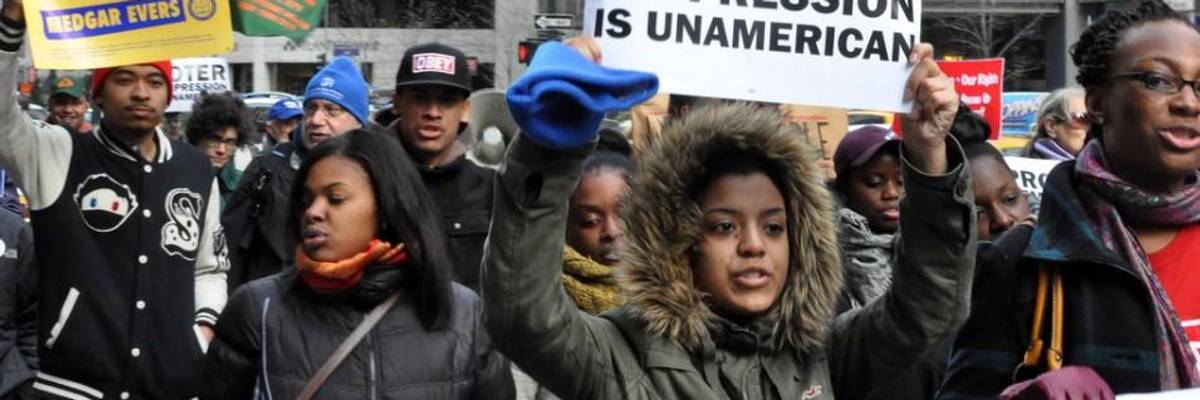
The only way to counter these measures is massive citizen mobilization--and to elect leaders who will make the right to vote a priority. (Photo: Flickr/cc)
The Right to Vote Should Not Fall Victim to Partisan Battles
Republican state legislators and governors push measures to suppress the vote of targeted populations.
The right to vote is fundamental to any democracy. Protecting that right--and making it easier to exercise it--ought to be a priority across partisan lines.
Instead, in states across the country--particularly in the five years since the Supreme Court gutted the Voting Rights Act--it has become a pitched battle.
The basic reality is clear: Republicans, increasingly a party of older, white voters, have chosen not to reach out to Hispanics, African Americans or the young, but instead seek ways to make it harder for them to vote -- or for their votes to count. Backed by right-wing think tanks, Republican state legislators and governors push a slew of measures to suppress the vote of targeted populations. These are increasingly challenged in courts and protested on the streets.
Across the country, instead of making voter registration automatic and adopting same-day registration, Republican-led states are making registration harder.
Alabama, for example, is a state that is over one-fourth African American. Yet it has had all white appellate court justices for a quarter-century. This was locked in by requiring at-large statewide elections for both appellate and Supreme Court judges instead of district elections where African American candidates would have a good chance of being elected in some areas. This practice--followed in Texas against Hispanic voters--is now being challenged in a lawsuit filed by the Alabama State Conference of the NAACP.
At-large elections are only one of the tactics tried by the Republican power structure in Alabama.
Since the Supreme Court's Shelby decision that ended federal pre-approval of voting rights changes, Alabama has passed measures to require a photo ID to vote while seeking to close driver's license offices disproportionately in black areas. They sought to impose a "proof of citizenship" mandate to register to vote in state and local elections. Dozens of polling places were closed, disproportionately in areas with large African American populations. Get-out-the-vote efforts were made more difficult with the passage of a ban on financial transfers from one PAC to another, an act aimed at the leading organizations working on African American turnout, which got much of their revenue from other political entities. Alabama has also begun the process of purging the voting rolls. When the state legislature passed a measure giving felons who had served their sentences the right to vote, the state government refused to do anything to inform people that their rights had been restored. Some of these measures have been stalled by judicial decisions, but the effort to constrict the vote continues.
Across the country, instead of making voter registration automatic and adopting same-day registration, Republican-led states are making registration harder. Instead of expanding days to vote, they are limiting them. Instead of encouraging voter registration drives, they are adopting various measures to criminalize the activities of voter registration groups. Partisan gerrymandering gets ever more sophisticated. Hackable voting machines pose a true threat of even getting an honest count. Closing polling stations forces some--again, disproportionately those from minority or poor districts--to travel longer and wait in long lines to vote.
The only way to counter these measures is massive citizen mobilization--and to elect leaders who will make the right to vote a priority. In 2018, efforts to restrict the right to vote overwhelmed a voter turnout that was the highest since 1914. In 2020, with the fundamental direction of the country at stake, another record turnout is vital. Upon gaining the majority in the House of Representatives in 2018, Democrats immediately passed HR 1, the most extensive election and democracy reform bill since the Voting Rights Act. Among other things, it would adopt same-day voter registration, limit the role of big money in elections, curb political gerrymanders and much more. That bill sits on the desk of Republican Senate Majority Leader Mitch McConnell, who won't even allow it to come to a vote.
If voters overcome the tricks and traps designed to make voting difficult and vote in large numbers in 2020, fundamental democratic reform is teed up to move.
We are at a crossroads
This country and this world are at a monumental crossroads. In a few short weeks, US voters will have an opportunity to beat back the forces of fascism and confront the billionaires who are rigging the economy, our media system, and our democracy, making it increasingly impossible for ordinary people to get by. We’re not just talking about the election. We’re talking about what must be done once these fascist elements are vanquished from power. We need a bolder set of solutions than what either major party has so far been willing to offer and a working-class movement ready to fight like hell for it. Trump didn't emerge from nowhere. The conditions that fueled MAGA authoritarianism were created by decades of radical neoliberal economic policies and a corrupt political system dominated by corporate interests. They slashed taxes on the super-rich, promising that the benefits would trickle down. They said giveaways to the corporate titans would make life more affordable for the rest of us. It was all bullshit. And when a bitter, betrayed populace searches for someone to blame, right-wing demagogues have little trouble finding scapegoats. People know when they're being lied to, but you won't hear any of this from the corporate media. Only independent journalism—powered and funded by people who believe in building a better world—can deliver truly trustworthy daily news. Our Fall Campaign is underway, and we need your help. To power our newsroom through the rest of the year, we need to raise $125,000 by midnight on October 31. So if you share our vision, please contribute whatever you can to sustain our work. |
The right to vote is fundamental to any democracy. Protecting that right--and making it easier to exercise it--ought to be a priority across partisan lines.
Instead, in states across the country--particularly in the five years since the Supreme Court gutted the Voting Rights Act--it has become a pitched battle.
The basic reality is clear: Republicans, increasingly a party of older, white voters, have chosen not to reach out to Hispanics, African Americans or the young, but instead seek ways to make it harder for them to vote -- or for their votes to count. Backed by right-wing think tanks, Republican state legislators and governors push a slew of measures to suppress the vote of targeted populations. These are increasingly challenged in courts and protested on the streets.
Across the country, instead of making voter registration automatic and adopting same-day registration, Republican-led states are making registration harder.
Alabama, for example, is a state that is over one-fourth African American. Yet it has had all white appellate court justices for a quarter-century. This was locked in by requiring at-large statewide elections for both appellate and Supreme Court judges instead of district elections where African American candidates would have a good chance of being elected in some areas. This practice--followed in Texas against Hispanic voters--is now being challenged in a lawsuit filed by the Alabama State Conference of the NAACP.
At-large elections are only one of the tactics tried by the Republican power structure in Alabama.
Since the Supreme Court's Shelby decision that ended federal pre-approval of voting rights changes, Alabama has passed measures to require a photo ID to vote while seeking to close driver's license offices disproportionately in black areas. They sought to impose a "proof of citizenship" mandate to register to vote in state and local elections. Dozens of polling places were closed, disproportionately in areas with large African American populations. Get-out-the-vote efforts were made more difficult with the passage of a ban on financial transfers from one PAC to another, an act aimed at the leading organizations working on African American turnout, which got much of their revenue from other political entities. Alabama has also begun the process of purging the voting rolls. When the state legislature passed a measure giving felons who had served their sentences the right to vote, the state government refused to do anything to inform people that their rights had been restored. Some of these measures have been stalled by judicial decisions, but the effort to constrict the vote continues.
Across the country, instead of making voter registration automatic and adopting same-day registration, Republican-led states are making registration harder. Instead of expanding days to vote, they are limiting them. Instead of encouraging voter registration drives, they are adopting various measures to criminalize the activities of voter registration groups. Partisan gerrymandering gets ever more sophisticated. Hackable voting machines pose a true threat of even getting an honest count. Closing polling stations forces some--again, disproportionately those from minority or poor districts--to travel longer and wait in long lines to vote.
The only way to counter these measures is massive citizen mobilization--and to elect leaders who will make the right to vote a priority. In 2018, efforts to restrict the right to vote overwhelmed a voter turnout that was the highest since 1914. In 2020, with the fundamental direction of the country at stake, another record turnout is vital. Upon gaining the majority in the House of Representatives in 2018, Democrats immediately passed HR 1, the most extensive election and democracy reform bill since the Voting Rights Act. Among other things, it would adopt same-day voter registration, limit the role of big money in elections, curb political gerrymanders and much more. That bill sits on the desk of Republican Senate Majority Leader Mitch McConnell, who won't even allow it to come to a vote.
If voters overcome the tricks and traps designed to make voting difficult and vote in large numbers in 2020, fundamental democratic reform is teed up to move.
The right to vote is fundamental to any democracy. Protecting that right--and making it easier to exercise it--ought to be a priority across partisan lines.
Instead, in states across the country--particularly in the five years since the Supreme Court gutted the Voting Rights Act--it has become a pitched battle.
The basic reality is clear: Republicans, increasingly a party of older, white voters, have chosen not to reach out to Hispanics, African Americans or the young, but instead seek ways to make it harder for them to vote -- or for their votes to count. Backed by right-wing think tanks, Republican state legislators and governors push a slew of measures to suppress the vote of targeted populations. These are increasingly challenged in courts and protested on the streets.
Across the country, instead of making voter registration automatic and adopting same-day registration, Republican-led states are making registration harder.
Alabama, for example, is a state that is over one-fourth African American. Yet it has had all white appellate court justices for a quarter-century. This was locked in by requiring at-large statewide elections for both appellate and Supreme Court judges instead of district elections where African American candidates would have a good chance of being elected in some areas. This practice--followed in Texas against Hispanic voters--is now being challenged in a lawsuit filed by the Alabama State Conference of the NAACP.
At-large elections are only one of the tactics tried by the Republican power structure in Alabama.
Since the Supreme Court's Shelby decision that ended federal pre-approval of voting rights changes, Alabama has passed measures to require a photo ID to vote while seeking to close driver's license offices disproportionately in black areas. They sought to impose a "proof of citizenship" mandate to register to vote in state and local elections. Dozens of polling places were closed, disproportionately in areas with large African American populations. Get-out-the-vote efforts were made more difficult with the passage of a ban on financial transfers from one PAC to another, an act aimed at the leading organizations working on African American turnout, which got much of their revenue from other political entities. Alabama has also begun the process of purging the voting rolls. When the state legislature passed a measure giving felons who had served their sentences the right to vote, the state government refused to do anything to inform people that their rights had been restored. Some of these measures have been stalled by judicial decisions, but the effort to constrict the vote continues.
Across the country, instead of making voter registration automatic and adopting same-day registration, Republican-led states are making registration harder. Instead of expanding days to vote, they are limiting them. Instead of encouraging voter registration drives, they are adopting various measures to criminalize the activities of voter registration groups. Partisan gerrymandering gets ever more sophisticated. Hackable voting machines pose a true threat of even getting an honest count. Closing polling stations forces some--again, disproportionately those from minority or poor districts--to travel longer and wait in long lines to vote.
The only way to counter these measures is massive citizen mobilization--and to elect leaders who will make the right to vote a priority. In 2018, efforts to restrict the right to vote overwhelmed a voter turnout that was the highest since 1914. In 2020, with the fundamental direction of the country at stake, another record turnout is vital. Upon gaining the majority in the House of Representatives in 2018, Democrats immediately passed HR 1, the most extensive election and democracy reform bill since the Voting Rights Act. Among other things, it would adopt same-day voter registration, limit the role of big money in elections, curb political gerrymanders and much more. That bill sits on the desk of Republican Senate Majority Leader Mitch McConnell, who won't even allow it to come to a vote.
If voters overcome the tricks and traps designed to make voting difficult and vote in large numbers in 2020, fundamental democratic reform is teed up to move.