SUBSCRIBE TO OUR FREE NEWSLETTER
Daily news & progressive opinion—funded by the people, not the corporations—delivered straight to your inbox.
5
#000000
#FFFFFF
To donate by check, phone, or other method, see our More Ways to Give page.
Daily news & progressive opinion—funded by the people, not the corporations—delivered straight to your inbox.
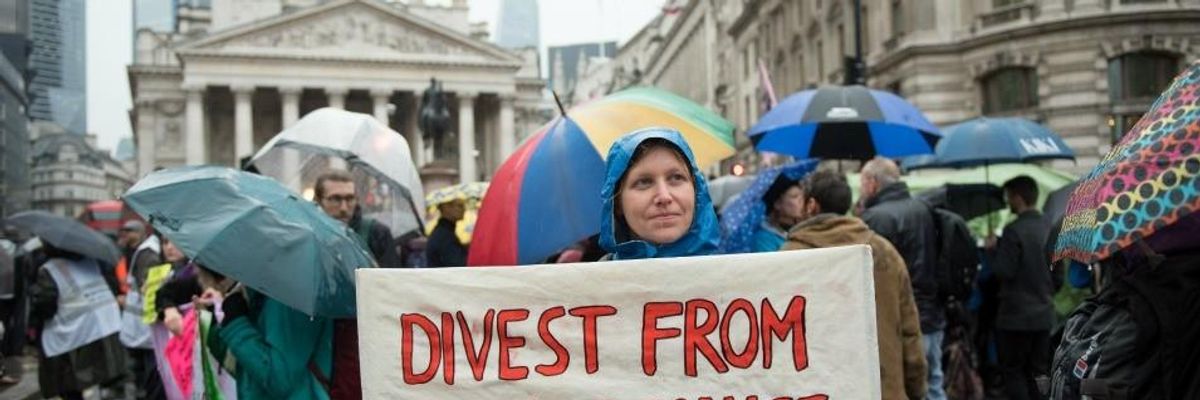
An Extinction Rebellion protester holds up a placard saying "Divest from climate change" on October 14, 2019 in London, England. (Photo by John Keeble/Getty Images)
As climate wins go this has been a long time coming but it is also a big one. It should not be understated.
For years climate campaigners and organizations such as Oil Change International (OCI) along with scientists, students and huge sections of civil society, have been targeting the hugely wealthy and influential European Investment Bank (EIB) to stop funding fossil fuels.
The reason was simple: the EIB is the world's largest multilateral development bank. And despite the climate crisis, the Bank was still funding large amounts of fossil fuel projects.
According to a previous analysis by OCI, since 2013 the EIB's fossil fuel finance has averaged more than EUR 2 billion annually. Despite growing evidence that gas is neither green nor a bridging fuel, the largest portion of this funding has been going to gas infrastructure projects.
Under increasing pressure to act, back in July this year, the EIB's Board proposed a potentially ground-breaking policy to stop all loans to fossil fuel projects from 2020, based on the urgent need for the E.U. to decarbonise in line with the Paris Agreement goals. But there was resistance from Germany and other fossil fuel friendly member states to carry on financing gas.
However, earlier this week, in the run up to yesterday's Board meeting, as they prepared to vote on excluding natural gas from its lending policy, lawyers from ClientEarth issued a clear warning: continuing to finance fossil fuels would breach the Bank's legal duties.
ClientEarth CEO, James Thornton, said: "Our message to the EIB's Board of Directors is clear: it must revert to its original draft policy, cutting gas lending out of its portfolio and channelling investments instead into clean energy and carbon-neutral solutions. In the transition to net-zero, it is impossible to justify ongoing finance to fossil fuels from the public purse."
And yesterday, after what was described as a "marathon board meeting", the EIB announced it will end financing for fossil fuel energy projects, not from the end of 2020, but from the end of 2021.
It added that the EIB will align all financing activities with the goals of the Paris Agreement from the end of 2020. Furthermore, its financing will "unlock EUR 1 trillion of climate action and environmental sustainable investment in the decade to 2030."
After the Board meeting, EIB President Werner Hoyer, said: "Climate is the top issue on the political agenda of our time. Scientists estimate that we are currently heading for 3-4degC of temperature increase by the end of the century. If that happens, large portions of our planet will become uninhabitable, with disastrous consequences for people around the world."
He added: "The EU bank has been Europe's climate bank for many years. Today it has decided to make a quantum leap in its ambition. We will stop financing fossil fuels and we will launch the most ambitious climate investment strategy of any public financial institution anywhere."
The EIB press release celebrating the policy also gave a nod to the power of activism, citing the petitions signed by tens of thousands of people who called on the Bank to stop funding fossils.
Although the cut off date was one year later than the draft policy, this is still a significant win for the climate. However, there are caveats as well. According to an analysis by the Financial Times, "Under the new regime, certain low-emission gas projects will still be possible, as long as they meet a new lower emissions performance standard of 250 grammes of Co2 per kilowatt/hour."
After hearing the news, Alex Doukas, the Lead Analyst with OCI, who has been working on this issue for years, said: "This new policy is a signal to the wider financial community that the era of fossil fuels is past. The policy approved today positions the EIB ahead of its peers by starting from the assumption that new fossil fuel infrastructure is not acceptable if we are serious about fighting climate change".
Doukas did criticise the EIB for caving in to lobbying by Germany and the European Commission over the gas "loopholes". "The inability of the EIB to pass a policy consistent with the Paris Agreement underscores the hold the fossil fuel industry still has over EU politics," he said.
What is clear now, is that other multilateral development banks must now act too. Nick Mabey, the chief executive of think-tank E3G, said "The EIB is sending a message to other financial institutions that investment in fossil fuels is drawing to an end."
Sebastien Godinot, an economist at WWF's European policy office, added: "All public and private banks must now follow suit and end funding of coal, oil and gas to safeguard investments and tackle the climate crisis."
Kate Cahoon, from 350.org, also commented that "When the world's biggest public lender decides to largely ditch fossil fuels, financial markets across the globe will take notice: this is the beginning of the end of climate-wrecking fossil fuel finance."
Dear Common Dreams reader, It’s been nearly 30 years since I co-founded Common Dreams with my late wife, Lina Newhouser. We had the radical notion that journalism should serve the public good, not corporate profits. It was clear to us from the outset what it would take to build such a project. No paid advertisements. No corporate sponsors. No millionaire publisher telling us what to think or do. Many people said we wouldn't last a year, but we proved those doubters wrong. Together with a tremendous team of journalists and dedicated staff, we built an independent media outlet free from the constraints of profits and corporate control. Our mission has always been simple: To inform. To inspire. To ignite change for the common good. Building Common Dreams was not easy. Our survival was never guaranteed. When you take on the most powerful forces—Wall Street greed, fossil fuel industry destruction, Big Tech lobbyists, and uber-rich oligarchs who have spent billions upon billions rigging the economy and democracy in their favor—the only bulwark you have is supporters who believe in your work. But here’s the urgent message from me today. It's never been this bad out there. And it's never been this hard to keep us going. At the very moment Common Dreams is most needed, the threats we face are intensifying. We need your support now more than ever. We don't accept corporate advertising and never will. We don't have a paywall because we don't think people should be blocked from critical news based on their ability to pay. Everything we do is funded by the donations of readers like you. When everyone does the little they can afford, we are strong. But if that support retreats or dries up, so do we. Will you donate now to make sure Common Dreams not only survives but thrives? —Craig Brown, Co-founder |
As climate wins go this has been a long time coming but it is also a big one. It should not be understated.
For years climate campaigners and organizations such as Oil Change International (OCI) along with scientists, students and huge sections of civil society, have been targeting the hugely wealthy and influential European Investment Bank (EIB) to stop funding fossil fuels.
The reason was simple: the EIB is the world's largest multilateral development bank. And despite the climate crisis, the Bank was still funding large amounts of fossil fuel projects.
According to a previous analysis by OCI, since 2013 the EIB's fossil fuel finance has averaged more than EUR 2 billion annually. Despite growing evidence that gas is neither green nor a bridging fuel, the largest portion of this funding has been going to gas infrastructure projects.
Under increasing pressure to act, back in July this year, the EIB's Board proposed a potentially ground-breaking policy to stop all loans to fossil fuel projects from 2020, based on the urgent need for the E.U. to decarbonise in line with the Paris Agreement goals. But there was resistance from Germany and other fossil fuel friendly member states to carry on financing gas.
However, earlier this week, in the run up to yesterday's Board meeting, as they prepared to vote on excluding natural gas from its lending policy, lawyers from ClientEarth issued a clear warning: continuing to finance fossil fuels would breach the Bank's legal duties.
ClientEarth CEO, James Thornton, said: "Our message to the EIB's Board of Directors is clear: it must revert to its original draft policy, cutting gas lending out of its portfolio and channelling investments instead into clean energy and carbon-neutral solutions. In the transition to net-zero, it is impossible to justify ongoing finance to fossil fuels from the public purse."
And yesterday, after what was described as a "marathon board meeting", the EIB announced it will end financing for fossil fuel energy projects, not from the end of 2020, but from the end of 2021.
It added that the EIB will align all financing activities with the goals of the Paris Agreement from the end of 2020. Furthermore, its financing will "unlock EUR 1 trillion of climate action and environmental sustainable investment in the decade to 2030."
After the Board meeting, EIB President Werner Hoyer, said: "Climate is the top issue on the political agenda of our time. Scientists estimate that we are currently heading for 3-4degC of temperature increase by the end of the century. If that happens, large portions of our planet will become uninhabitable, with disastrous consequences for people around the world."
He added: "The EU bank has been Europe's climate bank for many years. Today it has decided to make a quantum leap in its ambition. We will stop financing fossil fuels and we will launch the most ambitious climate investment strategy of any public financial institution anywhere."
The EIB press release celebrating the policy also gave a nod to the power of activism, citing the petitions signed by tens of thousands of people who called on the Bank to stop funding fossils.
Although the cut off date was one year later than the draft policy, this is still a significant win for the climate. However, there are caveats as well. According to an analysis by the Financial Times, "Under the new regime, certain low-emission gas projects will still be possible, as long as they meet a new lower emissions performance standard of 250 grammes of Co2 per kilowatt/hour."
After hearing the news, Alex Doukas, the Lead Analyst with OCI, who has been working on this issue for years, said: "This new policy is a signal to the wider financial community that the era of fossil fuels is past. The policy approved today positions the EIB ahead of its peers by starting from the assumption that new fossil fuel infrastructure is not acceptable if we are serious about fighting climate change".
Doukas did criticise the EIB for caving in to lobbying by Germany and the European Commission over the gas "loopholes". "The inability of the EIB to pass a policy consistent with the Paris Agreement underscores the hold the fossil fuel industry still has over EU politics," he said.
What is clear now, is that other multilateral development banks must now act too. Nick Mabey, the chief executive of think-tank E3G, said "The EIB is sending a message to other financial institutions that investment in fossil fuels is drawing to an end."
Sebastien Godinot, an economist at WWF's European policy office, added: "All public and private banks must now follow suit and end funding of coal, oil and gas to safeguard investments and tackle the climate crisis."
Kate Cahoon, from 350.org, also commented that "When the world's biggest public lender decides to largely ditch fossil fuels, financial markets across the globe will take notice: this is the beginning of the end of climate-wrecking fossil fuel finance."
As climate wins go this has been a long time coming but it is also a big one. It should not be understated.
For years climate campaigners and organizations such as Oil Change International (OCI) along with scientists, students and huge sections of civil society, have been targeting the hugely wealthy and influential European Investment Bank (EIB) to stop funding fossil fuels.
The reason was simple: the EIB is the world's largest multilateral development bank. And despite the climate crisis, the Bank was still funding large amounts of fossil fuel projects.
According to a previous analysis by OCI, since 2013 the EIB's fossil fuel finance has averaged more than EUR 2 billion annually. Despite growing evidence that gas is neither green nor a bridging fuel, the largest portion of this funding has been going to gas infrastructure projects.
Under increasing pressure to act, back in July this year, the EIB's Board proposed a potentially ground-breaking policy to stop all loans to fossil fuel projects from 2020, based on the urgent need for the E.U. to decarbonise in line with the Paris Agreement goals. But there was resistance from Germany and other fossil fuel friendly member states to carry on financing gas.
However, earlier this week, in the run up to yesterday's Board meeting, as they prepared to vote on excluding natural gas from its lending policy, lawyers from ClientEarth issued a clear warning: continuing to finance fossil fuels would breach the Bank's legal duties.
ClientEarth CEO, James Thornton, said: "Our message to the EIB's Board of Directors is clear: it must revert to its original draft policy, cutting gas lending out of its portfolio and channelling investments instead into clean energy and carbon-neutral solutions. In the transition to net-zero, it is impossible to justify ongoing finance to fossil fuels from the public purse."
And yesterday, after what was described as a "marathon board meeting", the EIB announced it will end financing for fossil fuel energy projects, not from the end of 2020, but from the end of 2021.
It added that the EIB will align all financing activities with the goals of the Paris Agreement from the end of 2020. Furthermore, its financing will "unlock EUR 1 trillion of climate action and environmental sustainable investment in the decade to 2030."
After the Board meeting, EIB President Werner Hoyer, said: "Climate is the top issue on the political agenda of our time. Scientists estimate that we are currently heading for 3-4degC of temperature increase by the end of the century. If that happens, large portions of our planet will become uninhabitable, with disastrous consequences for people around the world."
He added: "The EU bank has been Europe's climate bank for many years. Today it has decided to make a quantum leap in its ambition. We will stop financing fossil fuels and we will launch the most ambitious climate investment strategy of any public financial institution anywhere."
The EIB press release celebrating the policy also gave a nod to the power of activism, citing the petitions signed by tens of thousands of people who called on the Bank to stop funding fossils.
Although the cut off date was one year later than the draft policy, this is still a significant win for the climate. However, there are caveats as well. According to an analysis by the Financial Times, "Under the new regime, certain low-emission gas projects will still be possible, as long as they meet a new lower emissions performance standard of 250 grammes of Co2 per kilowatt/hour."
After hearing the news, Alex Doukas, the Lead Analyst with OCI, who has been working on this issue for years, said: "This new policy is a signal to the wider financial community that the era of fossil fuels is past. The policy approved today positions the EIB ahead of its peers by starting from the assumption that new fossil fuel infrastructure is not acceptable if we are serious about fighting climate change".
Doukas did criticise the EIB for caving in to lobbying by Germany and the European Commission over the gas "loopholes". "The inability of the EIB to pass a policy consistent with the Paris Agreement underscores the hold the fossil fuel industry still has over EU politics," he said.
What is clear now, is that other multilateral development banks must now act too. Nick Mabey, the chief executive of think-tank E3G, said "The EIB is sending a message to other financial institutions that investment in fossil fuels is drawing to an end."
Sebastien Godinot, an economist at WWF's European policy office, added: "All public and private banks must now follow suit and end funding of coal, oil and gas to safeguard investments and tackle the climate crisis."
Kate Cahoon, from 350.org, also commented that "When the world's biggest public lender decides to largely ditch fossil fuels, financial markets across the globe will take notice: this is the beginning of the end of climate-wrecking fossil fuel finance."