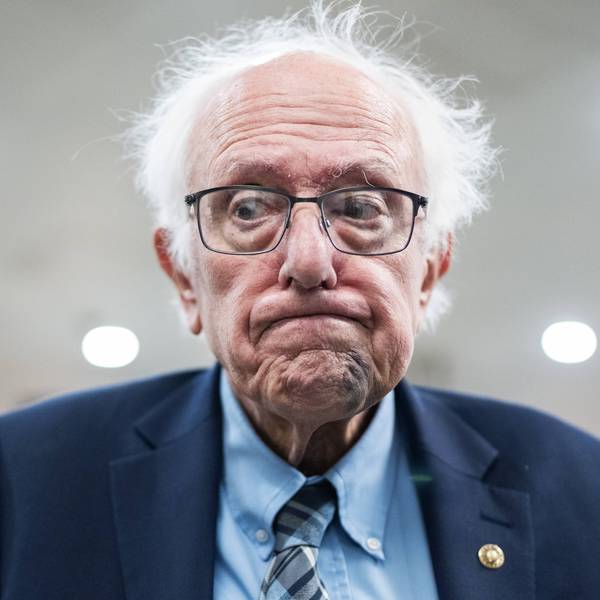
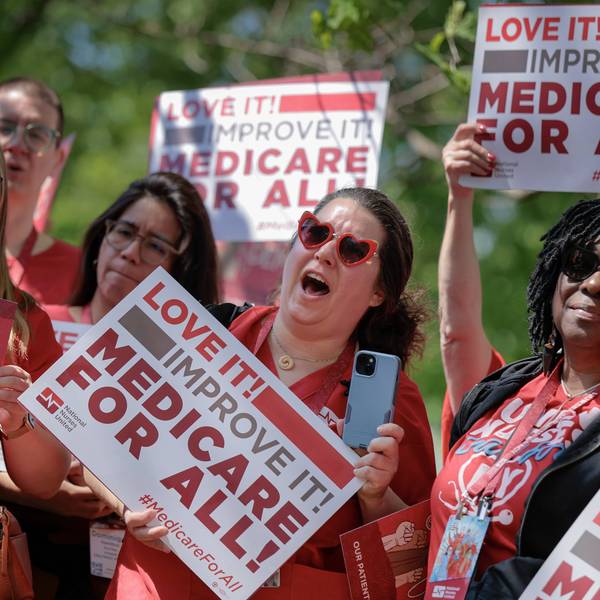

The Massachusetts senator is adamant that her plan would not impose any taxes on the middle class. (Photo: Lori Shaull/Flickr/cc)
How Warren's 'Medicare for All' Plan Hurts the Cause
Warren’s funding scheme is getting major criticism from the left.
Presidential candidates Bernie Sanders and Elizabeth Warren agree that the American health care system causes harm to the people it claims to help. They also believe it needs massive change, and that a "Medicare for All" plan is the best avenue to achieve that. Their sharpest disagreements are over how to pay for it, however, and Warren's funding scheme is getting major criticism from the left.
The Massachusetts senator is adamant that her plan would not impose any taxes on the middle class. According to Tim Higginbotham, a Democratic Socialists of America organizer writing in Jacobin, her plan is "an impossible premise."
Higginbotham believes Warren's no-middle-class-taxes claim is dishonest: First, because any Medicare for All plan "will require some form of taxation, direct or indirect, on the broad 'middle class.'" Second, because her premise ignores the possibility that even with a modest tax increase, Medicare for All will still provide overall health care cost savings in the long run for low- and middle-income families.
Sanders told ABC News that his plan "would raise taxes on the middle class, but [also] would substantially reduce the cost of health care for the average American." That is because, he explains, "We're doing away with all premiums, copayments, deductibles and out-of-pocket expenses. So for the overwhelming majority of the American people, they would save, and save substantially, on their health care bills."
As Vox's Ezra Klein writes, Warren is operating under the impression "that ... a middle-class hike is politically lethal," while Sanders "has long believed that Americans will support European-style taxes in return for a European-style social welfare state."
Warren plans to tax employers, which seems like a plus until you consider the ways employers could try to get out of it. In Warren's vision, a company would pay a head tax--a designated amount in taxes per employee--regardless of the employee's salary. The tax wouldn't apply to employees that classify their workers as independent contractors, or smaller businesses with fewer than 50 employees.
Higginbotham goes deeper on the dangers of that approach:
Instead of taxing a certain percentage of an employee's pay (a payroll tax), Warren's head tax would charge employers a flat amount no matter the employee's salary. Seeing as any employer-side tax ultimately comes out of workers' potential earnings, this is a regressive approach that would disproportionately impact low- and middle-income workers."
And not taxing employers who use independent contractors also could backfire in a big way--by giving employers an incentive to reclassify their workers away from full-time status and the ability to get benefits in the first place.
Matt Bruenig, president of People's Policy Project, a progressive think tank, told Politico that Warren's plan is "most regressive of all the possibilities," adding that "[a]mong all the ways you can solve this piece of the puzzle, it's the worst. ... Even a payroll tax that's a flat percentage instead of a flat amount would be more progressive, because if you make twice as much income, you pay twice as much into the system."
Worse than the tax issue, according to Higginbotham, is "the lack of urgency" in Warren's plan. "Warren argues that her plan for comprehensive immigration reform could free up $400 billion toward Medicare for All over ten years, while cutting the dangerous military slush fund will free up another $798 billion," he explains,
Tying Medicare for All to these larger fights, coupled with her use of the word "eventually" in relation to the date by which Medicare for All would implemented, is a sign, to Higginbotham, that Warren is not ready to fight hard for the cause, unlike Sanders, his preferred candidate. According to Higginbotham, "[Sanders] takes every opportunity given to him to straightforwardly explain how Medicare for All will benefit Americans ... while pointing his finger straight at those who have financial- and power-based interests in defeating his plan."
We are at a crossroads
This country and this world are at a monumental crossroads. In a few short weeks, US voters will have an opportunity to beat back the forces of fascism and confront the billionaires who are rigging the economy, our media system, and our democracy, making it increasingly impossible for ordinary people to get by. We’re not just talking about the election. We’re talking about what must be done once these fascist elements are vanquished from power. We need a bolder set of solutions than what either major party has so far been willing to offer and a working-class movement ready to fight like hell for it. Trump didn't emerge from nowhere. The conditions that fueled MAGA authoritarianism were created by decades of radical neoliberal economic policies and a corrupt political system dominated by corporate interests. They slashed taxes on the super-rich, promising that the benefits would trickle down. They said giveaways to the corporate titans would make life more affordable for the rest of us. It was all bullshit. And when a bitter, betrayed populace searches for someone to blame, right-wing demagogues have little trouble finding scapegoats. People know when they're being lied to, but you won't hear any of this from the corporate media. Only independent journalism—powered and funded by people who believe in building a better world—can deliver truly trustworthy daily news. Our Fall Campaign is underway, and we need your help. To power our newsroom through the rest of the year, we need to raise $125,000 by midnight on October 31. So if you share our vision, please contribute whatever you can to sustain our work. |
Presidential candidates Bernie Sanders and Elizabeth Warren agree that the American health care system causes harm to the people it claims to help. They also believe it needs massive change, and that a "Medicare for All" plan is the best avenue to achieve that. Their sharpest disagreements are over how to pay for it, however, and Warren's funding scheme is getting major criticism from the left.
The Massachusetts senator is adamant that her plan would not impose any taxes on the middle class. According to Tim Higginbotham, a Democratic Socialists of America organizer writing in Jacobin, her plan is "an impossible premise."
Higginbotham believes Warren's no-middle-class-taxes claim is dishonest: First, because any Medicare for All plan "will require some form of taxation, direct or indirect, on the broad 'middle class.'" Second, because her premise ignores the possibility that even with a modest tax increase, Medicare for All will still provide overall health care cost savings in the long run for low- and middle-income families.
Sanders told ABC News that his plan "would raise taxes on the middle class, but [also] would substantially reduce the cost of health care for the average American." That is because, he explains, "We're doing away with all premiums, copayments, deductibles and out-of-pocket expenses. So for the overwhelming majority of the American people, they would save, and save substantially, on their health care bills."
As Vox's Ezra Klein writes, Warren is operating under the impression "that ... a middle-class hike is politically lethal," while Sanders "has long believed that Americans will support European-style taxes in return for a European-style social welfare state."
Warren plans to tax employers, which seems like a plus until you consider the ways employers could try to get out of it. In Warren's vision, a company would pay a head tax--a designated amount in taxes per employee--regardless of the employee's salary. The tax wouldn't apply to employees that classify their workers as independent contractors, or smaller businesses with fewer than 50 employees.
Higginbotham goes deeper on the dangers of that approach:
Instead of taxing a certain percentage of an employee's pay (a payroll tax), Warren's head tax would charge employers a flat amount no matter the employee's salary. Seeing as any employer-side tax ultimately comes out of workers' potential earnings, this is a regressive approach that would disproportionately impact low- and middle-income workers."
And not taxing employers who use independent contractors also could backfire in a big way--by giving employers an incentive to reclassify their workers away from full-time status and the ability to get benefits in the first place.
Matt Bruenig, president of People's Policy Project, a progressive think tank, told Politico that Warren's plan is "most regressive of all the possibilities," adding that "[a]mong all the ways you can solve this piece of the puzzle, it's the worst. ... Even a payroll tax that's a flat percentage instead of a flat amount would be more progressive, because if you make twice as much income, you pay twice as much into the system."
Worse than the tax issue, according to Higginbotham, is "the lack of urgency" in Warren's plan. "Warren argues that her plan for comprehensive immigration reform could free up $400 billion toward Medicare for All over ten years, while cutting the dangerous military slush fund will free up another $798 billion," he explains,
Tying Medicare for All to these larger fights, coupled with her use of the word "eventually" in relation to the date by which Medicare for All would implemented, is a sign, to Higginbotham, that Warren is not ready to fight hard for the cause, unlike Sanders, his preferred candidate. According to Higginbotham, "[Sanders] takes every opportunity given to him to straightforwardly explain how Medicare for All will benefit Americans ... while pointing his finger straight at those who have financial- and power-based interests in defeating his plan."
Presidential candidates Bernie Sanders and Elizabeth Warren agree that the American health care system causes harm to the people it claims to help. They also believe it needs massive change, and that a "Medicare for All" plan is the best avenue to achieve that. Their sharpest disagreements are over how to pay for it, however, and Warren's funding scheme is getting major criticism from the left.
The Massachusetts senator is adamant that her plan would not impose any taxes on the middle class. According to Tim Higginbotham, a Democratic Socialists of America organizer writing in Jacobin, her plan is "an impossible premise."
Higginbotham believes Warren's no-middle-class-taxes claim is dishonest: First, because any Medicare for All plan "will require some form of taxation, direct or indirect, on the broad 'middle class.'" Second, because her premise ignores the possibility that even with a modest tax increase, Medicare for All will still provide overall health care cost savings in the long run for low- and middle-income families.
Sanders told ABC News that his plan "would raise taxes on the middle class, but [also] would substantially reduce the cost of health care for the average American." That is because, he explains, "We're doing away with all premiums, copayments, deductibles and out-of-pocket expenses. So for the overwhelming majority of the American people, they would save, and save substantially, on their health care bills."
As Vox's Ezra Klein writes, Warren is operating under the impression "that ... a middle-class hike is politically lethal," while Sanders "has long believed that Americans will support European-style taxes in return for a European-style social welfare state."
Warren plans to tax employers, which seems like a plus until you consider the ways employers could try to get out of it. In Warren's vision, a company would pay a head tax--a designated amount in taxes per employee--regardless of the employee's salary. The tax wouldn't apply to employees that classify their workers as independent contractors, or smaller businesses with fewer than 50 employees.
Higginbotham goes deeper on the dangers of that approach:
Instead of taxing a certain percentage of an employee's pay (a payroll tax), Warren's head tax would charge employers a flat amount no matter the employee's salary. Seeing as any employer-side tax ultimately comes out of workers' potential earnings, this is a regressive approach that would disproportionately impact low- and middle-income workers."
And not taxing employers who use independent contractors also could backfire in a big way--by giving employers an incentive to reclassify their workers away from full-time status and the ability to get benefits in the first place.
Matt Bruenig, president of People's Policy Project, a progressive think tank, told Politico that Warren's plan is "most regressive of all the possibilities," adding that "[a]mong all the ways you can solve this piece of the puzzle, it's the worst. ... Even a payroll tax that's a flat percentage instead of a flat amount would be more progressive, because if you make twice as much income, you pay twice as much into the system."
Worse than the tax issue, according to Higginbotham, is "the lack of urgency" in Warren's plan. "Warren argues that her plan for comprehensive immigration reform could free up $400 billion toward Medicare for All over ten years, while cutting the dangerous military slush fund will free up another $798 billion," he explains,
Tying Medicare for All to these larger fights, coupled with her use of the word "eventually" in relation to the date by which Medicare for All would implemented, is a sign, to Higginbotham, that Warren is not ready to fight hard for the cause, unlike Sanders, his preferred candidate. According to Higginbotham, "[Sanders] takes every opportunity given to him to straightforwardly explain how Medicare for All will benefit Americans ... while pointing his finger straight at those who have financial- and power-based interests in defeating his plan."