SUBSCRIBE TO OUR FREE NEWSLETTER
Daily news & progressive opinion—funded by the people, not the corporations—delivered straight to your inbox.
5
#000000
#FFFFFF
To donate by check, phone, or other method, see our More Ways to Give page.
Daily news & progressive opinion—funded by the people, not the corporations—delivered straight to your inbox.
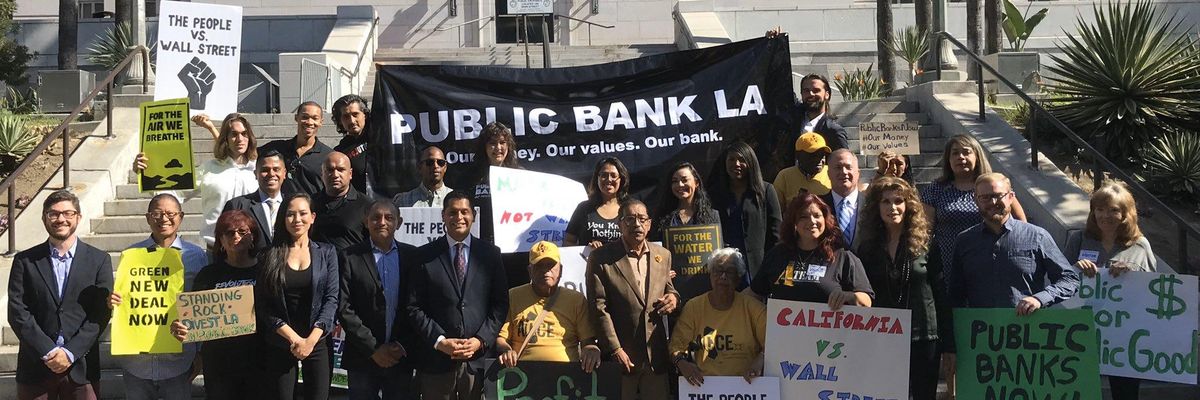
What happened in Los Angeles proves it is possible to create a society where the public as a whole determines its goals and sets its own financial strategies for achieving them. (Photo: Twitter/@publicbankla)
When you pay state and local taxes, parking fees and other payments to your regional government, chances are those funds will almost immediately end up in a corporate bank.
For instance, until recently the majority of these payments to the city of Los Angeles were held by Wells Fargo, a bank that has routinely paid out millions of dollars in fines and settlements due to predatory lending, foreclosure abuses and defrauding investors. Although the Los Angeles City Council voted in December 2017 to divest from Wells Fargo, the city must still use the banking services of JP Morgan Chase and Bank of America, which are among the largest financiers of fossil fuel industry. That's in large part because the city has lacked the option of chartering its own public banks.
That changed on October 2, when the California Public Banking Act was signed into law by the state's governor, Gavin Newsom, making it explicitly legal for municipalities in California to create their own public banks and use those banks to hold and leverage public funds.
The question at the heart of public banking may seem technical but is actually about political power. Should small groups of wealthy corporate board members get to decide how to leverage public money so that they may further enrich themselves? Or should public funds be used in a way that is accountable to the public itself, for initiatives that will secure the long-term health of society at large?
The question at the heart of public banking may seem technical but is actually about political power.
To date, the only publicly owned banks in the United States are in North Dakota and American Samoa. But now California, which has the world's fifth largest economy and is known for setting national precedents and having its policies emulated by others, has opened the floodgates by permitting the creation of public banks. This will shift power away from profit-motivated board members of corporate banks and into the hands of the people.
For example, these banks could follow in the footsteps of the German KfW Group, a collection of state-owned infrastructure banks that directed more than one-third of its funds to climate and environmental protection in 2018--not just in Germany, but in thirty countries. So instead of propping up oil pipelines, public money could catalyze a rapid transition to a zero-carbon economy.
Public banks can also drastically reduce the cost of financing infrastructure projects, because if the lender is a public bank, interest payments can be re-used for public benefit, rather than to enrich investors.
Returning to Los Angeles, the city council voted to divest from Well Fargo in late 2017, following rapid grassroots mobilization against the bank. The movement that spearheaded that action, Revolution LA, also played an instrumental role in advocating for the California Public Banking Act, along with a coalition of other cities and regions that formed the California Public Banking Alliance.
One of Revolution LA's original organizers, Trinity Tran, recalls that its very first meeting consisted of "just me, an apolitical friend of mine who came to support me, and one other person who saw the Meetup post. But within a few months, we quickly outgrew the Koreatown coffee shops we were meeting in."
What happened in Los Angeles proves it is possible to create a society where the public as a whole determines its goals and sets its own financial strategies for achieving them.
Dear Common Dreams reader, It’s been nearly 30 years since I co-founded Common Dreams with my late wife, Lina Newhouser. We had the radical notion that journalism should serve the public good, not corporate profits. It was clear to us from the outset what it would take to build such a project. No paid advertisements. No corporate sponsors. No millionaire publisher telling us what to think or do. Many people said we wouldn't last a year, but we proved those doubters wrong. Together with a tremendous team of journalists and dedicated staff, we built an independent media outlet free from the constraints of profits and corporate control. Our mission has always been simple: To inform. To inspire. To ignite change for the common good. Building Common Dreams was not easy. Our survival was never guaranteed. When you take on the most powerful forces—Wall Street greed, fossil fuel industry destruction, Big Tech lobbyists, and uber-rich oligarchs who have spent billions upon billions rigging the economy and democracy in their favor—the only bulwark you have is supporters who believe in your work. But here’s the urgent message from me today. It's never been this bad out there. And it's never been this hard to keep us going. At the very moment Common Dreams is most needed, the threats we face are intensifying. We need your support now more than ever. We don't accept corporate advertising and never will. We don't have a paywall because we don't think people should be blocked from critical news based on their ability to pay. Everything we do is funded by the donations of readers like you. When everyone does the little they can afford, we are strong. But if that support retreats or dries up, so do we. Will you donate now to make sure Common Dreams not only survives but thrives? —Craig Brown, Co-founder |
When you pay state and local taxes, parking fees and other payments to your regional government, chances are those funds will almost immediately end up in a corporate bank.
For instance, until recently the majority of these payments to the city of Los Angeles were held by Wells Fargo, a bank that has routinely paid out millions of dollars in fines and settlements due to predatory lending, foreclosure abuses and defrauding investors. Although the Los Angeles City Council voted in December 2017 to divest from Wells Fargo, the city must still use the banking services of JP Morgan Chase and Bank of America, which are among the largest financiers of fossil fuel industry. That's in large part because the city has lacked the option of chartering its own public banks.
That changed on October 2, when the California Public Banking Act was signed into law by the state's governor, Gavin Newsom, making it explicitly legal for municipalities in California to create their own public banks and use those banks to hold and leverage public funds.
The question at the heart of public banking may seem technical but is actually about political power. Should small groups of wealthy corporate board members get to decide how to leverage public money so that they may further enrich themselves? Or should public funds be used in a way that is accountable to the public itself, for initiatives that will secure the long-term health of society at large?
The question at the heart of public banking may seem technical but is actually about political power.
To date, the only publicly owned banks in the United States are in North Dakota and American Samoa. But now California, which has the world's fifth largest economy and is known for setting national precedents and having its policies emulated by others, has opened the floodgates by permitting the creation of public banks. This will shift power away from profit-motivated board members of corporate banks and into the hands of the people.
For example, these banks could follow in the footsteps of the German KfW Group, a collection of state-owned infrastructure banks that directed more than one-third of its funds to climate and environmental protection in 2018--not just in Germany, but in thirty countries. So instead of propping up oil pipelines, public money could catalyze a rapid transition to a zero-carbon economy.
Public banks can also drastically reduce the cost of financing infrastructure projects, because if the lender is a public bank, interest payments can be re-used for public benefit, rather than to enrich investors.
Returning to Los Angeles, the city council voted to divest from Well Fargo in late 2017, following rapid grassroots mobilization against the bank. The movement that spearheaded that action, Revolution LA, also played an instrumental role in advocating for the California Public Banking Act, along with a coalition of other cities and regions that formed the California Public Banking Alliance.
One of Revolution LA's original organizers, Trinity Tran, recalls that its very first meeting consisted of "just me, an apolitical friend of mine who came to support me, and one other person who saw the Meetup post. But within a few months, we quickly outgrew the Koreatown coffee shops we were meeting in."
What happened in Los Angeles proves it is possible to create a society where the public as a whole determines its goals and sets its own financial strategies for achieving them.
When you pay state and local taxes, parking fees and other payments to your regional government, chances are those funds will almost immediately end up in a corporate bank.
For instance, until recently the majority of these payments to the city of Los Angeles were held by Wells Fargo, a bank that has routinely paid out millions of dollars in fines and settlements due to predatory lending, foreclosure abuses and defrauding investors. Although the Los Angeles City Council voted in December 2017 to divest from Wells Fargo, the city must still use the banking services of JP Morgan Chase and Bank of America, which are among the largest financiers of fossil fuel industry. That's in large part because the city has lacked the option of chartering its own public banks.
That changed on October 2, when the California Public Banking Act was signed into law by the state's governor, Gavin Newsom, making it explicitly legal for municipalities in California to create their own public banks and use those banks to hold and leverage public funds.
The question at the heart of public banking may seem technical but is actually about political power. Should small groups of wealthy corporate board members get to decide how to leverage public money so that they may further enrich themselves? Or should public funds be used in a way that is accountable to the public itself, for initiatives that will secure the long-term health of society at large?
The question at the heart of public banking may seem technical but is actually about political power.
To date, the only publicly owned banks in the United States are in North Dakota and American Samoa. But now California, which has the world's fifth largest economy and is known for setting national precedents and having its policies emulated by others, has opened the floodgates by permitting the creation of public banks. This will shift power away from profit-motivated board members of corporate banks and into the hands of the people.
For example, these banks could follow in the footsteps of the German KfW Group, a collection of state-owned infrastructure banks that directed more than one-third of its funds to climate and environmental protection in 2018--not just in Germany, but in thirty countries. So instead of propping up oil pipelines, public money could catalyze a rapid transition to a zero-carbon economy.
Public banks can also drastically reduce the cost of financing infrastructure projects, because if the lender is a public bank, interest payments can be re-used for public benefit, rather than to enrich investors.
Returning to Los Angeles, the city council voted to divest from Well Fargo in late 2017, following rapid grassroots mobilization against the bank. The movement that spearheaded that action, Revolution LA, also played an instrumental role in advocating for the California Public Banking Act, along with a coalition of other cities and regions that formed the California Public Banking Alliance.
One of Revolution LA's original organizers, Trinity Tran, recalls that its very first meeting consisted of "just me, an apolitical friend of mine who came to support me, and one other person who saw the Meetup post. But within a few months, we quickly outgrew the Koreatown coffee shops we were meeting in."
What happened in Los Angeles proves it is possible to create a society where the public as a whole determines its goals and sets its own financial strategies for achieving them.