SUBSCRIBE TO OUR FREE NEWSLETTER
Daily news & progressive opinion—funded by the people, not the corporations—delivered straight to your inbox.
5
#000000
#FFFFFF
To donate by check, phone, or other method, see our More Ways to Give page.
Daily news & progressive opinion—funded by the people, not the corporations—delivered straight to your inbox.
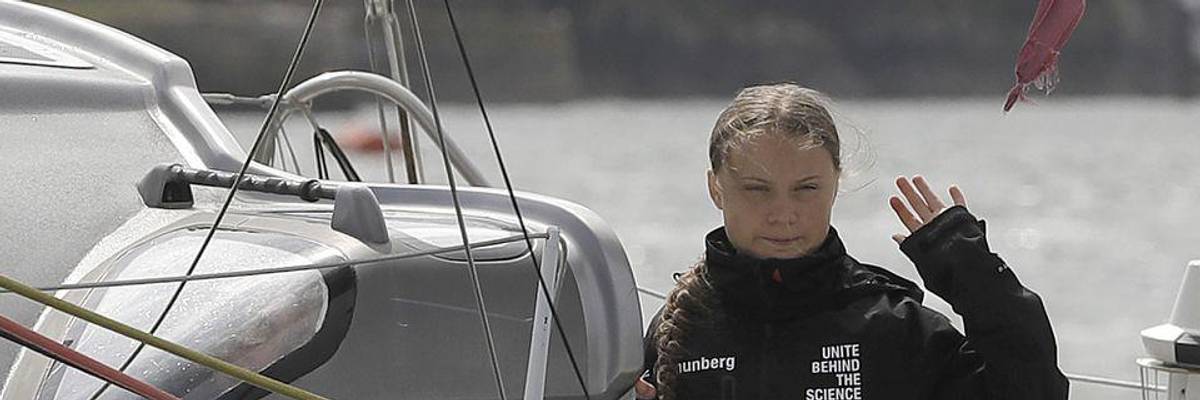
Climate change activist Greta Thunberg sets sail for New York, in the 60-foot Malizia II yacht, from Plymouth, England, on Aug. 14.(Photo: KIRSTY WIGGLESWORTH/WPA POOL/GETTY IMAGES)
So far it's been the hottest summer ever recorded -- June was the hottest June, and July was the hottest month ever. France, Germany, Britain, Belgium, and the Netherlands had their hottest days of all time, joining countries from Cuba to Vietnam and Togo to the Reunion Islands.
This is dangerous for two reasons.
One, it's destroying the planet.
And two, it's becoming so common that people may lose hope or tune out -- the news can be almost as sapping as the heat. But that apathy would come at just the wrong moment. The price of renewable energy hit a record low last month, when a Portuguese power auction produced the cheapest electricity in history. Given the political will, we could quickly make huge strides in combatting climate change.
The climate crisis represents an assault on justice (those who have done the least to cause it suffer the most) but also an assault on the future, a future that some have a larger share in simply because they'll be alive longer.
That's why we should be grateful to some of the youngest activists on the planet, people who refuse to become inured to business as usual, who won't give up. The most famous of them, Greta Thunberg, is on a sailboat for a journey to the United States, where she'll address the UN's climate summit in September. But she's far from alone. Thanks to the organization Fridays for Future, you can find Greta equivalents from Peru to Pensacola to Prague, from Ulan Bator to the gates of the UN.
Thunberg began her "school strike for the climate'' a year ago, arguing that if the world's adults weren't willing to prepare the planet for her generation, they were forfeiting their right to demand that her generation spend their youth preparing for their future. Kids across the planet saw the logic -- the biggest days of action have seen 1.4 million students out of the classroom and on the streets.
But after a year, they've done something new -- they've asked adults to join them. On Sept. 20, there will be the first all-ages climate strike (it will be Sept. 27 in some countries). People will walk off their jobs at some point during the day -- some will plant trees, others will join protests. The targets will be as diverse as the geography: In different parts of the planet, people will be sitting down in front of pipelines; demanding that their institutions divest fossil fuel stocks; urging UN nations to increase their carbon-cutting commitments; calling for carbon taxes; insisting on a Green New Deal. Athletes have pledged to join in, as have chefs and actors and politicians. Unions and even some businesses have said they'll take part. It's likely that the Global Climate Strike will mark the largest day of climate protest in the planet's history.
Will a single strike solve the climate crisis? Of course not. The students have shown persistence, and the adults will need to do the same. But the September strike will demonstrate two invaluable principles.
The first is that solving the climate crisis will involve disrupting business as usual. Even amid the greatest physical crisis human civilization has ever faced, we mostly get up each morning and do the same things we did the day before. There's nothing to indicate we're in an emergency, an emergency that grows deeper as each month passes. Adults should consider joining this walkout as a statement that they're committed to disruptive, transformative change.
The second principle is that elders need to act like elders. On what kind of world do we expect 15-year-olds to tackle our biggest problems by themselves? The climate crisis represents an assault on justice (those who have done the least to cause it suffer the most) but also an assault on the future, a future that some have a larger share in simply because they'll be alive longer. For the rest of us -- those who will die before climate change reaches its burning zenith -- the strike is a chance to show that our theoretical affection for our children and their children is sincere.
There's no guarantee that we can still solve the climate problem. One can be excused for despairing, but not for walking away. Especially at the most desperate moments, human solidarity is required. If a kid says help, you help.
Dear Common Dreams reader, It’s been nearly 30 years since I co-founded Common Dreams with my late wife, Lina Newhouser. We had the radical notion that journalism should serve the public good, not corporate profits. It was clear to us from the outset what it would take to build such a project. No paid advertisements. No corporate sponsors. No millionaire publisher telling us what to think or do. Many people said we wouldn't last a year, but we proved those doubters wrong. Together with a tremendous team of journalists and dedicated staff, we built an independent media outlet free from the constraints of profits and corporate control. Our mission has always been simple: To inform. To inspire. To ignite change for the common good. Building Common Dreams was not easy. Our survival was never guaranteed. When you take on the most powerful forces—Wall Street greed, fossil fuel industry destruction, Big Tech lobbyists, and uber-rich oligarchs who have spent billions upon billions rigging the economy and democracy in their favor—the only bulwark you have is supporters who believe in your work. But here’s the urgent message from me today. It's never been this bad out there. And it's never been this hard to keep us going. At the very moment Common Dreams is most needed, the threats we face are intensifying. We need your support now more than ever. We don't accept corporate advertising and never will. We don't have a paywall because we don't think people should be blocked from critical news based on their ability to pay. Everything we do is funded by the donations of readers like you. When everyone does the little they can afford, we are strong. But if that support retreats or dries up, so do we. Will you donate now to make sure Common Dreams not only survives but thrives? —Craig Brown, Co-founder |
So far it's been the hottest summer ever recorded -- June was the hottest June, and July was the hottest month ever. France, Germany, Britain, Belgium, and the Netherlands had their hottest days of all time, joining countries from Cuba to Vietnam and Togo to the Reunion Islands.
This is dangerous for two reasons.
One, it's destroying the planet.
And two, it's becoming so common that people may lose hope or tune out -- the news can be almost as sapping as the heat. But that apathy would come at just the wrong moment. The price of renewable energy hit a record low last month, when a Portuguese power auction produced the cheapest electricity in history. Given the political will, we could quickly make huge strides in combatting climate change.
The climate crisis represents an assault on justice (those who have done the least to cause it suffer the most) but also an assault on the future, a future that some have a larger share in simply because they'll be alive longer.
That's why we should be grateful to some of the youngest activists on the planet, people who refuse to become inured to business as usual, who won't give up. The most famous of them, Greta Thunberg, is on a sailboat for a journey to the United States, where she'll address the UN's climate summit in September. But she's far from alone. Thanks to the organization Fridays for Future, you can find Greta equivalents from Peru to Pensacola to Prague, from Ulan Bator to the gates of the UN.
Thunberg began her "school strike for the climate'' a year ago, arguing that if the world's adults weren't willing to prepare the planet for her generation, they were forfeiting their right to demand that her generation spend their youth preparing for their future. Kids across the planet saw the logic -- the biggest days of action have seen 1.4 million students out of the classroom and on the streets.
But after a year, they've done something new -- they've asked adults to join them. On Sept. 20, there will be the first all-ages climate strike (it will be Sept. 27 in some countries). People will walk off their jobs at some point during the day -- some will plant trees, others will join protests. The targets will be as diverse as the geography: In different parts of the planet, people will be sitting down in front of pipelines; demanding that their institutions divest fossil fuel stocks; urging UN nations to increase their carbon-cutting commitments; calling for carbon taxes; insisting on a Green New Deal. Athletes have pledged to join in, as have chefs and actors and politicians. Unions and even some businesses have said they'll take part. It's likely that the Global Climate Strike will mark the largest day of climate protest in the planet's history.
Will a single strike solve the climate crisis? Of course not. The students have shown persistence, and the adults will need to do the same. But the September strike will demonstrate two invaluable principles.
The first is that solving the climate crisis will involve disrupting business as usual. Even amid the greatest physical crisis human civilization has ever faced, we mostly get up each morning and do the same things we did the day before. There's nothing to indicate we're in an emergency, an emergency that grows deeper as each month passes. Adults should consider joining this walkout as a statement that they're committed to disruptive, transformative change.
The second principle is that elders need to act like elders. On what kind of world do we expect 15-year-olds to tackle our biggest problems by themselves? The climate crisis represents an assault on justice (those who have done the least to cause it suffer the most) but also an assault on the future, a future that some have a larger share in simply because they'll be alive longer. For the rest of us -- those who will die before climate change reaches its burning zenith -- the strike is a chance to show that our theoretical affection for our children and their children is sincere.
There's no guarantee that we can still solve the climate problem. One can be excused for despairing, but not for walking away. Especially at the most desperate moments, human solidarity is required. If a kid says help, you help.
So far it's been the hottest summer ever recorded -- June was the hottest June, and July was the hottest month ever. France, Germany, Britain, Belgium, and the Netherlands had their hottest days of all time, joining countries from Cuba to Vietnam and Togo to the Reunion Islands.
This is dangerous for two reasons.
One, it's destroying the planet.
And two, it's becoming so common that people may lose hope or tune out -- the news can be almost as sapping as the heat. But that apathy would come at just the wrong moment. The price of renewable energy hit a record low last month, when a Portuguese power auction produced the cheapest electricity in history. Given the political will, we could quickly make huge strides in combatting climate change.
The climate crisis represents an assault on justice (those who have done the least to cause it suffer the most) but also an assault on the future, a future that some have a larger share in simply because they'll be alive longer.
That's why we should be grateful to some of the youngest activists on the planet, people who refuse to become inured to business as usual, who won't give up. The most famous of them, Greta Thunberg, is on a sailboat for a journey to the United States, where she'll address the UN's climate summit in September. But she's far from alone. Thanks to the organization Fridays for Future, you can find Greta equivalents from Peru to Pensacola to Prague, from Ulan Bator to the gates of the UN.
Thunberg began her "school strike for the climate'' a year ago, arguing that if the world's adults weren't willing to prepare the planet for her generation, they were forfeiting their right to demand that her generation spend their youth preparing for their future. Kids across the planet saw the logic -- the biggest days of action have seen 1.4 million students out of the classroom and on the streets.
But after a year, they've done something new -- they've asked adults to join them. On Sept. 20, there will be the first all-ages climate strike (it will be Sept. 27 in some countries). People will walk off their jobs at some point during the day -- some will plant trees, others will join protests. The targets will be as diverse as the geography: In different parts of the planet, people will be sitting down in front of pipelines; demanding that their institutions divest fossil fuel stocks; urging UN nations to increase their carbon-cutting commitments; calling for carbon taxes; insisting on a Green New Deal. Athletes have pledged to join in, as have chefs and actors and politicians. Unions and even some businesses have said they'll take part. It's likely that the Global Climate Strike will mark the largest day of climate protest in the planet's history.
Will a single strike solve the climate crisis? Of course not. The students have shown persistence, and the adults will need to do the same. But the September strike will demonstrate two invaluable principles.
The first is that solving the climate crisis will involve disrupting business as usual. Even amid the greatest physical crisis human civilization has ever faced, we mostly get up each morning and do the same things we did the day before. There's nothing to indicate we're in an emergency, an emergency that grows deeper as each month passes. Adults should consider joining this walkout as a statement that they're committed to disruptive, transformative change.
The second principle is that elders need to act like elders. On what kind of world do we expect 15-year-olds to tackle our biggest problems by themselves? The climate crisis represents an assault on justice (those who have done the least to cause it suffer the most) but also an assault on the future, a future that some have a larger share in simply because they'll be alive longer. For the rest of us -- those who will die before climate change reaches its burning zenith -- the strike is a chance to show that our theoretical affection for our children and their children is sincere.
There's no guarantee that we can still solve the climate problem. One can be excused for despairing, but not for walking away. Especially at the most desperate moments, human solidarity is required. If a kid says help, you help.