SUBSCRIBE TO OUR FREE NEWSLETTER
Daily news & progressive opinion—funded by the people, not the corporations—delivered straight to your inbox.
5
#000000
#FFFFFF
To donate by check, phone, or other method, see our More Ways to Give page.
Daily news & progressive opinion—funded by the people, not the corporations—delivered straight to your inbox.

45 percent of Americans--including a third of households making more than $180,000 a year--worry they could go bankrupt over a major health issue. (Photo: Shutterstock)
One night a few years ago, my partner woke up delirious with fever, a bright rash, and joint pain so bad he couldn't get out of bed without help. I was scared -- mostly for his health, but also for our financial situation, which weighed heavily on me during our 4 a.m. ride to the emergency room.
As a freelancer, his catastrophic health insurance plan had an outrageously high deductible, and every day he couldn't work was a day he wouldn't get paid. I'd lost my job -- and my own health insurance -- earlier that year, and was still piecing together a livelihood from gig to gig. I didn't know what we'd do if something went seriously wrong.
We left the hospital several hours later after an IV and a couple ibuprofens -- and no diagnosis. Even after insurance kicked in, we were billed about $1,000 for the experience. My partner's joints hurt for months afterwards, but the already hefty price tag scared him off following up.
It turns out he's far from the only one who looked at a bank statement before considering a trip to the doctor.
A recent study found that 65 million Americans had a health issue in the last year that they didn't treat because they were worried about the cost.
A recent study found that 65 million Americans had a health issue in the last year that they didn't treat because they were worried about the cost. And 45 percent of Americans -- including a third of households making more than $180,000 a year -- worry they could go bankrupt over a major health issue.
Nearly half of those survey respondents said they thought U.S. health care was either the best or among the best in the world. But our actual health tells another story.
By a long shot, the U.S. has the most expensive health care system among the 36 mostly high-income countries that make up the Organization for Economic Cooperation and Development, or OECD. But for all that money, we rank just 28th in life expectancy and 31st in infant mortality.
Nothing about this system is healthy or caring. But it doesn't have to be this way.
In 2014, the same year we worried about a $1,000 trip to the emergency room, our insurance company spent nearly $20 million on executive compensation. More than $5 million went to the CEO alone.
What if our health care system didn't allow people to make these exorbitant profits off our pain? What -- and who -- could we save?
By one assessment, a universal, single-payer system like Medicare for All could expand coverage to everyone while reducing the cost to American businesses and people by as much as $310 billion -- primarily by cutting down on industry bloat and by negotiating fairer pharmaceutical prices.
While our monstrously expensive health care system is maddening, the harm done to people who can't afford to participate in that system is what's truly enraging.
Read the stories attached to the third of GoFundMes specifically devoted to crowdsourcing money for medical costs and I'm sure you'll feel the same. Thousands of people in the United States die preventable deaths each year simply from lack of insurance.
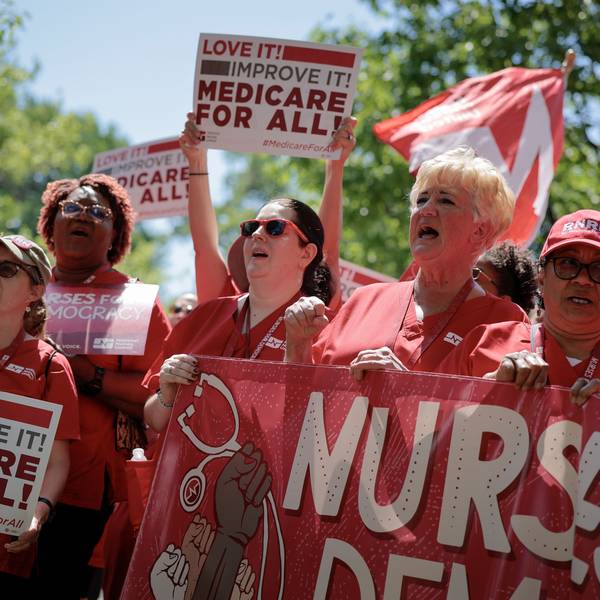
Fortunately, there's a groundswell of support for a publicly funded health care system. And researchers say one proposal -- the Medicare for All Act of 2019 that's in front of Congress right now -- sets "a new standard for universally and equitably guaranteeing health care as a human right in the United States."
No one should have to worry about bankruptcy before seeking out the treatment they need. Health care is a human right, and we deserve no less than a system that provides it universally and equitably.
Dear Common Dreams reader, It’s been nearly 30 years since I co-founded Common Dreams with my late wife, Lina Newhouser. We had the radical notion that journalism should serve the public good, not corporate profits. It was clear to us from the outset what it would take to build such a project. No paid advertisements. No corporate sponsors. No millionaire publisher telling us what to think or do. Many people said we wouldn't last a year, but we proved those doubters wrong. Together with a tremendous team of journalists and dedicated staff, we built an independent media outlet free from the constraints of profits and corporate control. Our mission has always been simple: To inform. To inspire. To ignite change for the common good. Building Common Dreams was not easy. Our survival was never guaranteed. When you take on the most powerful forces—Wall Street greed, fossil fuel industry destruction, Big Tech lobbyists, and uber-rich oligarchs who have spent billions upon billions rigging the economy and democracy in their favor—the only bulwark you have is supporters who believe in your work. But here’s the urgent message from me today. It's never been this bad out there. And it's never been this hard to keep us going. At the very moment Common Dreams is most needed, the threats we face are intensifying. We need your support now more than ever. We don't accept corporate advertising and never will. We don't have a paywall because we don't think people should be blocked from critical news based on their ability to pay. Everything we do is funded by the donations of readers like you. When everyone does the little they can afford, we are strong. But if that support retreats or dries up, so do we. Will you donate now to make sure Common Dreams not only survives but thrives? —Craig Brown, Co-founder |
One night a few years ago, my partner woke up delirious with fever, a bright rash, and joint pain so bad he couldn't get out of bed without help. I was scared -- mostly for his health, but also for our financial situation, which weighed heavily on me during our 4 a.m. ride to the emergency room.
As a freelancer, his catastrophic health insurance plan had an outrageously high deductible, and every day he couldn't work was a day he wouldn't get paid. I'd lost my job -- and my own health insurance -- earlier that year, and was still piecing together a livelihood from gig to gig. I didn't know what we'd do if something went seriously wrong.
We left the hospital several hours later after an IV and a couple ibuprofens -- and no diagnosis. Even after insurance kicked in, we were billed about $1,000 for the experience. My partner's joints hurt for months afterwards, but the already hefty price tag scared him off following up.
It turns out he's far from the only one who looked at a bank statement before considering a trip to the doctor.
A recent study found that 65 million Americans had a health issue in the last year that they didn't treat because they were worried about the cost.
A recent study found that 65 million Americans had a health issue in the last year that they didn't treat because they were worried about the cost. And 45 percent of Americans -- including a third of households making more than $180,000 a year -- worry they could go bankrupt over a major health issue.
Nearly half of those survey respondents said they thought U.S. health care was either the best or among the best in the world. But our actual health tells another story.
By a long shot, the U.S. has the most expensive health care system among the 36 mostly high-income countries that make up the Organization for Economic Cooperation and Development, or OECD. But for all that money, we rank just 28th in life expectancy and 31st in infant mortality.
Nothing about this system is healthy or caring. But it doesn't have to be this way.
In 2014, the same year we worried about a $1,000 trip to the emergency room, our insurance company spent nearly $20 million on executive compensation. More than $5 million went to the CEO alone.
What if our health care system didn't allow people to make these exorbitant profits off our pain? What -- and who -- could we save?
By one assessment, a universal, single-payer system like Medicare for All could expand coverage to everyone while reducing the cost to American businesses and people by as much as $310 billion -- primarily by cutting down on industry bloat and by negotiating fairer pharmaceutical prices.
While our monstrously expensive health care system is maddening, the harm done to people who can't afford to participate in that system is what's truly enraging.
Read the stories attached to the third of GoFundMes specifically devoted to crowdsourcing money for medical costs and I'm sure you'll feel the same. Thousands of people in the United States die preventable deaths each year simply from lack of insurance.
Fortunately, there's a groundswell of support for a publicly funded health care system. And researchers say one proposal -- the Medicare for All Act of 2019 that's in front of Congress right now -- sets "a new standard for universally and equitably guaranteeing health care as a human right in the United States."
No one should have to worry about bankruptcy before seeking out the treatment they need. Health care is a human right, and we deserve no less than a system that provides it universally and equitably.
One night a few years ago, my partner woke up delirious with fever, a bright rash, and joint pain so bad he couldn't get out of bed without help. I was scared -- mostly for his health, but also for our financial situation, which weighed heavily on me during our 4 a.m. ride to the emergency room.
As a freelancer, his catastrophic health insurance plan had an outrageously high deductible, and every day he couldn't work was a day he wouldn't get paid. I'd lost my job -- and my own health insurance -- earlier that year, and was still piecing together a livelihood from gig to gig. I didn't know what we'd do if something went seriously wrong.
We left the hospital several hours later after an IV and a couple ibuprofens -- and no diagnosis. Even after insurance kicked in, we were billed about $1,000 for the experience. My partner's joints hurt for months afterwards, but the already hefty price tag scared him off following up.
It turns out he's far from the only one who looked at a bank statement before considering a trip to the doctor.
A recent study found that 65 million Americans had a health issue in the last year that they didn't treat because they were worried about the cost.
A recent study found that 65 million Americans had a health issue in the last year that they didn't treat because they were worried about the cost. And 45 percent of Americans -- including a third of households making more than $180,000 a year -- worry they could go bankrupt over a major health issue.
Nearly half of those survey respondents said they thought U.S. health care was either the best or among the best in the world. But our actual health tells another story.
By a long shot, the U.S. has the most expensive health care system among the 36 mostly high-income countries that make up the Organization for Economic Cooperation and Development, or OECD. But for all that money, we rank just 28th in life expectancy and 31st in infant mortality.
Nothing about this system is healthy or caring. But it doesn't have to be this way.
In 2014, the same year we worried about a $1,000 trip to the emergency room, our insurance company spent nearly $20 million on executive compensation. More than $5 million went to the CEO alone.
What if our health care system didn't allow people to make these exorbitant profits off our pain? What -- and who -- could we save?
By one assessment, a universal, single-payer system like Medicare for All could expand coverage to everyone while reducing the cost to American businesses and people by as much as $310 billion -- primarily by cutting down on industry bloat and by negotiating fairer pharmaceutical prices.
While our monstrously expensive health care system is maddening, the harm done to people who can't afford to participate in that system is what's truly enraging.
Read the stories attached to the third of GoFundMes specifically devoted to crowdsourcing money for medical costs and I'm sure you'll feel the same. Thousands of people in the United States die preventable deaths each year simply from lack of insurance.
Fortunately, there's a groundswell of support for a publicly funded health care system. And researchers say one proposal -- the Medicare for All Act of 2019 that's in front of Congress right now -- sets "a new standard for universally and equitably guaranteeing health care as a human right in the United States."
No one should have to worry about bankruptcy before seeking out the treatment they need. Health care is a human right, and we deserve no less than a system that provides it universally and equitably.