SUBSCRIBE TO OUR FREE NEWSLETTER
Daily news & progressive opinion—funded by the people, not the corporations—delivered straight to your inbox.
5
#000000
#FFFFFF
To donate by check, phone, or other method, see our More Ways to Give page.
Daily news & progressive opinion—funded by the people, not the corporations—delivered straight to your inbox.
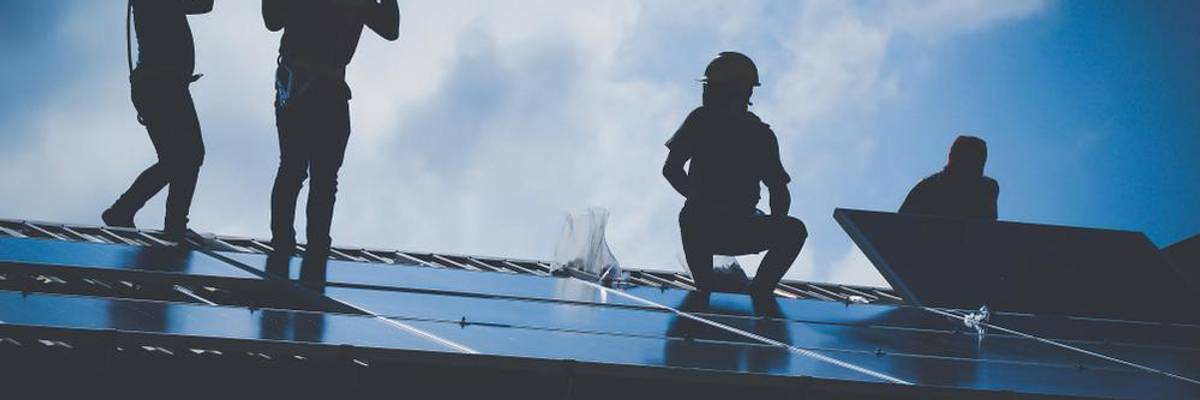
What we really need to make the Green New Deal real is for people of conscience to work together, grow our movement, and push our representatives to invest in a just transition for our communities. (Photo: Shutterstock)
Across the country, you'll find millions of working families whose wages haven't budged in a generation, even as the cost of living has skyrocketed.
Many of these same communities are now getting hit hardest by floods, droughts, storms, and other climate disasters. How are workers going to withstand rising climate risks if their paychecks don't even cover the bills, while corporate polluters rake in profits?
Our communities don't experience climate change and inequality as two isolated issues, but as interlinked crises.
A Green New Deal offers an immense opportunity to tackle both crises at the speed and scale that justice and science demand. It's the only plan out there to transition to a clean energy economy built on good, union jobs that leaves no worker -- or community -- behind.
It's a roadmap rooted in solid, realistic changes that are already happening. From the Midwest to the South to the coasts, communities are retrofitting buildings to save energy, replacing lead pipes to ensure clean water, and restoring green spaces to reduce climate-related flooding.
Meanwhile, broad local coalitions are pushing for investments in local wind and solar manufacturing, clean and affordable light rail, wetlands restoration, smart electric grids, and sustainable family farming.
These programs are already creating high-paying jobs, slashing pollution as well as energy bills, and supporting community-led efforts to prevent climate disasters. Our generational task of bringing wages up and climate pollution down is both doable and indispensable--and it starts with massively scaling up these local solutions.
Some politicians try to divide us by saying we have to choose between good jobs and healthy communities. This is a false choice.
In fact, a Green New Deal is an opportunity to create millions of good union jobs, clean up our air and water, and to become more resilient in the face of the climate crisis. It's an opportunity to cut energy costs by providing cheaper, more efficient choices for clean energy and transportation. And it's an opportunity to build a more just economy -- and society -- by investing directly in the workers and communities who got the worst deal in the economic status quo.
For far too long, the wealthiest corporations have profited from a system that allows workers and communities -- especially immigrants, people of color, and the poor of all races -- to bear the brunt of toxic pollution, climate disasters, and economic insecurity.
We can change this.
We don't lack ideas -- frontline communities are already generating realistic solutions. And we don't lack funding sources -- the corporations profiting from low wages and climate pollution have the funds to support a transition to a new economy.
What we really need to make the Green New Deal real is for people of conscience to work together, grow our movement, and push our representatives to invest in a just transition for our communities.
Right now, political will is mounting. More than 100 members of Congress have already endorsed a Green New Deal, and that number continues to grow. So does the panoply of environmental, labor, and justice groups backing the idea -- including our own.
As that movement gains momentum, so does our resolve to lay the groundwork for a new economy -- one powered by family-sustaining wages and clean energy.
If that goal seems big, it's no bigger than the problems our communities face. That, after all, is what this Green New Deal moment is all about: an invitation to all of us to name solutions that match the scale of our problems.
Dear Common Dreams reader, It’s been nearly 30 years since I co-founded Common Dreams with my late wife, Lina Newhouser. We had the radical notion that journalism should serve the public good, not corporate profits. It was clear to us from the outset what it would take to build such a project. No paid advertisements. No corporate sponsors. No millionaire publisher telling us what to think or do. Many people said we wouldn't last a year, but we proved those doubters wrong. Together with a tremendous team of journalists and dedicated staff, we built an independent media outlet free from the constraints of profits and corporate control. Our mission has always been simple: To inform. To inspire. To ignite change for the common good. Building Common Dreams was not easy. Our survival was never guaranteed. When you take on the most powerful forces—Wall Street greed, fossil fuel industry destruction, Big Tech lobbyists, and uber-rich oligarchs who have spent billions upon billions rigging the economy and democracy in their favor—the only bulwark you have is supporters who believe in your work. But here’s the urgent message from me today. It's never been this bad out there. And it's never been this hard to keep us going. At the very moment Common Dreams is most needed, the threats we face are intensifying. We need your support now more than ever. We don't accept corporate advertising and never will. We don't have a paywall because we don't think people should be blocked from critical news based on their ability to pay. Everything we do is funded by the donations of readers like you. When everyone does the little they can afford, we are strong. But if that support retreats or dries up, so do we. Will you donate now to make sure Common Dreams not only survives but thrives? —Craig Brown, Co-founder |
Across the country, you'll find millions of working families whose wages haven't budged in a generation, even as the cost of living has skyrocketed.
Many of these same communities are now getting hit hardest by floods, droughts, storms, and other climate disasters. How are workers going to withstand rising climate risks if their paychecks don't even cover the bills, while corporate polluters rake in profits?
Our communities don't experience climate change and inequality as two isolated issues, but as interlinked crises.
A Green New Deal offers an immense opportunity to tackle both crises at the speed and scale that justice and science demand. It's the only plan out there to transition to a clean energy economy built on good, union jobs that leaves no worker -- or community -- behind.
It's a roadmap rooted in solid, realistic changes that are already happening. From the Midwest to the South to the coasts, communities are retrofitting buildings to save energy, replacing lead pipes to ensure clean water, and restoring green spaces to reduce climate-related flooding.
Meanwhile, broad local coalitions are pushing for investments in local wind and solar manufacturing, clean and affordable light rail, wetlands restoration, smart electric grids, and sustainable family farming.
These programs are already creating high-paying jobs, slashing pollution as well as energy bills, and supporting community-led efforts to prevent climate disasters. Our generational task of bringing wages up and climate pollution down is both doable and indispensable--and it starts with massively scaling up these local solutions.
Some politicians try to divide us by saying we have to choose between good jobs and healthy communities. This is a false choice.
In fact, a Green New Deal is an opportunity to create millions of good union jobs, clean up our air and water, and to become more resilient in the face of the climate crisis. It's an opportunity to cut energy costs by providing cheaper, more efficient choices for clean energy and transportation. And it's an opportunity to build a more just economy -- and society -- by investing directly in the workers and communities who got the worst deal in the economic status quo.
For far too long, the wealthiest corporations have profited from a system that allows workers and communities -- especially immigrants, people of color, and the poor of all races -- to bear the brunt of toxic pollution, climate disasters, and economic insecurity.
We can change this.
We don't lack ideas -- frontline communities are already generating realistic solutions. And we don't lack funding sources -- the corporations profiting from low wages and climate pollution have the funds to support a transition to a new economy.
What we really need to make the Green New Deal real is for people of conscience to work together, grow our movement, and push our representatives to invest in a just transition for our communities.
Right now, political will is mounting. More than 100 members of Congress have already endorsed a Green New Deal, and that number continues to grow. So does the panoply of environmental, labor, and justice groups backing the idea -- including our own.
As that movement gains momentum, so does our resolve to lay the groundwork for a new economy -- one powered by family-sustaining wages and clean energy.
If that goal seems big, it's no bigger than the problems our communities face. That, after all, is what this Green New Deal moment is all about: an invitation to all of us to name solutions that match the scale of our problems.
Across the country, you'll find millions of working families whose wages haven't budged in a generation, even as the cost of living has skyrocketed.
Many of these same communities are now getting hit hardest by floods, droughts, storms, and other climate disasters. How are workers going to withstand rising climate risks if their paychecks don't even cover the bills, while corporate polluters rake in profits?
Our communities don't experience climate change and inequality as two isolated issues, but as interlinked crises.
A Green New Deal offers an immense opportunity to tackle both crises at the speed and scale that justice and science demand. It's the only plan out there to transition to a clean energy economy built on good, union jobs that leaves no worker -- or community -- behind.
It's a roadmap rooted in solid, realistic changes that are already happening. From the Midwest to the South to the coasts, communities are retrofitting buildings to save energy, replacing lead pipes to ensure clean water, and restoring green spaces to reduce climate-related flooding.
Meanwhile, broad local coalitions are pushing for investments in local wind and solar manufacturing, clean and affordable light rail, wetlands restoration, smart electric grids, and sustainable family farming.
These programs are already creating high-paying jobs, slashing pollution as well as energy bills, and supporting community-led efforts to prevent climate disasters. Our generational task of bringing wages up and climate pollution down is both doable and indispensable--and it starts with massively scaling up these local solutions.
Some politicians try to divide us by saying we have to choose between good jobs and healthy communities. This is a false choice.
In fact, a Green New Deal is an opportunity to create millions of good union jobs, clean up our air and water, and to become more resilient in the face of the climate crisis. It's an opportunity to cut energy costs by providing cheaper, more efficient choices for clean energy and transportation. And it's an opportunity to build a more just economy -- and society -- by investing directly in the workers and communities who got the worst deal in the economic status quo.
For far too long, the wealthiest corporations have profited from a system that allows workers and communities -- especially immigrants, people of color, and the poor of all races -- to bear the brunt of toxic pollution, climate disasters, and economic insecurity.
We can change this.
We don't lack ideas -- frontline communities are already generating realistic solutions. And we don't lack funding sources -- the corporations profiting from low wages and climate pollution have the funds to support a transition to a new economy.
What we really need to make the Green New Deal real is for people of conscience to work together, grow our movement, and push our representatives to invest in a just transition for our communities.
Right now, political will is mounting. More than 100 members of Congress have already endorsed a Green New Deal, and that number continues to grow. So does the panoply of environmental, labor, and justice groups backing the idea -- including our own.
As that movement gains momentum, so does our resolve to lay the groundwork for a new economy -- one powered by family-sustaining wages and clean energy.
If that goal seems big, it's no bigger than the problems our communities face. That, after all, is what this Green New Deal moment is all about: an invitation to all of us to name solutions that match the scale of our problems.