SUBSCRIBE TO OUR FREE NEWSLETTER
Daily news & progressive opinion—funded by the people, not the corporations—delivered straight to your inbox.
5
#000000
#FFFFFF
To donate by check, phone, or other method, see our More Ways to Give page.
Daily news & progressive opinion—funded by the people, not the corporations—delivered straight to your inbox.
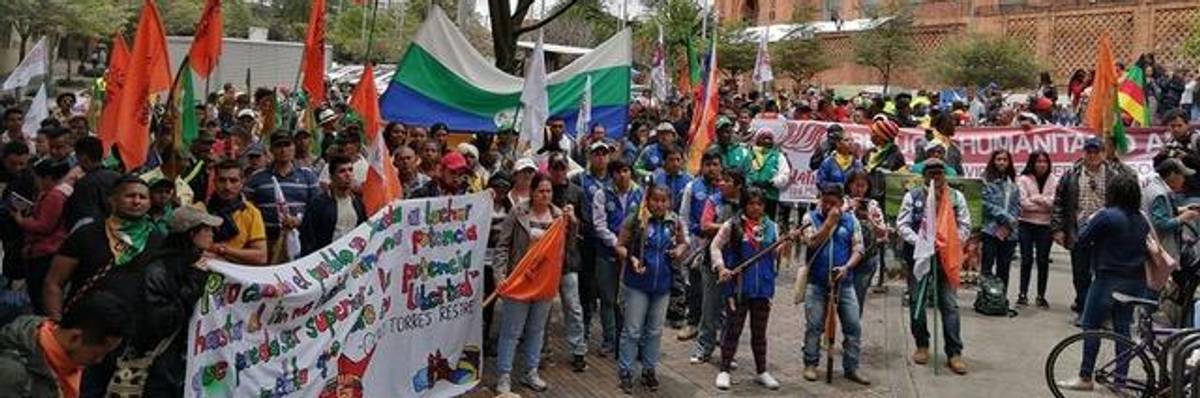
"We need an alternative model globally that would allow the construction of another civilization, one that would save our planet and life itself," said Wilmer Castillo, a spokesperson for the National Agrarian Coordination. "We, the great majority of people in the world, are victims of only one system: capitalism."
With Venezuela occupying the small bandwidth our media has for news about Latin America, there is virtually no information about Colombia, where a horrible wave of violence in the past two years has taken the lives of hundreds of social movement leaders and activists around the country, especially in places such as Cauca, Antioquia, Santander and Arauca. That's why Colombia's social movements organized the Humanitarian Refugee Convergence, taking place April 28-May 2 in Bogota, Colombia. It brings together over 1,000 activists from indigenous, black, women and campesino (farmer) organizations, as well as groups representing victims of Colombia's long armed conflict, to speak out against the violence and call on the government to protect their lives.
During the Convergence, we had a chance to talk to Wilmer Castillo, a spokesperson for the National Agrarian Coordination, a group that brought campesinos from around the country to Bogota.
For people in the United States, they only issue we hear about regarding Latin America is the conflict in Venezuela. Americans, if they know anything about Colombia, might know that a peace agreement was signed with the armed groups in 2016 and they probably think that the situation in Colombia is now calm. Can you tell us what is actually happening here?
It has been falsely reported in the international press that the armed conflict in Colombia has ended. The armed conflict ended with only one guerrilla organization, the FARC. There are still two others, the EPL, the Popular Liberation Army, and the ELN, the National Liberation Army. The present right-wing government of Ivan Duque has canceled the negotiations that were going on with the ELN, which has worsened the armed conflict. Even though the FARC was demobilized and has moved into the arena of nonviolent, political struggle, creating a political party, the armed struggle continues in the places where these two other groups remain active.
Another reason to tell the world that there is no peace in Colombia is because the causes that led to the armed rebellions have not been addressed. On the contrary. There are still multinational companies that invade our lands and displace our rural communities. There are still paramilitary groups that terrorize our organizations. There is still a military strategy to consolidate the land and hand it over to the multinationals. So one of the primary reasons that the armed conflict still exists is because of the economic model that is so destructive.
To make matters worse, the government's armed forces not only fight against the armed insurgents, but against our communities and social movements as well. Their bullets are not just killing insurgents; they are also killing the organized communities that defend their lands and try to build an alternative movement in this country. This alternative goes against the interests of the neoliberal model what has given, and continues to give, all the riches of our territory to the multinational corporations and to national private businesses. When we fight against this model, we are murdered and jailed, which is why we are organizing this Humanitarian Refugee Convergence.
What connection does the US government or US companies have to the conflict?
Unfortunately, foreign companies have invaded our territory and robbed our resources--oil, gold, water and now a series of minerals that they have discovered as the mining technology has advanced. There is also agribusiness. Many of these companies come from the United States. In addition to the companies that extract our resources, there is transnational private capital that sets the economic rules.
As for the U.S. government, it has interfered in our internal affairs from the time of our founding as a nation in 1810. Together, the U.S. government and companies have directly interfered in our way of life by imposing an economic model to benefit foreign interests and reinforcing that model with military agreements. I'm sorry to say that our armed forces have been shaped and trained by the US military. The US military has taught them how to terrorize and attack the people who rise up, how to destroy the organizations we have created to defend ourselves from the multinationals.
What is your message to US activists?
We have always had support from U.S. groups and we appreciate that support. We need to build on those links and find ways to educate more people about the horrible wave of violence our people are suffering. We also have to find more ways to support your struggles. We feel an affinity for the struggles you are waging in the United States and we have always believed in the unity of peoples' struggles around the world for emancipation, autonomy and sovereignty.
We need an alternative model globally that would allow the construction of another civilization, one that would save our planet and life itself. We, the great majority of people in the world, are victims of only one system: capitalism. So together we have to build another world, one in which all worlds fit, one in which all our rights are respected and our planet is protected. That's the world we are dreaming about.
Dear Common Dreams reader, It’s been nearly 30 years since I co-founded Common Dreams with my late wife, Lina Newhouser. We had the radical notion that journalism should serve the public good, not corporate profits. It was clear to us from the outset what it would take to build such a project. No paid advertisements. No corporate sponsors. No millionaire publisher telling us what to think or do. Many people said we wouldn't last a year, but we proved those doubters wrong. Together with a tremendous team of journalists and dedicated staff, we built an independent media outlet free from the constraints of profits and corporate control. Our mission has always been simple: To inform. To inspire. To ignite change for the common good. Building Common Dreams was not easy. Our survival was never guaranteed. When you take on the most powerful forces—Wall Street greed, fossil fuel industry destruction, Big Tech lobbyists, and uber-rich oligarchs who have spent billions upon billions rigging the economy and democracy in their favor—the only bulwark you have is supporters who believe in your work. But here’s the urgent message from me today. It's never been this bad out there. And it's never been this hard to keep us going. At the very moment Common Dreams is most needed, the threats we face are intensifying. We need your support now more than ever. We don't accept corporate advertising and never will. We don't have a paywall because we don't think people should be blocked from critical news based on their ability to pay. Everything we do is funded by the donations of readers like you. When everyone does the little they can afford, we are strong. But if that support retreats or dries up, so do we. Will you donate now to make sure Common Dreams not only survives but thrives? —Craig Brown, Co-founder |
With Venezuela occupying the small bandwidth our media has for news about Latin America, there is virtually no information about Colombia, where a horrible wave of violence in the past two years has taken the lives of hundreds of social movement leaders and activists around the country, especially in places such as Cauca, Antioquia, Santander and Arauca. That's why Colombia's social movements organized the Humanitarian Refugee Convergence, taking place April 28-May 2 in Bogota, Colombia. It brings together over 1,000 activists from indigenous, black, women and campesino (farmer) organizations, as well as groups representing victims of Colombia's long armed conflict, to speak out against the violence and call on the government to protect their lives.
During the Convergence, we had a chance to talk to Wilmer Castillo, a spokesperson for the National Agrarian Coordination, a group that brought campesinos from around the country to Bogota.
For people in the United States, they only issue we hear about regarding Latin America is the conflict in Venezuela. Americans, if they know anything about Colombia, might know that a peace agreement was signed with the armed groups in 2016 and they probably think that the situation in Colombia is now calm. Can you tell us what is actually happening here?
It has been falsely reported in the international press that the armed conflict in Colombia has ended. The armed conflict ended with only one guerrilla organization, the FARC. There are still two others, the EPL, the Popular Liberation Army, and the ELN, the National Liberation Army. The present right-wing government of Ivan Duque has canceled the negotiations that were going on with the ELN, which has worsened the armed conflict. Even though the FARC was demobilized and has moved into the arena of nonviolent, political struggle, creating a political party, the armed struggle continues in the places where these two other groups remain active.
Another reason to tell the world that there is no peace in Colombia is because the causes that led to the armed rebellions have not been addressed. On the contrary. There are still multinational companies that invade our lands and displace our rural communities. There are still paramilitary groups that terrorize our organizations. There is still a military strategy to consolidate the land and hand it over to the multinationals. So one of the primary reasons that the armed conflict still exists is because of the economic model that is so destructive.
To make matters worse, the government's armed forces not only fight against the armed insurgents, but against our communities and social movements as well. Their bullets are not just killing insurgents; they are also killing the organized communities that defend their lands and try to build an alternative movement in this country. This alternative goes against the interests of the neoliberal model what has given, and continues to give, all the riches of our territory to the multinational corporations and to national private businesses. When we fight against this model, we are murdered and jailed, which is why we are organizing this Humanitarian Refugee Convergence.
What connection does the US government or US companies have to the conflict?
Unfortunately, foreign companies have invaded our territory and robbed our resources--oil, gold, water and now a series of minerals that they have discovered as the mining technology has advanced. There is also agribusiness. Many of these companies come from the United States. In addition to the companies that extract our resources, there is transnational private capital that sets the economic rules.
As for the U.S. government, it has interfered in our internal affairs from the time of our founding as a nation in 1810. Together, the U.S. government and companies have directly interfered in our way of life by imposing an economic model to benefit foreign interests and reinforcing that model with military agreements. I'm sorry to say that our armed forces have been shaped and trained by the US military. The US military has taught them how to terrorize and attack the people who rise up, how to destroy the organizations we have created to defend ourselves from the multinationals.
What is your message to US activists?
We have always had support from U.S. groups and we appreciate that support. We need to build on those links and find ways to educate more people about the horrible wave of violence our people are suffering. We also have to find more ways to support your struggles. We feel an affinity for the struggles you are waging in the United States and we have always believed in the unity of peoples' struggles around the world for emancipation, autonomy and sovereignty.
We need an alternative model globally that would allow the construction of another civilization, one that would save our planet and life itself. We, the great majority of people in the world, are victims of only one system: capitalism. So together we have to build another world, one in which all worlds fit, one in which all our rights are respected and our planet is protected. That's the world we are dreaming about.
With Venezuela occupying the small bandwidth our media has for news about Latin America, there is virtually no information about Colombia, where a horrible wave of violence in the past two years has taken the lives of hundreds of social movement leaders and activists around the country, especially in places such as Cauca, Antioquia, Santander and Arauca. That's why Colombia's social movements organized the Humanitarian Refugee Convergence, taking place April 28-May 2 in Bogota, Colombia. It brings together over 1,000 activists from indigenous, black, women and campesino (farmer) organizations, as well as groups representing victims of Colombia's long armed conflict, to speak out against the violence and call on the government to protect their lives.
During the Convergence, we had a chance to talk to Wilmer Castillo, a spokesperson for the National Agrarian Coordination, a group that brought campesinos from around the country to Bogota.
For people in the United States, they only issue we hear about regarding Latin America is the conflict in Venezuela. Americans, if they know anything about Colombia, might know that a peace agreement was signed with the armed groups in 2016 and they probably think that the situation in Colombia is now calm. Can you tell us what is actually happening here?
It has been falsely reported in the international press that the armed conflict in Colombia has ended. The armed conflict ended with only one guerrilla organization, the FARC. There are still two others, the EPL, the Popular Liberation Army, and the ELN, the National Liberation Army. The present right-wing government of Ivan Duque has canceled the negotiations that were going on with the ELN, which has worsened the armed conflict. Even though the FARC was demobilized and has moved into the arena of nonviolent, political struggle, creating a political party, the armed struggle continues in the places where these two other groups remain active.
Another reason to tell the world that there is no peace in Colombia is because the causes that led to the armed rebellions have not been addressed. On the contrary. There are still multinational companies that invade our lands and displace our rural communities. There are still paramilitary groups that terrorize our organizations. There is still a military strategy to consolidate the land and hand it over to the multinationals. So one of the primary reasons that the armed conflict still exists is because of the economic model that is so destructive.
To make matters worse, the government's armed forces not only fight against the armed insurgents, but against our communities and social movements as well. Their bullets are not just killing insurgents; they are also killing the organized communities that defend their lands and try to build an alternative movement in this country. This alternative goes against the interests of the neoliberal model what has given, and continues to give, all the riches of our territory to the multinational corporations and to national private businesses. When we fight against this model, we are murdered and jailed, which is why we are organizing this Humanitarian Refugee Convergence.
What connection does the US government or US companies have to the conflict?
Unfortunately, foreign companies have invaded our territory and robbed our resources--oil, gold, water and now a series of minerals that they have discovered as the mining technology has advanced. There is also agribusiness. Many of these companies come from the United States. In addition to the companies that extract our resources, there is transnational private capital that sets the economic rules.
As for the U.S. government, it has interfered in our internal affairs from the time of our founding as a nation in 1810. Together, the U.S. government and companies have directly interfered in our way of life by imposing an economic model to benefit foreign interests and reinforcing that model with military agreements. I'm sorry to say that our armed forces have been shaped and trained by the US military. The US military has taught them how to terrorize and attack the people who rise up, how to destroy the organizations we have created to defend ourselves from the multinationals.
What is your message to US activists?
We have always had support from U.S. groups and we appreciate that support. We need to build on those links and find ways to educate more people about the horrible wave of violence our people are suffering. We also have to find more ways to support your struggles. We feel an affinity for the struggles you are waging in the United States and we have always believed in the unity of peoples' struggles around the world for emancipation, autonomy and sovereignty.
We need an alternative model globally that would allow the construction of another civilization, one that would save our planet and life itself. We, the great majority of people in the world, are victims of only one system: capitalism. So together we have to build another world, one in which all worlds fit, one in which all our rights are respected and our planet is protected. That's the world we are dreaming about.