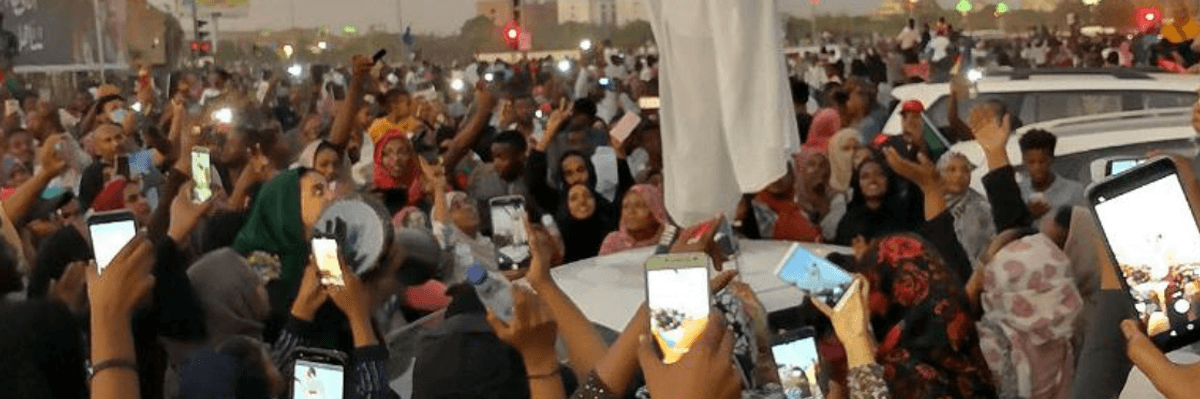
A photo of a woman leading anti-government protests in Sudan went viral in recent weeks. (Photo: Lana Haroun/Twitter)
How Women Are Leading the Sudanese Revolution
"Women are front, left, and center of the revolution."
Since December 2018, protests in Sudan that sparked over the tripled price of bread have turned into nationwide protests against the nearly three-decade rule regime of Omar Al Bashir.
Finally, on Thursday, April 11, 2019, Bashir was forced to step down.
AL-BASHIR IS OUT !! WE DID IT !!! #Sudan
-- Alaa Salah (@iAlaaSalah) April 11, 2019
Bashir's government has used repressive tactics and measures to quell the protests. More than 40 protesters have been killed, hundreds detained and tortured.
The brutal response did not stop women from placing themselves firmly at the heart of the protests.
They lead the march chanting a Zagrouda, an ululation commonly used by women in the Arab world to express celebration.
During the month of March, women wore the traditional white thobe in support of the protests and women's rights. Social media platforms filled with pictures of female protesters wearing the white robe, using the hashtag #whitemarch (#mrs_lbyD)
Women who protest regularly face police brutality. Authorities have fired tear gas and live ammunition and have even threatened with rape. Women have also reportedly been beaten, their faces have been branded and their hair cut off inside detention centers. Every day new footage of Sudanese women getting beaten and humiliated circulates on social media:
But the same hashtags are also used to show the bravery of women in Sudan.
This week, a photo and a video from the protests have gone viral. A 22-year-old engineering and architecture student named Alaa Salah raised her right arm as she led the crowd in a chant called "Thawra" (Arabic for 'revolution'). The video and photo would end up going viral and Sudanese activists are now referring to her as "Kandaka," the title given to Nubian queens of ancient Sudan.
Illustrations shared on social networks transformed Salah into the "Sudanese Statue of Liberty."
From the streets to the screen
Behind the screen, Facebook groups once dominated by conversations about marriage and crushes are now used to expose police brutality. The women in these groups disclose videos and pictures of abusive security forces. When the identity is revealed, the agent concerned is often beaten up and chased out of town. The impact of these groups is remarkable -- many security agents are now hiding their faces.
The Sudanese authorities have tried to block social media in the country, but the women bypass the blockade by using Virtual Private Networks (VPN), which can hide a user's location.
A revolution is never complete without art:
Female painters, digital artists, and musicians have produced works of art to complement street protests. They use art to honor the endurance of the people, especially women. They make art to document the events and portraits of the victims and depict the reality of living under an oppressive system.
"Women are front, left and center of the revolution. When people started protesting, they were like, 'Women should stay at home.' But we were like -- no." said Islam Elbeiti a 24-year-old jazz bass player.
Fighting for women's rights in Sudan
On March 12, the emergency court of appeals in Sudan, amid pressure from families of the women who rallied outside the courthouse, scrapped the flogging punishment of nine female Sudanese protesters that were sentenced to 20 lashes and one month in prison for rioting.
Flogging is a common form of punishment particularly for women in Sudan -- they risk flogging for crimes like indecent clothing or adultery.
In 2014, a woman was sentenced to death for marrying a non-Muslim, which is considered adultery. In 2015, a woman was lashed 75 times for marrying a man without her father's consent.
In 2017, 24 women were arrested for wearing trousers, a violation of the country's strict Shari'a Law.
Sometimes the brutality goes beyond flogging: Many Sudanese women have been sentenced to death by stoning.
According to Reuters, Bashir defended his position on strict adherence to Shari'a law in Sudan in 2011:
We want to present a constitution that serves as a template to those around us. And our template is clear, a 100 percent Islamic constitution, without communism or secularism or Western (influences).
The Sudanese Penal code, which is based on an interpretation of the Shari'a (Islamic Law) allows girls as young as 10 to get married, and states that a woman's rape by her husband cannot be qualified as such.
On top of that, women have to face "morality laws" that chain them and oppress them on a daily basis.
For this reason, Sudanese women are on the front lines of the protests, fighting for change.
We are at a crossroads
This country and this world are at a monumental crossroads. In a few short weeks, US voters will have an opportunity to beat back the forces of fascism and confront the billionaires who are rigging the economy, our media system, and our democracy, making it increasingly impossible for ordinary people to get by. We’re not just talking about the election. We’re talking about what must be done once these fascist elements are vanquished from power. We need a bolder set of solutions than what either major party has so far been willing to offer and a working-class movement ready to fight like hell for it. Trump didn't emerge from nowhere. The conditions that fueled MAGA authoritarianism were created by decades of radical neoliberal economic policies and a corrupt political system dominated by corporate interests. They slashed taxes on the super-rich, promising that the benefits would trickle down. They said giveaways to the corporate titans would make life more affordable for the rest of us. It was all bullshit. And when a bitter, betrayed populace searches for someone to blame, right-wing demagogues have little trouble finding scapegoats. People know when they're being lied to, but you won't hear any of this from the corporate media. Only independent journalism—powered and funded by people who believe in building a better world—can deliver truly trustworthy daily news. Our Fall Campaign is underway, and we need your help. To power our newsroom through the rest of the year, we need to raise $125,000 by midnight on October 31. So if you share our vision, please contribute whatever you can to sustain our work. |
Since December 2018, protests in Sudan that sparked over the tripled price of bread have turned into nationwide protests against the nearly three-decade rule regime of Omar Al Bashir.
Finally, on Thursday, April 11, 2019, Bashir was forced to step down.
AL-BASHIR IS OUT !! WE DID IT !!! #Sudan
-- Alaa Salah (@iAlaaSalah) April 11, 2019
Bashir's government has used repressive tactics and measures to quell the protests. More than 40 protesters have been killed, hundreds detained and tortured.
The brutal response did not stop women from placing themselves firmly at the heart of the protests.
They lead the march chanting a Zagrouda, an ululation commonly used by women in the Arab world to express celebration.
During the month of March, women wore the traditional white thobe in support of the protests and women's rights. Social media platforms filled with pictures of female protesters wearing the white robe, using the hashtag #whitemarch (#mrs_lbyD)
Women who protest regularly face police brutality. Authorities have fired tear gas and live ammunition and have even threatened with rape. Women have also reportedly been beaten, their faces have been branded and their hair cut off inside detention centers. Every day new footage of Sudanese women getting beaten and humiliated circulates on social media:
But the same hashtags are also used to show the bravery of women in Sudan.
This week, a photo and a video from the protests have gone viral. A 22-year-old engineering and architecture student named Alaa Salah raised her right arm as she led the crowd in a chant called "Thawra" (Arabic for 'revolution'). The video and photo would end up going viral and Sudanese activists are now referring to her as "Kandaka," the title given to Nubian queens of ancient Sudan.
Illustrations shared on social networks transformed Salah into the "Sudanese Statue of Liberty."
From the streets to the screen
Behind the screen, Facebook groups once dominated by conversations about marriage and crushes are now used to expose police brutality. The women in these groups disclose videos and pictures of abusive security forces. When the identity is revealed, the agent concerned is often beaten up and chased out of town. The impact of these groups is remarkable -- many security agents are now hiding their faces.
The Sudanese authorities have tried to block social media in the country, but the women bypass the blockade by using Virtual Private Networks (VPN), which can hide a user's location.
A revolution is never complete without art:
Female painters, digital artists, and musicians have produced works of art to complement street protests. They use art to honor the endurance of the people, especially women. They make art to document the events and portraits of the victims and depict the reality of living under an oppressive system.
"Women are front, left and center of the revolution. When people started protesting, they were like, 'Women should stay at home.' But we were like -- no." said Islam Elbeiti a 24-year-old jazz bass player.
Fighting for women's rights in Sudan
On March 12, the emergency court of appeals in Sudan, amid pressure from families of the women who rallied outside the courthouse, scrapped the flogging punishment of nine female Sudanese protesters that were sentenced to 20 lashes and one month in prison for rioting.
Flogging is a common form of punishment particularly for women in Sudan -- they risk flogging for crimes like indecent clothing or adultery.
In 2014, a woman was sentenced to death for marrying a non-Muslim, which is considered adultery. In 2015, a woman was lashed 75 times for marrying a man without her father's consent.
In 2017, 24 women were arrested for wearing trousers, a violation of the country's strict Shari'a Law.
Sometimes the brutality goes beyond flogging: Many Sudanese women have been sentenced to death by stoning.
According to Reuters, Bashir defended his position on strict adherence to Shari'a law in Sudan in 2011:
We want to present a constitution that serves as a template to those around us. And our template is clear, a 100 percent Islamic constitution, without communism or secularism or Western (influences).
The Sudanese Penal code, which is based on an interpretation of the Shari'a (Islamic Law) allows girls as young as 10 to get married, and states that a woman's rape by her husband cannot be qualified as such.
On top of that, women have to face "morality laws" that chain them and oppress them on a daily basis.
For this reason, Sudanese women are on the front lines of the protests, fighting for change.
Since December 2018, protests in Sudan that sparked over the tripled price of bread have turned into nationwide protests against the nearly three-decade rule regime of Omar Al Bashir.
Finally, on Thursday, April 11, 2019, Bashir was forced to step down.
AL-BASHIR IS OUT !! WE DID IT !!! #Sudan
-- Alaa Salah (@iAlaaSalah) April 11, 2019
Bashir's government has used repressive tactics and measures to quell the protests. More than 40 protesters have been killed, hundreds detained and tortured.
The brutal response did not stop women from placing themselves firmly at the heart of the protests.
They lead the march chanting a Zagrouda, an ululation commonly used by women in the Arab world to express celebration.
During the month of March, women wore the traditional white thobe in support of the protests and women's rights. Social media platforms filled with pictures of female protesters wearing the white robe, using the hashtag #whitemarch (#mrs_lbyD)
Women who protest regularly face police brutality. Authorities have fired tear gas and live ammunition and have even threatened with rape. Women have also reportedly been beaten, their faces have been branded and their hair cut off inside detention centers. Every day new footage of Sudanese women getting beaten and humiliated circulates on social media:
But the same hashtags are also used to show the bravery of women in Sudan.
This week, a photo and a video from the protests have gone viral. A 22-year-old engineering and architecture student named Alaa Salah raised her right arm as she led the crowd in a chant called "Thawra" (Arabic for 'revolution'). The video and photo would end up going viral and Sudanese activists are now referring to her as "Kandaka," the title given to Nubian queens of ancient Sudan.
Illustrations shared on social networks transformed Salah into the "Sudanese Statue of Liberty."
From the streets to the screen
Behind the screen, Facebook groups once dominated by conversations about marriage and crushes are now used to expose police brutality. The women in these groups disclose videos and pictures of abusive security forces. When the identity is revealed, the agent concerned is often beaten up and chased out of town. The impact of these groups is remarkable -- many security agents are now hiding their faces.
The Sudanese authorities have tried to block social media in the country, but the women bypass the blockade by using Virtual Private Networks (VPN), which can hide a user's location.
A revolution is never complete without art:
Female painters, digital artists, and musicians have produced works of art to complement street protests. They use art to honor the endurance of the people, especially women. They make art to document the events and portraits of the victims and depict the reality of living under an oppressive system.
"Women are front, left and center of the revolution. When people started protesting, they were like, 'Women should stay at home.' But we were like -- no." said Islam Elbeiti a 24-year-old jazz bass player.
Fighting for women's rights in Sudan
On March 12, the emergency court of appeals in Sudan, amid pressure from families of the women who rallied outside the courthouse, scrapped the flogging punishment of nine female Sudanese protesters that were sentenced to 20 lashes and one month in prison for rioting.
Flogging is a common form of punishment particularly for women in Sudan -- they risk flogging for crimes like indecent clothing or adultery.
In 2014, a woman was sentenced to death for marrying a non-Muslim, which is considered adultery. In 2015, a woman was lashed 75 times for marrying a man without her father's consent.
In 2017, 24 women were arrested for wearing trousers, a violation of the country's strict Shari'a Law.
Sometimes the brutality goes beyond flogging: Many Sudanese women have been sentenced to death by stoning.
According to Reuters, Bashir defended his position on strict adherence to Shari'a law in Sudan in 2011:
We want to present a constitution that serves as a template to those around us. And our template is clear, a 100 percent Islamic constitution, without communism or secularism or Western (influences).
The Sudanese Penal code, which is based on an interpretation of the Shari'a (Islamic Law) allows girls as young as 10 to get married, and states that a woman's rape by her husband cannot be qualified as such.
On top of that, women have to face "morality laws" that chain them and oppress them on a daily basis.
For this reason, Sudanese women are on the front lines of the protests, fighting for change.