SUBSCRIBE TO OUR FREE NEWSLETTER
Daily news & progressive opinion—funded by the people, not the corporations—delivered straight to your inbox.
5
#000000
#FFFFFF
To donate by check, phone, or other method, see our More Ways to Give page.
Daily news & progressive opinion—funded by the people, not the corporations—delivered straight to your inbox.
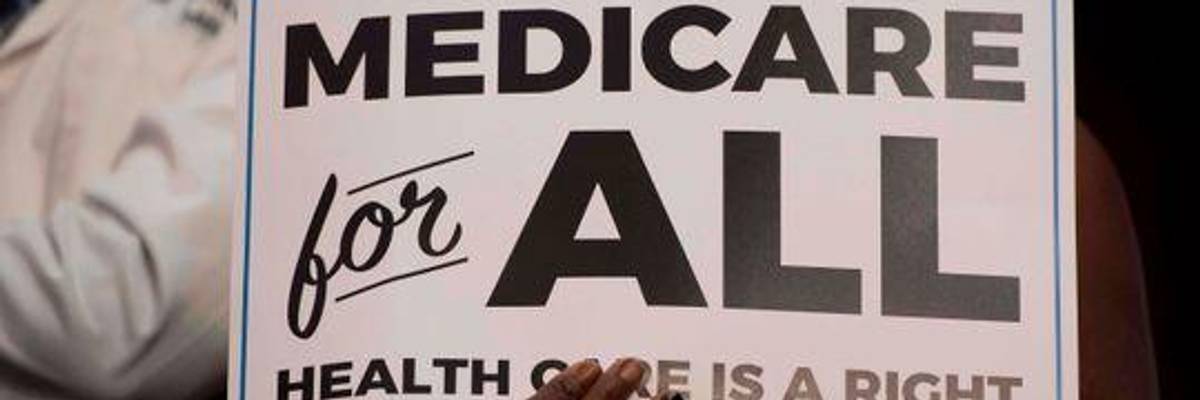
It is time to accept that Medicare for All is the practical alternative. (Photo: Jim Watson/AFP/Getty Images)
There is an instinct among political pundits to confuse caution for practicality -- an assumption that those who advocate for incremental change are being reasonable, while those pushing for bold reforms aren't. This is seen most starkly in the debate around health care reform, despite the fact that the "practical" pushers of limited reform fail to address the real problems in our health care system.
We spend more per person than any other country on health care, but we aren't getting any bang for our buck.
We all recognize that the status quo isn't working. We spend more per person than any other country on health care, but we aren't getting any bang for our buck. We have lower life expectancy, higher infant mortality rates and more preventable deaths, and too many personal bankruptcies are due at least in part to medical bills.
Where we disagree is the solution. The favorite new "reasonable" plan is "Medicare for America," a bill from Reps. Jan Schakowsky and Rosa DeLauro that has won the support of big names like Texas presidential hopeful Beto O'Rourke and the Center for American Progress, the left-of-center think tank where the plan originated as "Medicare Extra for All." It has been extolled in opinion pieces for some of America's largest newspapers as a "realistic" plan to fix what's broken in our health care system.
On the other side, if punditry is to be believed, there are the Medicare for All "hard-liners" who believe in expanding a significantly improved Medicare system to every American, with coverage that includes dental, vision and long-term care. This is portrayed as radical or even unreasonable.
Time to get real. As an economist who has spent decades studying our health care system, I can tell you that Medicare for All advocates are the only ones who are being reasonable, because theirs is the only plan that will control health care costs while finally achieving universal coverage.
The problem with incremental plans, whether they are public options, buy-ins to Medicare or Medicaid, or pumping more money into subsidies in the Affordable Care Act's individual marketplace, is that they preserve the private health insurance system weighing down our health care.
This may be why pundits and centrist politicians view those plans as "reasonable," but it means that they are leaving the main reason for our system's dysfunction in place: the multipayer, for-profit financing model.
Commercial insurance companies are nothing more than middle men. They add no value to our system, but they do drive up costs with their bloated claims departments, marketing and advertising budgets and executive salaries. We pay for all of these things before a single dollar is spent on the delivery of care.
They also create extra costs for providers who need large administrative staffs to deal with billing systems, accounting for as much as $100,000 per physician.
Any plans short of Medicare for All leaves these costs in place. In other words, they leave hundreds of billions of dollars a year in savings on the table.
The waste goes beyond administrative savings. While pharmaceutical companies and hospital groups are consolidating and forming regional monopolies, our fragmented, multipayer system leaves no one insurance plan with a large enough share of the market to negotiate effectively. That allows these companies to essentially set their own inflated prices and bilk the public for hundreds of billions of dollars.
Is it any wonder that they oppose Medicare for All?
If we're talking about which health care reform plans are serious about attacking cost, providing universal coverage and making sure everyone has access to health care, Medicare for All is the only reasonable answer. No other plan does this effectively, which is why I suspect that the Center for American Progress has not come out with spending estimates. Basic economic tenets tell us that their plan will not reduce health care spending as effectively.
Is Medicare for All bold? Absolutely. Is it reasonable? You bet. It is time to accept that Medicare for All is the practical alternative.
Dear Common Dreams reader, It’s been nearly 30 years since I co-founded Common Dreams with my late wife, Lina Newhouser. We had the radical notion that journalism should serve the public good, not corporate profits. It was clear to us from the outset what it would take to build such a project. No paid advertisements. No corporate sponsors. No millionaire publisher telling us what to think or do. Many people said we wouldn't last a year, but we proved those doubters wrong. Together with a tremendous team of journalists and dedicated staff, we built an independent media outlet free from the constraints of profits and corporate control. Our mission has always been simple: To inform. To inspire. To ignite change for the common good. Building Common Dreams was not easy. Our survival was never guaranteed. When you take on the most powerful forces—Wall Street greed, fossil fuel industry destruction, Big Tech lobbyists, and uber-rich oligarchs who have spent billions upon billions rigging the economy and democracy in their favor—the only bulwark you have is supporters who believe in your work. But here’s the urgent message from me today. It's never been this bad out there. And it's never been this hard to keep us going. At the very moment Common Dreams is most needed, the threats we face are intensifying. We need your support now more than ever. We don't accept corporate advertising and never will. We don't have a paywall because we don't think people should be blocked from critical news based on their ability to pay. Everything we do is funded by the donations of readers like you. When everyone does the little they can afford, we are strong. But if that support retreats or dries up, so do we. Will you donate now to make sure Common Dreams not only survives but thrives? —Craig Brown, Co-founder |
There is an instinct among political pundits to confuse caution for practicality -- an assumption that those who advocate for incremental change are being reasonable, while those pushing for bold reforms aren't. This is seen most starkly in the debate around health care reform, despite the fact that the "practical" pushers of limited reform fail to address the real problems in our health care system.
We spend more per person than any other country on health care, but we aren't getting any bang for our buck.
We all recognize that the status quo isn't working. We spend more per person than any other country on health care, but we aren't getting any bang for our buck. We have lower life expectancy, higher infant mortality rates and more preventable deaths, and too many personal bankruptcies are due at least in part to medical bills.
Where we disagree is the solution. The favorite new "reasonable" plan is "Medicare for America," a bill from Reps. Jan Schakowsky and Rosa DeLauro that has won the support of big names like Texas presidential hopeful Beto O'Rourke and the Center for American Progress, the left-of-center think tank where the plan originated as "Medicare Extra for All." It has been extolled in opinion pieces for some of America's largest newspapers as a "realistic" plan to fix what's broken in our health care system.
On the other side, if punditry is to be believed, there are the Medicare for All "hard-liners" who believe in expanding a significantly improved Medicare system to every American, with coverage that includes dental, vision and long-term care. This is portrayed as radical or even unreasonable.
Time to get real. As an economist who has spent decades studying our health care system, I can tell you that Medicare for All advocates are the only ones who are being reasonable, because theirs is the only plan that will control health care costs while finally achieving universal coverage.
The problem with incremental plans, whether they are public options, buy-ins to Medicare or Medicaid, or pumping more money into subsidies in the Affordable Care Act's individual marketplace, is that they preserve the private health insurance system weighing down our health care.
This may be why pundits and centrist politicians view those plans as "reasonable," but it means that they are leaving the main reason for our system's dysfunction in place: the multipayer, for-profit financing model.
Commercial insurance companies are nothing more than middle men. They add no value to our system, but they do drive up costs with their bloated claims departments, marketing and advertising budgets and executive salaries. We pay for all of these things before a single dollar is spent on the delivery of care.
They also create extra costs for providers who need large administrative staffs to deal with billing systems, accounting for as much as $100,000 per physician.
Any plans short of Medicare for All leaves these costs in place. In other words, they leave hundreds of billions of dollars a year in savings on the table.
The waste goes beyond administrative savings. While pharmaceutical companies and hospital groups are consolidating and forming regional monopolies, our fragmented, multipayer system leaves no one insurance plan with a large enough share of the market to negotiate effectively. That allows these companies to essentially set their own inflated prices and bilk the public for hundreds of billions of dollars.
Is it any wonder that they oppose Medicare for All?
If we're talking about which health care reform plans are serious about attacking cost, providing universal coverage and making sure everyone has access to health care, Medicare for All is the only reasonable answer. No other plan does this effectively, which is why I suspect that the Center for American Progress has not come out with spending estimates. Basic economic tenets tell us that their plan will not reduce health care spending as effectively.
Is Medicare for All bold? Absolutely. Is it reasonable? You bet. It is time to accept that Medicare for All is the practical alternative.
There is an instinct among political pundits to confuse caution for practicality -- an assumption that those who advocate for incremental change are being reasonable, while those pushing for bold reforms aren't. This is seen most starkly in the debate around health care reform, despite the fact that the "practical" pushers of limited reform fail to address the real problems in our health care system.
We spend more per person than any other country on health care, but we aren't getting any bang for our buck.
We all recognize that the status quo isn't working. We spend more per person than any other country on health care, but we aren't getting any bang for our buck. We have lower life expectancy, higher infant mortality rates and more preventable deaths, and too many personal bankruptcies are due at least in part to medical bills.
Where we disagree is the solution. The favorite new "reasonable" plan is "Medicare for America," a bill from Reps. Jan Schakowsky and Rosa DeLauro that has won the support of big names like Texas presidential hopeful Beto O'Rourke and the Center for American Progress, the left-of-center think tank where the plan originated as "Medicare Extra for All." It has been extolled in opinion pieces for some of America's largest newspapers as a "realistic" plan to fix what's broken in our health care system.
On the other side, if punditry is to be believed, there are the Medicare for All "hard-liners" who believe in expanding a significantly improved Medicare system to every American, with coverage that includes dental, vision and long-term care. This is portrayed as radical or even unreasonable.
Time to get real. As an economist who has spent decades studying our health care system, I can tell you that Medicare for All advocates are the only ones who are being reasonable, because theirs is the only plan that will control health care costs while finally achieving universal coverage.
The problem with incremental plans, whether they are public options, buy-ins to Medicare or Medicaid, or pumping more money into subsidies in the Affordable Care Act's individual marketplace, is that they preserve the private health insurance system weighing down our health care.
This may be why pundits and centrist politicians view those plans as "reasonable," but it means that they are leaving the main reason for our system's dysfunction in place: the multipayer, for-profit financing model.
Commercial insurance companies are nothing more than middle men. They add no value to our system, but they do drive up costs with their bloated claims departments, marketing and advertising budgets and executive salaries. We pay for all of these things before a single dollar is spent on the delivery of care.
They also create extra costs for providers who need large administrative staffs to deal with billing systems, accounting for as much as $100,000 per physician.
Any plans short of Medicare for All leaves these costs in place. In other words, they leave hundreds of billions of dollars a year in savings on the table.
The waste goes beyond administrative savings. While pharmaceutical companies and hospital groups are consolidating and forming regional monopolies, our fragmented, multipayer system leaves no one insurance plan with a large enough share of the market to negotiate effectively. That allows these companies to essentially set their own inflated prices and bilk the public for hundreds of billions of dollars.
Is it any wonder that they oppose Medicare for All?
If we're talking about which health care reform plans are serious about attacking cost, providing universal coverage and making sure everyone has access to health care, Medicare for All is the only reasonable answer. No other plan does this effectively, which is why I suspect that the Center for American Progress has not come out with spending estimates. Basic economic tenets tell us that their plan will not reduce health care spending as effectively.
Is Medicare for All bold? Absolutely. Is it reasonable? You bet. It is time to accept that Medicare for All is the practical alternative.