SUBSCRIBE TO OUR FREE NEWSLETTER
Daily news & progressive opinion—funded by the people, not the corporations—delivered straight to your inbox.
5
#000000
#FFFFFF
To donate by check, phone, or other method, see our More Ways to Give page.
Daily news & progressive opinion—funded by the people, not the corporations—delivered straight to your inbox.
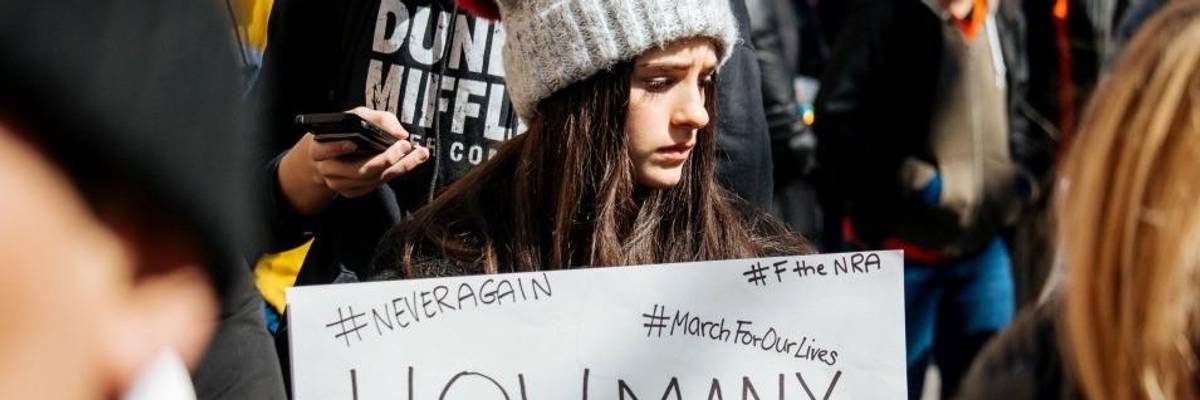
The mass murders continue. When an ideology of separation rules, the killing never stops. (Photo: mathiaswasik/Flickr/cc)
Should we save the planet or kill the enemy?
Perhaps no question more succinctly separates the past from the future, or so it occurred to me after I read Rebecca Solnit's stunning observation in a recent essay: that the mass murders in Christchurch, N.Z. on March 15 occurred on the same day, and in the same general area, as the climate strike young activists were holding in Christchurch as part of a global action, with rallies in well over a hundred countries involving tens of thousands of people.
This juxtaposition was "also a perfectly coherent one, a clash of opposing ideologies," Solnit wrote. "Behind the urgency of climate action is the understanding that everything is connected; behind white supremacy is an ideology of separation."
Everything is connected -- insects, humanity, the oceans, the planet. The meaning and spiritual pull of these words is beyond simple comprehension. The propensity of molecules to unite led to cellular life, Pierre Teilhard de Chardin points out in The Phenomenon of Man, then adds: "Driven by the forces of love, the fragments of the world seek each other so that the world may come into being."
This is the core of the environmental movement that has begun simmering across the planet and has found its way into the U.S. political system, but the ideology of separation remains entrenched: the idea, Solnit writes, "that human beings are divided into races, and those in one race have nothing in common with those in others. . . .
"To kill someone you have to feel separate from them, and some violence -- lynching, rape -- ritualizes this separateness. Violence too comes out of a sort of entitlement: I have the right to hurt you, to determine your fate, to end your life. I am more important than you. It seems like, among other things a miserable mindset, one that aggrandizes your ego but withers your soul."
The U.S. may well be the leader of the global ideology of separation, which means a world of standing armies, unconscionable military budgets and endless war; a world of wealth and poverty, where profit is officially valued over the common good; a world of guns and racism; a world of borders and immigrant scapegoating; a world of nuclear weapons.
This isn't just extremism and white supremacy. This is our social infrastructure, our status quo: a consensus utterly unquestioned by most politicians and the mainstream media. Indeed, the U.S. may well be the leader of the global ideology of separation, which means a world of standing armies, unconscionable military budgets and endless war; a world of wealth and poverty, where profit is officially valued over the common good; a world of punishment-based justice, a growing prison-industrial complex and indifference to healing; a world of guns and racism; a world of borders and immigrant scapegoating; a world of nuclear weapons.
And, of course, a world where most political leaders are clueless about addressing climate change, perhaps because they are funded by the fossil fuel industry and all the interests threatened by ideological change.
For instance, David Roberts, writing at Vox about the Green New Deal, notes the hypocrisy of its political opponents as they cry that we can't afford it: "When Congress funnels trillions to the military or cuts taxes for the wealthy, no one asks how they will pay for it. Pay-for demands seem only to apply to Democrats, and only for social spending."
In other words, spending to maintain the ideology of separation knows no limits. But spending that acknowledges and strengthens connection . . . uh, sorry, kids, we can't let you bankrupt us. Or as Mitch McConnell put it the other day, just prior to the Senate's sham vote to kill the Green New Deal, senators who support it "are so fully committed to radical left-wing ideology that they can't even vote 'no' on self-inflicted economic ruin that would take a sledgehammer to America's middle class."
There's no compromise with such a lie, just as there was no compromise, back in the day, with segregated schools and segregated bathrooms and legal tricks that prevented African-Americans from voting.
This is a revolution. Indeed, it's the same revolution -- nonviolent, uncompromising, spiritual. It will -- it must -- keep growing, beyond McConnell's wildest dreams and fears. Eventually it will crack the established order, the unchallenged belief in the existence of enemies, the need for an enemy, and the core thinking of how we create and organize our world will change.
Imagine Mitch McConnell sitting in a circle with tribal elders, with the spiritual leaders of Planet Earth, learning about the Anthropocene and human responsibility for the changing planet. Imagine him listening to Desmond Tutu speak of ubuntu: "Ubuntu is not easy to describe because it has no equivalent in any of the Western languages," Tutu has said. "The solitary individual is in our understanding a contradiction in terms. You are a person through other persons."
I am because you are!
The world we live in today is far too bereft of such wisdom. The mass murders continue. When an ideology of separation rules, the killing never stops. In the past few days, two young survivors of the Parkland shootings a year ago committed suicide; so did the father of a 6-year-old child who was murdered in 2012 at Sandy Hook Elementary School. And since 2008, more than 6,000 U.S. military veterans and enlisted men and women have committed suicide every year.
Jeremy Richman, the Sandy Hook dad, tried to reach past the horror of what happened to his daughter, toward healing and prevention. He helped launch a foundation, named after his daughter, Avielle, funding "neuroscience research aimed at understanding the brain's chemistry, structure, and circuits that lead to violence and compassion."
This wasn't enough to save his life. His wound was too large -- but it's part of the collective wound we all must bear. It's part of our wounded planet.
Dear Common Dreams reader, It’s been nearly 30 years since I co-founded Common Dreams with my late wife, Lina Newhouser. We had the radical notion that journalism should serve the public good, not corporate profits. It was clear to us from the outset what it would take to build such a project. No paid advertisements. No corporate sponsors. No millionaire publisher telling us what to think or do. Many people said we wouldn't last a year, but we proved those doubters wrong. Together with a tremendous team of journalists and dedicated staff, we built an independent media outlet free from the constraints of profits and corporate control. Our mission has always been simple: To inform. To inspire. To ignite change for the common good. Building Common Dreams was not easy. Our survival was never guaranteed. When you take on the most powerful forces—Wall Street greed, fossil fuel industry destruction, Big Tech lobbyists, and uber-rich oligarchs who have spent billions upon billions rigging the economy and democracy in their favor—the only bulwark you have is supporters who believe in your work. But here’s the urgent message from me today. It's never been this bad out there. And it's never been this hard to keep us going. At the very moment Common Dreams is most needed, the threats we face are intensifying. We need your support now more than ever. We don't accept corporate advertising and never will. We don't have a paywall because we don't think people should be blocked from critical news based on their ability to pay. Everything we do is funded by the donations of readers like you. When everyone does the little they can afford, we are strong. But if that support retreats or dries up, so do we. Will you donate now to make sure Common Dreams not only survives but thrives? —Craig Brown, Co-founder |
Should we save the planet or kill the enemy?
Perhaps no question more succinctly separates the past from the future, or so it occurred to me after I read Rebecca Solnit's stunning observation in a recent essay: that the mass murders in Christchurch, N.Z. on March 15 occurred on the same day, and in the same general area, as the climate strike young activists were holding in Christchurch as part of a global action, with rallies in well over a hundred countries involving tens of thousands of people.
This juxtaposition was "also a perfectly coherent one, a clash of opposing ideologies," Solnit wrote. "Behind the urgency of climate action is the understanding that everything is connected; behind white supremacy is an ideology of separation."
Everything is connected -- insects, humanity, the oceans, the planet. The meaning and spiritual pull of these words is beyond simple comprehension. The propensity of molecules to unite led to cellular life, Pierre Teilhard de Chardin points out in The Phenomenon of Man, then adds: "Driven by the forces of love, the fragments of the world seek each other so that the world may come into being."
This is the core of the environmental movement that has begun simmering across the planet and has found its way into the U.S. political system, but the ideology of separation remains entrenched: the idea, Solnit writes, "that human beings are divided into races, and those in one race have nothing in common with those in others. . . .
"To kill someone you have to feel separate from them, and some violence -- lynching, rape -- ritualizes this separateness. Violence too comes out of a sort of entitlement: I have the right to hurt you, to determine your fate, to end your life. I am more important than you. It seems like, among other things a miserable mindset, one that aggrandizes your ego but withers your soul."
The U.S. may well be the leader of the global ideology of separation, which means a world of standing armies, unconscionable military budgets and endless war; a world of wealth and poverty, where profit is officially valued over the common good; a world of guns and racism; a world of borders and immigrant scapegoating; a world of nuclear weapons.
This isn't just extremism and white supremacy. This is our social infrastructure, our status quo: a consensus utterly unquestioned by most politicians and the mainstream media. Indeed, the U.S. may well be the leader of the global ideology of separation, which means a world of standing armies, unconscionable military budgets and endless war; a world of wealth and poverty, where profit is officially valued over the common good; a world of punishment-based justice, a growing prison-industrial complex and indifference to healing; a world of guns and racism; a world of borders and immigrant scapegoating; a world of nuclear weapons.
And, of course, a world where most political leaders are clueless about addressing climate change, perhaps because they are funded by the fossil fuel industry and all the interests threatened by ideological change.
For instance, David Roberts, writing at Vox about the Green New Deal, notes the hypocrisy of its political opponents as they cry that we can't afford it: "When Congress funnels trillions to the military or cuts taxes for the wealthy, no one asks how they will pay for it. Pay-for demands seem only to apply to Democrats, and only for social spending."
In other words, spending to maintain the ideology of separation knows no limits. But spending that acknowledges and strengthens connection . . . uh, sorry, kids, we can't let you bankrupt us. Or as Mitch McConnell put it the other day, just prior to the Senate's sham vote to kill the Green New Deal, senators who support it "are so fully committed to radical left-wing ideology that they can't even vote 'no' on self-inflicted economic ruin that would take a sledgehammer to America's middle class."
There's no compromise with such a lie, just as there was no compromise, back in the day, with segregated schools and segregated bathrooms and legal tricks that prevented African-Americans from voting.
This is a revolution. Indeed, it's the same revolution -- nonviolent, uncompromising, spiritual. It will -- it must -- keep growing, beyond McConnell's wildest dreams and fears. Eventually it will crack the established order, the unchallenged belief in the existence of enemies, the need for an enemy, and the core thinking of how we create and organize our world will change.
Imagine Mitch McConnell sitting in a circle with tribal elders, with the spiritual leaders of Planet Earth, learning about the Anthropocene and human responsibility for the changing planet. Imagine him listening to Desmond Tutu speak of ubuntu: "Ubuntu is not easy to describe because it has no equivalent in any of the Western languages," Tutu has said. "The solitary individual is in our understanding a contradiction in terms. You are a person through other persons."
I am because you are!
The world we live in today is far too bereft of such wisdom. The mass murders continue. When an ideology of separation rules, the killing never stops. In the past few days, two young survivors of the Parkland shootings a year ago committed suicide; so did the father of a 6-year-old child who was murdered in 2012 at Sandy Hook Elementary School. And since 2008, more than 6,000 U.S. military veterans and enlisted men and women have committed suicide every year.
Jeremy Richman, the Sandy Hook dad, tried to reach past the horror of what happened to his daughter, toward healing and prevention. He helped launch a foundation, named after his daughter, Avielle, funding "neuroscience research aimed at understanding the brain's chemistry, structure, and circuits that lead to violence and compassion."
This wasn't enough to save his life. His wound was too large -- but it's part of the collective wound we all must bear. It's part of our wounded planet.
Should we save the planet or kill the enemy?
Perhaps no question more succinctly separates the past from the future, or so it occurred to me after I read Rebecca Solnit's stunning observation in a recent essay: that the mass murders in Christchurch, N.Z. on March 15 occurred on the same day, and in the same general area, as the climate strike young activists were holding in Christchurch as part of a global action, with rallies in well over a hundred countries involving tens of thousands of people.
This juxtaposition was "also a perfectly coherent one, a clash of opposing ideologies," Solnit wrote. "Behind the urgency of climate action is the understanding that everything is connected; behind white supremacy is an ideology of separation."
Everything is connected -- insects, humanity, the oceans, the planet. The meaning and spiritual pull of these words is beyond simple comprehension. The propensity of molecules to unite led to cellular life, Pierre Teilhard de Chardin points out in The Phenomenon of Man, then adds: "Driven by the forces of love, the fragments of the world seek each other so that the world may come into being."
This is the core of the environmental movement that has begun simmering across the planet and has found its way into the U.S. political system, but the ideology of separation remains entrenched: the idea, Solnit writes, "that human beings are divided into races, and those in one race have nothing in common with those in others. . . .
"To kill someone you have to feel separate from them, and some violence -- lynching, rape -- ritualizes this separateness. Violence too comes out of a sort of entitlement: I have the right to hurt you, to determine your fate, to end your life. I am more important than you. It seems like, among other things a miserable mindset, one that aggrandizes your ego but withers your soul."
The U.S. may well be the leader of the global ideology of separation, which means a world of standing armies, unconscionable military budgets and endless war; a world of wealth and poverty, where profit is officially valued over the common good; a world of guns and racism; a world of borders and immigrant scapegoating; a world of nuclear weapons.
This isn't just extremism and white supremacy. This is our social infrastructure, our status quo: a consensus utterly unquestioned by most politicians and the mainstream media. Indeed, the U.S. may well be the leader of the global ideology of separation, which means a world of standing armies, unconscionable military budgets and endless war; a world of wealth and poverty, where profit is officially valued over the common good; a world of punishment-based justice, a growing prison-industrial complex and indifference to healing; a world of guns and racism; a world of borders and immigrant scapegoating; a world of nuclear weapons.
And, of course, a world where most political leaders are clueless about addressing climate change, perhaps because they are funded by the fossil fuel industry and all the interests threatened by ideological change.
For instance, David Roberts, writing at Vox about the Green New Deal, notes the hypocrisy of its political opponents as they cry that we can't afford it: "When Congress funnels trillions to the military or cuts taxes for the wealthy, no one asks how they will pay for it. Pay-for demands seem only to apply to Democrats, and only for social spending."
In other words, spending to maintain the ideology of separation knows no limits. But spending that acknowledges and strengthens connection . . . uh, sorry, kids, we can't let you bankrupt us. Or as Mitch McConnell put it the other day, just prior to the Senate's sham vote to kill the Green New Deal, senators who support it "are so fully committed to radical left-wing ideology that they can't even vote 'no' on self-inflicted economic ruin that would take a sledgehammer to America's middle class."
There's no compromise with such a lie, just as there was no compromise, back in the day, with segregated schools and segregated bathrooms and legal tricks that prevented African-Americans from voting.
This is a revolution. Indeed, it's the same revolution -- nonviolent, uncompromising, spiritual. It will -- it must -- keep growing, beyond McConnell's wildest dreams and fears. Eventually it will crack the established order, the unchallenged belief in the existence of enemies, the need for an enemy, and the core thinking of how we create and organize our world will change.
Imagine Mitch McConnell sitting in a circle with tribal elders, with the spiritual leaders of Planet Earth, learning about the Anthropocene and human responsibility for the changing planet. Imagine him listening to Desmond Tutu speak of ubuntu: "Ubuntu is not easy to describe because it has no equivalent in any of the Western languages," Tutu has said. "The solitary individual is in our understanding a contradiction in terms. You are a person through other persons."
I am because you are!
The world we live in today is far too bereft of such wisdom. The mass murders continue. When an ideology of separation rules, the killing never stops. In the past few days, two young survivors of the Parkland shootings a year ago committed suicide; so did the father of a 6-year-old child who was murdered in 2012 at Sandy Hook Elementary School. And since 2008, more than 6,000 U.S. military veterans and enlisted men and women have committed suicide every year.
Jeremy Richman, the Sandy Hook dad, tried to reach past the horror of what happened to his daughter, toward healing and prevention. He helped launch a foundation, named after his daughter, Avielle, funding "neuroscience research aimed at understanding the brain's chemistry, structure, and circuits that lead to violence and compassion."
This wasn't enough to save his life. His wound was too large -- but it's part of the collective wound we all must bear. It's part of our wounded planet.