

SUBSCRIBE TO OUR FREE NEWSLETTER
Daily news & progressive opinion—funded by the people, not the corporations—delivered straight to your inbox.
5
#000000
#FFFFFF
To donate by check, phone, or other method, see our More Ways to Give page.
A friend sent me an email the other day, complaining about the 70 percent marginal tax rate floated by Democratic Representative Alexandria Ocasio-Cortez and the new wealth tax proposed by Democratic Senator Elizabeth Warren.
Ocasio-Cortez first mentioned the 70 percent rate in response to a question from CNN's Anderson Cooper about how she proposes to pay for programs like a Green New Deal that could cost trillions of dollars. Higher tax rates, she suggested, might be one part of the answer.
Then Warren released a video explaining that her "ultra-millionaire tax" could raise nearly $3 trillion over 10 years, money that she says could be used to pay for programs like universal child care, a Green New Deal and student-debt forgiveness.
Oh, I forgot to mention, my friend is wealthy enough to get hit by both.
I've argued elsewhere that we can pay for a Green New Deal and that the obsession with finding a dollar of new "revenue" to offset every new dollar of spending is the wrong way to approach the federal budgeting process. My views belong to the macroeconomic school of thought known as Modern Monetary Theory -- MMT, for short.
I've debated those views here at Bloomberg Opinion, and they are beginning to gain a foothold in policy circles. But there is a long a way to go before politicians and the journalists who interview them stop demanding a road map to the source of funding for every new spending proposal.
My wealthy friend doesn't want to pay for your child care. He doesn't want to help pay off your student loans. And he sure as heck doesn't want to shell out the big bucks for a multi-trillion-dollar Green New Deal.
So where does that leave Democrats, who insist that they need the rich to pay for their progressive agenda? Here's what I told him.
"I am with the Democrats. I want to see us build a cleaner, safer, more prosperous world. I agree with billionaire hedge-fund manager Ray Dalio, who argues that inequality has become so extreme that it should be declared a "national emergency" and dealt with by presidential action.
"And I worry very much that it may prove impossible to raise taxes on the ultra-wealthy (who have enormous political power). Then what? The planet burns, our third-world infrastructure falls into total disrepair, and our society becomes ever more bifurcated until the tensions reach a boiling point and.... The pitchforks are coming.
"The problem is that every politician is confronted with the question, "How are you going to pay for it?" What these journalists are really asking is, 'Who's going to pay for it?'
"The question is designed to stop any meaningful policy debate by dividing us up, and get us fighting over where the money is going to come from. Since none of the headline politicians has really figured out how to respond -- by explaining that when Congress approves a budget, the Treasury Department instructs the Federal Reserve to credit a seller's bank account -- they all end up trying to answer it by pointing to some new revenue source.
"And then there are self-imposed constraints, like PAYGO, that require lawmakers to offset any new spending with higher taxes or cuts to some other part of the budget. That means you can't even get a piece of legislation to the floor for a vote if isn't fully "paid for." It also makes passing anything that much harder, since it requires politicians to raise taxes or carve out money from other programs. And don't even get me started on CBO.
"So that's why you see people like Representative Ocasio-Cortez and Senator Warren looking at the ultra-rich to fund their agendas. Billionaires are the magic money tree!
"To be blunt, the super-rich have become victims of their own successful marketing campaign. Conservative billionaires like Pete Peterson spent decades complaining about debt and deficits, putting enormous sums of money into a PR campaign to turn politicians and the public against deficit spending.
"So here we are. As Hillary Clinton said during the 2016 campaign, 'You have to go where the money is.' That means you!
"What can higher-income taxpayers do? I guess they could point the finger at Congress and say: "Don't look at us! That's where the money comes from!" Because the truth is, funding a Green New Deal with some deficit spending means we get good-paying jobs, a cleaner world and more safe assets (Treasuries) for everyone, including wealthier taxpayers."
To help my friend see the choices we face, I sent him a sketch that is shown here in a chart.
You don't need precise data to make the point. Just think of it, loosely, as a reflection of the gap between the top and the bottom. Start off with today's degree of disparity, represented by the black bar on the left.
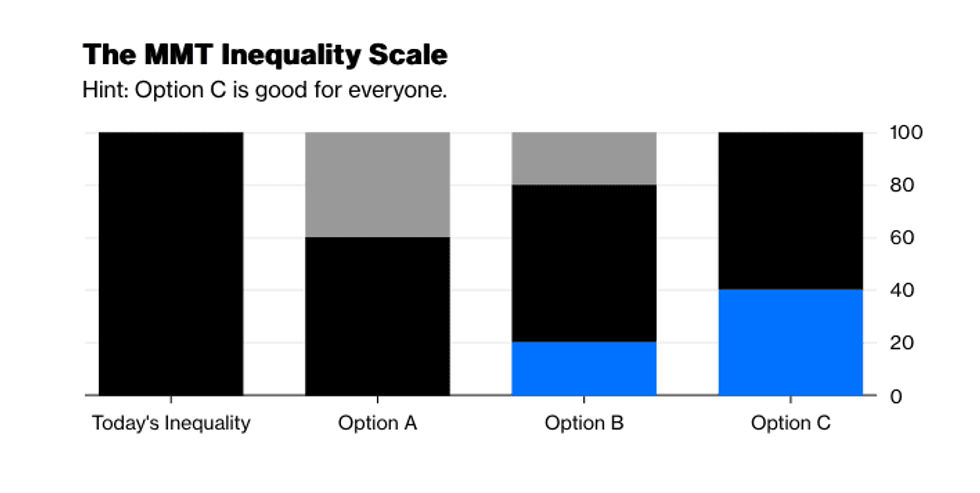
Now suppose someone offers you three different ways to reduce inequality, shown in bars A, B and C. Each will leave you with a less unequal society but the same absolute disparity between the top and the bottom.
To get outcome A, you simply tax money away from the rich (the part shown in gray at the top). This does nothing to improve the material well-being of anyone below, but it does compress the distribution, so inequality is diminished.
Option B is your standard Robin Hood redistribution. Money is taxed away from those at the top, and money is invested in programs to lift everyone else (shown in blue). Again, the distance (or degree of disparity) between the top and the bottom is the same as under Option A, but this time the top lost and the bottom gained.
Finally, consider what happens if we simply invest in programs to benefit the non-rich (student-debt forgiveness, free child care and so on) without treating the super-rich as our piggy bank. In Option C, the top doesn't move, but the bottom is boosted to new heights.
It's sort of incredible that the option that is clearly better for both groups is the one we're most afraid of. But that's what happens when deficit phobias force politicians to "pay for" everything by going where the money is.
A friend sent me an email the other day, complaining about the 70 percent marginal tax rate floated by Democratic Representative Alexandria Ocasio-Cortez and the new wealth tax proposed by Democratic Senator Elizabeth Warren.
Ocasio-Cortez first mentioned the 70 percent rate in response to a question from CNN's Anderson Cooper about how she proposes to pay for programs like a Green New Deal that could cost trillions of dollars. Higher tax rates, she suggested, might be one part of the answer.
Then Warren released a video explaining that her "ultra-millionaire tax" could raise nearly $3 trillion over 10 years, money that she says could be used to pay for programs like universal child care, a Green New Deal and student-debt forgiveness.
Oh, I forgot to mention, my friend is wealthy enough to get hit by both.
I've argued elsewhere that we can pay for a Green New Deal and that the obsession with finding a dollar of new "revenue" to offset every new dollar of spending is the wrong way to approach the federal budgeting process. My views belong to the macroeconomic school of thought known as Modern Monetary Theory -- MMT, for short.
I've debated those views here at Bloomberg Opinion, and they are beginning to gain a foothold in policy circles. But there is a long a way to go before politicians and the journalists who interview them stop demanding a road map to the source of funding for every new spending proposal.
My wealthy friend doesn't want to pay for your child care. He doesn't want to help pay off your student loans. And he sure as heck doesn't want to shell out the big bucks for a multi-trillion-dollar Green New Deal.
So where does that leave Democrats, who insist that they need the rich to pay for their progressive agenda? Here's what I told him.
"I am with the Democrats. I want to see us build a cleaner, safer, more prosperous world. I agree with billionaire hedge-fund manager Ray Dalio, who argues that inequality has become so extreme that it should be declared a "national emergency" and dealt with by presidential action.
"And I worry very much that it may prove impossible to raise taxes on the ultra-wealthy (who have enormous political power). Then what? The planet burns, our third-world infrastructure falls into total disrepair, and our society becomes ever more bifurcated until the tensions reach a boiling point and.... The pitchforks are coming.
"The problem is that every politician is confronted with the question, "How are you going to pay for it?" What these journalists are really asking is, 'Who's going to pay for it?'
"The question is designed to stop any meaningful policy debate by dividing us up, and get us fighting over where the money is going to come from. Since none of the headline politicians has really figured out how to respond -- by explaining that when Congress approves a budget, the Treasury Department instructs the Federal Reserve to credit a seller's bank account -- they all end up trying to answer it by pointing to some new revenue source.
"And then there are self-imposed constraints, like PAYGO, that require lawmakers to offset any new spending with higher taxes or cuts to some other part of the budget. That means you can't even get a piece of legislation to the floor for a vote if isn't fully "paid for." It also makes passing anything that much harder, since it requires politicians to raise taxes or carve out money from other programs. And don't even get me started on CBO.
"So that's why you see people like Representative Ocasio-Cortez and Senator Warren looking at the ultra-rich to fund their agendas. Billionaires are the magic money tree!
"To be blunt, the super-rich have become victims of their own successful marketing campaign. Conservative billionaires like Pete Peterson spent decades complaining about debt and deficits, putting enormous sums of money into a PR campaign to turn politicians and the public against deficit spending.
"So here we are. As Hillary Clinton said during the 2016 campaign, 'You have to go where the money is.' That means you!
"What can higher-income taxpayers do? I guess they could point the finger at Congress and say: "Don't look at us! That's where the money comes from!" Because the truth is, funding a Green New Deal with some deficit spending means we get good-paying jobs, a cleaner world and more safe assets (Treasuries) for everyone, including wealthier taxpayers."
To help my friend see the choices we face, I sent him a sketch that is shown here in a chart.
You don't need precise data to make the point. Just think of it, loosely, as a reflection of the gap between the top and the bottom. Start off with today's degree of disparity, represented by the black bar on the left.
Now suppose someone offers you three different ways to reduce inequality, shown in bars A, B and C. Each will leave you with a less unequal society but the same absolute disparity between the top and the bottom.
To get outcome A, you simply tax money away from the rich (the part shown in gray at the top). This does nothing to improve the material well-being of anyone below, but it does compress the distribution, so inequality is diminished.
Option B is your standard Robin Hood redistribution. Money is taxed away from those at the top, and money is invested in programs to lift everyone else (shown in blue). Again, the distance (or degree of disparity) between the top and the bottom is the same as under Option A, but this time the top lost and the bottom gained.
Finally, consider what happens if we simply invest in programs to benefit the non-rich (student-debt forgiveness, free child care and so on) without treating the super-rich as our piggy bank. In Option C, the top doesn't move, but the bottom is boosted to new heights.
It's sort of incredible that the option that is clearly better for both groups is the one we're most afraid of. But that's what happens when deficit phobias force politicians to "pay for" everything by going where the money is.
A friend sent me an email the other day, complaining about the 70 percent marginal tax rate floated by Democratic Representative Alexandria Ocasio-Cortez and the new wealth tax proposed by Democratic Senator Elizabeth Warren.
Ocasio-Cortez first mentioned the 70 percent rate in response to a question from CNN's Anderson Cooper about how she proposes to pay for programs like a Green New Deal that could cost trillions of dollars. Higher tax rates, she suggested, might be one part of the answer.
Then Warren released a video explaining that her "ultra-millionaire tax" could raise nearly $3 trillion over 10 years, money that she says could be used to pay for programs like universal child care, a Green New Deal and student-debt forgiveness.
Oh, I forgot to mention, my friend is wealthy enough to get hit by both.
I've argued elsewhere that we can pay for a Green New Deal and that the obsession with finding a dollar of new "revenue" to offset every new dollar of spending is the wrong way to approach the federal budgeting process. My views belong to the macroeconomic school of thought known as Modern Monetary Theory -- MMT, for short.
I've debated those views here at Bloomberg Opinion, and they are beginning to gain a foothold in policy circles. But there is a long a way to go before politicians and the journalists who interview them stop demanding a road map to the source of funding for every new spending proposal.
My wealthy friend doesn't want to pay for your child care. He doesn't want to help pay off your student loans. And he sure as heck doesn't want to shell out the big bucks for a multi-trillion-dollar Green New Deal.
So where does that leave Democrats, who insist that they need the rich to pay for their progressive agenda? Here's what I told him.
"I am with the Democrats. I want to see us build a cleaner, safer, more prosperous world. I agree with billionaire hedge-fund manager Ray Dalio, who argues that inequality has become so extreme that it should be declared a "national emergency" and dealt with by presidential action.
"And I worry very much that it may prove impossible to raise taxes on the ultra-wealthy (who have enormous political power). Then what? The planet burns, our third-world infrastructure falls into total disrepair, and our society becomes ever more bifurcated until the tensions reach a boiling point and.... The pitchforks are coming.
"The problem is that every politician is confronted with the question, "How are you going to pay for it?" What these journalists are really asking is, 'Who's going to pay for it?'
"The question is designed to stop any meaningful policy debate by dividing us up, and get us fighting over where the money is going to come from. Since none of the headline politicians has really figured out how to respond -- by explaining that when Congress approves a budget, the Treasury Department instructs the Federal Reserve to credit a seller's bank account -- they all end up trying to answer it by pointing to some new revenue source.
"And then there are self-imposed constraints, like PAYGO, that require lawmakers to offset any new spending with higher taxes or cuts to some other part of the budget. That means you can't even get a piece of legislation to the floor for a vote if isn't fully "paid for." It also makes passing anything that much harder, since it requires politicians to raise taxes or carve out money from other programs. And don't even get me started on CBO.
"So that's why you see people like Representative Ocasio-Cortez and Senator Warren looking at the ultra-rich to fund their agendas. Billionaires are the magic money tree!
"To be blunt, the super-rich have become victims of their own successful marketing campaign. Conservative billionaires like Pete Peterson spent decades complaining about debt and deficits, putting enormous sums of money into a PR campaign to turn politicians and the public against deficit spending.
"So here we are. As Hillary Clinton said during the 2016 campaign, 'You have to go where the money is.' That means you!
"What can higher-income taxpayers do? I guess they could point the finger at Congress and say: "Don't look at us! That's where the money comes from!" Because the truth is, funding a Green New Deal with some deficit spending means we get good-paying jobs, a cleaner world and more safe assets (Treasuries) for everyone, including wealthier taxpayers."
To help my friend see the choices we face, I sent him a sketch that is shown here in a chart.
You don't need precise data to make the point. Just think of it, loosely, as a reflection of the gap between the top and the bottom. Start off with today's degree of disparity, represented by the black bar on the left.
Now suppose someone offers you three different ways to reduce inequality, shown in bars A, B and C. Each will leave you with a less unequal society but the same absolute disparity between the top and the bottom.
To get outcome A, you simply tax money away from the rich (the part shown in gray at the top). This does nothing to improve the material well-being of anyone below, but it does compress the distribution, so inequality is diminished.
Option B is your standard Robin Hood redistribution. Money is taxed away from those at the top, and money is invested in programs to lift everyone else (shown in blue). Again, the distance (or degree of disparity) between the top and the bottom is the same as under Option A, but this time the top lost and the bottom gained.
Finally, consider what happens if we simply invest in programs to benefit the non-rich (student-debt forgiveness, free child care and so on) without treating the super-rich as our piggy bank. In Option C, the top doesn't move, but the bottom is boosted to new heights.
It's sort of incredible that the option that is clearly better for both groups is the one we're most afraid of. But that's what happens when deficit phobias force politicians to "pay for" everything by going where the money is.

