SUBSCRIBE TO OUR FREE NEWSLETTER
Daily news & progressive opinion—funded by the people, not the corporations—delivered straight to your inbox.
5
#000000
#FFFFFF
To donate by check, phone, or other method, see our More Ways to Give page.
Daily news & progressive opinion—funded by the people, not the corporations—delivered straight to your inbox.
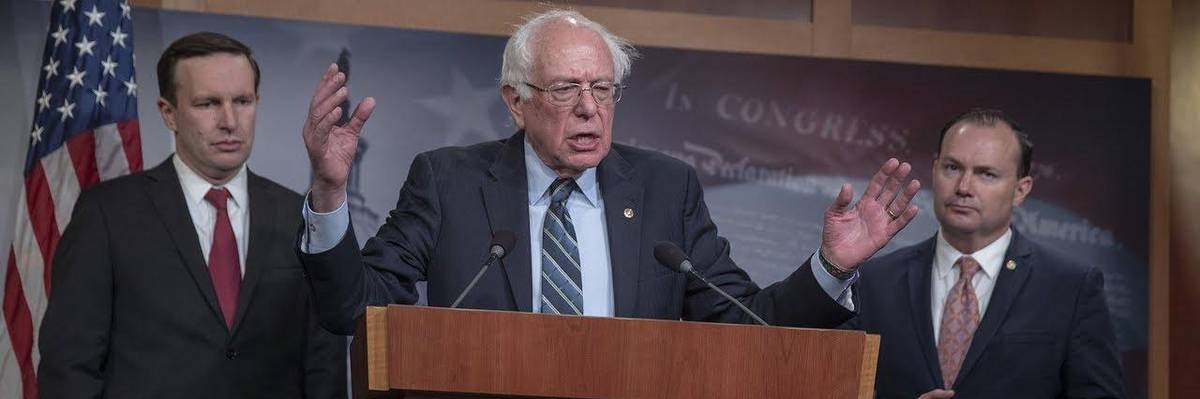
The invocation of the War Powers Resolution with regard to support for the irregular or irregular forces of a foreign country is pure genius, and now that it has been done once, it surely will be done again. (Photo: Screenshot)
Seven Republicans joined the Democrats in the Senate in voting for resolutions that 1) assigned the blame for the murder of the dissident Saudi journalist and Washington Post columnist Jamal Khashoggi to Saudi crown prince Mohammed Bin Salman and 2) invoked the War Powers Act of 1973 in calling for an end to US military involvement in the Saudi-led war on Yemen.
Neither house of the US Congress is typically very eager to get involved in foreign policy, which congressional representatives and senators typically leave to the president. (The Senate Select Committee on Foreign Affairs and the House counterpart are exceptions, but their deliberations seldom go to the whole Congress). How deep our current political crisis is under the beleaguered Trump presidency can be estimated by the mere fact that the Senate invoked the War Powers Resolution for the first time since it was enacted under Nixon in 1973.
How deep our current political crisis is under the beleaguered Trump presidency can be estimated by the mere fact that the Senate invoked the War Powers Resolution for the first time since it was enacted under Nixon in 1973.
First, Joint Resolution 69 asked for a diplomatic solution to the Yemen war, given that "nearly 12,000,000 people are suffering from "severe hunger," according to the United Nations' World Food Programme."
The Senators let Riyadh have it over the erratic and outrageous behavior of crown prince Mohammed Bin Salman:
They also blast Riyadh for "misleading statements by the Government of the Kingdom of Saudi Arabia regarding the murder of Jamal Khashoggi," which, they say, "have undermined trust and confidence in the longstanding friendship between the United States and the Kingdom of Saudi Arabia."
The Senate therefore said that it
(2) acknowledges the United States Government has sanctioned 17 Saudi individuals under the Global MagnitskyHuman Rights Accountability Act (subtitle F of title XII of Public Law 114-328; 22 U.S.C. 2656 note) for their roles in the murder;
(3) calls for the Government of the Kingdom of Saudi Arabia to ensure appropriate accountability for all those responsible for Jamal Khashoggi's murder...
In other words, King Salman should have his own son, Mohammed Bin Salman, arrested and tried for the murder of Jamal Khashoggi!
The Seate further
They go on to demand an end to the Yemen war, though they are careful to place some blame on Iran and the Houthi rebels.
These passages make for an absolutely astonishing and unprecedented document! They have played Perry Mason and convicted the crown prince of Saudi Arabia, Mohammed Bin Salman, of premeditated murder! He is the de facto ruler of the country, but he has been effectively barred from addressing Congress, and any state trip he makes to Washington, DC, will be awkward for years to come.
With regard to getting the US military out of Yemen, the Senators passed a separate measure:
The full resolution, S. J. Res. 54 of Dec. 13, 2018, is here.
Just so Trump and his Secretary of Defense, James Mattis, get the message right off the bat, the resolution is entitled "To direct the removal of United States Armed Forces from hostilities in the Republic of Yemen that have not been authorized by Congress."
The Senators point out that under article I, section 8, clause 11 of the United States Constitution, the Senate has the sole power to declare war, and go on to point out rather testily that Congress has not declared war on Yemen nor was it ever consulted about the US entering the fray against the Houthis or Helpers of God in the Republic of Yemen.
The Senators point out that under article I, section 8, clause 11 of the United States Constitution, the Senate has the sole power to declare war, and go on to point out rather testily that Congress has not declared war on Yemen nor was it ever consulted about the US entering the fray against the Houthis or Helpers of God in the Republic of Yemen.
Nevertheless, the Senators says, since March of 2015, the US armed forces have been "providing to the Saudi-led coalition aerial targeting assistance, intelligence sharing, and mid-flight aerial refueling, and established a Joint Combined Planning Cell with Saudi Arabia, "in which members of the United States Armed Forces assist in aerial targeting and help to coordinate military and intelligence activities."
They seem to take a certain amount of satisfaction in quoting Secretary Mattis against himself, noting that he has said publicly, "We have gone in to be very--to be helpful where we can in identifying how you do target analysis and how you make certain you hit the right thing." That is, if the Senate's argument is that it needs to be the initiator of this sort of activity, Mattis is admitting he is pursuing unauthorized military action.
Then the senators up their game, insisting that the war in Yemen is in fact a war, and therefore falls under the authority of section 4(a) of the War Powers Resolution (50 U.S.C. 1543(a), which says that any time the US is engaged in military action beyond US borders without congressional authorization, "such forces shall be removed by the President if the Congress so directs." The senators recognize that US ground forces are not engaged in conventional troop movements in Yemen, but note that the War Powers Resolution also covers "the assignment of members of such armed forces to command, coordinate, participate in the movement of, or accompany the regular or irregular military forces of any foreign country or government..."
The Senate concludes that "activities that the United States is conducting in support of the Saudi-led coalition, including aerial refueling and targeting assistance, fall within this definition.."
The invocation of the War Powers Resolution with regard to support for the irregular or irregular forces of a foreign country is pure genius, and now that it has been done once, it surely will be done again.
The Senators conclude,
The Senators therefore say:
They also demand from Trump a report on the likely risks of ceasing US support of Saudi military action in Yemen. This provision is likely intended as a way for Democrats from red districts and for Republicans who favored the resolution to cover their behinds with their constituents.
Despite their symbolic character, these resolutions are a turning point for the Yemen War, and for US diplomacy in general.
Thursday was a historic day, and these bipartisan resolutions will go down in history for their moral clarity and jealous guarding of constitutional prerogatives, as well as for their remarkably frank designation of a de facto head of state with whom the US is allied as a murderer.
Sen. Bernie Sanders' fingerprints are all over these documents (he wrote the one on withdrawing from Yemen), but support for them was broader than for most pieces of legislation in recent years.
The resolutions do not have the force of law as yet, and the House won't even take them up until January, when the Dems will be weaker in the Senate. Trump will veto them and it isn't clear there is enough opposition to overrule his veto.
Still, maybe, despite their symbolic character, these resolutions are a turning point for the Yemen War, and for US diplomacy in general.
Dear Common Dreams reader, It’s been nearly 30 years since I co-founded Common Dreams with my late wife, Lina Newhouser. We had the radical notion that journalism should serve the public good, not corporate profits. It was clear to us from the outset what it would take to build such a project. No paid advertisements. No corporate sponsors. No millionaire publisher telling us what to think or do. Many people said we wouldn't last a year, but we proved those doubters wrong. Together with a tremendous team of journalists and dedicated staff, we built an independent media outlet free from the constraints of profits and corporate control. Our mission has always been simple: To inform. To inspire. To ignite change for the common good. Building Common Dreams was not easy. Our survival was never guaranteed. When you take on the most powerful forces—Wall Street greed, fossil fuel industry destruction, Big Tech lobbyists, and uber-rich oligarchs who have spent billions upon billions rigging the economy and democracy in their favor—the only bulwark you have is supporters who believe in your work. But here’s the urgent message from me today. It's never been this bad out there. And it's never been this hard to keep us going. At the very moment Common Dreams is most needed, the threats we face are intensifying. We need your support now more than ever. We don't accept corporate advertising and never will. We don't have a paywall because we don't think people should be blocked from critical news based on their ability to pay. Everything we do is funded by the donations of readers like you. When everyone does the little they can afford, we are strong. But if that support retreats or dries up, so do we. Will you donate now to make sure Common Dreams not only survives but thrives? —Craig Brown, Co-founder |
Seven Republicans joined the Democrats in the Senate in voting for resolutions that 1) assigned the blame for the murder of the dissident Saudi journalist and Washington Post columnist Jamal Khashoggi to Saudi crown prince Mohammed Bin Salman and 2) invoked the War Powers Act of 1973 in calling for an end to US military involvement in the Saudi-led war on Yemen.
Neither house of the US Congress is typically very eager to get involved in foreign policy, which congressional representatives and senators typically leave to the president. (The Senate Select Committee on Foreign Affairs and the House counterpart are exceptions, but their deliberations seldom go to the whole Congress). How deep our current political crisis is under the beleaguered Trump presidency can be estimated by the mere fact that the Senate invoked the War Powers Resolution for the first time since it was enacted under Nixon in 1973.
How deep our current political crisis is under the beleaguered Trump presidency can be estimated by the mere fact that the Senate invoked the War Powers Resolution for the first time since it was enacted under Nixon in 1973.
First, Joint Resolution 69 asked for a diplomatic solution to the Yemen war, given that "nearly 12,000,000 people are suffering from "severe hunger," according to the United Nations' World Food Programme."
The Senators let Riyadh have it over the erratic and outrageous behavior of crown prince Mohammed Bin Salman:
They also blast Riyadh for "misleading statements by the Government of the Kingdom of Saudi Arabia regarding the murder of Jamal Khashoggi," which, they say, "have undermined trust and confidence in the longstanding friendship between the United States and the Kingdom of Saudi Arabia."
The Senate therefore said that it
(2) acknowledges the United States Government has sanctioned 17 Saudi individuals under the Global MagnitskyHuman Rights Accountability Act (subtitle F of title XII of Public Law 114-328; 22 U.S.C. 2656 note) for their roles in the murder;
(3) calls for the Government of the Kingdom of Saudi Arabia to ensure appropriate accountability for all those responsible for Jamal Khashoggi's murder...
In other words, King Salman should have his own son, Mohammed Bin Salman, arrested and tried for the murder of Jamal Khashoggi!
The Seate further
They go on to demand an end to the Yemen war, though they are careful to place some blame on Iran and the Houthi rebels.
These passages make for an absolutely astonishing and unprecedented document! They have played Perry Mason and convicted the crown prince of Saudi Arabia, Mohammed Bin Salman, of premeditated murder! He is the de facto ruler of the country, but he has been effectively barred from addressing Congress, and any state trip he makes to Washington, DC, will be awkward for years to come.
With regard to getting the US military out of Yemen, the Senators passed a separate measure:
The full resolution, S. J. Res. 54 of Dec. 13, 2018, is here.
Just so Trump and his Secretary of Defense, James Mattis, get the message right off the bat, the resolution is entitled "To direct the removal of United States Armed Forces from hostilities in the Republic of Yemen that have not been authorized by Congress."
The Senators point out that under article I, section 8, clause 11 of the United States Constitution, the Senate has the sole power to declare war, and go on to point out rather testily that Congress has not declared war on Yemen nor was it ever consulted about the US entering the fray against the Houthis or Helpers of God in the Republic of Yemen.
The Senators point out that under article I, section 8, clause 11 of the United States Constitution, the Senate has the sole power to declare war, and go on to point out rather testily that Congress has not declared war on Yemen nor was it ever consulted about the US entering the fray against the Houthis or Helpers of God in the Republic of Yemen.
Nevertheless, the Senators says, since March of 2015, the US armed forces have been "providing to the Saudi-led coalition aerial targeting assistance, intelligence sharing, and mid-flight aerial refueling, and established a Joint Combined Planning Cell with Saudi Arabia, "in which members of the United States Armed Forces assist in aerial targeting and help to coordinate military and intelligence activities."
They seem to take a certain amount of satisfaction in quoting Secretary Mattis against himself, noting that he has said publicly, "We have gone in to be very--to be helpful where we can in identifying how you do target analysis and how you make certain you hit the right thing." That is, if the Senate's argument is that it needs to be the initiator of this sort of activity, Mattis is admitting he is pursuing unauthorized military action.
Then the senators up their game, insisting that the war in Yemen is in fact a war, and therefore falls under the authority of section 4(a) of the War Powers Resolution (50 U.S.C. 1543(a), which says that any time the US is engaged in military action beyond US borders without congressional authorization, "such forces shall be removed by the President if the Congress so directs." The senators recognize that US ground forces are not engaged in conventional troop movements in Yemen, but note that the War Powers Resolution also covers "the assignment of members of such armed forces to command, coordinate, participate in the movement of, or accompany the regular or irregular military forces of any foreign country or government..."
The Senate concludes that "activities that the United States is conducting in support of the Saudi-led coalition, including aerial refueling and targeting assistance, fall within this definition.."
The invocation of the War Powers Resolution with regard to support for the irregular or irregular forces of a foreign country is pure genius, and now that it has been done once, it surely will be done again.
The Senators conclude,
The Senators therefore say:
They also demand from Trump a report on the likely risks of ceasing US support of Saudi military action in Yemen. This provision is likely intended as a way for Democrats from red districts and for Republicans who favored the resolution to cover their behinds with their constituents.
Despite their symbolic character, these resolutions are a turning point for the Yemen War, and for US diplomacy in general.
Thursday was a historic day, and these bipartisan resolutions will go down in history for their moral clarity and jealous guarding of constitutional prerogatives, as well as for their remarkably frank designation of a de facto head of state with whom the US is allied as a murderer.
Sen. Bernie Sanders' fingerprints are all over these documents (he wrote the one on withdrawing from Yemen), but support for them was broader than for most pieces of legislation in recent years.
The resolutions do not have the force of law as yet, and the House won't even take them up until January, when the Dems will be weaker in the Senate. Trump will veto them and it isn't clear there is enough opposition to overrule his veto.
Still, maybe, despite their symbolic character, these resolutions are a turning point for the Yemen War, and for US diplomacy in general.
Seven Republicans joined the Democrats in the Senate in voting for resolutions that 1) assigned the blame for the murder of the dissident Saudi journalist and Washington Post columnist Jamal Khashoggi to Saudi crown prince Mohammed Bin Salman and 2) invoked the War Powers Act of 1973 in calling for an end to US military involvement in the Saudi-led war on Yemen.
Neither house of the US Congress is typically very eager to get involved in foreign policy, which congressional representatives and senators typically leave to the president. (The Senate Select Committee on Foreign Affairs and the House counterpart are exceptions, but their deliberations seldom go to the whole Congress). How deep our current political crisis is under the beleaguered Trump presidency can be estimated by the mere fact that the Senate invoked the War Powers Resolution for the first time since it was enacted under Nixon in 1973.
How deep our current political crisis is under the beleaguered Trump presidency can be estimated by the mere fact that the Senate invoked the War Powers Resolution for the first time since it was enacted under Nixon in 1973.
First, Joint Resolution 69 asked for a diplomatic solution to the Yemen war, given that "nearly 12,000,000 people are suffering from "severe hunger," according to the United Nations' World Food Programme."
The Senators let Riyadh have it over the erratic and outrageous behavior of crown prince Mohammed Bin Salman:
They also blast Riyadh for "misleading statements by the Government of the Kingdom of Saudi Arabia regarding the murder of Jamal Khashoggi," which, they say, "have undermined trust and confidence in the longstanding friendship between the United States and the Kingdom of Saudi Arabia."
The Senate therefore said that it
(2) acknowledges the United States Government has sanctioned 17 Saudi individuals under the Global MagnitskyHuman Rights Accountability Act (subtitle F of title XII of Public Law 114-328; 22 U.S.C. 2656 note) for their roles in the murder;
(3) calls for the Government of the Kingdom of Saudi Arabia to ensure appropriate accountability for all those responsible for Jamal Khashoggi's murder...
In other words, King Salman should have his own son, Mohammed Bin Salman, arrested and tried for the murder of Jamal Khashoggi!
The Seate further
They go on to demand an end to the Yemen war, though they are careful to place some blame on Iran and the Houthi rebels.
These passages make for an absolutely astonishing and unprecedented document! They have played Perry Mason and convicted the crown prince of Saudi Arabia, Mohammed Bin Salman, of premeditated murder! He is the de facto ruler of the country, but he has been effectively barred from addressing Congress, and any state trip he makes to Washington, DC, will be awkward for years to come.
With regard to getting the US military out of Yemen, the Senators passed a separate measure:
The full resolution, S. J. Res. 54 of Dec. 13, 2018, is here.
Just so Trump and his Secretary of Defense, James Mattis, get the message right off the bat, the resolution is entitled "To direct the removal of United States Armed Forces from hostilities in the Republic of Yemen that have not been authorized by Congress."
The Senators point out that under article I, section 8, clause 11 of the United States Constitution, the Senate has the sole power to declare war, and go on to point out rather testily that Congress has not declared war on Yemen nor was it ever consulted about the US entering the fray against the Houthis or Helpers of God in the Republic of Yemen.
The Senators point out that under article I, section 8, clause 11 of the United States Constitution, the Senate has the sole power to declare war, and go on to point out rather testily that Congress has not declared war on Yemen nor was it ever consulted about the US entering the fray against the Houthis or Helpers of God in the Republic of Yemen.
Nevertheless, the Senators says, since March of 2015, the US armed forces have been "providing to the Saudi-led coalition aerial targeting assistance, intelligence sharing, and mid-flight aerial refueling, and established a Joint Combined Planning Cell with Saudi Arabia, "in which members of the United States Armed Forces assist in aerial targeting and help to coordinate military and intelligence activities."
They seem to take a certain amount of satisfaction in quoting Secretary Mattis against himself, noting that he has said publicly, "We have gone in to be very--to be helpful where we can in identifying how you do target analysis and how you make certain you hit the right thing." That is, if the Senate's argument is that it needs to be the initiator of this sort of activity, Mattis is admitting he is pursuing unauthorized military action.
Then the senators up their game, insisting that the war in Yemen is in fact a war, and therefore falls under the authority of section 4(a) of the War Powers Resolution (50 U.S.C. 1543(a), which says that any time the US is engaged in military action beyond US borders without congressional authorization, "such forces shall be removed by the President if the Congress so directs." The senators recognize that US ground forces are not engaged in conventional troop movements in Yemen, but note that the War Powers Resolution also covers "the assignment of members of such armed forces to command, coordinate, participate in the movement of, or accompany the regular or irregular military forces of any foreign country or government..."
The Senate concludes that "activities that the United States is conducting in support of the Saudi-led coalition, including aerial refueling and targeting assistance, fall within this definition.."
The invocation of the War Powers Resolution with regard to support for the irregular or irregular forces of a foreign country is pure genius, and now that it has been done once, it surely will be done again.
The Senators conclude,
The Senators therefore say:
They also demand from Trump a report on the likely risks of ceasing US support of Saudi military action in Yemen. This provision is likely intended as a way for Democrats from red districts and for Republicans who favored the resolution to cover their behinds with their constituents.
Despite their symbolic character, these resolutions are a turning point for the Yemen War, and for US diplomacy in general.
Thursday was a historic day, and these bipartisan resolutions will go down in history for their moral clarity and jealous guarding of constitutional prerogatives, as well as for their remarkably frank designation of a de facto head of state with whom the US is allied as a murderer.
Sen. Bernie Sanders' fingerprints are all over these documents (he wrote the one on withdrawing from Yemen), but support for them was broader than for most pieces of legislation in recent years.
The resolutions do not have the force of law as yet, and the House won't even take them up until January, when the Dems will be weaker in the Senate. Trump will veto them and it isn't clear there is enough opposition to overrule his veto.
Still, maybe, despite their symbolic character, these resolutions are a turning point for the Yemen War, and for US diplomacy in general.