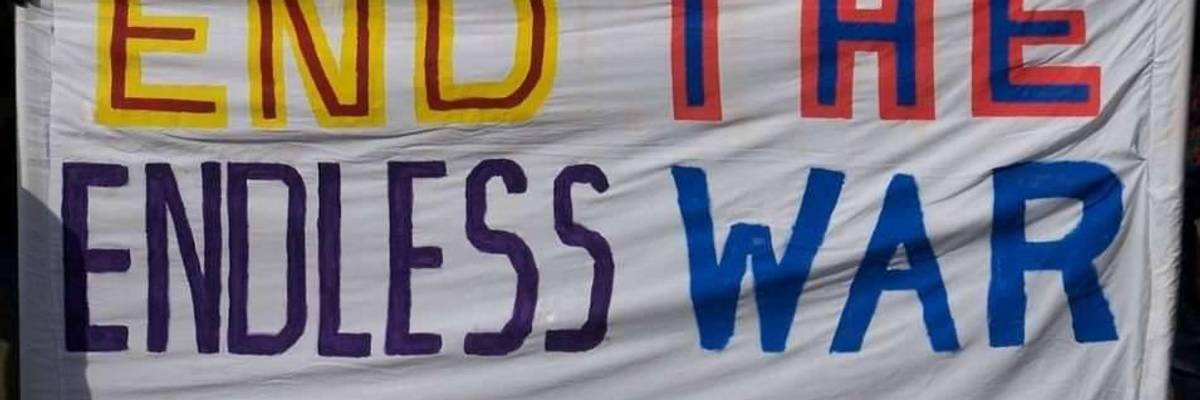
"Those of us who know war are compelled to work for peace," Bica writes. (Photo: Dandelion Salad/Flickr/cc)
Reclaiming Armistice Day: A Day to Perpetuate Peace
As a veteran, I will not be misled and victimized once more by the militarists and war profiteers.
Following World War One, up until then the bloodiest and most destructive war in the history of humankind, many of the beleaguered belligerent nations resolved, at least temporarily, that such devastation and tragic loss of life must never happen again. In the United States, on June 4, 1926, Congress passed a concurrent resolution establishing November 11th, the day in 1918 when the fighting stopped, as Armistice Day, a legal holiday, the intent and purpose of which would be to "commemorate with thanksgiving and prayer and exercises designed to perpetuate peace through good will and mutual understanding between nations."
In accordance with this resolution, President Calvin Coolidge issued a Proclamation on November 3rd 1926, "inviting the people of the United States to observe the day in schools and churches or other places, with appropriate ceremonies expressive of our gratitude for peace and our desire for the continuance of friendly relations with all other peoples."
Disappointingly, despite its designation as "the war to end all wars," and the intent of Armistice Day to make November 11th a day to celebrate peace, the resolve of nations to ensure that "good will and mutual understanding between nations" prevail, all too quickly faltered. Following another equally "destructive, sanguinary, and far reaching war," World War Two, and the "police action" in Korea, President Dwight D. Eisenhower issued a Proclamation that changed the designation of November 11th from Armistice Day to Veterans Day.
"I, Dwight D. Eisenhower, President of the United States of America, do hereby call upon all of our citizens to observe Thursday, November 11, 1954, as Veterans Day. On that day let us solemnly remember the sacrifices of all those who fought so valiantly, on the seas, in the air, and on foreign shores, to preserve our heritage of freedom, and let us reconsecrate ourselves to the task of promoting an enduring peace so that their efforts shall not have been in vain."
Though some continue to question Eisenhower's decision to change the designation, upon analysis, his motivation and reasoning become apparent. Though far from being a pacifist, as the Supreme Commander of the Allied Expeditionary Force during World War II, he knew and abhorred the destruction and tragic loss of life that war entails. Eisenhower's Proclamation, I would argue, is an expression of his disappointment and frustration with the failure of nations to follow through with their Armistice Day resolve to avoid war and seek alternative means for conflict resolution. In changing the designation, Eisenhower hoped to remind America of war's horror and futility, the sacrifices of those who struggled in its behalf, and the need to reassert a commitment to an enduring peace. Though the name was changed, the promise to promote friendly relations between all nations and all people of the world remained the same.
The accuracy of my analysis is attested to by Eisenhower's Farewell Address to the Nation. In this historic speech, he presciently warned of the threat posed by the Military Industrial Complex and its propensity for militarism and perpetual wars for profit. In addition, he reaffirmed the plea for peaceful coexistence that he asserted in his Veteran's Day Proclamation. "We must learn how to compose differences not with arms," he counseled us, "but with intellect and decent purpose." And with a sense of great urgency, he warned that "Only an alert and knowledgeable citizenry can compel the proper meshing of the huge industrial and military machinery of defense with our peaceful methods and goals."
Unfortunately, as was the case with Armistice Day, Eisenhower's Veterans Day Proclamation and Farewell Address has gone unheeded. Since his leaving office, the United States maintains nearly 800 military bases in more than 70 countries and territories abroad; spends $716 billion on Defense, more than the next seven nations combined including Russia, China, the United Kingdom and Saudi Arabia; has become the world's largest arm's dealer, $9.9 Billion; and has been involved in wars in Vietnam, Panama, Nicaragua, Haiti, Lebanon, Granada, Kosovo, Bosnia and Herzegovina, Somalia, Afghanistan, Iraq, Pakistan, Yemen, and Syria.
Tragically, not only has Eisenhower's warnings been ignored, but changing the designation of Armistice Day to Veterans Day, has provided the militarists and war profiteers the means and the opportunity, not to "reconsecrate ourselves to the task of promoting an enduring peace" as was originally intended in his Proclamation, but to celebrate and promote militarism and war, fabricate and perpetuate its mythology of honor and nobility, misrepresent members of the military and veterans as heroes, and encourage the enlistment of the cannon fodder for future wars for profit. Consequently, I advocate restoring November 11th to its original designation and to reaffirm its original intent. We must "Reclaim Armistice Day."
I do not make this assertion lightly, as I am a veteran of the Vietnam War and a patriot. The proof of my patriotism, my love of country, is evidenced not by my military service, however, but by my acceptance of responsibility to live my life, and to ensure that those entrusted with my country's leadership live theirs and govern, in accordance with the rule of law and morality.
As a veteran, I will not be misled and victimized once more by the militarists and war profiteers. As a patriot, I will put my love of country before false acknowledgments of respect and gratitude for my service. As we celebrate the 100th anniversary of the cessation of hostilities in the "war to end all wars," I will strive to ensure that the America I love is exceptional, as is so often claimed, but not for its superior military power or willingness to use it to intimidate, kill, exploit, or subjugate other nations and people for political, strategic, or economic advantage. Rather, as a veteran and a patriot, I understand that America's greatness depends upon its wisdom, tolerance, compassion, benevolence and for its resolve to settle conflicts and disagreements rationally, fairly, and non violently. These American values of which I am proud, and mistakenly thought I was defending in Vietnam, are not merely a pretense for power and profit, but guidelines for behavior that tends to the well-being of this nation, the earth, and ALL of its inhabitants.
Those of us who know war are compelled to work for peace. There is no better, more meaningful way to acknowledge and honor the sacrifices of veterans and to express a love of America than to "perpetuate peace through good will and mutual understanding between nations." Let us begin by Reclaiming Armistice Day.
We are at a crossroads
This country and this world are at a monumental crossroads. In a few short weeks, US voters will have an opportunity to beat back the forces of fascism and confront the billionaires who are rigging the economy, our media system, and our democracy, making it increasingly impossible for ordinary people to get by. We’re not just talking about the election. We’re talking about what must be done once these fascist elements are vanquished from power. We need a bolder set of solutions than what either major party has so far been willing to offer and a working-class movement ready to fight like hell for it. Trump didn't emerge from nowhere. The conditions that fueled MAGA authoritarianism were created by decades of radical neoliberal economic policies and a corrupt political system dominated by corporate interests. They slashed taxes on the super-rich, promising that the benefits would trickle down. They said giveaways to the corporate titans would make life more affordable for the rest of us. It was all bullshit. And when a bitter, betrayed populace searches for someone to blame, right-wing demagogues have little trouble finding scapegoats. People know when they're being lied to, but you won't hear any of this from the corporate media. Only independent journalism—powered and funded by people who believe in building a better world—can deliver truly trustworthy daily news. Our Fall Campaign is underway, and we need your help. To power our newsroom through the rest of the year, we need to raise $125,000 by midnight on October 31. So if you share our vision, please contribute whatever you can to sustain our work. |
Following World War One, up until then the bloodiest and most destructive war in the history of humankind, many of the beleaguered belligerent nations resolved, at least temporarily, that such devastation and tragic loss of life must never happen again. In the United States, on June 4, 1926, Congress passed a concurrent resolution establishing November 11th, the day in 1918 when the fighting stopped, as Armistice Day, a legal holiday, the intent and purpose of which would be to "commemorate with thanksgiving and prayer and exercises designed to perpetuate peace through good will and mutual understanding between nations."
In accordance with this resolution, President Calvin Coolidge issued a Proclamation on November 3rd 1926, "inviting the people of the United States to observe the day in schools and churches or other places, with appropriate ceremonies expressive of our gratitude for peace and our desire for the continuance of friendly relations with all other peoples."
Disappointingly, despite its designation as "the war to end all wars," and the intent of Armistice Day to make November 11th a day to celebrate peace, the resolve of nations to ensure that "good will and mutual understanding between nations" prevail, all too quickly faltered. Following another equally "destructive, sanguinary, and far reaching war," World War Two, and the "police action" in Korea, President Dwight D. Eisenhower issued a Proclamation that changed the designation of November 11th from Armistice Day to Veterans Day.
"I, Dwight D. Eisenhower, President of the United States of America, do hereby call upon all of our citizens to observe Thursday, November 11, 1954, as Veterans Day. On that day let us solemnly remember the sacrifices of all those who fought so valiantly, on the seas, in the air, and on foreign shores, to preserve our heritage of freedom, and let us reconsecrate ourselves to the task of promoting an enduring peace so that their efforts shall not have been in vain."
Though some continue to question Eisenhower's decision to change the designation, upon analysis, his motivation and reasoning become apparent. Though far from being a pacifist, as the Supreme Commander of the Allied Expeditionary Force during World War II, he knew and abhorred the destruction and tragic loss of life that war entails. Eisenhower's Proclamation, I would argue, is an expression of his disappointment and frustration with the failure of nations to follow through with their Armistice Day resolve to avoid war and seek alternative means for conflict resolution. In changing the designation, Eisenhower hoped to remind America of war's horror and futility, the sacrifices of those who struggled in its behalf, and the need to reassert a commitment to an enduring peace. Though the name was changed, the promise to promote friendly relations between all nations and all people of the world remained the same.
The accuracy of my analysis is attested to by Eisenhower's Farewell Address to the Nation. In this historic speech, he presciently warned of the threat posed by the Military Industrial Complex and its propensity for militarism and perpetual wars for profit. In addition, he reaffirmed the plea for peaceful coexistence that he asserted in his Veteran's Day Proclamation. "We must learn how to compose differences not with arms," he counseled us, "but with intellect and decent purpose." And with a sense of great urgency, he warned that "Only an alert and knowledgeable citizenry can compel the proper meshing of the huge industrial and military machinery of defense with our peaceful methods and goals."
Unfortunately, as was the case with Armistice Day, Eisenhower's Veterans Day Proclamation and Farewell Address has gone unheeded. Since his leaving office, the United States maintains nearly 800 military bases in more than 70 countries and territories abroad; spends $716 billion on Defense, more than the next seven nations combined including Russia, China, the United Kingdom and Saudi Arabia; has become the world's largest arm's dealer, $9.9 Billion; and has been involved in wars in Vietnam, Panama, Nicaragua, Haiti, Lebanon, Granada, Kosovo, Bosnia and Herzegovina, Somalia, Afghanistan, Iraq, Pakistan, Yemen, and Syria.
Tragically, not only has Eisenhower's warnings been ignored, but changing the designation of Armistice Day to Veterans Day, has provided the militarists and war profiteers the means and the opportunity, not to "reconsecrate ourselves to the task of promoting an enduring peace" as was originally intended in his Proclamation, but to celebrate and promote militarism and war, fabricate and perpetuate its mythology of honor and nobility, misrepresent members of the military and veterans as heroes, and encourage the enlistment of the cannon fodder for future wars for profit. Consequently, I advocate restoring November 11th to its original designation and to reaffirm its original intent. We must "Reclaim Armistice Day."
I do not make this assertion lightly, as I am a veteran of the Vietnam War and a patriot. The proof of my patriotism, my love of country, is evidenced not by my military service, however, but by my acceptance of responsibility to live my life, and to ensure that those entrusted with my country's leadership live theirs and govern, in accordance with the rule of law and morality.
As a veteran, I will not be misled and victimized once more by the militarists and war profiteers. As a patriot, I will put my love of country before false acknowledgments of respect and gratitude for my service. As we celebrate the 100th anniversary of the cessation of hostilities in the "war to end all wars," I will strive to ensure that the America I love is exceptional, as is so often claimed, but not for its superior military power or willingness to use it to intimidate, kill, exploit, or subjugate other nations and people for political, strategic, or economic advantage. Rather, as a veteran and a patriot, I understand that America's greatness depends upon its wisdom, tolerance, compassion, benevolence and for its resolve to settle conflicts and disagreements rationally, fairly, and non violently. These American values of which I am proud, and mistakenly thought I was defending in Vietnam, are not merely a pretense for power and profit, but guidelines for behavior that tends to the well-being of this nation, the earth, and ALL of its inhabitants.
Those of us who know war are compelled to work for peace. There is no better, more meaningful way to acknowledge and honor the sacrifices of veterans and to express a love of America than to "perpetuate peace through good will and mutual understanding between nations." Let us begin by Reclaiming Armistice Day.
Following World War One, up until then the bloodiest and most destructive war in the history of humankind, many of the beleaguered belligerent nations resolved, at least temporarily, that such devastation and tragic loss of life must never happen again. In the United States, on June 4, 1926, Congress passed a concurrent resolution establishing November 11th, the day in 1918 when the fighting stopped, as Armistice Day, a legal holiday, the intent and purpose of which would be to "commemorate with thanksgiving and prayer and exercises designed to perpetuate peace through good will and mutual understanding between nations."
In accordance with this resolution, President Calvin Coolidge issued a Proclamation on November 3rd 1926, "inviting the people of the United States to observe the day in schools and churches or other places, with appropriate ceremonies expressive of our gratitude for peace and our desire for the continuance of friendly relations with all other peoples."
Disappointingly, despite its designation as "the war to end all wars," and the intent of Armistice Day to make November 11th a day to celebrate peace, the resolve of nations to ensure that "good will and mutual understanding between nations" prevail, all too quickly faltered. Following another equally "destructive, sanguinary, and far reaching war," World War Two, and the "police action" in Korea, President Dwight D. Eisenhower issued a Proclamation that changed the designation of November 11th from Armistice Day to Veterans Day.
"I, Dwight D. Eisenhower, President of the United States of America, do hereby call upon all of our citizens to observe Thursday, November 11, 1954, as Veterans Day. On that day let us solemnly remember the sacrifices of all those who fought so valiantly, on the seas, in the air, and on foreign shores, to preserve our heritage of freedom, and let us reconsecrate ourselves to the task of promoting an enduring peace so that their efforts shall not have been in vain."
Though some continue to question Eisenhower's decision to change the designation, upon analysis, his motivation and reasoning become apparent. Though far from being a pacifist, as the Supreme Commander of the Allied Expeditionary Force during World War II, he knew and abhorred the destruction and tragic loss of life that war entails. Eisenhower's Proclamation, I would argue, is an expression of his disappointment and frustration with the failure of nations to follow through with their Armistice Day resolve to avoid war and seek alternative means for conflict resolution. In changing the designation, Eisenhower hoped to remind America of war's horror and futility, the sacrifices of those who struggled in its behalf, and the need to reassert a commitment to an enduring peace. Though the name was changed, the promise to promote friendly relations between all nations and all people of the world remained the same.
The accuracy of my analysis is attested to by Eisenhower's Farewell Address to the Nation. In this historic speech, he presciently warned of the threat posed by the Military Industrial Complex and its propensity for militarism and perpetual wars for profit. In addition, he reaffirmed the plea for peaceful coexistence that he asserted in his Veteran's Day Proclamation. "We must learn how to compose differences not with arms," he counseled us, "but with intellect and decent purpose." And with a sense of great urgency, he warned that "Only an alert and knowledgeable citizenry can compel the proper meshing of the huge industrial and military machinery of defense with our peaceful methods and goals."
Unfortunately, as was the case with Armistice Day, Eisenhower's Veterans Day Proclamation and Farewell Address has gone unheeded. Since his leaving office, the United States maintains nearly 800 military bases in more than 70 countries and territories abroad; spends $716 billion on Defense, more than the next seven nations combined including Russia, China, the United Kingdom and Saudi Arabia; has become the world's largest arm's dealer, $9.9 Billion; and has been involved in wars in Vietnam, Panama, Nicaragua, Haiti, Lebanon, Granada, Kosovo, Bosnia and Herzegovina, Somalia, Afghanistan, Iraq, Pakistan, Yemen, and Syria.
Tragically, not only has Eisenhower's warnings been ignored, but changing the designation of Armistice Day to Veterans Day, has provided the militarists and war profiteers the means and the opportunity, not to "reconsecrate ourselves to the task of promoting an enduring peace" as was originally intended in his Proclamation, but to celebrate and promote militarism and war, fabricate and perpetuate its mythology of honor and nobility, misrepresent members of the military and veterans as heroes, and encourage the enlistment of the cannon fodder for future wars for profit. Consequently, I advocate restoring November 11th to its original designation and to reaffirm its original intent. We must "Reclaim Armistice Day."
I do not make this assertion lightly, as I am a veteran of the Vietnam War and a patriot. The proof of my patriotism, my love of country, is evidenced not by my military service, however, but by my acceptance of responsibility to live my life, and to ensure that those entrusted with my country's leadership live theirs and govern, in accordance with the rule of law and morality.
As a veteran, I will not be misled and victimized once more by the militarists and war profiteers. As a patriot, I will put my love of country before false acknowledgments of respect and gratitude for my service. As we celebrate the 100th anniversary of the cessation of hostilities in the "war to end all wars," I will strive to ensure that the America I love is exceptional, as is so often claimed, but not for its superior military power or willingness to use it to intimidate, kill, exploit, or subjugate other nations and people for political, strategic, or economic advantage. Rather, as a veteran and a patriot, I understand that America's greatness depends upon its wisdom, tolerance, compassion, benevolence and for its resolve to settle conflicts and disagreements rationally, fairly, and non violently. These American values of which I am proud, and mistakenly thought I was defending in Vietnam, are not merely a pretense for power and profit, but guidelines for behavior that tends to the well-being of this nation, the earth, and ALL of its inhabitants.
Those of us who know war are compelled to work for peace. There is no better, more meaningful way to acknowledge and honor the sacrifices of veterans and to express a love of America than to "perpetuate peace through good will and mutual understanding between nations." Let us begin by Reclaiming Armistice Day.