SUBSCRIBE TO OUR FREE NEWSLETTER
Daily news & progressive opinion—funded by the people, not the corporations—delivered straight to your inbox.
5
#000000
#FFFFFF
To donate by check, phone, or other method, see our More Ways to Give page.
Daily news & progressive opinion—funded by the people, not the corporations—delivered straight to your inbox.
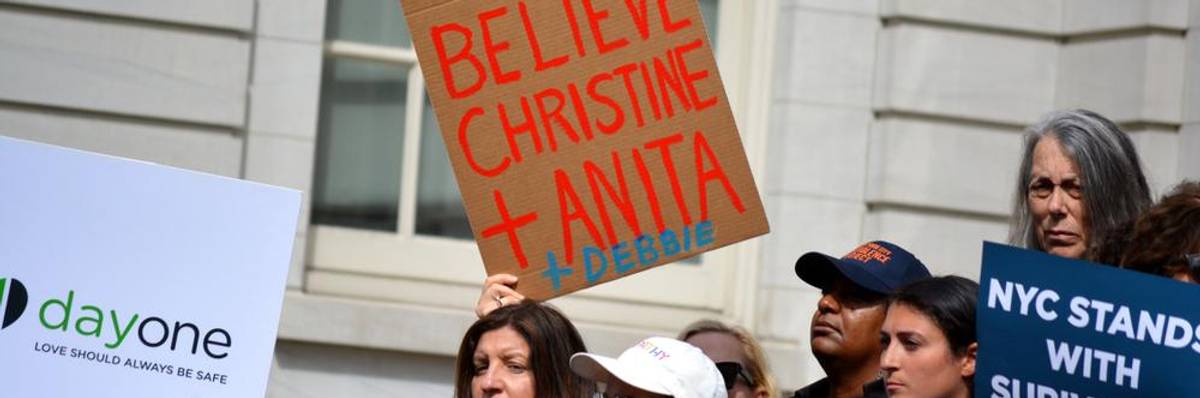
On TV, politicians say that it's unreasonable to hold a man accountable for an assault he committed decades ago. Why on earth not? His victim is almost certainly still suffering from it. (Photo: Shutterstock)
This past week, my private reality and the public reality playing out on the television have diverged. It's hard to believe that I live in the same world as Senator Chuck Grassley, the Senate judiciary chair trying to Brett Kavanaugh onto the Supreme Court.
When Christine Blasey Ford first alleged Kavanaugh sexually assaulted her -- and when talking heads on TV began doubting her veracity, or insisting that the assault was not a big deal -- a different conversation began.
It's a private conversation, one-on-one, mostly. A few of us posted about sexual assault in general or about our own past assaults on our Facebook pages. Then the private messages began.
In some cases I knew my friends had been assaulted. Sometimes I knew because we were friends when it happened, and they'd told me at the time. In other cases, the rapes or assaults occurred long before we met, up to four decades ago.
In other cases, I found out this week.
Often, I don't know the details of what happened to my friends. The details are painful to talk about. They're painful to hear.
I know: I re-lived each of my past assaults in the last week. Four of them.
When you're sexually assaulted, you can suffer long-term consequences, stored in your body. My body learned early on that sex is dangerous, and it keeps me safe with pain.
To those who think something that happened decades ago can't be that big of a deal, you're wrong. When you're sexually assaulted, you can suffer long-term consequences, stored in your body. My body learned early on that sex is dangerous, and it keeps me safe with pain.
Since my first sexual experiences were assaults, I've never once had a sexual experience that wasn't painful. I'm afraid of sex. I don't desire it. Why would I? It just hurts.
I'm in therapy now, trying to recover from what happened in a college dorm room 18 year ago. I've spent the entire past week with a migraine because of the nonstop talk about sexual assaults and the government's unwillingness to take sexual assault allegations seriously.
Hearing people on TV say that an assault in one's teens isn't a big deal, or that the woman cannot be believed, and so on, feels personal. It feels like they're shouting at me, that I can't be believed either.
In all of my private conversations with other survivors, there's a common understanding. We all know that if we spoke out publicly about our past assaults, most of us wouldn't be believed either. So often there are no witnesses. One shower and one load of laundry destroys the evidence.
It's hard to admit to oneself that one was powerless. Weak. A victim. I like to see myself as strong, independent, and decisive. If someone tried to do something to me that I didn't want, I would resist. And yet, I didn't.
Instead of accepting a narrative of myself as weak, I dealt with what happened by attempting to forget it. I mostly did forget it -- but my body remembered.
On TV, politicians say that it's unreasonable to hold a man accountable for an assault he committed decades ago. Why on earth not? His victim is almost certainly still suffering from it.
I wish the politicians could hear what I've heard in all of the private, one-on-one conversations of the past week. But speaking out makes one vulnerable. That's why most of these conversations remain private.
Shouting at women to silence them might get your man onto the Supreme Court. It worked for Clarence Thomas, and it can work for Brett Kavanaugh. But it doesn't change reality, or make you right.
Dear Common Dreams reader, It’s been nearly 30 years since I co-founded Common Dreams with my late wife, Lina Newhouser. We had the radical notion that journalism should serve the public good, not corporate profits. It was clear to us from the outset what it would take to build such a project. No paid advertisements. No corporate sponsors. No millionaire publisher telling us what to think or do. Many people said we wouldn't last a year, but we proved those doubters wrong. Together with a tremendous team of journalists and dedicated staff, we built an independent media outlet free from the constraints of profits and corporate control. Our mission has always been simple: To inform. To inspire. To ignite change for the common good. Building Common Dreams was not easy. Our survival was never guaranteed. When you take on the most powerful forces—Wall Street greed, fossil fuel industry destruction, Big Tech lobbyists, and uber-rich oligarchs who have spent billions upon billions rigging the economy and democracy in their favor—the only bulwark you have is supporters who believe in your work. But here’s the urgent message from me today. It's never been this bad out there. And it's never been this hard to keep us going. At the very moment Common Dreams is most needed, the threats we face are intensifying. We need your support now more than ever. We don't accept corporate advertising and never will. We don't have a paywall because we don't think people should be blocked from critical news based on their ability to pay. Everything we do is funded by the donations of readers like you. When everyone does the little they can afford, we are strong. But if that support retreats or dries up, so do we. Will you donate now to make sure Common Dreams not only survives but thrives? —Craig Brown, Co-founder |
This past week, my private reality and the public reality playing out on the television have diverged. It's hard to believe that I live in the same world as Senator Chuck Grassley, the Senate judiciary chair trying to Brett Kavanaugh onto the Supreme Court.
When Christine Blasey Ford first alleged Kavanaugh sexually assaulted her -- and when talking heads on TV began doubting her veracity, or insisting that the assault was not a big deal -- a different conversation began.
It's a private conversation, one-on-one, mostly. A few of us posted about sexual assault in general or about our own past assaults on our Facebook pages. Then the private messages began.
In some cases I knew my friends had been assaulted. Sometimes I knew because we were friends when it happened, and they'd told me at the time. In other cases, the rapes or assaults occurred long before we met, up to four decades ago.
In other cases, I found out this week.
Often, I don't know the details of what happened to my friends. The details are painful to talk about. They're painful to hear.
I know: I re-lived each of my past assaults in the last week. Four of them.
When you're sexually assaulted, you can suffer long-term consequences, stored in your body. My body learned early on that sex is dangerous, and it keeps me safe with pain.
To those who think something that happened decades ago can't be that big of a deal, you're wrong. When you're sexually assaulted, you can suffer long-term consequences, stored in your body. My body learned early on that sex is dangerous, and it keeps me safe with pain.
Since my first sexual experiences were assaults, I've never once had a sexual experience that wasn't painful. I'm afraid of sex. I don't desire it. Why would I? It just hurts.
I'm in therapy now, trying to recover from what happened in a college dorm room 18 year ago. I've spent the entire past week with a migraine because of the nonstop talk about sexual assaults and the government's unwillingness to take sexual assault allegations seriously.
Hearing people on TV say that an assault in one's teens isn't a big deal, or that the woman cannot be believed, and so on, feels personal. It feels like they're shouting at me, that I can't be believed either.
In all of my private conversations with other survivors, there's a common understanding. We all know that if we spoke out publicly about our past assaults, most of us wouldn't be believed either. So often there are no witnesses. One shower and one load of laundry destroys the evidence.
It's hard to admit to oneself that one was powerless. Weak. A victim. I like to see myself as strong, independent, and decisive. If someone tried to do something to me that I didn't want, I would resist. And yet, I didn't.
Instead of accepting a narrative of myself as weak, I dealt with what happened by attempting to forget it. I mostly did forget it -- but my body remembered.
On TV, politicians say that it's unreasonable to hold a man accountable for an assault he committed decades ago. Why on earth not? His victim is almost certainly still suffering from it.
I wish the politicians could hear what I've heard in all of the private, one-on-one conversations of the past week. But speaking out makes one vulnerable. That's why most of these conversations remain private.
Shouting at women to silence them might get your man onto the Supreme Court. It worked for Clarence Thomas, and it can work for Brett Kavanaugh. But it doesn't change reality, or make you right.
This past week, my private reality and the public reality playing out on the television have diverged. It's hard to believe that I live in the same world as Senator Chuck Grassley, the Senate judiciary chair trying to Brett Kavanaugh onto the Supreme Court.
When Christine Blasey Ford first alleged Kavanaugh sexually assaulted her -- and when talking heads on TV began doubting her veracity, or insisting that the assault was not a big deal -- a different conversation began.
It's a private conversation, one-on-one, mostly. A few of us posted about sexual assault in general or about our own past assaults on our Facebook pages. Then the private messages began.
In some cases I knew my friends had been assaulted. Sometimes I knew because we were friends when it happened, and they'd told me at the time. In other cases, the rapes or assaults occurred long before we met, up to four decades ago.
In other cases, I found out this week.
Often, I don't know the details of what happened to my friends. The details are painful to talk about. They're painful to hear.
I know: I re-lived each of my past assaults in the last week. Four of them.
When you're sexually assaulted, you can suffer long-term consequences, stored in your body. My body learned early on that sex is dangerous, and it keeps me safe with pain.
To those who think something that happened decades ago can't be that big of a deal, you're wrong. When you're sexually assaulted, you can suffer long-term consequences, stored in your body. My body learned early on that sex is dangerous, and it keeps me safe with pain.
Since my first sexual experiences were assaults, I've never once had a sexual experience that wasn't painful. I'm afraid of sex. I don't desire it. Why would I? It just hurts.
I'm in therapy now, trying to recover from what happened in a college dorm room 18 year ago. I've spent the entire past week with a migraine because of the nonstop talk about sexual assaults and the government's unwillingness to take sexual assault allegations seriously.
Hearing people on TV say that an assault in one's teens isn't a big deal, or that the woman cannot be believed, and so on, feels personal. It feels like they're shouting at me, that I can't be believed either.
In all of my private conversations with other survivors, there's a common understanding. We all know that if we spoke out publicly about our past assaults, most of us wouldn't be believed either. So often there are no witnesses. One shower and one load of laundry destroys the evidence.
It's hard to admit to oneself that one was powerless. Weak. A victim. I like to see myself as strong, independent, and decisive. If someone tried to do something to me that I didn't want, I would resist. And yet, I didn't.
Instead of accepting a narrative of myself as weak, I dealt with what happened by attempting to forget it. I mostly did forget it -- but my body remembered.
On TV, politicians say that it's unreasonable to hold a man accountable for an assault he committed decades ago. Why on earth not? His victim is almost certainly still suffering from it.
I wish the politicians could hear what I've heard in all of the private, one-on-one conversations of the past week. But speaking out makes one vulnerable. That's why most of these conversations remain private.
Shouting at women to silence them might get your man onto the Supreme Court. It worked for Clarence Thomas, and it can work for Brett Kavanaugh. But it doesn't change reality, or make you right.