SUBSCRIBE TO OUR FREE NEWSLETTER
Daily news & progressive opinion—funded by the people, not the corporations—delivered straight to your inbox.
5
#000000
#FFFFFF
To donate by check, phone, or other method, see our More Ways to Give page.
Daily news & progressive opinion—funded by the people, not the corporations—delivered straight to your inbox.
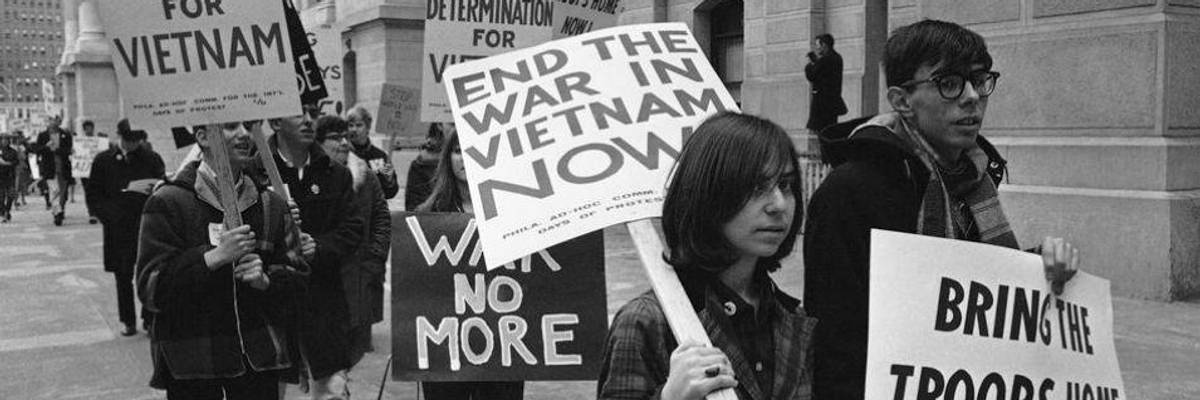
"But we the people have not surrendered. We were outmaneuvered, gerrymandered, removed from the voting roster, but we have not surrendered." (Photo: AP/Bill Ingraham via Flickr)
I was a hippie/bicycle delivery boy living in San Francisco when the Democratic National Convention was held in Chicago fifty years ago, so I absorbed the chaos, the police riot, from half a continent away, but I knew with absolute certainty that the nation was changing and I was part of it.
We were in the violent spasm of transition. How long would it last? MLK and RFK, as they called for peace and sanity and civil rights for all, had just been assassinated. This was the God of War, turning its vengeance inward.
A year earlier I had been part of the march on the Pentagon. At one point a group of soldiers charged us as we stood on the grounds next to the building and I got clonked in the head by a rifle butt. Later, as we sat in, I felt with sudden certainty that Lyndon Johnson was going to emerge from the Pentagon and declare an end to the Vietnam War. Uh . . . that didn't happen.
Instead, I eventually just got up and left. When I returned to Kalamazoo, Michigan, where I was in college, the first thing I did was drop out. Apparently I wanted to remove myself entirely from the infrastructure or normal, middle-class existence and join others in creating something new.
As I read about the chaos in Chicago at the convention -- the thousands of cops and National Guardsmen and U.S. troops storming the protesters, whacking them with their batons, throwing them into paddy wagons, as the pro-war consensus (epitomized by the grimace on the face of Chicago's mayor, Richard J. Daley) held tight to the reins of power -- I felt myself quietly retreat back into my own life. The "movement" wasn't going to remake America. Or rather, idealism all by itself wasn't going to bring about the world I had envisioned with such certainty as I sat on the steps of the Pentagon.
I didn't surrender my idealism; I didn't turn into a cynic. But I shifted my focus to my own life and returned to school. Half a century later . . .
I gape in awe at how little has changed.
"At least one child dies every 10 minutes from causes linked to the war, according to the United Nations."
"The reality is that the war has created the world's worst humanitarian catastrophe today," Moustafa Bayoumi wrote recently in The Guardian. "Three-quarters of the population, some 22 million Yemenis, require humanitarian assistance and protection. About 8.4 million people hang on the brink of starvation and another 7 million lie malnourished. Since 2015, more than 28,000 thousand people have been killed or injured, and many thousands more have died from causes exacerbated by war, such as a cholera epidemic that has afflicted more than a million people and claimed over 2,300 lives. At least one child dies every 10 minutes from causes linked to the war, according to the United Nations."
Actually, something has changed -- the opposite of what I had anticipated in 1967, as I sat on the steps of the Pentagon, or in 1968, as I silently cheered the protesters demanding that the Democratic Party become a party of peace.
The war in Yemen, which the U.S. is making possible with billions of dollars in weapons sales to the Saudi coalition, is barely even news. Neither are the wars -- at least seven of them -- in which the U.S. is directly participating, including Iraq (15 years and counting) and Afghanistan (17 years and counting). I fear the forces the antiwar protesters were confronting fifty years ago have made a shift in keeping with their deepest interests: not to "win" the wars but simply to make sure they continue.
Even Donald Trump was shocked by this: "When Trump announced . . . that he was ordering a new approach to the war," theAssociated Press reported last March about Afghanistan, "he said he realized 'the American people are weary of war without victory.' He said his instinct was to pull out, but that after consulting with aides, he decided to seek 'an honorable and enduring outcome.' He said that meant committing more resources to the war, giving commanders in the field more authority and staying in Afghanistan for as long as it takes."
In other words, he was pulled back into line -- that is, back into lyin'. Glory, glory, hallelujah. In America, cliches rule. We may bomb children, and (even more to the point) manufacture and sell the bombs that take out school buses, etc., etc., etc., but we still pull out our cliches about freedom and honor and such, stale as they may be, on a moment's notice.
We may bomb children, and (even more to the point) manufacture and sell the bombs that take out school buses, etc., etc., etc., but we still pull out our cliches about freedom and honor and such, stale as they may be, on a moment's notice.
America's journey to its Orwellian present-day reality, in which wars are endlessly expanding background noise (as opposed to news), essentially began in the tumultuous late '60s, when peace consciousness had seized much of the nation. While LBJ did not declare the end of the Vietnam War, the war eventually did end -- in defeat, dishonor and disgrace, leaving behind a shattered country (a million or more dead, an environment despoiled with Agent Orange and unexploded ordnance) and countless U.S. vets spiritually and physically wounded. The American public was weary not of war without victory but of war itself. This was called Vietnam Syndrome, and it was profoundly troubling to the political status quo.
It took several decades, but Militarized America did achieve its one and only post-World War II victory. It defeated Vietnam Syndrome. Step one was eliminating the draft, which freed the public from any personal risk -- and thus, any real stake -- in future wars, leaving only a poverty draft to fill the ranks, and who cares about them?
Ronald Reagan was forced to fight proxy wars against the commies in Central America, but his successor, George H.W. Bush, declared a victory over Vietnam Syndrome after Gulf War I. A decade later, his son, as we know, launched wars in Afghanistan and Iraq, which, having accomplished none of their alleged aims, nonetheless continue with no end in sight, two presidents later. Victory no longer matters. A seemingly rational mission no longer matters. Cliches and a bloated military budget are enough.
The War Machine, which owned (owns) both parties, held fast and tough. Billy clubs won. The media surrendered.
Fifty years ago, the country was in tumult about the war in Vietnam and millions of people wanted to reshape the Democratic Party into a party of peace. The War Machine, which owned (owns) both parties, held fast and tough. Billy clubs won. The media surrendered.
But we the people have not surrendered. We were outmaneuvered, gerrymandered, removed from the voting roster, but we have not surrendered. Is the spirit of '68 coming back to life in the Trump era, as evinced by an upsurge in progressive electoral victories? The War God is ruthless and clever and will not give up. Neither should we.
Dear Common Dreams reader, It’s been nearly 30 years since I co-founded Common Dreams with my late wife, Lina Newhouser. We had the radical notion that journalism should serve the public good, not corporate profits. It was clear to us from the outset what it would take to build such a project. No paid advertisements. No corporate sponsors. No millionaire publisher telling us what to think or do. Many people said we wouldn't last a year, but we proved those doubters wrong. Together with a tremendous team of journalists and dedicated staff, we built an independent media outlet free from the constraints of profits and corporate control. Our mission has always been simple: To inform. To inspire. To ignite change for the common good. Building Common Dreams was not easy. Our survival was never guaranteed. When you take on the most powerful forces—Wall Street greed, fossil fuel industry destruction, Big Tech lobbyists, and uber-rich oligarchs who have spent billions upon billions rigging the economy and democracy in their favor—the only bulwark you have is supporters who believe in your work. But here’s the urgent message from me today. It's never been this bad out there. And it's never been this hard to keep us going. At the very moment Common Dreams is most needed, the threats we face are intensifying. We need your support now more than ever. We don't accept corporate advertising and never will. We don't have a paywall because we don't think people should be blocked from critical news based on their ability to pay. Everything we do is funded by the donations of readers like you. When everyone does the little they can afford, we are strong. But if that support retreats or dries up, so do we. Will you donate now to make sure Common Dreams not only survives but thrives? —Craig Brown, Co-founder |
I was a hippie/bicycle delivery boy living in San Francisco when the Democratic National Convention was held in Chicago fifty years ago, so I absorbed the chaos, the police riot, from half a continent away, but I knew with absolute certainty that the nation was changing and I was part of it.
We were in the violent spasm of transition. How long would it last? MLK and RFK, as they called for peace and sanity and civil rights for all, had just been assassinated. This was the God of War, turning its vengeance inward.
A year earlier I had been part of the march on the Pentagon. At one point a group of soldiers charged us as we stood on the grounds next to the building and I got clonked in the head by a rifle butt. Later, as we sat in, I felt with sudden certainty that Lyndon Johnson was going to emerge from the Pentagon and declare an end to the Vietnam War. Uh . . . that didn't happen.
Instead, I eventually just got up and left. When I returned to Kalamazoo, Michigan, where I was in college, the first thing I did was drop out. Apparently I wanted to remove myself entirely from the infrastructure or normal, middle-class existence and join others in creating something new.
As I read about the chaos in Chicago at the convention -- the thousands of cops and National Guardsmen and U.S. troops storming the protesters, whacking them with their batons, throwing them into paddy wagons, as the pro-war consensus (epitomized by the grimace on the face of Chicago's mayor, Richard J. Daley) held tight to the reins of power -- I felt myself quietly retreat back into my own life. The "movement" wasn't going to remake America. Or rather, idealism all by itself wasn't going to bring about the world I had envisioned with such certainty as I sat on the steps of the Pentagon.
I didn't surrender my idealism; I didn't turn into a cynic. But I shifted my focus to my own life and returned to school. Half a century later . . .
I gape in awe at how little has changed.
"At least one child dies every 10 minutes from causes linked to the war, according to the United Nations."
"The reality is that the war has created the world's worst humanitarian catastrophe today," Moustafa Bayoumi wrote recently in The Guardian. "Three-quarters of the population, some 22 million Yemenis, require humanitarian assistance and protection. About 8.4 million people hang on the brink of starvation and another 7 million lie malnourished. Since 2015, more than 28,000 thousand people have been killed or injured, and many thousands more have died from causes exacerbated by war, such as a cholera epidemic that has afflicted more than a million people and claimed over 2,300 lives. At least one child dies every 10 minutes from causes linked to the war, according to the United Nations."
Actually, something has changed -- the opposite of what I had anticipated in 1967, as I sat on the steps of the Pentagon, or in 1968, as I silently cheered the protesters demanding that the Democratic Party become a party of peace.
The war in Yemen, which the U.S. is making possible with billions of dollars in weapons sales to the Saudi coalition, is barely even news. Neither are the wars -- at least seven of them -- in which the U.S. is directly participating, including Iraq (15 years and counting) and Afghanistan (17 years and counting). I fear the forces the antiwar protesters were confronting fifty years ago have made a shift in keeping with their deepest interests: not to "win" the wars but simply to make sure they continue.
Even Donald Trump was shocked by this: "When Trump announced . . . that he was ordering a new approach to the war," theAssociated Press reported last March about Afghanistan, "he said he realized 'the American people are weary of war without victory.' He said his instinct was to pull out, but that after consulting with aides, he decided to seek 'an honorable and enduring outcome.' He said that meant committing more resources to the war, giving commanders in the field more authority and staying in Afghanistan for as long as it takes."
In other words, he was pulled back into line -- that is, back into lyin'. Glory, glory, hallelujah. In America, cliches rule. We may bomb children, and (even more to the point) manufacture and sell the bombs that take out school buses, etc., etc., etc., but we still pull out our cliches about freedom and honor and such, stale as they may be, on a moment's notice.
We may bomb children, and (even more to the point) manufacture and sell the bombs that take out school buses, etc., etc., etc., but we still pull out our cliches about freedom and honor and such, stale as they may be, on a moment's notice.
America's journey to its Orwellian present-day reality, in which wars are endlessly expanding background noise (as opposed to news), essentially began in the tumultuous late '60s, when peace consciousness had seized much of the nation. While LBJ did not declare the end of the Vietnam War, the war eventually did end -- in defeat, dishonor and disgrace, leaving behind a shattered country (a million or more dead, an environment despoiled with Agent Orange and unexploded ordnance) and countless U.S. vets spiritually and physically wounded. The American public was weary not of war without victory but of war itself. This was called Vietnam Syndrome, and it was profoundly troubling to the political status quo.
It took several decades, but Militarized America did achieve its one and only post-World War II victory. It defeated Vietnam Syndrome. Step one was eliminating the draft, which freed the public from any personal risk -- and thus, any real stake -- in future wars, leaving only a poverty draft to fill the ranks, and who cares about them?
Ronald Reagan was forced to fight proxy wars against the commies in Central America, but his successor, George H.W. Bush, declared a victory over Vietnam Syndrome after Gulf War I. A decade later, his son, as we know, launched wars in Afghanistan and Iraq, which, having accomplished none of their alleged aims, nonetheless continue with no end in sight, two presidents later. Victory no longer matters. A seemingly rational mission no longer matters. Cliches and a bloated military budget are enough.
The War Machine, which owned (owns) both parties, held fast and tough. Billy clubs won. The media surrendered.
Fifty years ago, the country was in tumult about the war in Vietnam and millions of people wanted to reshape the Democratic Party into a party of peace. The War Machine, which owned (owns) both parties, held fast and tough. Billy clubs won. The media surrendered.
But we the people have not surrendered. We were outmaneuvered, gerrymandered, removed from the voting roster, but we have not surrendered. Is the spirit of '68 coming back to life in the Trump era, as evinced by an upsurge in progressive electoral victories? The War God is ruthless and clever and will not give up. Neither should we.
I was a hippie/bicycle delivery boy living in San Francisco when the Democratic National Convention was held in Chicago fifty years ago, so I absorbed the chaos, the police riot, from half a continent away, but I knew with absolute certainty that the nation was changing and I was part of it.
We were in the violent spasm of transition. How long would it last? MLK and RFK, as they called for peace and sanity and civil rights for all, had just been assassinated. This was the God of War, turning its vengeance inward.
A year earlier I had been part of the march on the Pentagon. At one point a group of soldiers charged us as we stood on the grounds next to the building and I got clonked in the head by a rifle butt. Later, as we sat in, I felt with sudden certainty that Lyndon Johnson was going to emerge from the Pentagon and declare an end to the Vietnam War. Uh . . . that didn't happen.
Instead, I eventually just got up and left. When I returned to Kalamazoo, Michigan, where I was in college, the first thing I did was drop out. Apparently I wanted to remove myself entirely from the infrastructure or normal, middle-class existence and join others in creating something new.
As I read about the chaos in Chicago at the convention -- the thousands of cops and National Guardsmen and U.S. troops storming the protesters, whacking them with their batons, throwing them into paddy wagons, as the pro-war consensus (epitomized by the grimace on the face of Chicago's mayor, Richard J. Daley) held tight to the reins of power -- I felt myself quietly retreat back into my own life. The "movement" wasn't going to remake America. Or rather, idealism all by itself wasn't going to bring about the world I had envisioned with such certainty as I sat on the steps of the Pentagon.
I didn't surrender my idealism; I didn't turn into a cynic. But I shifted my focus to my own life and returned to school. Half a century later . . .
I gape in awe at how little has changed.
"At least one child dies every 10 minutes from causes linked to the war, according to the United Nations."
"The reality is that the war has created the world's worst humanitarian catastrophe today," Moustafa Bayoumi wrote recently in The Guardian. "Three-quarters of the population, some 22 million Yemenis, require humanitarian assistance and protection. About 8.4 million people hang on the brink of starvation and another 7 million lie malnourished. Since 2015, more than 28,000 thousand people have been killed or injured, and many thousands more have died from causes exacerbated by war, such as a cholera epidemic that has afflicted more than a million people and claimed over 2,300 lives. At least one child dies every 10 minutes from causes linked to the war, according to the United Nations."
Actually, something has changed -- the opposite of what I had anticipated in 1967, as I sat on the steps of the Pentagon, or in 1968, as I silently cheered the protesters demanding that the Democratic Party become a party of peace.
The war in Yemen, which the U.S. is making possible with billions of dollars in weapons sales to the Saudi coalition, is barely even news. Neither are the wars -- at least seven of them -- in which the U.S. is directly participating, including Iraq (15 years and counting) and Afghanistan (17 years and counting). I fear the forces the antiwar protesters were confronting fifty years ago have made a shift in keeping with their deepest interests: not to "win" the wars but simply to make sure they continue.
Even Donald Trump was shocked by this: "When Trump announced . . . that he was ordering a new approach to the war," theAssociated Press reported last March about Afghanistan, "he said he realized 'the American people are weary of war without victory.' He said his instinct was to pull out, but that after consulting with aides, he decided to seek 'an honorable and enduring outcome.' He said that meant committing more resources to the war, giving commanders in the field more authority and staying in Afghanistan for as long as it takes."
In other words, he was pulled back into line -- that is, back into lyin'. Glory, glory, hallelujah. In America, cliches rule. We may bomb children, and (even more to the point) manufacture and sell the bombs that take out school buses, etc., etc., etc., but we still pull out our cliches about freedom and honor and such, stale as they may be, on a moment's notice.
We may bomb children, and (even more to the point) manufacture and sell the bombs that take out school buses, etc., etc., etc., but we still pull out our cliches about freedom and honor and such, stale as they may be, on a moment's notice.
America's journey to its Orwellian present-day reality, in which wars are endlessly expanding background noise (as opposed to news), essentially began in the tumultuous late '60s, when peace consciousness had seized much of the nation. While LBJ did not declare the end of the Vietnam War, the war eventually did end -- in defeat, dishonor and disgrace, leaving behind a shattered country (a million or more dead, an environment despoiled with Agent Orange and unexploded ordnance) and countless U.S. vets spiritually and physically wounded. The American public was weary not of war without victory but of war itself. This was called Vietnam Syndrome, and it was profoundly troubling to the political status quo.
It took several decades, but Militarized America did achieve its one and only post-World War II victory. It defeated Vietnam Syndrome. Step one was eliminating the draft, which freed the public from any personal risk -- and thus, any real stake -- in future wars, leaving only a poverty draft to fill the ranks, and who cares about them?
Ronald Reagan was forced to fight proxy wars against the commies in Central America, but his successor, George H.W. Bush, declared a victory over Vietnam Syndrome after Gulf War I. A decade later, his son, as we know, launched wars in Afghanistan and Iraq, which, having accomplished none of their alleged aims, nonetheless continue with no end in sight, two presidents later. Victory no longer matters. A seemingly rational mission no longer matters. Cliches and a bloated military budget are enough.
The War Machine, which owned (owns) both parties, held fast and tough. Billy clubs won. The media surrendered.
Fifty years ago, the country was in tumult about the war in Vietnam and millions of people wanted to reshape the Democratic Party into a party of peace. The War Machine, which owned (owns) both parties, held fast and tough. Billy clubs won. The media surrendered.
But we the people have not surrendered. We were outmaneuvered, gerrymandered, removed from the voting roster, but we have not surrendered. Is the spirit of '68 coming back to life in the Trump era, as evinced by an upsurge in progressive electoral victories? The War God is ruthless and clever and will not give up. Neither should we.