SUBSCRIBE TO OUR FREE NEWSLETTER
Daily news & progressive opinion—funded by the people, not the corporations—delivered straight to your inbox.
5
#000000
#FFFFFF
To donate by check, phone, or other method, see our More Ways to Give page.
Daily news & progressive opinion—funded by the people, not the corporations—delivered straight to your inbox.
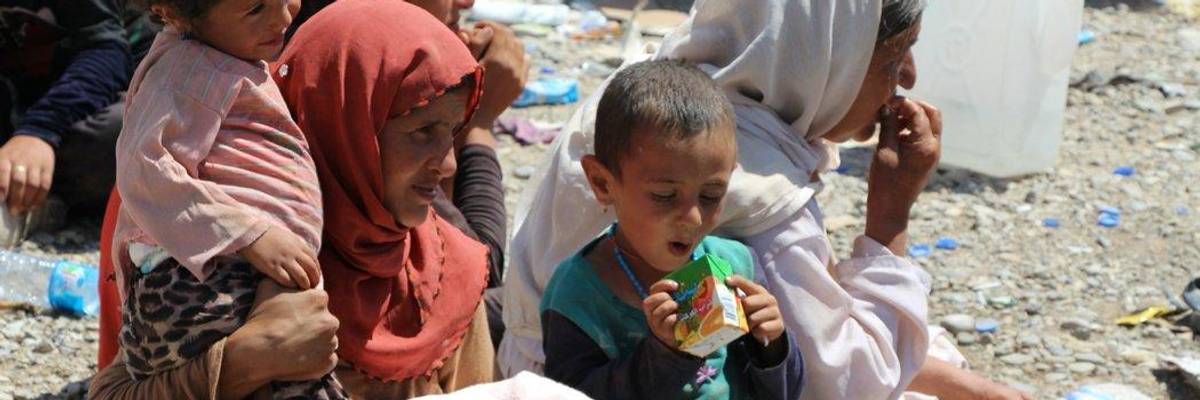
In 2014 ISIS drove Yazidis out of central Iraq as the U.S.-trained Iraqi Army collapsed. (Photo: Reese Elrich)
Militant protests, which began July 14, continue in Iraq's oil-rich city of Basra, despite a harsh government crackdown. Thousands of Iraqis are demanding jobs, restoration of basic utility services, and an end to government corruption. The protests have quickly spread to other southern Iraqi cities and Baghdad.
Iraq has faced major electricity shortages since the 2003 U.S. invasion. In Basra, salt water flows from faucets because of filtration system breakdowns. Transparency International lists Iraq as one of the most corrupt countries in the world.
In the first two weeks of the protests, more than a dozen protesters were killed, hundreds were wounded, and 750 arrested, according to the Gulf Centre for Human Rights.
Angry protesters closed the port of Umm Qasr and even shut the Iraq-Kuwait border for a time, according to Yerevan Saeed, a research fellow at the Middle East Research Institute.
Saeed, a colleague with whom I worked during reporting trips to Iraq, said the protests reflect widespread anger throughout the country.
"Everyone, from Basra to Kurdistan, is frustrated with the current politicians," he told me. "The political elite are corrupt. That brings everyone together at the moment."
Iraq has been in turmoil since the 2003 U.S. invasion. Far from bringing democracy and prosperity as U.S. officials promised, the occupation resulted in rule by a corrupt, wealthy elite. As many as 7,000 U.S. troops continue to occupy Iraq, fifteen years after the initial invasion. And Iraqis are pissed--as seen in the results of parliamentary elections in May and a recount finalized in August.
A coalition headed by anti-U.S., nationalist cleric Muqtada al Sadr won fifty-four out of 329 seats in parliament, more than any other party. A pro-Iranian coalition headed by Hadi al Ameri took forty-eight seats. The U.S.-backed coalition led by Prime Minister Haider al Abadi came in third with forty-two seats--a big blow to the Trump Administration.
'Everyone, from Basra to Kurdistan, is frustrated with the current politicians. The political elite are corrupt. That brings everyone together at the moment.'
Sadr, a Shia cleric with conservative views on social issues, formed an alliance with the secular Iraqi Communist Party. Both agreed to focus on jobs, fighting corruption, and combating outside domination of Iraq--whether from the United States or Iran.
To some extent, the two parties share a common social base among workers and the poor. For example, voters elected a woman Iraqi Communist Party candidate Suhad al-Khateeb, a teacher who organized in the poor neighborhoods of Najaf, an otherwise religious and conservative city. It will be interesting to see if the left can expand its base in the months ahead.
Iraqi politicians now face the difficult task of forming a new government. Although a solid majority voted for parties opposed to U.S. domination, a pro-U.S. candidate could emerge from back room chicanery, according to Saeed.
"I think we're months away from a new government," he said.
Two recent films about Iraq help provide a fuller sense of what the U.S. invasion has wrought. Shock and Awe dramatizes the struggle of Knight Ridder reporters and an editor to expose the George Bush Administration's lies leading to the 2003 Iraq War. It has an outstanding cast that includes Rob Reiner, Tommy Lee Jones, and Woody Harrelson.
The Knight Ridder wire, which provided news to thirty-one dailies, was one of the few mainstream outlets to challenge the assertion that Iraqi President Saddam Hussein had weapons of mass destruction.
The film uses video from speeches and press conferences to skewer Bush, Don Rumsfeld, Condoleezza Rice, Colin Powell, and Dick Cheney. It's great to hear the editor character played by Rob Reiner declaim that "We will not be stenographers for the Bush Administration."
Shock and Awe may not be great cinema: The good guys remain good and the bad guys stay evil, so there's little dramatic tension. It got rotten reviews and stopped playing in theaters soon after release. Nevertheless, I would recommend streaming it as a refresher on the close collaboration of the U.S. ruling elite and the mainstream media.
The documentary film Nowhere to Hide, which will air on PBS, has the opposite problem. It's compelling cinema but without a clear political edge or angle.
Norwegian-Kurdish filmmaker Zaradasht Ahmed gave a small camera to Nori Sharif, a hospital nurse, and told him to film his life for the next three years. Nori lived in Jawala, a mostly Sunni area of central Iraq known as the Triangle of Death because of its fierce resistance to U.S. occupation.
The documentary film Nowhere to Hide, which will air on PBS, is compelling cinema but without a clear political edge or angle
The documentary opens with Nori expressing his joy that the American troops are finally pulling out of Iraq at the end of 2011. He's optimistic about an independent Iraq.
But we get a hint of things to come when Nori interviews a crane operator who was kidnapped twice by Al Qaeda and has been disabled as a result.
We then experience the ISIS onslaught through Nori's eyes. "Who creates this violence and why?" he asks plaintively. "No one understands, not even me."
And that's the film's biggest weakness. The documentary maker could have included other sources to provide context: the U.S. desire to control oil, establish military bases and dominate the region. Instead, we're left with the impression that Sunnis, Shia, Yazidis, and others are just doomed to fight one another.
The film does effectively give us an on-the-ground perspective, however. And Nori manages to express some optimism.
"Right now, we cannot tell when or how the war will end," Nori says. "In the end, the will to build will win over the forces of destruction. Because life must go on."
Dear Common Dreams reader, It’s been nearly 30 years since I co-founded Common Dreams with my late wife, Lina Newhouser. We had the radical notion that journalism should serve the public good, not corporate profits. It was clear to us from the outset what it would take to build such a project. No paid advertisements. No corporate sponsors. No millionaire publisher telling us what to think or do. Many people said we wouldn't last a year, but we proved those doubters wrong. Together with a tremendous team of journalists and dedicated staff, we built an independent media outlet free from the constraints of profits and corporate control. Our mission has always been simple: To inform. To inspire. To ignite change for the common good. Building Common Dreams was not easy. Our survival was never guaranteed. When you take on the most powerful forces—Wall Street greed, fossil fuel industry destruction, Big Tech lobbyists, and uber-rich oligarchs who have spent billions upon billions rigging the economy and democracy in their favor—the only bulwark you have is supporters who believe in your work. But here’s the urgent message from me today. It's never been this bad out there. And it's never been this hard to keep us going. At the very moment Common Dreams is most needed, the threats we face are intensifying. We need your support now more than ever. We don't accept corporate advertising and never will. We don't have a paywall because we don't think people should be blocked from critical news based on their ability to pay. Everything we do is funded by the donations of readers like you. When everyone does the little they can afford, we are strong. But if that support retreats or dries up, so do we. Will you donate now to make sure Common Dreams not only survives but thrives? —Craig Brown, Co-founder |
Militant protests, which began July 14, continue in Iraq's oil-rich city of Basra, despite a harsh government crackdown. Thousands of Iraqis are demanding jobs, restoration of basic utility services, and an end to government corruption. The protests have quickly spread to other southern Iraqi cities and Baghdad.
Iraq has faced major electricity shortages since the 2003 U.S. invasion. In Basra, salt water flows from faucets because of filtration system breakdowns. Transparency International lists Iraq as one of the most corrupt countries in the world.
In the first two weeks of the protests, more than a dozen protesters were killed, hundreds were wounded, and 750 arrested, according to the Gulf Centre for Human Rights.
Angry protesters closed the port of Umm Qasr and even shut the Iraq-Kuwait border for a time, according to Yerevan Saeed, a research fellow at the Middle East Research Institute.
Saeed, a colleague with whom I worked during reporting trips to Iraq, said the protests reflect widespread anger throughout the country.
"Everyone, from Basra to Kurdistan, is frustrated with the current politicians," he told me. "The political elite are corrupt. That brings everyone together at the moment."
Iraq has been in turmoil since the 2003 U.S. invasion. Far from bringing democracy and prosperity as U.S. officials promised, the occupation resulted in rule by a corrupt, wealthy elite. As many as 7,000 U.S. troops continue to occupy Iraq, fifteen years after the initial invasion. And Iraqis are pissed--as seen in the results of parliamentary elections in May and a recount finalized in August.
A coalition headed by anti-U.S., nationalist cleric Muqtada al Sadr won fifty-four out of 329 seats in parliament, more than any other party. A pro-Iranian coalition headed by Hadi al Ameri took forty-eight seats. The U.S.-backed coalition led by Prime Minister Haider al Abadi came in third with forty-two seats--a big blow to the Trump Administration.
'Everyone, from Basra to Kurdistan, is frustrated with the current politicians. The political elite are corrupt. That brings everyone together at the moment.'
Sadr, a Shia cleric with conservative views on social issues, formed an alliance with the secular Iraqi Communist Party. Both agreed to focus on jobs, fighting corruption, and combating outside domination of Iraq--whether from the United States or Iran.
To some extent, the two parties share a common social base among workers and the poor. For example, voters elected a woman Iraqi Communist Party candidate Suhad al-Khateeb, a teacher who organized in the poor neighborhoods of Najaf, an otherwise religious and conservative city. It will be interesting to see if the left can expand its base in the months ahead.
Iraqi politicians now face the difficult task of forming a new government. Although a solid majority voted for parties opposed to U.S. domination, a pro-U.S. candidate could emerge from back room chicanery, according to Saeed.
"I think we're months away from a new government," he said.
Two recent films about Iraq help provide a fuller sense of what the U.S. invasion has wrought. Shock and Awe dramatizes the struggle of Knight Ridder reporters and an editor to expose the George Bush Administration's lies leading to the 2003 Iraq War. It has an outstanding cast that includes Rob Reiner, Tommy Lee Jones, and Woody Harrelson.
The Knight Ridder wire, which provided news to thirty-one dailies, was one of the few mainstream outlets to challenge the assertion that Iraqi President Saddam Hussein had weapons of mass destruction.
The film uses video from speeches and press conferences to skewer Bush, Don Rumsfeld, Condoleezza Rice, Colin Powell, and Dick Cheney. It's great to hear the editor character played by Rob Reiner declaim that "We will not be stenographers for the Bush Administration."
Shock and Awe may not be great cinema: The good guys remain good and the bad guys stay evil, so there's little dramatic tension. It got rotten reviews and stopped playing in theaters soon after release. Nevertheless, I would recommend streaming it as a refresher on the close collaboration of the U.S. ruling elite and the mainstream media.
The documentary film Nowhere to Hide, which will air on PBS, has the opposite problem. It's compelling cinema but without a clear political edge or angle.
Norwegian-Kurdish filmmaker Zaradasht Ahmed gave a small camera to Nori Sharif, a hospital nurse, and told him to film his life for the next three years. Nori lived in Jawala, a mostly Sunni area of central Iraq known as the Triangle of Death because of its fierce resistance to U.S. occupation.
The documentary film Nowhere to Hide, which will air on PBS, is compelling cinema but without a clear political edge or angle
The documentary opens with Nori expressing his joy that the American troops are finally pulling out of Iraq at the end of 2011. He's optimistic about an independent Iraq.
But we get a hint of things to come when Nori interviews a crane operator who was kidnapped twice by Al Qaeda and has been disabled as a result.
We then experience the ISIS onslaught through Nori's eyes. "Who creates this violence and why?" he asks plaintively. "No one understands, not even me."
And that's the film's biggest weakness. The documentary maker could have included other sources to provide context: the U.S. desire to control oil, establish military bases and dominate the region. Instead, we're left with the impression that Sunnis, Shia, Yazidis, and others are just doomed to fight one another.
The film does effectively give us an on-the-ground perspective, however. And Nori manages to express some optimism.
"Right now, we cannot tell when or how the war will end," Nori says. "In the end, the will to build will win over the forces of destruction. Because life must go on."
Militant protests, which began July 14, continue in Iraq's oil-rich city of Basra, despite a harsh government crackdown. Thousands of Iraqis are demanding jobs, restoration of basic utility services, and an end to government corruption. The protests have quickly spread to other southern Iraqi cities and Baghdad.
Iraq has faced major electricity shortages since the 2003 U.S. invasion. In Basra, salt water flows from faucets because of filtration system breakdowns. Transparency International lists Iraq as one of the most corrupt countries in the world.
In the first two weeks of the protests, more than a dozen protesters were killed, hundreds were wounded, and 750 arrested, according to the Gulf Centre for Human Rights.
Angry protesters closed the port of Umm Qasr and even shut the Iraq-Kuwait border for a time, according to Yerevan Saeed, a research fellow at the Middle East Research Institute.
Saeed, a colleague with whom I worked during reporting trips to Iraq, said the protests reflect widespread anger throughout the country.
"Everyone, from Basra to Kurdistan, is frustrated with the current politicians," he told me. "The political elite are corrupt. That brings everyone together at the moment."
Iraq has been in turmoil since the 2003 U.S. invasion. Far from bringing democracy and prosperity as U.S. officials promised, the occupation resulted in rule by a corrupt, wealthy elite. As many as 7,000 U.S. troops continue to occupy Iraq, fifteen years after the initial invasion. And Iraqis are pissed--as seen in the results of parliamentary elections in May and a recount finalized in August.
A coalition headed by anti-U.S., nationalist cleric Muqtada al Sadr won fifty-four out of 329 seats in parliament, more than any other party. A pro-Iranian coalition headed by Hadi al Ameri took forty-eight seats. The U.S.-backed coalition led by Prime Minister Haider al Abadi came in third with forty-two seats--a big blow to the Trump Administration.
'Everyone, from Basra to Kurdistan, is frustrated with the current politicians. The political elite are corrupt. That brings everyone together at the moment.'
Sadr, a Shia cleric with conservative views on social issues, formed an alliance with the secular Iraqi Communist Party. Both agreed to focus on jobs, fighting corruption, and combating outside domination of Iraq--whether from the United States or Iran.
To some extent, the two parties share a common social base among workers and the poor. For example, voters elected a woman Iraqi Communist Party candidate Suhad al-Khateeb, a teacher who organized in the poor neighborhoods of Najaf, an otherwise religious and conservative city. It will be interesting to see if the left can expand its base in the months ahead.
Iraqi politicians now face the difficult task of forming a new government. Although a solid majority voted for parties opposed to U.S. domination, a pro-U.S. candidate could emerge from back room chicanery, according to Saeed.
"I think we're months away from a new government," he said.
Two recent films about Iraq help provide a fuller sense of what the U.S. invasion has wrought. Shock and Awe dramatizes the struggle of Knight Ridder reporters and an editor to expose the George Bush Administration's lies leading to the 2003 Iraq War. It has an outstanding cast that includes Rob Reiner, Tommy Lee Jones, and Woody Harrelson.
The Knight Ridder wire, which provided news to thirty-one dailies, was one of the few mainstream outlets to challenge the assertion that Iraqi President Saddam Hussein had weapons of mass destruction.
The film uses video from speeches and press conferences to skewer Bush, Don Rumsfeld, Condoleezza Rice, Colin Powell, and Dick Cheney. It's great to hear the editor character played by Rob Reiner declaim that "We will not be stenographers for the Bush Administration."
Shock and Awe may not be great cinema: The good guys remain good and the bad guys stay evil, so there's little dramatic tension. It got rotten reviews and stopped playing in theaters soon after release. Nevertheless, I would recommend streaming it as a refresher on the close collaboration of the U.S. ruling elite and the mainstream media.
The documentary film Nowhere to Hide, which will air on PBS, has the opposite problem. It's compelling cinema but without a clear political edge or angle.
Norwegian-Kurdish filmmaker Zaradasht Ahmed gave a small camera to Nori Sharif, a hospital nurse, and told him to film his life for the next three years. Nori lived in Jawala, a mostly Sunni area of central Iraq known as the Triangle of Death because of its fierce resistance to U.S. occupation.
The documentary film Nowhere to Hide, which will air on PBS, is compelling cinema but without a clear political edge or angle
The documentary opens with Nori expressing his joy that the American troops are finally pulling out of Iraq at the end of 2011. He's optimistic about an independent Iraq.
But we get a hint of things to come when Nori interviews a crane operator who was kidnapped twice by Al Qaeda and has been disabled as a result.
We then experience the ISIS onslaught through Nori's eyes. "Who creates this violence and why?" he asks plaintively. "No one understands, not even me."
And that's the film's biggest weakness. The documentary maker could have included other sources to provide context: the U.S. desire to control oil, establish military bases and dominate the region. Instead, we're left with the impression that Sunnis, Shia, Yazidis, and others are just doomed to fight one another.
The film does effectively give us an on-the-ground perspective, however. And Nori manages to express some optimism.
"Right now, we cannot tell when or how the war will end," Nori says. "In the end, the will to build will win over the forces of destruction. Because life must go on."