SUBSCRIBE TO OUR FREE NEWSLETTER
Daily news & progressive opinion—funded by the people, not the corporations—delivered straight to your inbox.
5
#000000
#FFFFFF
To donate by check, phone, or other method, see our More Ways to Give page.
Daily news & progressive opinion—funded by the people, not the corporations—delivered straight to your inbox.
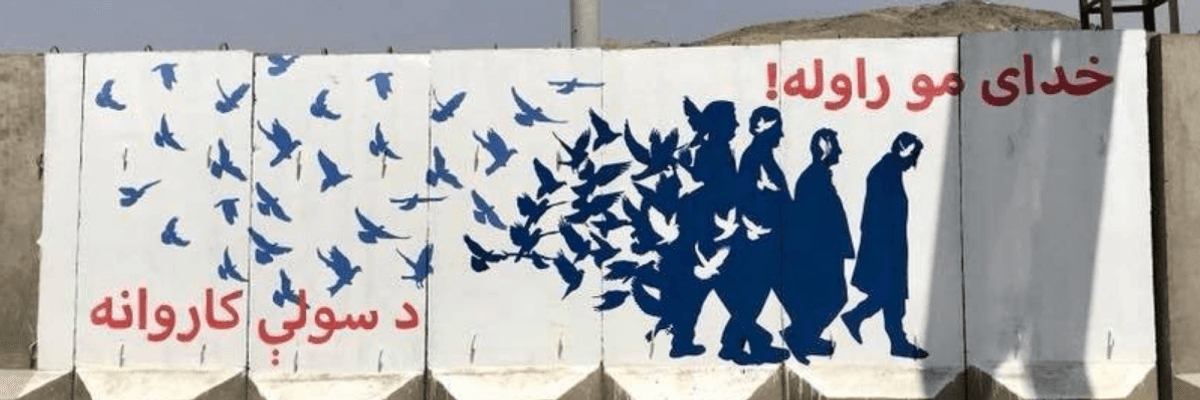
One of several murals being created by Kabul's "ArtLords" painters to welcome the Helmand to Kabul peace walkers. (Photo: Kathy Kelly/VCNC)
This past Friday in Afghanistan's Ghazni province, Hazara girls joined young Pashto boys to sing Afghanistan's national anthem as a welcome to Pashto men walking 400 miles from Helmand to Kabul. The walkers are calling on warring parties in Afghanistan to end the war. Most of the men making the journey are wearing sandals. At rest stops, they must tend to their torn and blistered feet. But their mission grows stronger as they walk. In Ghazni, hundreds of residents, along with religious leaders, showed remarkable readiness to embrace the courage and vision of the Helmand-to-Kabul peace walk participants. It seems likely that ordinary Afghans, no matter their tribal lineages, share a profound desire to end forty years of war. The 17-year U.S. war in Afghanistan exceeds the lifetimes of the youngsters in Ghazni who greeted the peace walkers.
On June 7th, Afghanistan's president, Ashraf Ghani, declared a week-long halt to attacks against the Taliban. Spokespersons representing an undetermined number of Taliban affiliates accepted the ceasefire on June 9th, with the U.S. also agreeing to suspend attacks against Taliban fighters.
"Rather than extending a hand of friendship to people in other lands and, in the case of Afghanistan, paying reparations for the terrible suffering we've caused, the U.S. continues to seek security through dominance and military might. It's a futile effort."
Can the declared cease-fire lead to negotiations and an end to the war? Given the desperate circumstances I saw during a visit to Kabul in early June, it seems clear that a lasting peace will require finding ways to employ people and enable them to provide food and water for their families.
Destitution has caused numerous Afghan people to enlist in military forces, pro-government or insurgent. It's extremely difficult to earn a living wage in Afghanistan, but military and paramilitary units, answerable to various warlords, including the U.S., pay wages which many Afghan families can't afford to dismiss. My young friends in Kabul assure me their family members who joined military groups don't want to cause bloodshed and they don't want to be killed. They simply don't have other viable options.
Almost 54 percent of Afghan citizens live below the poverty line, according to Afghanistan's Tolo News coverage of a recent joint survey undertaken by the Central Statistics Organization and an international NGO.
The Afghan Peace Volunteers (APV), who welcomed me as their guest last week, want to help build a more egalitarian economy that will provide basic human needs. This year, they're forging ahead in establishing worker cooperatives. During my visit, they celebrated the opening of a shoe-making cooperative. They've also devised a one-year plan for seamstresses to form a tailoring cooperative and explored possibilities for a carpentry cooperative.
"Once up-and-running," their blog explains, "these worker cooperatives will pledge part of their earnings to the long-term, self-reliant work of the Afghan Peace Volunteers."
The APV find inspiration in the story of Badshah Khan, sometimes referred to as "the Muslim Gandhi."
After meeting Gandhi in 1919, Badshah Khan educated and organized members of the Pashtun (or "Pathan") tribe, in an area that is now a border between Pakistan and Afghanistan, steadily building a movement to rebel against British occupation. The "khidmatgyars" - Servants of God - refused to cooperate with the British and instead practiced self-reliance. They created their own constructive projects and persisted even when British repression became increasingly brutal.
Describing the growth of the "Servants" movement, Michael Nagler writes: "After perpetrating a terrible massacre in 1930 in Peshawar, the British saw the ranks of the Servants swell from several hundred to 80,000." They continued rejecting armed struggle, choosing instead to experiment with Gandhi's methods of nonviolent resistance. To the astonishment of onlookers, they were a key element in the eventual liberation from British rule.
"The Helmand to Kabul peace walkers display a better means of securing peace: the path of fellowship with our neighbors on this planet, of living simply so that others might simply live, and of willingness to share, even partially, in the human hardship and precarity others face."
Badshah Kahn's preferred method of transportation was walking. He trod along paths linking mountain villages and small towns, relying upon goodwill and the truth of his cause, not on weaponry, for his defense.
A likeness of Badshah Khan decorates the entrance to the APV center in Kabul. Stenciled underneath is his fundamental belief: "My religion is truth, love and service to God and humankind."
I worry that in my country, the U.S., the dominant religion has become militarism. Rather than extending a hand of friendship to people in other lands and, in the case of Afghanistan, paying reparations for the terrible suffering we've caused, the U.S. continues to seek security through dominance and military might. It's a futile effort. The Helmand to Kabul peace walkers display a better means of securing peace: the path of fellowship with our neighbors on this planet, of living simply so that others might simply live, and of willingness to share, even partially, in the human hardship and precarity others face.
I hope those walking for peace, working for equality, and imploring a different way forward can be heard and celebrated not only in Afghanistan, but in every country and amongst every group that has ever caused bloodshed and ruin in Afghanistan.
Dear Common Dreams reader, It’s been nearly 30 years since I co-founded Common Dreams with my late wife, Lina Newhouser. We had the radical notion that journalism should serve the public good, not corporate profits. It was clear to us from the outset what it would take to build such a project. No paid advertisements. No corporate sponsors. No millionaire publisher telling us what to think or do. Many people said we wouldn't last a year, but we proved those doubters wrong. Together with a tremendous team of journalists and dedicated staff, we built an independent media outlet free from the constraints of profits and corporate control. Our mission has always been simple: To inform. To inspire. To ignite change for the common good. Building Common Dreams was not easy. Our survival was never guaranteed. When you take on the most powerful forces—Wall Street greed, fossil fuel industry destruction, Big Tech lobbyists, and uber-rich oligarchs who have spent billions upon billions rigging the economy and democracy in their favor—the only bulwark you have is supporters who believe in your work. But here’s the urgent message from me today. It's never been this bad out there. And it's never been this hard to keep us going. At the very moment Common Dreams is most needed, the threats we face are intensifying. We need your support now more than ever. We don't accept corporate advertising and never will. We don't have a paywall because we don't think people should be blocked from critical news based on their ability to pay. Everything we do is funded by the donations of readers like you. When everyone does the little they can afford, we are strong. But if that support retreats or dries up, so do we. Will you donate now to make sure Common Dreams not only survives but thrives? —Craig Brown, Co-founder |
This past Friday in Afghanistan's Ghazni province, Hazara girls joined young Pashto boys to sing Afghanistan's national anthem as a welcome to Pashto men walking 400 miles from Helmand to Kabul. The walkers are calling on warring parties in Afghanistan to end the war. Most of the men making the journey are wearing sandals. At rest stops, they must tend to their torn and blistered feet. But their mission grows stronger as they walk. In Ghazni, hundreds of residents, along with religious leaders, showed remarkable readiness to embrace the courage and vision of the Helmand-to-Kabul peace walk participants. It seems likely that ordinary Afghans, no matter their tribal lineages, share a profound desire to end forty years of war. The 17-year U.S. war in Afghanistan exceeds the lifetimes of the youngsters in Ghazni who greeted the peace walkers.
On June 7th, Afghanistan's president, Ashraf Ghani, declared a week-long halt to attacks against the Taliban. Spokespersons representing an undetermined number of Taliban affiliates accepted the ceasefire on June 9th, with the U.S. also agreeing to suspend attacks against Taliban fighters.
"Rather than extending a hand of friendship to people in other lands and, in the case of Afghanistan, paying reparations for the terrible suffering we've caused, the U.S. continues to seek security through dominance and military might. It's a futile effort."
Can the declared cease-fire lead to negotiations and an end to the war? Given the desperate circumstances I saw during a visit to Kabul in early June, it seems clear that a lasting peace will require finding ways to employ people and enable them to provide food and water for their families.
Destitution has caused numerous Afghan people to enlist in military forces, pro-government or insurgent. It's extremely difficult to earn a living wage in Afghanistan, but military and paramilitary units, answerable to various warlords, including the U.S., pay wages which many Afghan families can't afford to dismiss. My young friends in Kabul assure me their family members who joined military groups don't want to cause bloodshed and they don't want to be killed. They simply don't have other viable options.
Almost 54 percent of Afghan citizens live below the poverty line, according to Afghanistan's Tolo News coverage of a recent joint survey undertaken by the Central Statistics Organization and an international NGO.
The Afghan Peace Volunteers (APV), who welcomed me as their guest last week, want to help build a more egalitarian economy that will provide basic human needs. This year, they're forging ahead in establishing worker cooperatives. During my visit, they celebrated the opening of a shoe-making cooperative. They've also devised a one-year plan for seamstresses to form a tailoring cooperative and explored possibilities for a carpentry cooperative.
"Once up-and-running," their blog explains, "these worker cooperatives will pledge part of their earnings to the long-term, self-reliant work of the Afghan Peace Volunteers."
The APV find inspiration in the story of Badshah Khan, sometimes referred to as "the Muslim Gandhi."
After meeting Gandhi in 1919, Badshah Khan educated and organized members of the Pashtun (or "Pathan") tribe, in an area that is now a border between Pakistan and Afghanistan, steadily building a movement to rebel against British occupation. The "khidmatgyars" - Servants of God - refused to cooperate with the British and instead practiced self-reliance. They created their own constructive projects and persisted even when British repression became increasingly brutal.
Describing the growth of the "Servants" movement, Michael Nagler writes: "After perpetrating a terrible massacre in 1930 in Peshawar, the British saw the ranks of the Servants swell from several hundred to 80,000." They continued rejecting armed struggle, choosing instead to experiment with Gandhi's methods of nonviolent resistance. To the astonishment of onlookers, they were a key element in the eventual liberation from British rule.
"The Helmand to Kabul peace walkers display a better means of securing peace: the path of fellowship with our neighbors on this planet, of living simply so that others might simply live, and of willingness to share, even partially, in the human hardship and precarity others face."
Badshah Kahn's preferred method of transportation was walking. He trod along paths linking mountain villages and small towns, relying upon goodwill and the truth of his cause, not on weaponry, for his defense.
A likeness of Badshah Khan decorates the entrance to the APV center in Kabul. Stenciled underneath is his fundamental belief: "My religion is truth, love and service to God and humankind."
I worry that in my country, the U.S., the dominant religion has become militarism. Rather than extending a hand of friendship to people in other lands and, in the case of Afghanistan, paying reparations for the terrible suffering we've caused, the U.S. continues to seek security through dominance and military might. It's a futile effort. The Helmand to Kabul peace walkers display a better means of securing peace: the path of fellowship with our neighbors on this planet, of living simply so that others might simply live, and of willingness to share, even partially, in the human hardship and precarity others face.
I hope those walking for peace, working for equality, and imploring a different way forward can be heard and celebrated not only in Afghanistan, but in every country and amongst every group that has ever caused bloodshed and ruin in Afghanistan.
This past Friday in Afghanistan's Ghazni province, Hazara girls joined young Pashto boys to sing Afghanistan's national anthem as a welcome to Pashto men walking 400 miles from Helmand to Kabul. The walkers are calling on warring parties in Afghanistan to end the war. Most of the men making the journey are wearing sandals. At rest stops, they must tend to their torn and blistered feet. But their mission grows stronger as they walk. In Ghazni, hundreds of residents, along with religious leaders, showed remarkable readiness to embrace the courage and vision of the Helmand-to-Kabul peace walk participants. It seems likely that ordinary Afghans, no matter their tribal lineages, share a profound desire to end forty years of war. The 17-year U.S. war in Afghanistan exceeds the lifetimes of the youngsters in Ghazni who greeted the peace walkers.
On June 7th, Afghanistan's president, Ashraf Ghani, declared a week-long halt to attacks against the Taliban. Spokespersons representing an undetermined number of Taliban affiliates accepted the ceasefire on June 9th, with the U.S. also agreeing to suspend attacks against Taliban fighters.
"Rather than extending a hand of friendship to people in other lands and, in the case of Afghanistan, paying reparations for the terrible suffering we've caused, the U.S. continues to seek security through dominance and military might. It's a futile effort."
Can the declared cease-fire lead to negotiations and an end to the war? Given the desperate circumstances I saw during a visit to Kabul in early June, it seems clear that a lasting peace will require finding ways to employ people and enable them to provide food and water for their families.
Destitution has caused numerous Afghan people to enlist in military forces, pro-government or insurgent. It's extremely difficult to earn a living wage in Afghanistan, but military and paramilitary units, answerable to various warlords, including the U.S., pay wages which many Afghan families can't afford to dismiss. My young friends in Kabul assure me their family members who joined military groups don't want to cause bloodshed and they don't want to be killed. They simply don't have other viable options.
Almost 54 percent of Afghan citizens live below the poverty line, according to Afghanistan's Tolo News coverage of a recent joint survey undertaken by the Central Statistics Organization and an international NGO.
The Afghan Peace Volunteers (APV), who welcomed me as their guest last week, want to help build a more egalitarian economy that will provide basic human needs. This year, they're forging ahead in establishing worker cooperatives. During my visit, they celebrated the opening of a shoe-making cooperative. They've also devised a one-year plan for seamstresses to form a tailoring cooperative and explored possibilities for a carpentry cooperative.
"Once up-and-running," their blog explains, "these worker cooperatives will pledge part of their earnings to the long-term, self-reliant work of the Afghan Peace Volunteers."
The APV find inspiration in the story of Badshah Khan, sometimes referred to as "the Muslim Gandhi."
After meeting Gandhi in 1919, Badshah Khan educated and organized members of the Pashtun (or "Pathan") tribe, in an area that is now a border between Pakistan and Afghanistan, steadily building a movement to rebel against British occupation. The "khidmatgyars" - Servants of God - refused to cooperate with the British and instead practiced self-reliance. They created their own constructive projects and persisted even when British repression became increasingly brutal.
Describing the growth of the "Servants" movement, Michael Nagler writes: "After perpetrating a terrible massacre in 1930 in Peshawar, the British saw the ranks of the Servants swell from several hundred to 80,000." They continued rejecting armed struggle, choosing instead to experiment with Gandhi's methods of nonviolent resistance. To the astonishment of onlookers, they were a key element in the eventual liberation from British rule.
"The Helmand to Kabul peace walkers display a better means of securing peace: the path of fellowship with our neighbors on this planet, of living simply so that others might simply live, and of willingness to share, even partially, in the human hardship and precarity others face."
Badshah Kahn's preferred method of transportation was walking. He trod along paths linking mountain villages and small towns, relying upon goodwill and the truth of his cause, not on weaponry, for his defense.
A likeness of Badshah Khan decorates the entrance to the APV center in Kabul. Stenciled underneath is his fundamental belief: "My religion is truth, love and service to God and humankind."
I worry that in my country, the U.S., the dominant religion has become militarism. Rather than extending a hand of friendship to people in other lands and, in the case of Afghanistan, paying reparations for the terrible suffering we've caused, the U.S. continues to seek security through dominance and military might. It's a futile effort. The Helmand to Kabul peace walkers display a better means of securing peace: the path of fellowship with our neighbors on this planet, of living simply so that others might simply live, and of willingness to share, even partially, in the human hardship and precarity others face.
I hope those walking for peace, working for equality, and imploring a different way forward can be heard and celebrated not only in Afghanistan, but in every country and amongst every group that has ever caused bloodshed and ruin in Afghanistan.