

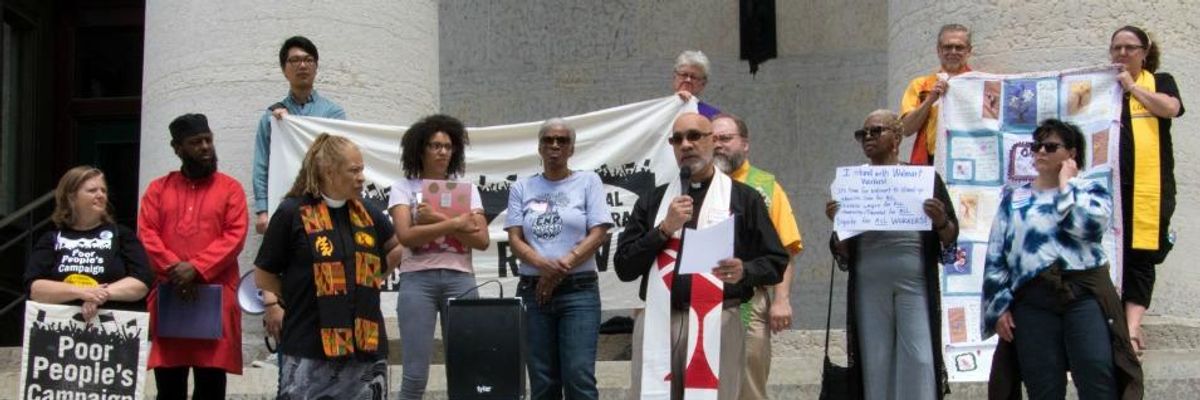
Martin Luther KIng, Jr.'s Poor People's Campaign was revived this week with protests taking place across the country. (Photo: Becker1999/Flickr/cc)
More Thoughts on the Poor People's Campaign
"The primary reason I joined the Poor People’s Campaign and have encouraged others to do so is its potential for realizing basic structural change."
The Poor People's Campaign, modeled on MLK's original movement from fifty years ago, held its first rallies and direct actions this past Monday at 37 state capitals across the country. I was privileged to be arrested for blocking the roadway during the civil disobedience portion of our rally at the capitol building in Harrisburg, PA. These actions will continue every Monday for 40 days and culminate in a national mobilization at the nation's capital in Washington, D.C. The campaign is non-partisan and politicians are not allowed on the platform.
The primary reason I joined the Poor People's Campaign and have encouraged others to do so is its potential for realizing basic structural change. So far, my personal experience with the PPC has been overwhelmingly positive. Hallmarks include dynamic leadership, superb organizational skills, a diverse membership and high morale. I've also witnessed instances of MLK's "beloved community" when interacting with the members. And I agree with radical activist and writer Patrick Taylor that "We need to articulate the moral foundations of our political positions."
There is, however, one caveat and I offer it with only the best of intentions. The PPC is tantalizingly close to taking, for me at least, the next logical step for reaching its potential. Along with its powerful moral message, there's a need to be explicit about how the class and power structure of capitalism is inextricably linked to the PPC's "Four Evils" of systemic racism, systemic poverty, ecological devastation and the cost of America's war economy. It's not disparaging to either approach to advocate combining faith-based motives with a fact-based, political economy diagnosis of the problem. This symbiotic fusion would provide a formidable tool for advancing the PPC's objectives.
Doing so, would be entirely in keeping with Martin Luther King's own political evolution. By 1966, when speaking to his staff, King offered some positive words about democratic socialism and then said, "You're really getting on dangerous ground here because you're messing around with the folks. You are messing around with the captains of industry." Two years later, in an interview with a NYT's reporter, King said "In a sense you could say we're involved with class struggle..."
This is why King was described as "the most dangerous man in America." Jared Ball, writing for the Black Agenda Report described how King's image has been sanitized (in Cornel West's phrase, "the Santa Clausification" of King) when powerful forces came together "...to ensure that King would be separated from his anti-capitalist, anti-imperialist and patient work for a genuine revolution."
Bruce Dixon, the managing editor of Black Agenda Report, has been critical of the PPC's focus on symptoms but not causes. Yet Dixon writes, "we can and should march alongside them. What we cannot do, as socialists is consent to be led by a this cramped vision, a vision which refuses to name capitalism as the problem..."
Yes, there are risks that rank-and-file Democrat types might be offended. But telling the truth about the neoliberal capitalist DP national leadership can't be avoided if the PPC is to obtain its radically transformative potential.
The title of Dr. King's last book was "Where Do We Go From Here?"
We should be having that conversation.
An Urgent Message From Our Co-Founder
Dear Common Dreams reader, It’s been nearly 30 years since I co-founded Common Dreams with my late wife, Lina Newhouser. We had the radical notion that journalism should serve the public good, not corporate profits. It was clear to us from the outset what it would take to build such a project. No paid advertisements. No corporate sponsors. No millionaire publisher telling us what to think or do. Many people said we wouldn't last a year, but we proved those doubters wrong. Together with a tremendous team of journalists and dedicated staff, we built an independent media outlet free from the constraints of profits and corporate control. Our mission has always been simple: To inform. To inspire. To ignite change for the common good. Building Common Dreams was not easy. Our survival was never guaranteed. When you take on the most powerful forces—Wall Street greed, fossil fuel industry destruction, Big Tech lobbyists, and uber-rich oligarchs who have spent billions upon billions rigging the economy and democracy in their favor—the only bulwark you have is supporters who believe in your work. But here’s the urgent message from me today. It's never been this bad out there. And it's never been this hard to keep us going. At the very moment Common Dreams is most needed, the threats we face are intensifying. We need your support now more than ever. We don't accept corporate advertising and never will. We don't have a paywall because we don't think people should be blocked from critical news based on their ability to pay. Everything we do is funded by the donations of readers like you. When everyone does the little they can afford, we are strong. But if that support retreats or dries up, so do we. Will you donate now to make sure Common Dreams not only survives but thrives? —Craig Brown, Co-founder |
The Poor People's Campaign, modeled on MLK's original movement from fifty years ago, held its first rallies and direct actions this past Monday at 37 state capitals across the country. I was privileged to be arrested for blocking the roadway during the civil disobedience portion of our rally at the capitol building in Harrisburg, PA. These actions will continue every Monday for 40 days and culminate in a national mobilization at the nation's capital in Washington, D.C. The campaign is non-partisan and politicians are not allowed on the platform.
The primary reason I joined the Poor People's Campaign and have encouraged others to do so is its potential for realizing basic structural change. So far, my personal experience with the PPC has been overwhelmingly positive. Hallmarks include dynamic leadership, superb organizational skills, a diverse membership and high morale. I've also witnessed instances of MLK's "beloved community" when interacting with the members. And I agree with radical activist and writer Patrick Taylor that "We need to articulate the moral foundations of our political positions."
There is, however, one caveat and I offer it with only the best of intentions. The PPC is tantalizingly close to taking, for me at least, the next logical step for reaching its potential. Along with its powerful moral message, there's a need to be explicit about how the class and power structure of capitalism is inextricably linked to the PPC's "Four Evils" of systemic racism, systemic poverty, ecological devastation and the cost of America's war economy. It's not disparaging to either approach to advocate combining faith-based motives with a fact-based, political economy diagnosis of the problem. This symbiotic fusion would provide a formidable tool for advancing the PPC's objectives.
Doing so, would be entirely in keeping with Martin Luther King's own political evolution. By 1966, when speaking to his staff, King offered some positive words about democratic socialism and then said, "You're really getting on dangerous ground here because you're messing around with the folks. You are messing around with the captains of industry." Two years later, in an interview with a NYT's reporter, King said "In a sense you could say we're involved with class struggle..."
This is why King was described as "the most dangerous man in America." Jared Ball, writing for the Black Agenda Report described how King's image has been sanitized (in Cornel West's phrase, "the Santa Clausification" of King) when powerful forces came together "...to ensure that King would be separated from his anti-capitalist, anti-imperialist and patient work for a genuine revolution."
Bruce Dixon, the managing editor of Black Agenda Report, has been critical of the PPC's focus on symptoms but not causes. Yet Dixon writes, "we can and should march alongside them. What we cannot do, as socialists is consent to be led by a this cramped vision, a vision which refuses to name capitalism as the problem..."
Yes, there are risks that rank-and-file Democrat types might be offended. But telling the truth about the neoliberal capitalist DP national leadership can't be avoided if the PPC is to obtain its radically transformative potential.
The title of Dr. King's last book was "Where Do We Go From Here?"
We should be having that conversation.
The Poor People's Campaign, modeled on MLK's original movement from fifty years ago, held its first rallies and direct actions this past Monday at 37 state capitals across the country. I was privileged to be arrested for blocking the roadway during the civil disobedience portion of our rally at the capitol building in Harrisburg, PA. These actions will continue every Monday for 40 days and culminate in a national mobilization at the nation's capital in Washington, D.C. The campaign is non-partisan and politicians are not allowed on the platform.
The primary reason I joined the Poor People's Campaign and have encouraged others to do so is its potential for realizing basic structural change. So far, my personal experience with the PPC has been overwhelmingly positive. Hallmarks include dynamic leadership, superb organizational skills, a diverse membership and high morale. I've also witnessed instances of MLK's "beloved community" when interacting with the members. And I agree with radical activist and writer Patrick Taylor that "We need to articulate the moral foundations of our political positions."
There is, however, one caveat and I offer it with only the best of intentions. The PPC is tantalizingly close to taking, for me at least, the next logical step for reaching its potential. Along with its powerful moral message, there's a need to be explicit about how the class and power structure of capitalism is inextricably linked to the PPC's "Four Evils" of systemic racism, systemic poverty, ecological devastation and the cost of America's war economy. It's not disparaging to either approach to advocate combining faith-based motives with a fact-based, political economy diagnosis of the problem. This symbiotic fusion would provide a formidable tool for advancing the PPC's objectives.
Doing so, would be entirely in keeping with Martin Luther King's own political evolution. By 1966, when speaking to his staff, King offered some positive words about democratic socialism and then said, "You're really getting on dangerous ground here because you're messing around with the folks. You are messing around with the captains of industry." Two years later, in an interview with a NYT's reporter, King said "In a sense you could say we're involved with class struggle..."
This is why King was described as "the most dangerous man in America." Jared Ball, writing for the Black Agenda Report described how King's image has been sanitized (in Cornel West's phrase, "the Santa Clausification" of King) when powerful forces came together "...to ensure that King would be separated from his anti-capitalist, anti-imperialist and patient work for a genuine revolution."
Bruce Dixon, the managing editor of Black Agenda Report, has been critical of the PPC's focus on symptoms but not causes. Yet Dixon writes, "we can and should march alongside them. What we cannot do, as socialists is consent to be led by a this cramped vision, a vision which refuses to name capitalism as the problem..."
Yes, there are risks that rank-and-file Democrat types might be offended. But telling the truth about the neoliberal capitalist DP national leadership can't be avoided if the PPC is to obtain its radically transformative potential.
The title of Dr. King's last book was "Where Do We Go From Here?"
We should be having that conversation.