SUBSCRIBE TO OUR FREE NEWSLETTER
Daily news & progressive opinion—funded by the people, not the corporations—delivered straight to your inbox.
5
#000000
#FFFFFF
To donate by check, phone, or other method, see our More Ways to Give page.
Daily news & progressive opinion—funded by the people, not the corporations—delivered straight to your inbox.
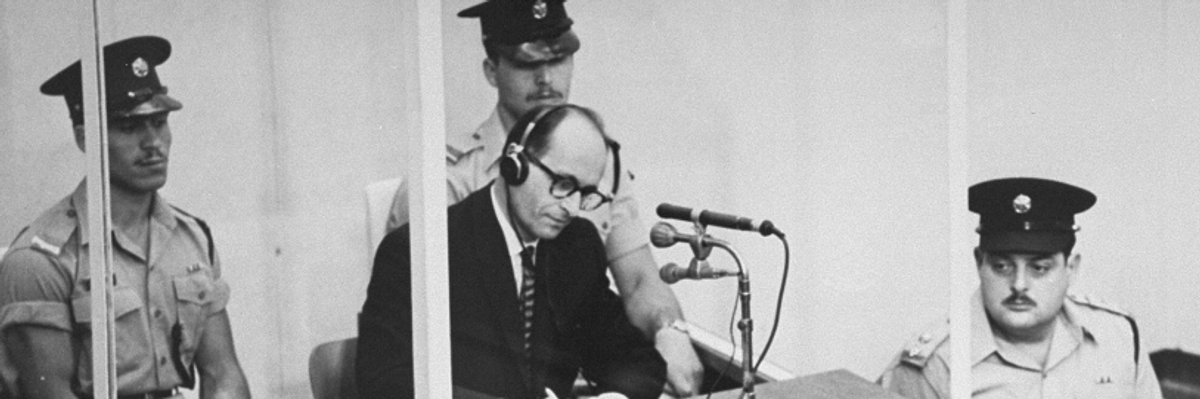
Defendant Adolf Eichmann takes notes during his trial in Jerusalem. The glass booth in which Eichmann sat was erected to protect him from assassination. (Photo credit: Israeli Government)
On May 9, Gina Haspel, Donald Trump's choice for head of the Central Intelligence Agency, testified at her Senate confirmation hearing in Washington, DC. Some senators questioned her about her tenure, in 2002, as CIA station chief in Thailand. There, the agency ran one of the "black sites" where suspected al-Qaida extremists were interrogated using procedures that included waterboarding. She was also asked about her role in the destruction of videotapes in 2005 that documented the torture of illegally detained suspects. Her evasive answers to these questions, disconcerting and unsatisfying, are also hauntingly familiar.
In 1960, Adolf Eichmann was kidnapped by Israeli spies in Argentina and brought to trial in Jerusalem for his part in the extermination of millions of European Jews during Germany's Third Reich. In his interrogation with Israeli police--published as Eichmann Interrogated (DeCopo Books, NY, 1999)--Eichmann stated that in the intervening years since the acts in question his own view of them had evolved and before the Senate on May 9, Haspel expressed herself similarly.
"Eichmann's cowardly protestations that he could not have known that facilitating torture and murder was illegal ring hollow. It was only after Eichmann's atrocities, though, that such crimes as torture were formally codified into law."
Haspel testified that while she can't say what exactly might constitute an immoral order in the past, her "moral compass" would not allow her to obey one today, given the "stricter moral standard" she says "we have chosen to hold ourselves to." She does not judge the actions that she and her colleagues took in the years after 9-11, "in that tumultuous time" of decidedly looser moral standards: "I'm not going to sit here, with the benefit of hindsight, and judge the very good people who made hard decisions." She testified that she supports laws that prohibit torture, but insists that such laws were not in place at the time and that such "harsh interrogations" were allowable under the legal guidance the CIA had at the time and "that the highest legal authority in the United States had approved it, and that the president of the United States had approved it."
Likewise Eichmann was probed about his obedience when "ordered to do something blatantly illegal." In a response that augured Haspel's Senate testimony a half century later, Eichmann told his interrogators: "You say illegal. Today I have a very different view of things...But then? I wouldn't have considered any of those actions illegal... If anyone had asked me about it up until May 8, 1945, the end of the war, I'd have said: This government was elected by a majority of the German people... every civilized country on earth had its diplomatic mission. Who is a little man like me to trouble his head about it? I get orders from my superior and I look neither right nor left. That's not my job. My job is to obey and comply."
Not to compare the evil of the holocaust with the CIA rendition and torture (as if evil could be measured by quantity) but the evasions and obfuscations of these two willing technicians of state terror are chillingly similar. Eichmann's cowardly protestations that he could not have known that facilitating torture and murder was illegal ring hollow. It was only after Eichmann's atrocities, though, that such crimes as torture were formally codified into law. By 2002, however, along the precedents of the war crimes tribunal at Nuremberg, the United States was legally bound along with most nations in the world to the Geneva Conventions, to the Universal Declaration of Human Rights and the United Nations Convention against Torture. Even the U.S. Army Field Manual, cited by Haspel in her hearing, labels waterboarding as torture and a war crime.
"We all believed in our work. We were all committed," Haspel proudly boasted to the Senate, describing the morale and esprit de corps of her CIA comrades overseeing illegal detention, torture and murder in the years after 9-11. Eichmann similarly praised the work ethic of his team. Inspired by Eichmann's trial, Thomas Merton, in his poem, "Chant to be Used in Processions Around a Site with Furnaces," put these words in the mouth of a condemned concentration camp commander: "In my day we worked hard we saw what we did our self-sacrifice was conscientious and complete our work was faultless and detailed."
An Israeli court did not buy Adolf Eichmann's defense that he was following orders and obeying the law as he understood it and he was hung on June 1, 1962. We will soon know if the U.S. Senate will accept Gina Haspel's appropriation of Eichmann's alibi and confirm her as Director of the Central Intelligence Agency.
Dear Common Dreams reader, It’s been nearly 30 years since I co-founded Common Dreams with my late wife, Lina Newhouser. We had the radical notion that journalism should serve the public good, not corporate profits. It was clear to us from the outset what it would take to build such a project. No paid advertisements. No corporate sponsors. No millionaire publisher telling us what to think or do. Many people said we wouldn't last a year, but we proved those doubters wrong. Together with a tremendous team of journalists and dedicated staff, we built an independent media outlet free from the constraints of profits and corporate control. Our mission has always been simple: To inform. To inspire. To ignite change for the common good. Building Common Dreams was not easy. Our survival was never guaranteed. When you take on the most powerful forces—Wall Street greed, fossil fuel industry destruction, Big Tech lobbyists, and uber-rich oligarchs who have spent billions upon billions rigging the economy and democracy in their favor—the only bulwark you have is supporters who believe in your work. But here’s the urgent message from me today. It's never been this bad out there. And it's never been this hard to keep us going. At the very moment Common Dreams is most needed, the threats we face are intensifying. We need your support now more than ever. We don't accept corporate advertising and never will. We don't have a paywall because we don't think people should be blocked from critical news based on their ability to pay. Everything we do is funded by the donations of readers like you. When everyone does the little they can afford, we are strong. But if that support retreats or dries up, so do we. Will you donate now to make sure Common Dreams not only survives but thrives? —Craig Brown, Co-founder |
On May 9, Gina Haspel, Donald Trump's choice for head of the Central Intelligence Agency, testified at her Senate confirmation hearing in Washington, DC. Some senators questioned her about her tenure, in 2002, as CIA station chief in Thailand. There, the agency ran one of the "black sites" where suspected al-Qaida extremists were interrogated using procedures that included waterboarding. She was also asked about her role in the destruction of videotapes in 2005 that documented the torture of illegally detained suspects. Her evasive answers to these questions, disconcerting and unsatisfying, are also hauntingly familiar.
In 1960, Adolf Eichmann was kidnapped by Israeli spies in Argentina and brought to trial in Jerusalem for his part in the extermination of millions of European Jews during Germany's Third Reich. In his interrogation with Israeli police--published as Eichmann Interrogated (DeCopo Books, NY, 1999)--Eichmann stated that in the intervening years since the acts in question his own view of them had evolved and before the Senate on May 9, Haspel expressed herself similarly.
"Eichmann's cowardly protestations that he could not have known that facilitating torture and murder was illegal ring hollow. It was only after Eichmann's atrocities, though, that such crimes as torture were formally codified into law."
Haspel testified that while she can't say what exactly might constitute an immoral order in the past, her "moral compass" would not allow her to obey one today, given the "stricter moral standard" she says "we have chosen to hold ourselves to." She does not judge the actions that she and her colleagues took in the years after 9-11, "in that tumultuous time" of decidedly looser moral standards: "I'm not going to sit here, with the benefit of hindsight, and judge the very good people who made hard decisions." She testified that she supports laws that prohibit torture, but insists that such laws were not in place at the time and that such "harsh interrogations" were allowable under the legal guidance the CIA had at the time and "that the highest legal authority in the United States had approved it, and that the president of the United States had approved it."
Likewise Eichmann was probed about his obedience when "ordered to do something blatantly illegal." In a response that augured Haspel's Senate testimony a half century later, Eichmann told his interrogators: "You say illegal. Today I have a very different view of things...But then? I wouldn't have considered any of those actions illegal... If anyone had asked me about it up until May 8, 1945, the end of the war, I'd have said: This government was elected by a majority of the German people... every civilized country on earth had its diplomatic mission. Who is a little man like me to trouble his head about it? I get orders from my superior and I look neither right nor left. That's not my job. My job is to obey and comply."
Not to compare the evil of the holocaust with the CIA rendition and torture (as if evil could be measured by quantity) but the evasions and obfuscations of these two willing technicians of state terror are chillingly similar. Eichmann's cowardly protestations that he could not have known that facilitating torture and murder was illegal ring hollow. It was only after Eichmann's atrocities, though, that such crimes as torture were formally codified into law. By 2002, however, along the precedents of the war crimes tribunal at Nuremberg, the United States was legally bound along with most nations in the world to the Geneva Conventions, to the Universal Declaration of Human Rights and the United Nations Convention against Torture. Even the U.S. Army Field Manual, cited by Haspel in her hearing, labels waterboarding as torture and a war crime.
"We all believed in our work. We were all committed," Haspel proudly boasted to the Senate, describing the morale and esprit de corps of her CIA comrades overseeing illegal detention, torture and murder in the years after 9-11. Eichmann similarly praised the work ethic of his team. Inspired by Eichmann's trial, Thomas Merton, in his poem, "Chant to be Used in Processions Around a Site with Furnaces," put these words in the mouth of a condemned concentration camp commander: "In my day we worked hard we saw what we did our self-sacrifice was conscientious and complete our work was faultless and detailed."
An Israeli court did not buy Adolf Eichmann's defense that he was following orders and obeying the law as he understood it and he was hung on June 1, 1962. We will soon know if the U.S. Senate will accept Gina Haspel's appropriation of Eichmann's alibi and confirm her as Director of the Central Intelligence Agency.
On May 9, Gina Haspel, Donald Trump's choice for head of the Central Intelligence Agency, testified at her Senate confirmation hearing in Washington, DC. Some senators questioned her about her tenure, in 2002, as CIA station chief in Thailand. There, the agency ran one of the "black sites" where suspected al-Qaida extremists were interrogated using procedures that included waterboarding. She was also asked about her role in the destruction of videotapes in 2005 that documented the torture of illegally detained suspects. Her evasive answers to these questions, disconcerting and unsatisfying, are also hauntingly familiar.
In 1960, Adolf Eichmann was kidnapped by Israeli spies in Argentina and brought to trial in Jerusalem for his part in the extermination of millions of European Jews during Germany's Third Reich. In his interrogation with Israeli police--published as Eichmann Interrogated (DeCopo Books, NY, 1999)--Eichmann stated that in the intervening years since the acts in question his own view of them had evolved and before the Senate on May 9, Haspel expressed herself similarly.
"Eichmann's cowardly protestations that he could not have known that facilitating torture and murder was illegal ring hollow. It was only after Eichmann's atrocities, though, that such crimes as torture were formally codified into law."
Haspel testified that while she can't say what exactly might constitute an immoral order in the past, her "moral compass" would not allow her to obey one today, given the "stricter moral standard" she says "we have chosen to hold ourselves to." She does not judge the actions that she and her colleagues took in the years after 9-11, "in that tumultuous time" of decidedly looser moral standards: "I'm not going to sit here, with the benefit of hindsight, and judge the very good people who made hard decisions." She testified that she supports laws that prohibit torture, but insists that such laws were not in place at the time and that such "harsh interrogations" were allowable under the legal guidance the CIA had at the time and "that the highest legal authority in the United States had approved it, and that the president of the United States had approved it."
Likewise Eichmann was probed about his obedience when "ordered to do something blatantly illegal." In a response that augured Haspel's Senate testimony a half century later, Eichmann told his interrogators: "You say illegal. Today I have a very different view of things...But then? I wouldn't have considered any of those actions illegal... If anyone had asked me about it up until May 8, 1945, the end of the war, I'd have said: This government was elected by a majority of the German people... every civilized country on earth had its diplomatic mission. Who is a little man like me to trouble his head about it? I get orders from my superior and I look neither right nor left. That's not my job. My job is to obey and comply."
Not to compare the evil of the holocaust with the CIA rendition and torture (as if evil could be measured by quantity) but the evasions and obfuscations of these two willing technicians of state terror are chillingly similar. Eichmann's cowardly protestations that he could not have known that facilitating torture and murder was illegal ring hollow. It was only after Eichmann's atrocities, though, that such crimes as torture were formally codified into law. By 2002, however, along the precedents of the war crimes tribunal at Nuremberg, the United States was legally bound along with most nations in the world to the Geneva Conventions, to the Universal Declaration of Human Rights and the United Nations Convention against Torture. Even the U.S. Army Field Manual, cited by Haspel in her hearing, labels waterboarding as torture and a war crime.
"We all believed in our work. We were all committed," Haspel proudly boasted to the Senate, describing the morale and esprit de corps of her CIA comrades overseeing illegal detention, torture and murder in the years after 9-11. Eichmann similarly praised the work ethic of his team. Inspired by Eichmann's trial, Thomas Merton, in his poem, "Chant to be Used in Processions Around a Site with Furnaces," put these words in the mouth of a condemned concentration camp commander: "In my day we worked hard we saw what we did our self-sacrifice was conscientious and complete our work was faultless and detailed."
An Israeli court did not buy Adolf Eichmann's defense that he was following orders and obeying the law as he understood it and he was hung on June 1, 1962. We will soon know if the U.S. Senate will accept Gina Haspel's appropriation of Eichmann's alibi and confirm her as Director of the Central Intelligence Agency.