SUBSCRIBE TO OUR FREE NEWSLETTER
Daily news & progressive opinion—funded by the people, not the corporations—delivered straight to your inbox.
5
#000000
#FFFFFF
To donate by check, phone, or other method, see our More Ways to Give page.
Daily news & progressive opinion—funded by the people, not the corporations—delivered straight to your inbox.
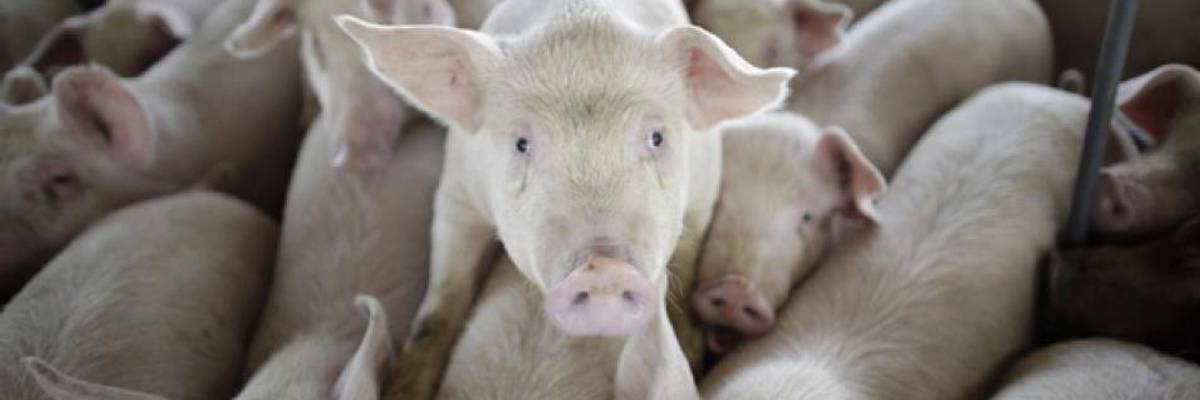
"The Animal Welfare Act, doesn't provide any legal protections for the more than 9 billion animals raised and killed for food in the U.S. each year." (Photo: file)
You may not know that Rep. Steve King (R-IA)--notorious for his racist tirades, denial of climate change, and ardent opposition to marriage equality--hates animals. He has historically opposed legislation prohibiting dog fighting, puppy mills, and the sale of dog, cat, and horse meat. A proud bully of vegetarians, King has defended exotic wildlife hunters and the slaughter of threatened polar bears.
Now, King is trying to gut the few protections that exist for farmed animals in the U.S.-- trampling states' rights in the process.
King's recent amendment to the farm bill, identical to his proposed Protect Interstate Commerce Act, HR 4879, aims to strip states of their time-honored right to set standards on the sale of agricultural products, including animal protection standards.
If the amendment makes it into the final farm bill, it would nullify popular laws in Massachusetts and California that ban the sale of eggs from hens cruelly confined in battery cages and force California to allow the sale of foie gras, a cruel "delicacy" made by force-feeding ducks and geese. King's amendment would also overturn laws in hundreds of counties and municipalities that restrict the sale of dogs from puppy mills, and it could force Virginia and other states to allow the sale of dog and horse meat.
Very few laws in the U.S. protect farmed animals, and even these laws aren't free of loopholes. U.S. law permits farmed animals to be routinely abused, mutilated, confined in unsanitary and inhumane conditions, and slaughtered by the billions.
King's amendment, if passed, wouldn't just affect animal protection laws; it could also preempt countless laws meant to protect consumers. According to the Harvard Law School Animal Law & Policy Program, laws prohibiting the sale of expired infant formula and the sale of baby food in containers with intentionally added bisphenol-A are among the hundreds that could become even more difficult to enforce if the King amendment were signed into law.
Very few laws in the U.S. protect farmed animals, and even these laws aren't free of loopholes. U.S. law permits farmed animals to be routinely abused, mutilated, confined in unsanitary and inhumane conditions, and slaughtered by the billions. The most significant piece of federal animal welfare legislation, the Animal Welfare Act, doesn't provide any legal protections for the more than 9 billion animals raised and killed for food in the U.S. each year. The Humane Methods of Slaughter Act, enacted in 1958, is hardly better. It requires that livestock be "rendered insensible to pain" before slaughter--but birds and fish are excluded, so more than 99 percent of animals slaughtered for food receive zero protections under the act.
King's amendment is an assault on animals and Americans, but we can stop it. A large and diverse coalition of over 170 groups, including Mercy For Animals, Farm Aid, United Farm Workers, Food and Water Watch, and Center for Food Safety, are dedicated to defeating the amendment and are urging people to take action by calling their U.S. representatives and telling them to oppose King's anti-animal agenda.
Billions of lives are on the line--both human and nonhuman--and they need all of us to speak up.
Dear Common Dreams reader, It’s been nearly 30 years since I co-founded Common Dreams with my late wife, Lina Newhouser. We had the radical notion that journalism should serve the public good, not corporate profits. It was clear to us from the outset what it would take to build such a project. No paid advertisements. No corporate sponsors. No millionaire publisher telling us what to think or do. Many people said we wouldn't last a year, but we proved those doubters wrong. Together with a tremendous team of journalists and dedicated staff, we built an independent media outlet free from the constraints of profits and corporate control. Our mission has always been simple: To inform. To inspire. To ignite change for the common good. Building Common Dreams was not easy. Our survival was never guaranteed. When you take on the most powerful forces—Wall Street greed, fossil fuel industry destruction, Big Tech lobbyists, and uber-rich oligarchs who have spent billions upon billions rigging the economy and democracy in their favor—the only bulwark you have is supporters who believe in your work. But here’s the urgent message from me today. It's never been this bad out there. And it's never been this hard to keep us going. At the very moment Common Dreams is most needed, the threats we face are intensifying. We need your support now more than ever. We don't accept corporate advertising and never will. We don't have a paywall because we don't think people should be blocked from critical news based on their ability to pay. Everything we do is funded by the donations of readers like you. When everyone does the little they can afford, we are strong. But if that support retreats or dries up, so do we. Will you donate now to make sure Common Dreams not only survives but thrives? —Craig Brown, Co-founder |
You may not know that Rep. Steve King (R-IA)--notorious for his racist tirades, denial of climate change, and ardent opposition to marriage equality--hates animals. He has historically opposed legislation prohibiting dog fighting, puppy mills, and the sale of dog, cat, and horse meat. A proud bully of vegetarians, King has defended exotic wildlife hunters and the slaughter of threatened polar bears.
Now, King is trying to gut the few protections that exist for farmed animals in the U.S.-- trampling states' rights in the process.
King's recent amendment to the farm bill, identical to his proposed Protect Interstate Commerce Act, HR 4879, aims to strip states of their time-honored right to set standards on the sale of agricultural products, including animal protection standards.
If the amendment makes it into the final farm bill, it would nullify popular laws in Massachusetts and California that ban the sale of eggs from hens cruelly confined in battery cages and force California to allow the sale of foie gras, a cruel "delicacy" made by force-feeding ducks and geese. King's amendment would also overturn laws in hundreds of counties and municipalities that restrict the sale of dogs from puppy mills, and it could force Virginia and other states to allow the sale of dog and horse meat.
Very few laws in the U.S. protect farmed animals, and even these laws aren't free of loopholes. U.S. law permits farmed animals to be routinely abused, mutilated, confined in unsanitary and inhumane conditions, and slaughtered by the billions.
King's amendment, if passed, wouldn't just affect animal protection laws; it could also preempt countless laws meant to protect consumers. According to the Harvard Law School Animal Law & Policy Program, laws prohibiting the sale of expired infant formula and the sale of baby food in containers with intentionally added bisphenol-A are among the hundreds that could become even more difficult to enforce if the King amendment were signed into law.
Very few laws in the U.S. protect farmed animals, and even these laws aren't free of loopholes. U.S. law permits farmed animals to be routinely abused, mutilated, confined in unsanitary and inhumane conditions, and slaughtered by the billions. The most significant piece of federal animal welfare legislation, the Animal Welfare Act, doesn't provide any legal protections for the more than 9 billion animals raised and killed for food in the U.S. each year. The Humane Methods of Slaughter Act, enacted in 1958, is hardly better. It requires that livestock be "rendered insensible to pain" before slaughter--but birds and fish are excluded, so more than 99 percent of animals slaughtered for food receive zero protections under the act.
King's amendment is an assault on animals and Americans, but we can stop it. A large and diverse coalition of over 170 groups, including Mercy For Animals, Farm Aid, United Farm Workers, Food and Water Watch, and Center for Food Safety, are dedicated to defeating the amendment and are urging people to take action by calling their U.S. representatives and telling them to oppose King's anti-animal agenda.
Billions of lives are on the line--both human and nonhuman--and they need all of us to speak up.
You may not know that Rep. Steve King (R-IA)--notorious for his racist tirades, denial of climate change, and ardent opposition to marriage equality--hates animals. He has historically opposed legislation prohibiting dog fighting, puppy mills, and the sale of dog, cat, and horse meat. A proud bully of vegetarians, King has defended exotic wildlife hunters and the slaughter of threatened polar bears.
Now, King is trying to gut the few protections that exist for farmed animals in the U.S.-- trampling states' rights in the process.
King's recent amendment to the farm bill, identical to his proposed Protect Interstate Commerce Act, HR 4879, aims to strip states of their time-honored right to set standards on the sale of agricultural products, including animal protection standards.
If the amendment makes it into the final farm bill, it would nullify popular laws in Massachusetts and California that ban the sale of eggs from hens cruelly confined in battery cages and force California to allow the sale of foie gras, a cruel "delicacy" made by force-feeding ducks and geese. King's amendment would also overturn laws in hundreds of counties and municipalities that restrict the sale of dogs from puppy mills, and it could force Virginia and other states to allow the sale of dog and horse meat.
Very few laws in the U.S. protect farmed animals, and even these laws aren't free of loopholes. U.S. law permits farmed animals to be routinely abused, mutilated, confined in unsanitary and inhumane conditions, and slaughtered by the billions.
King's amendment, if passed, wouldn't just affect animal protection laws; it could also preempt countless laws meant to protect consumers. According to the Harvard Law School Animal Law & Policy Program, laws prohibiting the sale of expired infant formula and the sale of baby food in containers with intentionally added bisphenol-A are among the hundreds that could become even more difficult to enforce if the King amendment were signed into law.
Very few laws in the U.S. protect farmed animals, and even these laws aren't free of loopholes. U.S. law permits farmed animals to be routinely abused, mutilated, confined in unsanitary and inhumane conditions, and slaughtered by the billions. The most significant piece of federal animal welfare legislation, the Animal Welfare Act, doesn't provide any legal protections for the more than 9 billion animals raised and killed for food in the U.S. each year. The Humane Methods of Slaughter Act, enacted in 1958, is hardly better. It requires that livestock be "rendered insensible to pain" before slaughter--but birds and fish are excluded, so more than 99 percent of animals slaughtered for food receive zero protections under the act.
King's amendment is an assault on animals and Americans, but we can stop it. A large and diverse coalition of over 170 groups, including Mercy For Animals, Farm Aid, United Farm Workers, Food and Water Watch, and Center for Food Safety, are dedicated to defeating the amendment and are urging people to take action by calling their U.S. representatives and telling them to oppose King's anti-animal agenda.
Billions of lives are on the line--both human and nonhuman--and they need all of us to speak up.