SUBSCRIBE TO OUR FREE NEWSLETTER
Daily news & progressive opinion—funded by the people, not the corporations—delivered straight to your inbox.
5
#000000
#FFFFFF
To donate by check, phone, or other method, see our More Ways to Give page.
Daily news & progressive opinion—funded by the people, not the corporations—delivered straight to your inbox.
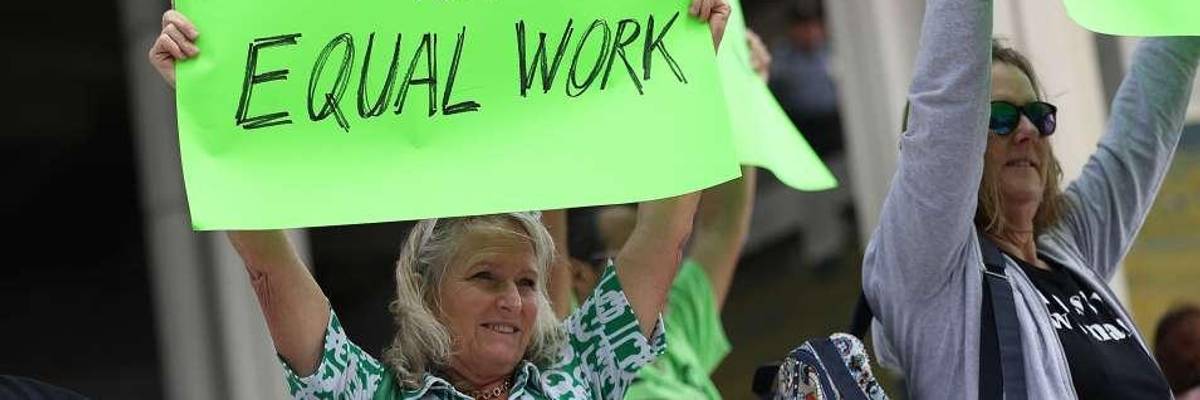
"Equal pay would cut poverty among working women and their families by more than half and add $513 billion to the national economy." (Photo: Joe Raedle/Getty Images)
April 10, 2018 is Equal Pay Day. It's a day when organizations draw attention to the disparities in pay between women and men doing equal work. We'll see social media posts meant to build awareness about how long it takes a woman's pay to catch up to that of white, non-Hispanic men from the previous year. Bottom line: a woman shouldn't have to work for 15 months to make what a man makes in 12.
But that's just what a white woman earns compared to a white man. It takes Black women 18 months to earn as much as a white man does in one year, and Equal Pay Day for black women is in July. For Latinas, it takes almost two years to catch up - Equal Pay Day for Latinas is in November. A 2017 report from the Women's Bureau of the U.S. Department of Labor stated, "In 2015, Hispanic women earned only 56.3 percent of the median weekly earnings of White, non-Hispanic men (the largest group of workers in the labor market), [and] Black women earned 61.2 percent." That significant disparity means the loss of tens of thousands of dollars in wages for women of color, who collectively represent the largest growing sector of working people.
Those are just the cold, hard statistics. How do we actually solve wage inequality?
That requires some significant changes on a broad scale, and the first big shift is cultural -- we have to change the whole notion that it is acceptable to pay people differently for equal work based on gender.
These shifts have to be real. It's not enough to acknowledge the problem, we have to create the space and willingness to change it as a society. Our whole nation benefits when women get equal pay for equal work.
Equal pay means an economy that works for women and their families who will benefit from better wages.
A report by the Institute for Women's Policy Research (IWPR) shows that equal pay for equal work improves the overall Gross Domestic Product (GDP) of our national economy. Approximately 44 percent of all the heads of households in this country are women. We also make most of the household decisions about the types and quantity of products that we buy for the home. And now, more and more of us are the principal breadwinners. If we make more money, we will spend more money. It's a pretty straightforward argument.
That economic impact would also go a long way to reducing poverty. According to the National Women's Law Center, equal pay would cut poverty among working women and their families by more than half and add $513 billion to the national economy.
Pay disparity affects women even before we get on the job. Right now, women need smart tactics for engagement when we're seeking a position and negotiating our salaries and benefits -- we're already on an uneven playing field. The Department of Labor's Women's Bureau shows salary information for each type of position. The Equal Employment Opportunity Commission (EEOC) requires companies to report how much they're paying their employees by race and gender, in order to bring transparency to company compensation practices and help close the gender pay gap thus creating an accountability measure by which to hold them to. Without data, it's very difficult to ensure that women are paid accordingly. And on simple principle, women deserve equal pay for equal work, period.
As we have recently witnessed in spaces like the #MeToo and #TimesUp movements combating sexual violence or the #NeverAgain movement advocating gun reforms, equal pay has to resonate deeply with ordinary people. This has to be a type of cultural change that permeates society as a whole to address deep social and economic inequities.
Just last week with very little fanfare, President Donald Trump signed an executive order that revoked the 2014 Fair Pay and Safe Workplaces order that former President Barack Obama put in place to ensure that companies with federal contracts comply with 14 labor and civil rights laws. The Fair Pay order was put in place after a 2010 Government Accountability Office investigation showed that companies with rampant violations were being awarded millions in federal contracts that they should never have received due to violations of fair labor laws.
Enforcement and accountability are huge issues at play here. We already have laws on the books that aim to address unequal pay for equal work. The 1963 Equal Pay Act, passed under President John F. Kennedy, banned unequal compensation between men and women for the same job. And the Lily Ledbetter Fair Pay Act of 2009 changed the statute of limitations for equal pay lawsuits, making it easier for women to sue their employers in cases of pay discrimination. The problem is that employers continue to engage in pay disparities without real accountability.
We need our government to step up and finish the job: we need equal pay in practice, not just in theory.
Women need to get paid fairly. It's time for equal pay for equal work.
Dear Common Dreams reader, It’s been nearly 30 years since I co-founded Common Dreams with my late wife, Lina Newhouser. We had the radical notion that journalism should serve the public good, not corporate profits. It was clear to us from the outset what it would take to build such a project. No paid advertisements. No corporate sponsors. No millionaire publisher telling us what to think or do. Many people said we wouldn't last a year, but we proved those doubters wrong. Together with a tremendous team of journalists and dedicated staff, we built an independent media outlet free from the constraints of profits and corporate control. Our mission has always been simple: To inform. To inspire. To ignite change for the common good. Building Common Dreams was not easy. Our survival was never guaranteed. When you take on the most powerful forces—Wall Street greed, fossil fuel industry destruction, Big Tech lobbyists, and uber-rich oligarchs who have spent billions upon billions rigging the economy and democracy in their favor—the only bulwark you have is supporters who believe in your work. But here’s the urgent message from me today. It's never been this bad out there. And it's never been this hard to keep us going. At the very moment Common Dreams is most needed, the threats we face are intensifying. We need your support now more than ever. We don't accept corporate advertising and never will. We don't have a paywall because we don't think people should be blocked from critical news based on their ability to pay. Everything we do is funded by the donations of readers like you. When everyone does the little they can afford, we are strong. But if that support retreats or dries up, so do we. Will you donate now to make sure Common Dreams not only survives but thrives? —Craig Brown, Co-founder |
April 10, 2018 is Equal Pay Day. It's a day when organizations draw attention to the disparities in pay between women and men doing equal work. We'll see social media posts meant to build awareness about how long it takes a woman's pay to catch up to that of white, non-Hispanic men from the previous year. Bottom line: a woman shouldn't have to work for 15 months to make what a man makes in 12.
But that's just what a white woman earns compared to a white man. It takes Black women 18 months to earn as much as a white man does in one year, and Equal Pay Day for black women is in July. For Latinas, it takes almost two years to catch up - Equal Pay Day for Latinas is in November. A 2017 report from the Women's Bureau of the U.S. Department of Labor stated, "In 2015, Hispanic women earned only 56.3 percent of the median weekly earnings of White, non-Hispanic men (the largest group of workers in the labor market), [and] Black women earned 61.2 percent." That significant disparity means the loss of tens of thousands of dollars in wages for women of color, who collectively represent the largest growing sector of working people.
Those are just the cold, hard statistics. How do we actually solve wage inequality?
That requires some significant changes on a broad scale, and the first big shift is cultural -- we have to change the whole notion that it is acceptable to pay people differently for equal work based on gender.
These shifts have to be real. It's not enough to acknowledge the problem, we have to create the space and willingness to change it as a society. Our whole nation benefits when women get equal pay for equal work.
Equal pay means an economy that works for women and their families who will benefit from better wages.
A report by the Institute for Women's Policy Research (IWPR) shows that equal pay for equal work improves the overall Gross Domestic Product (GDP) of our national economy. Approximately 44 percent of all the heads of households in this country are women. We also make most of the household decisions about the types and quantity of products that we buy for the home. And now, more and more of us are the principal breadwinners. If we make more money, we will spend more money. It's a pretty straightforward argument.
That economic impact would also go a long way to reducing poverty. According to the National Women's Law Center, equal pay would cut poverty among working women and their families by more than half and add $513 billion to the national economy.
Pay disparity affects women even before we get on the job. Right now, women need smart tactics for engagement when we're seeking a position and negotiating our salaries and benefits -- we're already on an uneven playing field. The Department of Labor's Women's Bureau shows salary information for each type of position. The Equal Employment Opportunity Commission (EEOC) requires companies to report how much they're paying their employees by race and gender, in order to bring transparency to company compensation practices and help close the gender pay gap thus creating an accountability measure by which to hold them to. Without data, it's very difficult to ensure that women are paid accordingly. And on simple principle, women deserve equal pay for equal work, period.
As we have recently witnessed in spaces like the #MeToo and #TimesUp movements combating sexual violence or the #NeverAgain movement advocating gun reforms, equal pay has to resonate deeply with ordinary people. This has to be a type of cultural change that permeates society as a whole to address deep social and economic inequities.
Just last week with very little fanfare, President Donald Trump signed an executive order that revoked the 2014 Fair Pay and Safe Workplaces order that former President Barack Obama put in place to ensure that companies with federal contracts comply with 14 labor and civil rights laws. The Fair Pay order was put in place after a 2010 Government Accountability Office investigation showed that companies with rampant violations were being awarded millions in federal contracts that they should never have received due to violations of fair labor laws.
Enforcement and accountability are huge issues at play here. We already have laws on the books that aim to address unequal pay for equal work. The 1963 Equal Pay Act, passed under President John F. Kennedy, banned unequal compensation between men and women for the same job. And the Lily Ledbetter Fair Pay Act of 2009 changed the statute of limitations for equal pay lawsuits, making it easier for women to sue their employers in cases of pay discrimination. The problem is that employers continue to engage in pay disparities without real accountability.
We need our government to step up and finish the job: we need equal pay in practice, not just in theory.
Women need to get paid fairly. It's time for equal pay for equal work.
April 10, 2018 is Equal Pay Day. It's a day when organizations draw attention to the disparities in pay between women and men doing equal work. We'll see social media posts meant to build awareness about how long it takes a woman's pay to catch up to that of white, non-Hispanic men from the previous year. Bottom line: a woman shouldn't have to work for 15 months to make what a man makes in 12.
But that's just what a white woman earns compared to a white man. It takes Black women 18 months to earn as much as a white man does in one year, and Equal Pay Day for black women is in July. For Latinas, it takes almost two years to catch up - Equal Pay Day for Latinas is in November. A 2017 report from the Women's Bureau of the U.S. Department of Labor stated, "In 2015, Hispanic women earned only 56.3 percent of the median weekly earnings of White, non-Hispanic men (the largest group of workers in the labor market), [and] Black women earned 61.2 percent." That significant disparity means the loss of tens of thousands of dollars in wages for women of color, who collectively represent the largest growing sector of working people.
Those are just the cold, hard statistics. How do we actually solve wage inequality?
That requires some significant changes on a broad scale, and the first big shift is cultural -- we have to change the whole notion that it is acceptable to pay people differently for equal work based on gender.
These shifts have to be real. It's not enough to acknowledge the problem, we have to create the space and willingness to change it as a society. Our whole nation benefits when women get equal pay for equal work.
Equal pay means an economy that works for women and their families who will benefit from better wages.
A report by the Institute for Women's Policy Research (IWPR) shows that equal pay for equal work improves the overall Gross Domestic Product (GDP) of our national economy. Approximately 44 percent of all the heads of households in this country are women. We also make most of the household decisions about the types and quantity of products that we buy for the home. And now, more and more of us are the principal breadwinners. If we make more money, we will spend more money. It's a pretty straightforward argument.
That economic impact would also go a long way to reducing poverty. According to the National Women's Law Center, equal pay would cut poverty among working women and their families by more than half and add $513 billion to the national economy.
Pay disparity affects women even before we get on the job. Right now, women need smart tactics for engagement when we're seeking a position and negotiating our salaries and benefits -- we're already on an uneven playing field. The Department of Labor's Women's Bureau shows salary information for each type of position. The Equal Employment Opportunity Commission (EEOC) requires companies to report how much they're paying their employees by race and gender, in order to bring transparency to company compensation practices and help close the gender pay gap thus creating an accountability measure by which to hold them to. Without data, it's very difficult to ensure that women are paid accordingly. And on simple principle, women deserve equal pay for equal work, period.
As we have recently witnessed in spaces like the #MeToo and #TimesUp movements combating sexual violence or the #NeverAgain movement advocating gun reforms, equal pay has to resonate deeply with ordinary people. This has to be a type of cultural change that permeates society as a whole to address deep social and economic inequities.
Just last week with very little fanfare, President Donald Trump signed an executive order that revoked the 2014 Fair Pay and Safe Workplaces order that former President Barack Obama put in place to ensure that companies with federal contracts comply with 14 labor and civil rights laws. The Fair Pay order was put in place after a 2010 Government Accountability Office investigation showed that companies with rampant violations were being awarded millions in federal contracts that they should never have received due to violations of fair labor laws.
Enforcement and accountability are huge issues at play here. We already have laws on the books that aim to address unequal pay for equal work. The 1963 Equal Pay Act, passed under President John F. Kennedy, banned unequal compensation between men and women for the same job. And the Lily Ledbetter Fair Pay Act of 2009 changed the statute of limitations for equal pay lawsuits, making it easier for women to sue their employers in cases of pay discrimination. The problem is that employers continue to engage in pay disparities without real accountability.
We need our government to step up and finish the job: we need equal pay in practice, not just in theory.
Women need to get paid fairly. It's time for equal pay for equal work.