SUBSCRIBE TO OUR FREE NEWSLETTER
Daily news & progressive opinion—funded by the people, not the corporations—delivered straight to your inbox.
5
#000000
#FFFFFF
To donate by check, phone, or other method, see our More Ways to Give page.
Daily news & progressive opinion—funded by the people, not the corporations—delivered straight to your inbox.
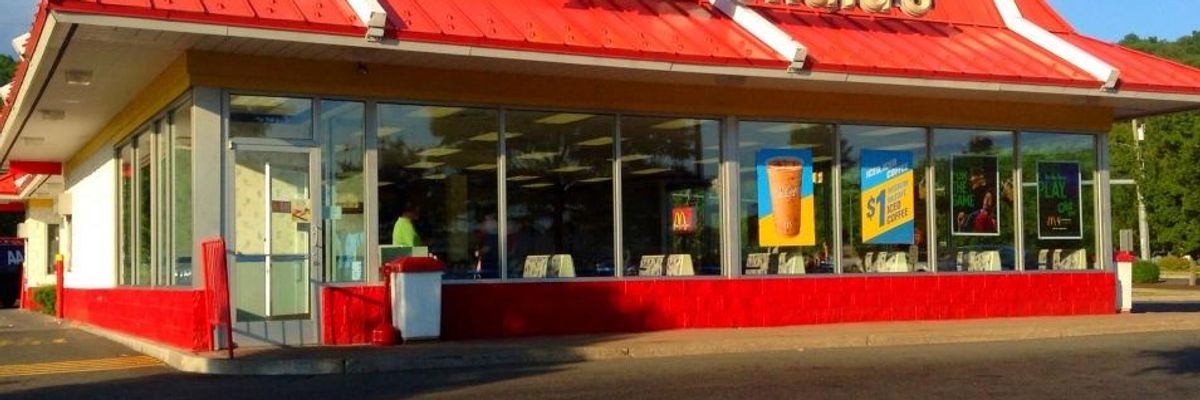
"Chickens raised and slaughtered for meat, known as "broiler chickens" by the poultry industry, are bred to grow so large, so fast, that many cannot even walk without pain." (Photo: Mike Mozart/flickr/cc)
In late March, as the million-plus New York Times print subscribers sat down to breakfast and cracked open their newspapers, they probably weren't expecting a full-page advertisement calling out McDonald's for its abuse of chickens. After all, a few years earlier the company had been praised for announcing it would source exclusively cage-free eggs -- an announcement that propelled the entire egg industry to begin to move away from barbaric battery cages, which confine hens so intensively they can't even spread their wings, to less cruel systems void of cages.
But in recent years the fast-food giant has fallen behind its competitors, such as Burger King and Subway, in addressing the worst factory farming practices, which are meted out on billions of chickens each year for our fast-food addiction to nuggets, tenders, and chicken sandwiches.
Chickens raised and slaughtered for meat, known as "broiler chickens" by the poultry industry, are bred to grow so large, so fast, that many cannot even walk without pain. According to University of Arkansas researchers, if humans grew at a rate similar to that of commercially bred chickens in the poultry industry, a six-pound newborn would weigh 660 pounds after just two months. They're then crammed by the tens of thousands into ammonia-ridden dark, windowless warehouses and forced to live in their own waste, which causes painful eye sores and respiratory distress.
While more than 100 food brands have committed to banning these cruel practices from their supply chains, Mickey D's has stood firm in its commitment to extreme animal cruelty. Six of the nation's largest animal welfare groups are -- mind the wordplay -- not lovin' it, and are now urging the super sized chain to catch up with its competitors and pledge to end this abuse.
These claims of cruelty in McDonald's supply chain have been corroborated by a Mercy For Animals undercover expose. In 2015, a whistleblower captured hidden-camera video footage of chickens who could barely even walk, suffering inside sheds where they were forced to live in their own excrement. On top of these standard cruelties in the poultry industry, workers were caught beating, stabbing, and impaling chickens on makeshift clubs with nails affixed to them, and then throwing the bloodied birds into buckets to slowly die. Factory farm owners stepped on the heads of live chickens and then pulled the birds' wings or bodies to break their necks. The investigative findings stood in stark contrast to McDonald's sanitized "food transparency" campaign it launched a year prior.
Will McDonald's continue being a laggard on animal welfare or once again take the lead? Time will tell. But McDonald's should recognize that releasing a stronger animal welfare policy isn't just good for animals; it's also what its customers want. A 2017 survey found that four out of five Americans agree these practices should be completely banned from our food system, even if it raises the price of chicken. A 2018 poll went a step further, finding that 47 percent of Americans would support a ban on all slaughterhouses.
While McDonald's may not be replacing all of its chicken sandwiches with its new McVegan burger just yet, the company would be wise to ban the worst factory farm abuses from its supply chain, lest it fall behind both business trends and consumer expectations.
Dear Common Dreams reader, It’s been nearly 30 years since I co-founded Common Dreams with my late wife, Lina Newhouser. We had the radical notion that journalism should serve the public good, not corporate profits. It was clear to us from the outset what it would take to build such a project. No paid advertisements. No corporate sponsors. No millionaire publisher telling us what to think or do. Many people said we wouldn't last a year, but we proved those doubters wrong. Together with a tremendous team of journalists and dedicated staff, we built an independent media outlet free from the constraints of profits and corporate control. Our mission has always been simple: To inform. To inspire. To ignite change for the common good. Building Common Dreams was not easy. Our survival was never guaranteed. When you take on the most powerful forces—Wall Street greed, fossil fuel industry destruction, Big Tech lobbyists, and uber-rich oligarchs who have spent billions upon billions rigging the economy and democracy in their favor—the only bulwark you have is supporters who believe in your work. But here’s the urgent message from me today. It's never been this bad out there. And it's never been this hard to keep us going. At the very moment Common Dreams is most needed, the threats we face are intensifying. We need your support now more than ever. We don't accept corporate advertising and never will. We don't have a paywall because we don't think people should be blocked from critical news based on their ability to pay. Everything we do is funded by the donations of readers like you. When everyone does the little they can afford, we are strong. But if that support retreats or dries up, so do we. Will you donate now to make sure Common Dreams not only survives but thrives? —Craig Brown, Co-founder |
In late March, as the million-plus New York Times print subscribers sat down to breakfast and cracked open their newspapers, they probably weren't expecting a full-page advertisement calling out McDonald's for its abuse of chickens. After all, a few years earlier the company had been praised for announcing it would source exclusively cage-free eggs -- an announcement that propelled the entire egg industry to begin to move away from barbaric battery cages, which confine hens so intensively they can't even spread their wings, to less cruel systems void of cages.
But in recent years the fast-food giant has fallen behind its competitors, such as Burger King and Subway, in addressing the worst factory farming practices, which are meted out on billions of chickens each year for our fast-food addiction to nuggets, tenders, and chicken sandwiches.
Chickens raised and slaughtered for meat, known as "broiler chickens" by the poultry industry, are bred to grow so large, so fast, that many cannot even walk without pain. According to University of Arkansas researchers, if humans grew at a rate similar to that of commercially bred chickens in the poultry industry, a six-pound newborn would weigh 660 pounds after just two months. They're then crammed by the tens of thousands into ammonia-ridden dark, windowless warehouses and forced to live in their own waste, which causes painful eye sores and respiratory distress.
While more than 100 food brands have committed to banning these cruel practices from their supply chains, Mickey D's has stood firm in its commitment to extreme animal cruelty. Six of the nation's largest animal welfare groups are -- mind the wordplay -- not lovin' it, and are now urging the super sized chain to catch up with its competitors and pledge to end this abuse.
These claims of cruelty in McDonald's supply chain have been corroborated by a Mercy For Animals undercover expose. In 2015, a whistleblower captured hidden-camera video footage of chickens who could barely even walk, suffering inside sheds where they were forced to live in their own excrement. On top of these standard cruelties in the poultry industry, workers were caught beating, stabbing, and impaling chickens on makeshift clubs with nails affixed to them, and then throwing the bloodied birds into buckets to slowly die. Factory farm owners stepped on the heads of live chickens and then pulled the birds' wings or bodies to break their necks. The investigative findings stood in stark contrast to McDonald's sanitized "food transparency" campaign it launched a year prior.
Will McDonald's continue being a laggard on animal welfare or once again take the lead? Time will tell. But McDonald's should recognize that releasing a stronger animal welfare policy isn't just good for animals; it's also what its customers want. A 2017 survey found that four out of five Americans agree these practices should be completely banned from our food system, even if it raises the price of chicken. A 2018 poll went a step further, finding that 47 percent of Americans would support a ban on all slaughterhouses.
While McDonald's may not be replacing all of its chicken sandwiches with its new McVegan burger just yet, the company would be wise to ban the worst factory farm abuses from its supply chain, lest it fall behind both business trends and consumer expectations.
In late March, as the million-plus New York Times print subscribers sat down to breakfast and cracked open their newspapers, they probably weren't expecting a full-page advertisement calling out McDonald's for its abuse of chickens. After all, a few years earlier the company had been praised for announcing it would source exclusively cage-free eggs -- an announcement that propelled the entire egg industry to begin to move away from barbaric battery cages, which confine hens so intensively they can't even spread their wings, to less cruel systems void of cages.
But in recent years the fast-food giant has fallen behind its competitors, such as Burger King and Subway, in addressing the worst factory farming practices, which are meted out on billions of chickens each year for our fast-food addiction to nuggets, tenders, and chicken sandwiches.
Chickens raised and slaughtered for meat, known as "broiler chickens" by the poultry industry, are bred to grow so large, so fast, that many cannot even walk without pain. According to University of Arkansas researchers, if humans grew at a rate similar to that of commercially bred chickens in the poultry industry, a six-pound newborn would weigh 660 pounds after just two months. They're then crammed by the tens of thousands into ammonia-ridden dark, windowless warehouses and forced to live in their own waste, which causes painful eye sores and respiratory distress.
While more than 100 food brands have committed to banning these cruel practices from their supply chains, Mickey D's has stood firm in its commitment to extreme animal cruelty. Six of the nation's largest animal welfare groups are -- mind the wordplay -- not lovin' it, and are now urging the super sized chain to catch up with its competitors and pledge to end this abuse.
These claims of cruelty in McDonald's supply chain have been corroborated by a Mercy For Animals undercover expose. In 2015, a whistleblower captured hidden-camera video footage of chickens who could barely even walk, suffering inside sheds where they were forced to live in their own excrement. On top of these standard cruelties in the poultry industry, workers were caught beating, stabbing, and impaling chickens on makeshift clubs with nails affixed to them, and then throwing the bloodied birds into buckets to slowly die. Factory farm owners stepped on the heads of live chickens and then pulled the birds' wings or bodies to break their necks. The investigative findings stood in stark contrast to McDonald's sanitized "food transparency" campaign it launched a year prior.
Will McDonald's continue being a laggard on animal welfare or once again take the lead? Time will tell. But McDonald's should recognize that releasing a stronger animal welfare policy isn't just good for animals; it's also what its customers want. A 2017 survey found that four out of five Americans agree these practices should be completely banned from our food system, even if it raises the price of chicken. A 2018 poll went a step further, finding that 47 percent of Americans would support a ban on all slaughterhouses.
While McDonald's may not be replacing all of its chicken sandwiches with its new McVegan burger just yet, the company would be wise to ban the worst factory farm abuses from its supply chain, lest it fall behind both business trends and consumer expectations.