

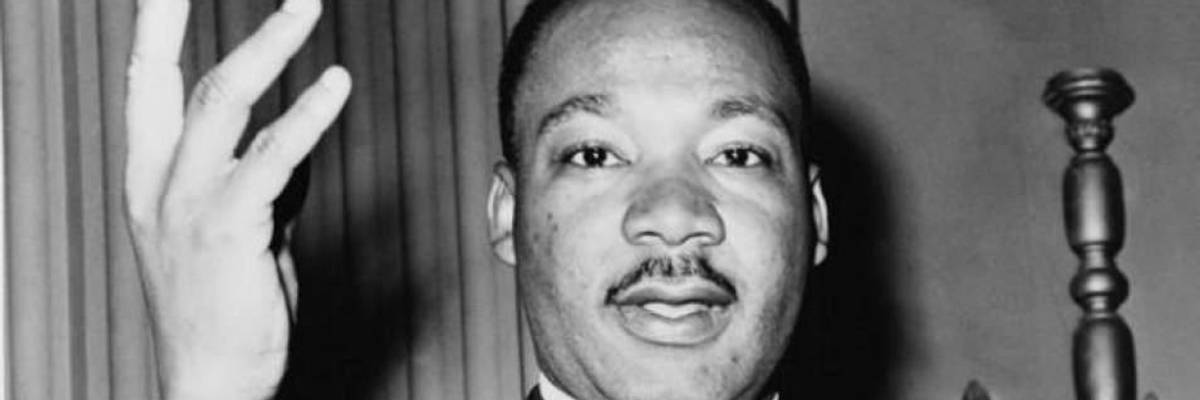
He pegged the U.S. government as "the greatest purveyor of violence in the world today."(Photo: Democracy Now!)
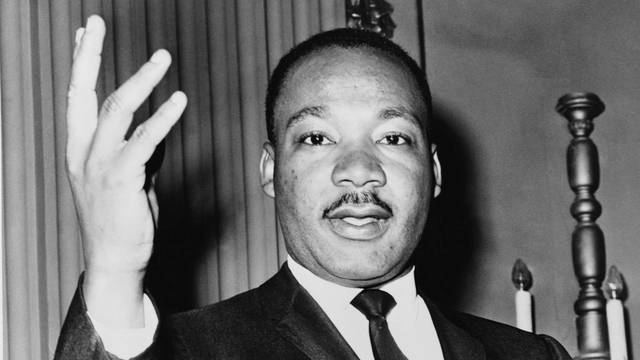
Remembering Martin Luther King, the Radical for Peace
He was a democratic socialist who believed that meeting the needs of the poor was a higher priority than ensuring profit for the few.
It is nothing short of tragic that the fiftieth anniversary of the assassination of Dr. Martin Luther King Jr. on April 4 arrives during a presidential administration containing some of the most overtly racist individuals to hold positions of such political power in generations.
Most people learn only about King's great accomplishments in the fight against racial segregation and Jim Crow laws in the South. Yet King also opposed the de facto segregation in housing and other manifestations of racism in the North, and was a passionate advocate for peace.
He challenged the draining of our national resources for the military. He opposed the Vietnam War and other aspects of U.S. foreign policy. He questioned an economic system that created enormous poverty amid great wealth. He was assassinated while organizing the Poor People's March, in which he planned to lead thousands of poor Americans of all races to Washington, D.C., to demand economic justice.
In speaking out against the Vietnam War, King recognized that it was "the symptom of a far deeper malady within the American spirit." He foresaw how, "we shall surely be dragged down the long, dark, and shameful corridors of time reserved for those who possess power without compassion, might without morality, and strength without sight." He pegged the U.S. government as "the greatest purveyor of violence in the world today."
King called for a "a radical revolution of values," noting how "a nation that continues year after year to spend more money on military defense than on programs of social uplift is approaching spiritual death." He warned, prophetically, of how the United States would be trapped in a series of overseas military entanglements while the gap between the rich and poor back home grew ever larger. He noted that the U.S. political and economic system was "on the side of the wealthy, and the secure, while we create a hell for the poor."
King saw clearly the interrelatedness of war, poverty, and racism and recognized how taking on one required confronting the others. In a sense, King's rightwing critics were more on target than many of his liberal supporters today: He was indeed a radical.
But King was never a communist, as he was often labelled. His commitment to democracy and deep religious faith made any adherence to the autocratic values of Marxism impossible. He was a democratic socialist who believed that meeting the needs of the poor was a higher priority than ensuring profit for the few. And even as he moved to the left later in his life, he never wavered on his firm commitment to nonviolence.
King was no communist, but he was certainly a radical.
To King, nonviolence was actually more radical than violence, which simply perpetuated the oppression of one group against the other. He believed that nonviolence was both a tactic and a personal ethos. King, like Mohandas Gandhi, was a great moral leader and a brilliant political strategist. He recognized that nonviolence was strategically the only realistic option for oppressed African-Americans to achieve justice, and that violence would simply polarize the races and make true justice and reconciliation impossible.
Indeed, King recognized that structural violence could truly be overcome only through the bold and creative application of nonviolent action. He also recognized that it would be naive to put too much faith in the electoral process or the judiciary to bring justice, and that real change must come from below. Inhis words, it was no longer a question of violence versus nonviolence, but nonviolence versus non-existence.
And nonviolence, for King, was not passive, which is perhaps his most relevant message for today. He recognized that "Freedom is never given voluntarily by the oppressor. It must be demanded by the oppressed."
An Urgent Message From Our Co-Founder
Dear Common Dreams reader, It’s been nearly 30 years since I co-founded Common Dreams with my late wife, Lina Newhouser. We had the radical notion that journalism should serve the public good, not corporate profits. It was clear to us from the outset what it would take to build such a project. No paid advertisements. No corporate sponsors. No millionaire publisher telling us what to think or do. Many people said we wouldn't last a year, but we proved those doubters wrong. Together with a tremendous team of journalists and dedicated staff, we built an independent media outlet free from the constraints of profits and corporate control. Our mission has always been simple: To inform. To inspire. To ignite change for the common good. Building Common Dreams was not easy. Our survival was never guaranteed. When you take on the most powerful forces—Wall Street greed, fossil fuel industry destruction, Big Tech lobbyists, and uber-rich oligarchs who have spent billions upon billions rigging the economy and democracy in their favor—the only bulwark you have is supporters who believe in your work. But here’s the urgent message from me today. It's never been this bad out there. And it's never been this hard to keep us going. At the very moment Common Dreams is most needed, the threats we face are intensifying. We need your support now more than ever. We don't accept corporate advertising and never will. We don't have a paywall because we don't think people should be blocked from critical news based on their ability to pay. Everything we do is funded by the donations of readers like you. When everyone does the little they can afford, we are strong. But if that support retreats or dries up, so do we. Will you donate now to make sure Common Dreams not only survives but thrives? —Craig Brown, Co-founder |
It is nothing short of tragic that the fiftieth anniversary of the assassination of Dr. Martin Luther King Jr. on April 4 arrives during a presidential administration containing some of the most overtly racist individuals to hold positions of such political power in generations.
Most people learn only about King's great accomplishments in the fight against racial segregation and Jim Crow laws in the South. Yet King also opposed the de facto segregation in housing and other manifestations of racism in the North, and was a passionate advocate for peace.
He challenged the draining of our national resources for the military. He opposed the Vietnam War and other aspects of U.S. foreign policy. He questioned an economic system that created enormous poverty amid great wealth. He was assassinated while organizing the Poor People's March, in which he planned to lead thousands of poor Americans of all races to Washington, D.C., to demand economic justice.
In speaking out against the Vietnam War, King recognized that it was "the symptom of a far deeper malady within the American spirit." He foresaw how, "we shall surely be dragged down the long, dark, and shameful corridors of time reserved for those who possess power without compassion, might without morality, and strength without sight." He pegged the U.S. government as "the greatest purveyor of violence in the world today."
King called for a "a radical revolution of values," noting how "a nation that continues year after year to spend more money on military defense than on programs of social uplift is approaching spiritual death." He warned, prophetically, of how the United States would be trapped in a series of overseas military entanglements while the gap between the rich and poor back home grew ever larger. He noted that the U.S. political and economic system was "on the side of the wealthy, and the secure, while we create a hell for the poor."
King saw clearly the interrelatedness of war, poverty, and racism and recognized how taking on one required confronting the others. In a sense, King's rightwing critics were more on target than many of his liberal supporters today: He was indeed a radical.
But King was never a communist, as he was often labelled. His commitment to democracy and deep religious faith made any adherence to the autocratic values of Marxism impossible. He was a democratic socialist who believed that meeting the needs of the poor was a higher priority than ensuring profit for the few. And even as he moved to the left later in his life, he never wavered on his firm commitment to nonviolence.
King was no communist, but he was certainly a radical.
To King, nonviolence was actually more radical than violence, which simply perpetuated the oppression of one group against the other. He believed that nonviolence was both a tactic and a personal ethos. King, like Mohandas Gandhi, was a great moral leader and a brilliant political strategist. He recognized that nonviolence was strategically the only realistic option for oppressed African-Americans to achieve justice, and that violence would simply polarize the races and make true justice and reconciliation impossible.
Indeed, King recognized that structural violence could truly be overcome only through the bold and creative application of nonviolent action. He also recognized that it would be naive to put too much faith in the electoral process or the judiciary to bring justice, and that real change must come from below. Inhis words, it was no longer a question of violence versus nonviolence, but nonviolence versus non-existence.
And nonviolence, for King, was not passive, which is perhaps his most relevant message for today. He recognized that "Freedom is never given voluntarily by the oppressor. It must be demanded by the oppressed."
It is nothing short of tragic that the fiftieth anniversary of the assassination of Dr. Martin Luther King Jr. on April 4 arrives during a presidential administration containing some of the most overtly racist individuals to hold positions of such political power in generations.
Most people learn only about King's great accomplishments in the fight against racial segregation and Jim Crow laws in the South. Yet King also opposed the de facto segregation in housing and other manifestations of racism in the North, and was a passionate advocate for peace.
He challenged the draining of our national resources for the military. He opposed the Vietnam War and other aspects of U.S. foreign policy. He questioned an economic system that created enormous poverty amid great wealth. He was assassinated while organizing the Poor People's March, in which he planned to lead thousands of poor Americans of all races to Washington, D.C., to demand economic justice.
In speaking out against the Vietnam War, King recognized that it was "the symptom of a far deeper malady within the American spirit." He foresaw how, "we shall surely be dragged down the long, dark, and shameful corridors of time reserved for those who possess power without compassion, might without morality, and strength without sight." He pegged the U.S. government as "the greatest purveyor of violence in the world today."
King called for a "a radical revolution of values," noting how "a nation that continues year after year to spend more money on military defense than on programs of social uplift is approaching spiritual death." He warned, prophetically, of how the United States would be trapped in a series of overseas military entanglements while the gap between the rich and poor back home grew ever larger. He noted that the U.S. political and economic system was "on the side of the wealthy, and the secure, while we create a hell for the poor."
King saw clearly the interrelatedness of war, poverty, and racism and recognized how taking on one required confronting the others. In a sense, King's rightwing critics were more on target than many of his liberal supporters today: He was indeed a radical.
But King was never a communist, as he was often labelled. His commitment to democracy and deep religious faith made any adherence to the autocratic values of Marxism impossible. He was a democratic socialist who believed that meeting the needs of the poor was a higher priority than ensuring profit for the few. And even as he moved to the left later in his life, he never wavered on his firm commitment to nonviolence.
King was no communist, but he was certainly a radical.
To King, nonviolence was actually more radical than violence, which simply perpetuated the oppression of one group against the other. He believed that nonviolence was both a tactic and a personal ethos. King, like Mohandas Gandhi, was a great moral leader and a brilliant political strategist. He recognized that nonviolence was strategically the only realistic option for oppressed African-Americans to achieve justice, and that violence would simply polarize the races and make true justice and reconciliation impossible.
Indeed, King recognized that structural violence could truly be overcome only through the bold and creative application of nonviolent action. He also recognized that it would be naive to put too much faith in the electoral process or the judiciary to bring justice, and that real change must come from below. Inhis words, it was no longer a question of violence versus nonviolence, but nonviolence versus non-existence.
And nonviolence, for King, was not passive, which is perhaps his most relevant message for today. He recognized that "Freedom is never given voluntarily by the oppressor. It must be demanded by the oppressed."