SUBSCRIBE TO OUR FREE NEWSLETTER
Daily news & progressive opinion—funded by the people, not the corporations—delivered straight to your inbox.
5
#000000
#FFFFFF
To donate by check, phone, or other method, see our More Ways to Give page.
Daily news & progressive opinion—funded by the people, not the corporations—delivered straight to your inbox.
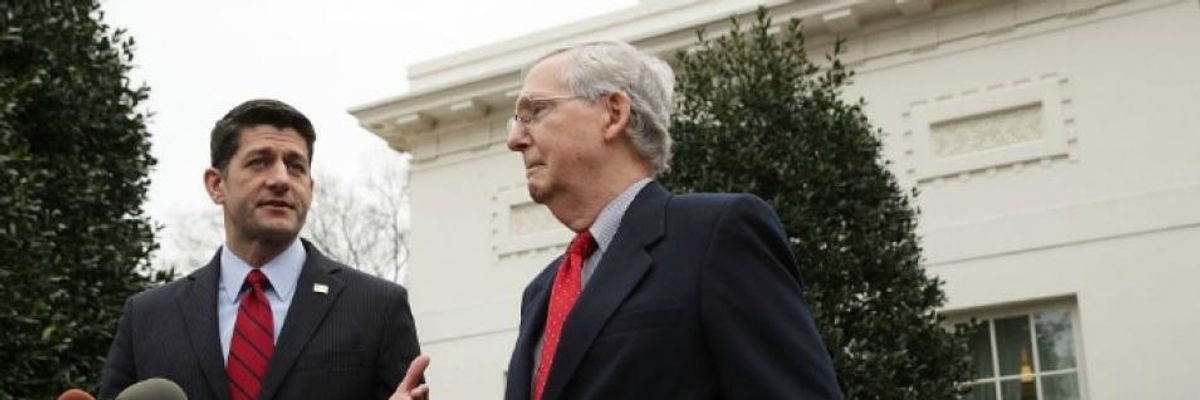
U.S. Speaker of the House Rep. Paul Ryan (R-Wis.) and Senate Majority Leader Sen. Mitch McConnell (R-Ky.) speak to members of the media in front of the West Wing of the White House February 27, 2017 in Washington, D.C. (Photo: Alex Wong/Getty Images)
"If at first you don't succeed, try, try again."
-- A Saying
Here are two idioms that have no applicability to the United States Congress: "Once bitten, twice shy"; "The third time's a charm."
It was all brought to mind upon seeing the headline in the New York Times on January 10, 2018, a few short days before Congress decided it was easier to shut down the government than to legislate. The headline announced that the I.R.S. "paid $20 million to collect $6.7 million in Tax Debts." At first blush the reader assumed this was a story that had somehow crept into the newspaper by mistake and escaped the attention of the articles editor. The reader who thought that could be forgiven for being surprised at seeing the story. That is because that story had appeared in the New York Times and other publications on two earlier occasions.
In 1996 Congress decided that the Internal Revenue Service could be assisted in collecting unpaid taxes by hiring Private Collection Agencies known as PCAs. Their task was to undertake collections from delinquent taxpayers. The program lasted one year before it was terminated. It was terminated because instead of making money for the government by collecting back taxes, it cost the government $17 million. In addition, it was learned that the PCAs had regularly violated the terms of the Fair Debt Collection Practices Act.
Those interested in collecting past due debts might find themselves leery of giving such a failed effort a second chance. Proving that "once bitten, twice shy" does not apply to Congress, however, the program was re-introduced again in 2004 as part of the American Jobs Creation Act. According to projections at the time that Act was passed, and contrary to empirical evidence from less than 10 years earlier, its Congressional supporters said that the PCAs would collect $1.3 billion and receive commissions of $350 million. It was, so the Congress believed, a sure fire winner.
In 2008 the House Ways and Means Committee held hearings to determine how well the program was working. Here is what it learned. It learned that 85 percent of the people contacted by the PCAs did not owe any back taxes. It learned that, whereas it cost the IRS $.07 for every dollar it collected, it cost the PCAs $.24 to collect the same amount. The IRS had an 11 percent success rate whereas the PCAs had a 4 percent success rate. The PCAs did not collect the promised $1.3 billion. They collected $4.5 million. By most measures that would not be considered a success. Nonetheless, the program continued until it was ended in 2009 by President Obama, who looked at the statistics and came to the conclusion that the program was not working as advertised by its proponents in 2004. Ending the program infuriated Senator Chuck Grassley (R. IA) who had always been a strong supporter of the program and believed that notwithstanding its obvious failures, the fact that the collections were handled by the private sector rather than the public sector was reason enough to continue the program. (Senator Grassley also observed that 60 people in his home state of Iowa would lose their jobs as a result of termination of the program.) And that brings us to the present when we learn that "the third time's a charm" has no applicability to congressional actions.
In December 2015, Congress enacted a law that required the IRS to use PCAs yet again, in order to collect a part of the $138 billion delinquent taxpayers owed the government. On September 26, 2016, the IRS announced that, following the Congressional mandate, it planned "to begin private collection of certain overdue federal tax debts [in 2016] and has selected four contractors." The program was in effect during 2017. It was not only Congress that thought the idea of private debt collection was a great idea. Treasury Secretary Steven Mnuchin, (whose name suggests his ancestors came from the land of Oz) was asked about the program during his confirmation hearing and said: "it seems like a very obvious thing to do." It may have been obvious. It was not successful. According to the I.R.S.'s taxpayer advocate, in 2017 the I.R.S. received $6.7 million in taxes collected by the PCAs whereas the PCAs received $20 million in commissions. In addition, in some cases, the PCAs received 25% commissions on collections that they had no role in obtaining. As of this writing, there is no suggestion that Congress intends to end this program. Instead, Congress has been cutting the I.R.S's budget.
When John Koskinen ended his tenure as commissioner of the IRS in early November 2016, he was open in his criticism of how Congress was funding the IRS. Among other things, he observed that the agency has lost 20,000 full time staffers since 2010. It has lot one-third of its compliance officers. (They are the ones who make the recalcitrant tax payer pay and the ones whose tasks are now being be supplemented by the PCAs.) Things are not all bleak for the PSAs, however. If Congress continues to cut the IRS's budget, as it seems certain to do, and if, as a result, the agency continues to lose compliance officers, its ability to collect delinquent taxes will get even worse than it now is, and if its budget is cut far enough, the PSAs will look good by comparison, thus justifying their continued employment. Go figure.
Dear Common Dreams reader, It’s been nearly 30 years since I co-founded Common Dreams with my late wife, Lina Newhouser. We had the radical notion that journalism should serve the public good, not corporate profits. It was clear to us from the outset what it would take to build such a project. No paid advertisements. No corporate sponsors. No millionaire publisher telling us what to think or do. Many people said we wouldn't last a year, but we proved those doubters wrong. Together with a tremendous team of journalists and dedicated staff, we built an independent media outlet free from the constraints of profits and corporate control. Our mission has always been simple: To inform. To inspire. To ignite change for the common good. Building Common Dreams was not easy. Our survival was never guaranteed. When you take on the most powerful forces—Wall Street greed, fossil fuel industry destruction, Big Tech lobbyists, and uber-rich oligarchs who have spent billions upon billions rigging the economy and democracy in their favor—the only bulwark you have is supporters who believe in your work. But here’s the urgent message from me today. It's never been this bad out there. And it's never been this hard to keep us going. At the very moment Common Dreams is most needed, the threats we face are intensifying. We need your support now more than ever. We don't accept corporate advertising and never will. We don't have a paywall because we don't think people should be blocked from critical news based on their ability to pay. Everything we do is funded by the donations of readers like you. When everyone does the little they can afford, we are strong. But if that support retreats or dries up, so do we. Will you donate now to make sure Common Dreams not only survives but thrives? —Craig Brown, Co-founder |
"If at first you don't succeed, try, try again."
-- A Saying
Here are two idioms that have no applicability to the United States Congress: "Once bitten, twice shy"; "The third time's a charm."
It was all brought to mind upon seeing the headline in the New York Times on January 10, 2018, a few short days before Congress decided it was easier to shut down the government than to legislate. The headline announced that the I.R.S. "paid $20 million to collect $6.7 million in Tax Debts." At first blush the reader assumed this was a story that had somehow crept into the newspaper by mistake and escaped the attention of the articles editor. The reader who thought that could be forgiven for being surprised at seeing the story. That is because that story had appeared in the New York Times and other publications on two earlier occasions.
In 1996 Congress decided that the Internal Revenue Service could be assisted in collecting unpaid taxes by hiring Private Collection Agencies known as PCAs. Their task was to undertake collections from delinquent taxpayers. The program lasted one year before it was terminated. It was terminated because instead of making money for the government by collecting back taxes, it cost the government $17 million. In addition, it was learned that the PCAs had regularly violated the terms of the Fair Debt Collection Practices Act.
Those interested in collecting past due debts might find themselves leery of giving such a failed effort a second chance. Proving that "once bitten, twice shy" does not apply to Congress, however, the program was re-introduced again in 2004 as part of the American Jobs Creation Act. According to projections at the time that Act was passed, and contrary to empirical evidence from less than 10 years earlier, its Congressional supporters said that the PCAs would collect $1.3 billion and receive commissions of $350 million. It was, so the Congress believed, a sure fire winner.
In 2008 the House Ways and Means Committee held hearings to determine how well the program was working. Here is what it learned. It learned that 85 percent of the people contacted by the PCAs did not owe any back taxes. It learned that, whereas it cost the IRS $.07 for every dollar it collected, it cost the PCAs $.24 to collect the same amount. The IRS had an 11 percent success rate whereas the PCAs had a 4 percent success rate. The PCAs did not collect the promised $1.3 billion. They collected $4.5 million. By most measures that would not be considered a success. Nonetheless, the program continued until it was ended in 2009 by President Obama, who looked at the statistics and came to the conclusion that the program was not working as advertised by its proponents in 2004. Ending the program infuriated Senator Chuck Grassley (R. IA) who had always been a strong supporter of the program and believed that notwithstanding its obvious failures, the fact that the collections were handled by the private sector rather than the public sector was reason enough to continue the program. (Senator Grassley also observed that 60 people in his home state of Iowa would lose their jobs as a result of termination of the program.) And that brings us to the present when we learn that "the third time's a charm" has no applicability to congressional actions.
In December 2015, Congress enacted a law that required the IRS to use PCAs yet again, in order to collect a part of the $138 billion delinquent taxpayers owed the government. On September 26, 2016, the IRS announced that, following the Congressional mandate, it planned "to begin private collection of certain overdue federal tax debts [in 2016] and has selected four contractors." The program was in effect during 2017. It was not only Congress that thought the idea of private debt collection was a great idea. Treasury Secretary Steven Mnuchin, (whose name suggests his ancestors came from the land of Oz) was asked about the program during his confirmation hearing and said: "it seems like a very obvious thing to do." It may have been obvious. It was not successful. According to the I.R.S.'s taxpayer advocate, in 2017 the I.R.S. received $6.7 million in taxes collected by the PCAs whereas the PCAs received $20 million in commissions. In addition, in some cases, the PCAs received 25% commissions on collections that they had no role in obtaining. As of this writing, there is no suggestion that Congress intends to end this program. Instead, Congress has been cutting the I.R.S's budget.
When John Koskinen ended his tenure as commissioner of the IRS in early November 2016, he was open in his criticism of how Congress was funding the IRS. Among other things, he observed that the agency has lost 20,000 full time staffers since 2010. It has lot one-third of its compliance officers. (They are the ones who make the recalcitrant tax payer pay and the ones whose tasks are now being be supplemented by the PCAs.) Things are not all bleak for the PSAs, however. If Congress continues to cut the IRS's budget, as it seems certain to do, and if, as a result, the agency continues to lose compliance officers, its ability to collect delinquent taxes will get even worse than it now is, and if its budget is cut far enough, the PSAs will look good by comparison, thus justifying their continued employment. Go figure.
"If at first you don't succeed, try, try again."
-- A Saying
Here are two idioms that have no applicability to the United States Congress: "Once bitten, twice shy"; "The third time's a charm."
It was all brought to mind upon seeing the headline in the New York Times on January 10, 2018, a few short days before Congress decided it was easier to shut down the government than to legislate. The headline announced that the I.R.S. "paid $20 million to collect $6.7 million in Tax Debts." At first blush the reader assumed this was a story that had somehow crept into the newspaper by mistake and escaped the attention of the articles editor. The reader who thought that could be forgiven for being surprised at seeing the story. That is because that story had appeared in the New York Times and other publications on two earlier occasions.
In 1996 Congress decided that the Internal Revenue Service could be assisted in collecting unpaid taxes by hiring Private Collection Agencies known as PCAs. Their task was to undertake collections from delinquent taxpayers. The program lasted one year before it was terminated. It was terminated because instead of making money for the government by collecting back taxes, it cost the government $17 million. In addition, it was learned that the PCAs had regularly violated the terms of the Fair Debt Collection Practices Act.
Those interested in collecting past due debts might find themselves leery of giving such a failed effort a second chance. Proving that "once bitten, twice shy" does not apply to Congress, however, the program was re-introduced again in 2004 as part of the American Jobs Creation Act. According to projections at the time that Act was passed, and contrary to empirical evidence from less than 10 years earlier, its Congressional supporters said that the PCAs would collect $1.3 billion and receive commissions of $350 million. It was, so the Congress believed, a sure fire winner.
In 2008 the House Ways and Means Committee held hearings to determine how well the program was working. Here is what it learned. It learned that 85 percent of the people contacted by the PCAs did not owe any back taxes. It learned that, whereas it cost the IRS $.07 for every dollar it collected, it cost the PCAs $.24 to collect the same amount. The IRS had an 11 percent success rate whereas the PCAs had a 4 percent success rate. The PCAs did not collect the promised $1.3 billion. They collected $4.5 million. By most measures that would not be considered a success. Nonetheless, the program continued until it was ended in 2009 by President Obama, who looked at the statistics and came to the conclusion that the program was not working as advertised by its proponents in 2004. Ending the program infuriated Senator Chuck Grassley (R. IA) who had always been a strong supporter of the program and believed that notwithstanding its obvious failures, the fact that the collections were handled by the private sector rather than the public sector was reason enough to continue the program. (Senator Grassley also observed that 60 people in his home state of Iowa would lose their jobs as a result of termination of the program.) And that brings us to the present when we learn that "the third time's a charm" has no applicability to congressional actions.
In December 2015, Congress enacted a law that required the IRS to use PCAs yet again, in order to collect a part of the $138 billion delinquent taxpayers owed the government. On September 26, 2016, the IRS announced that, following the Congressional mandate, it planned "to begin private collection of certain overdue federal tax debts [in 2016] and has selected four contractors." The program was in effect during 2017. It was not only Congress that thought the idea of private debt collection was a great idea. Treasury Secretary Steven Mnuchin, (whose name suggests his ancestors came from the land of Oz) was asked about the program during his confirmation hearing and said: "it seems like a very obvious thing to do." It may have been obvious. It was not successful. According to the I.R.S.'s taxpayer advocate, in 2017 the I.R.S. received $6.7 million in taxes collected by the PCAs whereas the PCAs received $20 million in commissions. In addition, in some cases, the PCAs received 25% commissions on collections that they had no role in obtaining. As of this writing, there is no suggestion that Congress intends to end this program. Instead, Congress has been cutting the I.R.S's budget.
When John Koskinen ended his tenure as commissioner of the IRS in early November 2016, he was open in his criticism of how Congress was funding the IRS. Among other things, he observed that the agency has lost 20,000 full time staffers since 2010. It has lot one-third of its compliance officers. (They are the ones who make the recalcitrant tax payer pay and the ones whose tasks are now being be supplemented by the PCAs.) Things are not all bleak for the PSAs, however. If Congress continues to cut the IRS's budget, as it seems certain to do, and if, as a result, the agency continues to lose compliance officers, its ability to collect delinquent taxes will get even worse than it now is, and if its budget is cut far enough, the PSAs will look good by comparison, thus justifying their continued employment. Go figure.